A French Word to Live By
How to Conjugate Se accrocher in French
/sə a.kʁɔ.ʃe/
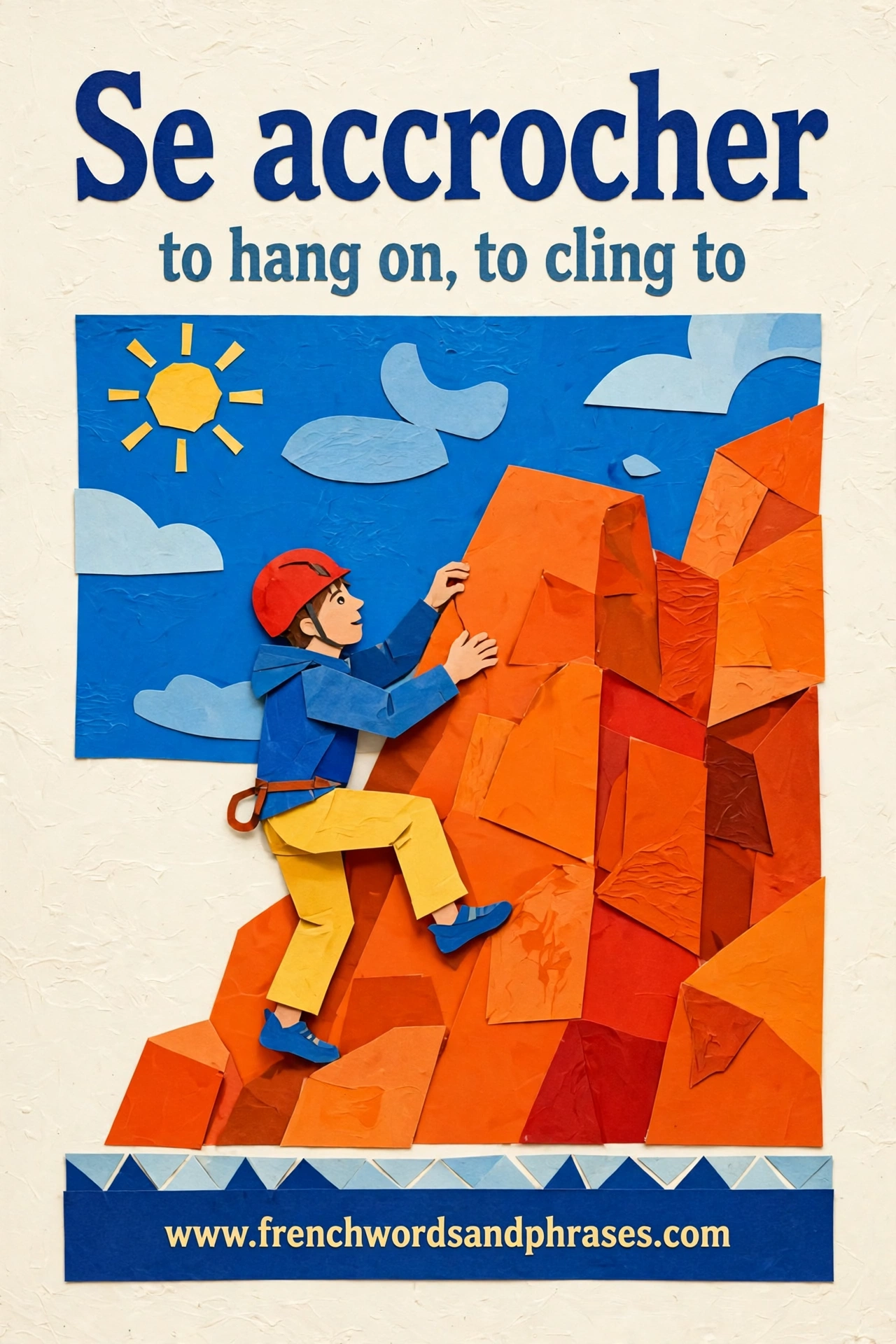
Se accrocher means to hang on, to cling to — to hook yourself onto something solid, a branch, a hand, a hope, and refuse to let go.
A toddler gripping his mother’s hand at the market, a swimmer reaching for the buoy, an old minister clinging to his post — se accrocher is accrocher turned back on oneself: the hook becomes two hands, and the thing hung is you.
In this guide, you’ll learn how to conjugate se accrocher in all the major French tenses and moods. Explore complete conjugation tables, French examples, English translations, and practice quizzes.
Understanding the French Verb Se accrocher
Se accrocher is a regular French verb belonging to the first group of verbs, those ending in-er.
It means to hang on, to cling to. It moves easily between the physical and the moral: hands cling to rails and ropes, and people cling to jobs, ideas, memories and hopes long past letting-go time — s’accrocher à son poste is the standard picture of the official who will not resign. As encouragement between friends, accroche-toi simply means hold on, stick it out.
Verb classification: First group (-er), reflexive
Auxiliary verb: Être
Past participle: accroché
Present participle: accrochant
English equivalents: To hang on, to cling to, to hold on tight; s’accrocher à une branche — to cling to a branch; s’accrocher à la rampe — to hold on to the handrail; s’accrocher à un espoir — to cling to a hope; accroche-toi ! — hang on tight!; s’accrocher à la vie — to cling to life.
One important detail: se accrocher is governed by à — one clings à something: s’accrocher à la rampe, à une branche, à un espoir, à son poste. The preposition never changes, whether the anchor is a handrail or a last hope. Being reflexive, the verb takes être and the participle agrees: elle s’est accrochée à la rampe, ils se sont accrochés à cet espoir. The imperative is a French classic, shouted on every funfair ride in the country: accroche-toi ! — hang on! And mind the street sense: two cars that se sont accrochées have clipped each other, bumped — a small accident, not an embrace.
Experience the Word
Se accrocher is the verb of not letting go — of fingers, and of everything fingers stand for: courage, hope, stubbornness.
Imagine a small ferry crossing a rough harbour in November. The deck tilts, the spray comes over the rail, and an old lady in a blue coat seizes the handrail with both hands and does not let go until the quay — elle s’accroche, calmly, the way she has held on to everything in her life.
The crossing lasts ten minutes. She has hung on — accrochée à la rampe, unshaken, from one shore to the other.
How to Conjugate Se accrocher: Complete French Conjugation Guide
Let’s explore every major conjugation of se accrocher, beginning with the indicative mood.
How to Conjugate Se accrocher in the Indicative Mood
The indicative mood is used to express facts, observations, actions, and events.
How to Conjugate Se accrocher in the Present Tense (Présent)
Used for actions happening now, habitual actions, and general truths.
| Subject | Conjugation |
|---|---|
| je | m’accroche |
| tu | t’accroches |
| il / elle | s’accroche |
| nous | nous accrochons |
| vous | vous accrochez |
| ils / elles | s’accrochent |
Example
L’enfant s’accroche à la main de sa mère.
The child is clinging to his mother’s hand.
Quick Quiz 1
Complete the sentence:
Nous nous ______ à la rampe.
Reveal the answer
accrochons
Nous nous accrochons à la rampe.
We are holding on to the handrail.
How to Conjugate Se accrocher in the Passé Composé
Used for completed actions in the past. Se accrocher takes the auxiliary verb être.
| Subject | Conjugation |
|---|---|
| je | me suis accroché / me suis accrochée |
| tu | t’es accroché / t’es accrochée |
| il / elle | s’est accroché / s’est accrochée |
| nous | nous sommes accrochés / nous sommes accrochées |
| vous | vous êtes accrochés / vous êtes accrochées / vous êtes accroché / vous êtes accrochée |
| ils / elles | se sont accrochés / se sont accrochées |
Example
Elle s’est accrochée à la rampe dans l’escalier.
She held on to the handrail on the stairs.
How to Conjugate Se accrocher in the Imparfait (Imperfect Tense)
Used for habitual past actions, descriptions, and ongoing situations in the past.
| Subject | Conjugation |
|---|---|
| je | m’accrochais |
| tu | t’accrochais |
| il / elle | s’accrochait |
| nous | nous accrochions |
| vous | vous accrochiez |
| ils / elles | s’accrochaient |
Example
Le nageur s’accrochait à la bouée pour reprendre son souffle.
The swimmer used to cling to the buoy to get his breath back.
Quick Quiz 2
Choose the correct form:
She held on to the handrail.
Elle ______ à la rampe. (s’est accrochée / a accroché)
Reveal the answer
s’est accrochée
Elle s’est accrochée à la rampe.
Se accrocher is reflexive, takes être, and the participle agrees: accrochée.
How to Conjugate Se accrocher in the Plus-que-parfait
Used to describe an action that had already been completed before another past event.
| Subject | Conjugation |
|---|---|
| je | m’étais accroché / m’étais accrochée |
| tu | t’étais accroché / t’étais accrochée |
| il / elle | s’était accroché / s’était accrochée |
| nous | nous étions accrochés / nous étions accrochées |
| vous | vous étiez accrochés / vous étiez accrochées / vous étiez accroché / vous étiez accrochée |
| ils / elles | s’étaient accrochés / s’étaient accrochées |
Example
Ils s’étaient accrochés à cet espoir pendant des mois.
They had clung to that hope for months.
How to Conjugate Se accrocher in the Passé Simple
Primarily used in formal writing, literature, and historical narratives. It is rarely used in everyday conversation.
| Subject | Conjugation |
|---|---|
| je | m’accrochai |
| tu | t’accrochas |
| il / elle | s’accrocha |
| nous | nous accrochâmes |
| vous | vous accrochâtes |
| ils / elles | s’accrochèrent |
Example
Le marin s’accrocha au mât pendant la tempête.
The sailor clung to the mast during the storm.
How to Conjugate Se accrocher in the Passé Antérieur
A literary tense used to express an action completed immediately before another past action, generally in the passé simple.
| Subject | Conjugation |
|---|---|
| je | me fus accroché / me fus accrochée |
| tu | te fus accroché / te fus accrochée |
| il / elle | se fut accroché / se fut accrochée |
| nous | nous fûmes accrochés / nous fûmes accrochées |
| vous | vous fûtes accrochés / vous fûtes accrochées / vous fûtes accroché / vous fûtes accrochée |
| ils / elles | se furent accrochés / se furent accrochées |
Example
Dès qu’elle se fut accrochée à la corde, on la hissa sur le pont.
As soon as she had grabbed hold of the rope, they hauled her onto the deck.
How to Conjugate Se accrocher in the Future Tense (Futur Simple)
Used to describe actions that will take place in the future.
| Subject | Conjugation |
|---|---|
| je | m’accrocherai |
| tu | t’accrocheras |
| il / elle | s’accrochera |
| nous | nous accrocherons |
| vous | vous accrocherez |
| ils / elles | s’accrocheront |
Example
Tu t’accrocheras à la branche, ne lâche surtout pas !
You will hold on to the branch — whatever you do, do not let go!
How to Conjugate Se accrocher in the Futur Antérieur (Future Perfect)
Used for an action that will have been completed before a particular point in the future.
| Subject | Conjugation |
|---|---|
| je | me serai accroché / me serai accrochée |
| tu | te seras accroché / te seras accrochée |
| il / elle | se sera accroché / se sera accrochée |
| nous | nous serons accrochés / nous serons accrochées |
| vous | vous serez accrochés / vous serez accrochées / vous serez accroché / vous serez accrochée |
| ils / elles | se seront accrochés / se seront accrochées |
Example
À la fin de l’hiver, il se sera accroché à son poste malgré toutes les critiques.
By the end of the winter, he will have clung to his post despite all the criticism.
How to Conjugate Se accrocher in the Near Future (Futur Proche)
Used to describe something that is going to happen soon. Formed with aller + infinitive.
| Subject | Conjugation |
|---|---|
| je | vais m’accrocher |
| tu | vas t’accrocher |
| il / elle | va s’accrocher |
| nous | allons nous accrocher |
| vous | allez vous accrocher |
| ils / elles | vont s’accrocher |
Example
Elle va s’accrocher à son idée, tu la connais.
She is going to stick stubbornly to her idea, you know what she is like.
How to Conjugate Se accrocher in the Conditional Mood
The conditional mood expresses what would happen under certain circumstances. It is also frequently used to make polite requests or express wishes.
How to Conjugate Se accrocher in the Present Conditional
| Subject | Conjugation |
|---|---|
| je | m’accrocherais |
| tu | t’accrocherais |
| il / elle | s’accrocherait |
| nous | nous accrocherions |
| vous | vous accrocheriez |
| ils / elles | s’accrocheraient |
Example
Sans la rampe, la vieille dame s’accrocherait au bras de son fils.
Without the handrail, the old lady would cling to her son’s arm.
How to Conjugate Se accrocher in the Past Conditional
| Subject | Conjugation |
|---|---|
| je | me serais accroché / me serais accrochée |
| tu | te serais accroché / te serais accrochée |
| il / elle | se serait accroché / se serait accrochée |
| nous | nous serions accrochés / nous serions accrochées |
| vous | vous seriez accrochés / vous seriez accrochées / vous seriez accroché / vous seriez accrochée |
| ils / elles | se seraient accrochés / se seraient accrochées |
Example
Il se serait accroché à n’importe quel espoir, même faux.
He would have clung to any hope at all, even a false one.
Se accrocher in the Literary Past Conditional Form
This less common literary form uses the imperfect subjunctive of être.
| Subject | Conjugation |
|---|---|
| je | me fusse accroché / me fusse accrochée |
| tu | te fusses accroché / te fusses accrochée |
| il / elle | se fût accroché / se fût accrochée |
| nous | nous fussions accrochés / nous fussions accrochées |
| vous | vous fussiez accrochés / vous fussiez accrochées / vous fussiez accroché / vous fussiez accrochée |
| ils / elles | se fussent accrochés / se fussent accrochées |
Example
Elle se fût accrochée à la rive sans la force du courant.
She would have clung to the bank if not for the force of the current.
How to Conjugate Se accrocher in the Subjunctive Mood
The subjunctive is used to express wishes, emotions, doubts, necessity, and uncertainty. It frequently follows expressions such as il faut que (it is necessary that) or bien que (although).
How to Conjugate Se accrocher in the Present Subjunctive
| Subject | Conjugation |
|---|---|
| que je | m’accroche |
| que tu | t’accroches |
| qu’il / qu’elle | s’accroche |
| que nous | nous accrochions |
| que vous | vous accrochiez |
| qu’ils / qu’elles | s’accrochent |
Example
Il faut que tu t’accroches à la branche des deux mains.
You must hold on to the branch with both hands.
Quick Quiz 3
Complete the sentence using the subjunctive:
Il faut que vous ______ au mât pendant la tempête.
Reveal the answer
vous accrochiez
Il faut que vous vous accrochiez au mât pendant la tempête.
You must cling to the mast during the storm.
How to Conjugate Se accrocher in the Imperfect Subjunctive
A literary tense, rarely encountered in modern spoken French.
| Subject | Conjugation |
|---|---|
| que je | m’accrochasse |
| que tu | t’accrochasses |
| qu’il / qu’elle | s’accrochât |
| que nous | nous accrochassions |
| que vous | vous accrochassiez |
| qu’ils / qu’elles | s’accrochassent |
Example
Le capitaine craignait que les marins s’accrochassent aux débris du navire.
The captain feared the sailors might cling to the wreckage of the ship.
How to Conjugate Se accrocher in the Pluperfect Subjunctive
A literary construction used to express an action completed before another past action.
| Subject | Conjugation |
|---|---|
| que je | me fusse accroché / me fusse accrochée |
| que tu | te fusses accroché / te fusses accrochée |
| qu’il / qu’elle | se fût accroché / se fût accrochée |
| que nous | nous fussions accrochés / nous fussions accrochées |
| que vous | vous fussiez accrochés / vous fussiez accrochées / vous fussiez accroché / vous fussiez accrochée |
| qu’ils / qu’elles | se fussent accrochés / se fussent accrochées |
Example
On disait qu’ils se fussent accrochés à ce mensonge pendant des années.
People said they had clung to that lie for years.
How to Conjugate Se accrocher in the Past Subjunctive
| Subject | Conjugation |
|---|---|
| que je | me sois accroché / me sois accrochée |
| que tu | te sois accroché / te sois accrochée |
| qu’il / qu’elle | se soit accroché / se soit accrochée |
| que nous | nous soyons accrochés / nous soyons accrochées |
| que vous | vous soyez accrochés / vous soyez accrochées / vous soyez accroché / vous soyez accrochée |
| qu’ils / qu’elles | se soient accrochés / se soient accrochées |
Example
Je suis étonné qu’elle se soit accrochée si longtemps à ce poste.
I am amazed she clung to that job for so long.
How to Conjugate Se accrocher in the Imperative
The imperative is used to give commands, instructions, invitations, or suggestions. Subject pronouns are omitted.
How to Conjugate Se accrocher in the Present Imperative
| Person | Conjugation |
|---|---|
| (tu) | accroche-toi |
| (nous) | accrochons-nous |
| (vous) | accrochez-vous |
Example
Accroche-toi bien, ça secoue !
Hang on tight, it is bumpy!
Quick Quiz 4
How would you say Hang on tight (tu form)?
Reveal the answer
Accroche-toi bien !
French Participles of Se accrocher
Participles are verb forms that can be used in compound tenses and other grammatical constructions.
Present Participle of Se accrocher
accrochant
En s’accrochant à la bouée, le nageur a repris son souffle.
By clinging to the buoy, the swimmer got his breath back.
Past Participle of Se accrocher
accroché
Accrochée au bras de son fils, la grand-mère traversa la rue lentement.
Clinging to her son’s arm, the grandmother crossed the street slowly.
Se accrocher in Everyday French: Real-Life Examples
Now that you know the conjugations, let’s see how se accrocher appears in everyday French.
Example 1 — Present
L’enfant s’accroche à la main de sa mère.
The child is clinging to his mother’s hand.
Example 2 — Passé composé
Elle s’est accrochée à la rampe.
She held on to the handrail.
Example 3 — Imparfait
Le nageur s’accrochait à la bouée.
The swimmer used to cling to the buoy.
Example 4 — Future
Tu t’accrocheras à la branche.
You will hold on to the branch.
Example 5 — Conditional
Il s’accrocherait à n’importe quel espoir.
He would cling to any hope at all.
Example 6 — Imperative
Accrochez-vous, le train démarre !
Hold on tight, the train is leaving!
Beyond Translation: The Meaning of Se accrocher
English hang on covers the hands, but French s’accrocher also covers the heart.
To cling is one verb, for branches and for hopes alike.
The same grip holds the toddler to his mother, the swimmer to the buoy and the old official to his post — and when a friend says accroche-toi before an exam or an operation, the funfair shout has become a small philosophy: hold on, it passes.
How to Remember the French Verb Se accrocher
Remember it this way: Se accrocher is about two hands on the handrail — and a heart clinging to its last hope.
- Always à after it: s’accrocher à la rampe, à une branche, à un espoir.
- Reflexive, so être and agreement: elle s’est accrochée, ils se sont accrochés.
- Accroche-toi ! is the classic shout for hang on tight — on rides, in boats, and in life.
The key idea is two hands on the handrail — and a heart clinging to its last hope.
Test Your Knowledge of Se accrocher
Let’s see how much you’ve learned. Try answering these questions before revealing the answers.
Question 1
Which preposition follows se accrocher?
Reveal the answer
À — s’accrocher à la rampe, s’accrocher à un espoir.
Question 2
How do you say She held on to the handrail in French?
Reveal the answer
Elle s’est accrochée à la rampe.
Question 3
Translate: Hang on tight, it is bumpy!
Reveal the answer
Accroche-toi bien, ça secoue !
Question 4
What is the past participle of se accrocher?
Reveal the answer
Accroché — agreeing: accrochée, accrochés, accrochées.
Question 5
Complete the sentence:
Il faut que tu ______ à la branche des deux mains.
Reveal the answer
t’accroches
Il faut que tu t’accroches à la branche des deux mains.
You must hold on to the branch with both hands.
Your Final Challenge
Can You Use It?
How would you say this in French?
She holds on to the handrail, the boat rolls, and she reaches harbour without ever letting go.
Reveal the answer
Elle s’accroche à la rampe, le bateau tangue, et elle arrive à bon port sans avoir lâché.
She holds on to the handrail, the boat rolls, and she reaches harbour without ever letting go.
A little French. A little curiosity. A richer everyday life.
LEARN FRENCH ONE WORD AT A TIME