A French Word to Live By
Translate Samedi to English
/sam.di/
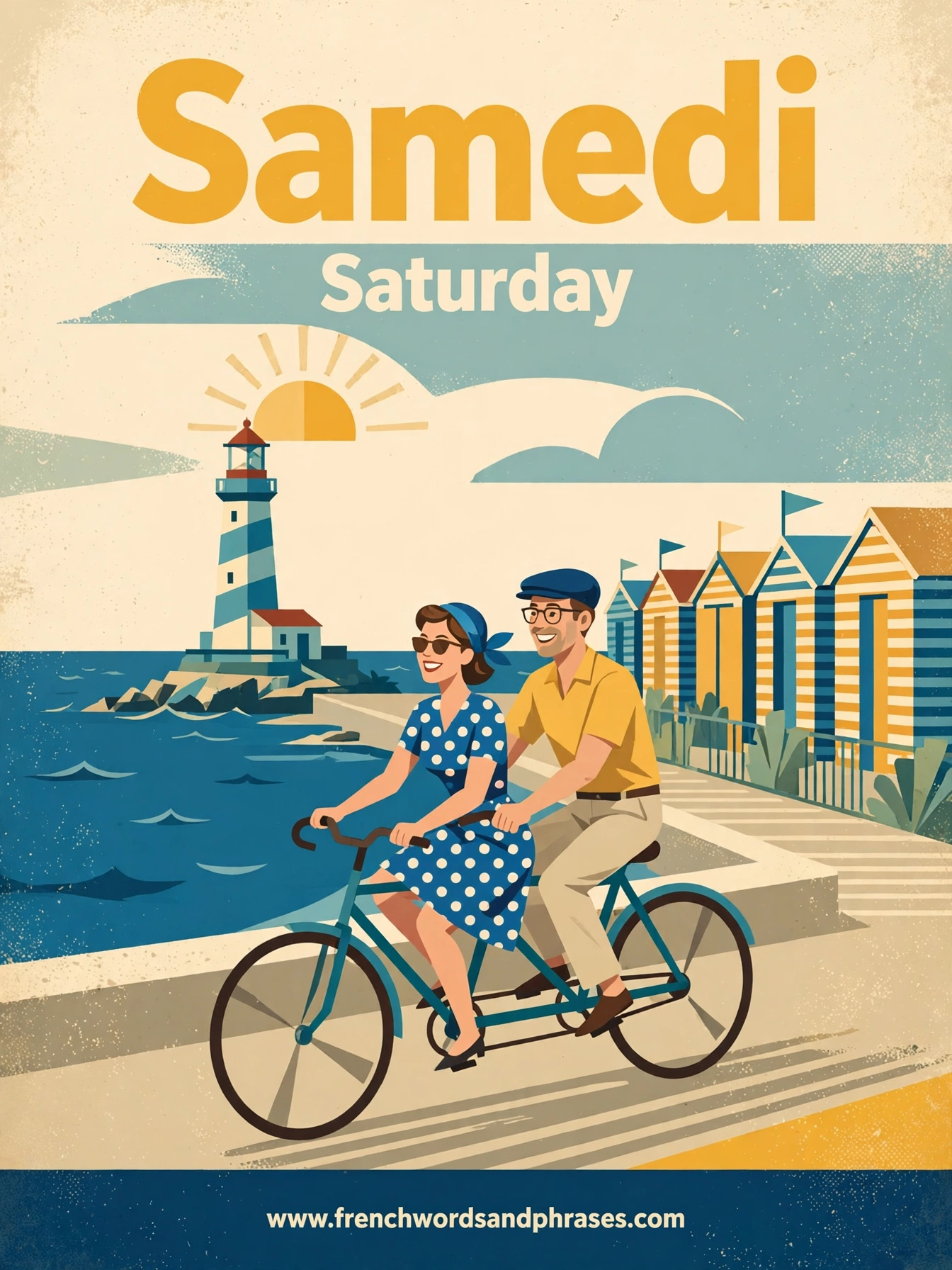
Le samedi means Saturday.
Baskets on arms, the square full of stalls, children weaving between the cheese stand and the flower seller: it is samedi — Saturday, market day, the week’s great outing.
In this guide, you’ll learn what samedi means in English, how to use it with its articles, how to form its plural, and how it appears in everyday French. Explore French examples, English translations, and practice quizzes.
Understanding the French Noun Samedi
Samedi is a masculine French noun, learned with its article: le samedi. Like every French day it takes no capital letter, and it follows the great day rule: on its own — samedi prochain — it names one specific Saturday; with le — le samedi — it means every Saturday, Saturdays as a habit.
It means Saturday — the first day of the weekend, the day of the market, the shopping and the wedding. Its name comes from the Sabbath day of rest, and the rest shows: nobody works, everybody is out — au marché, dans les magasins, or on the road to the countryside. Samedi soir, Saturday night, is the week’s great going-out evening.
Gender: Masculine
Definite article: le — le samedi (on Saturdays, every Saturday); no article for one specific Saturday
Indefinite article: un — un samedi (one Saturday, a Saturday)
Plural: les samedis
Capital letter: None — samedi, with a small s
English equivalents: Saturday.
One important usage detail: samedi is the day French towns come alive — « Le samedi matin, tout le monde va au marché. » For the weekly rhythm, say le samedi; for one date, bare samedi: « Samedi, on se marie ! » — Saturday is also, by far, the favourite day for weddings.
Experience the Word
Samedi is more than a day. It is the week’s celebration — the one morning nobody sets an alarm for work, and the whole town pours into the market square.
Imagine it: the basket filling with cheese, flowers and a warm baguette, a coffee on the terrace watching the crowd, the whole day still ahead.
You have not just named a day. You have stepped into the market crowd — le samedi matin.
How to Use Samedi in French: Complete Guide
Let’s explore how samedi works in French, beginning with its articles — bare samedi for one Saturday, le samedi for every Saturday.
Samedi with the Definite Article (Le, Les)
Bare samedi names one day, le samedi names the weekly habit, les samedis names them all.
| Form | French |
|---|---|
| One specific Saturday | samedi (no article) |
| Every Saturday, on Saturdays | le samedi |
| Plural | les samedis |
Example
Le samedi, le marché occupe toute la place.
On Saturdays, the market takes over the whole square.
Samedi with the Indefinite Article (Un, Des)
Un samedi picks out one Saturday among others — a market morning, a wedding day.
| Form | French |
|---|---|
| Masculine singular | un samedi |
| Plural | des samedis |
| A Saturday morning | un samedi matin |
Example
Un samedi matin ensoleillé, nous sommes partis en randonnée.
One sunny Saturday morning, we went off hiking.
Samedi with Quantities (Chaque, Tous les…)
Days have no partitive article — you cannot have « some of Saturday ». French counts Saturdays with rhythms and quantities instead.
| Quantity | French |
|---|---|
| every Saturday | chaque samedi |
| every Saturday (the whole set) | tous les samedis |
| every other Saturday | un samedi sur deux |
| several Saturdays | plusieurs samedis |
| the first Saturday of the month | le premier samedi du mois |
Example
Il travaille un samedi sur deux à la boutique.
He works every other Saturday at the shop.
Quick Quiz 1
You go to the market every Saturday. Complete the sentence:
______ je vais au marché avec mon panier.
Reveal the answer
Le samedi
Le samedi, je vais au marché avec mon panier.
On Saturdays, I go to the market with my basket — le makes it a weekly habit.
The Plural of Samedi
Samedi adds an -s in the plural — les samedis, all the Saturdays on the calendar.
| Number | French |
|---|---|
| Singular | samedi / le samedi |
| Plural | les samedis |
Example
Les samedis d’été, la ville organise des concerts gratuits.
On Saturdays in summer, the town puts on free concerts.
Samedi with Possessive Adjectives (Mon, Ton, Son…)
In diary talk, the day can belong to you: mon samedi, my Saturday, as it stands in your agenda.
| Owner | French |
|---|---|
| my | mon samedi |
| your (tu) | ton samedi |
| his / her | son samedi |
| our | notre samedi |
| your (vous) | votre samedi |
| their | leur samedi |
Example
Mon samedi est consacré aux courses et au jardin.
My Saturday is given over to shopping and the garden.
Quick Quiz 2
Complete the sentence:
______ samedi est pris par un mariage. (Their)
Reveal the answer
Leur
Leur samedi est pris par un mariage.
Their Saturday is taken up by a wedding — the possessive agrees with samedi, masculine.
Samedi with Demonstrative Adjectives (Ce, Ces)
Used to point at the Saturday you mean: ce samedi, this Saturday in the diary.
| Form | French |
|---|---|
| Masculine singular | ce samedi |
| Plural | ces samedis |
Example
Ce samedi, nous fêtons l’anniversaire de papa.
This Saturday, we’re celebrating Dad’s birthday.
Samedi with Adjectives
Adjectives agree with samedi — masculine: un samedi ensoleillé, un samedi chargé.
| Adjective | With Samedi |
|---|---|
| ensoleillé (sunny) | un samedi ensoleillé |
| chargé (busy, packed) | un samedi chargé |
| pluvieux (rainy) | un samedi pluvieux |
| libre (free) | un samedi libre |
| prochain (next) | samedi prochain |
| dernier (last) | samedi dernier |
Example
Un samedi ensoleillé, tout le village est dehors.
On a sunny Saturday, the whole village is outside.
Quick Quiz 3
Complete the sentence:
On se marie ______ prochain à la mairie ! (next Saturday)
Reveal the answer
samedi
On se marie samedi prochain à la mairie !
We’re getting married next Saturday at the town hall! — a specific day takes no article.
Everyday Expressions with Samedi
Markets, weddings and Saturday night — the samedi phrases of daily life.
| Expression | In English |
|---|---|
| le samedi matin | on Saturday morning(s) — market time |
| le marché du samedi | the Saturday market |
| le samedi soir | on Saturday evening(s) — the going-out night |
| samedi prochain | next Saturday |
| samedi dernier | last Saturday |
| à samedi ! | see you on Saturday! |
Example
Le samedi soir, les jeunes sortent en ville.
On Saturday evenings, young people go out in town.
Words from the Same Family as Samedi
Markets, weddings and weekends — the words that travel with samedi.
| French | In English |
|---|---|
| le marché | the market |
| les courses | the shopping |
| le mariage | the wedding |
| le week-end | the weekend |
| le jour | the day |
| la semaine | the week |
Example
Le mariage a lieu samedi, après le marché du matin.
The wedding takes place on Saturday, after the morning market.
Quick Quiz 4
What is le marché du samedi?
Reveal the answer
The Saturday market — the weekly open-air market that fills the square of almost every French town.
Le marché du samedi commence à huit heures.
The Saturday market starts at eight o’clock.
Samedi in Everyday French: Real-Life Examples
Now that you know the word, let’s see how samedi appears in everyday French.
Example 1 — Market day
Le samedi matin, on fait le marché en famille.
On Saturday mornings, we do the market as a family.
Example 2 — Making a plan
Tu viens samedi prochain à la fête du village ?
Are you coming next Saturday to the village fête?
Example 3 — A wedding
Samedi, ma cousine se marie à l’église du village.
On Saturday, my cousin is getting married at the village church.
Example 4 — Saying goodbye
À samedi ! On se retrouve au marché.
See you Saturday! We’ll meet at the market.
Example 5 — Shopping
Les samedis de décembre, les magasins sont pleins.
On Saturdays in December, the shops are full.
Example 6 — Saturday night
Le samedi soir, ils dînent chez des amis.
On Saturday evenings, they have dinner at friends’ houses.
Beyond Translation: The Meaning of Samedi
If one day owns the French town square, it is samedi. The weekly market — cheese, flowers, roast chicken, the soap seller and the knife grinder — has filled Saturday mornings since the Middle Ages, and it still sets the week’s social rhythm: you do not just shop at the marché, you meet everyone you know. Samedi is also the great day of celebration: most French weddings fill its afternoons, and its night, samedi soir, is when the country goes out.
To say samedi is to hear the market square at nine in the morning.
It evokes the basket on the arm, the terrace coffee after the stalls, the church bells for a wedding — the weekend with its sleeves rolled up.
How to Remember the French Noun Samedi
Remember it this way: Samedi is Saturday — the day of the market and the wedding, masculine, small letter: no article for one Saturday, le for every Saturday.
- You mean one Saturday — samedi prochain, no article at all.
- You mean every Saturday — le samedi, with le, and a basket for the market.
- You reach the evening — samedi soir, la grande sortie de la semaine.
The key idea is samedi = one Saturday; le samedi = every Saturday.
Test Your Knowledge of Samedi
Let’s see how much you’ve learned. Try answering these questions before revealing the answers.
Question 1
How do you say « on Saturdays » (every Saturday)?
Reveal the answer
Le samedi — the definite article turns the day into a habit.
Question 2
Is samedi masculine or feminine?
Reveal the answer
Masculine — le samedi, un samedi. All seven days are masculine.
Question 3
Translate: See you on Saturday!
Reveal the answer
À samedi !
Question 4
What traditionally happens in French towns on Saturday morning?
Reveal the answer
Le marché — the weekly open-air market fills the main square.
Question 5
Complete the sentence:
______ je vais au marché avec mon panier. (On Saturdays)
Reveal the answer
Le samedi
Le samedi, je vais au marché avec mon panier.
On Saturdays, I go to the market with my basket.
Your Final Challenge
Can You Use It?
How would you say this in French?
“On Saturday morning, we go to the market.”
Reveal the answer
Le samedi matin, on va au marché.
On Saturday morning, we go to the market.
A little French. A little curiosity. A richer everyday life.
LEARN FRENCH ONE WORD AT A TIME