A French Word to Live By
Translate Pacsé to English
/pak.se/
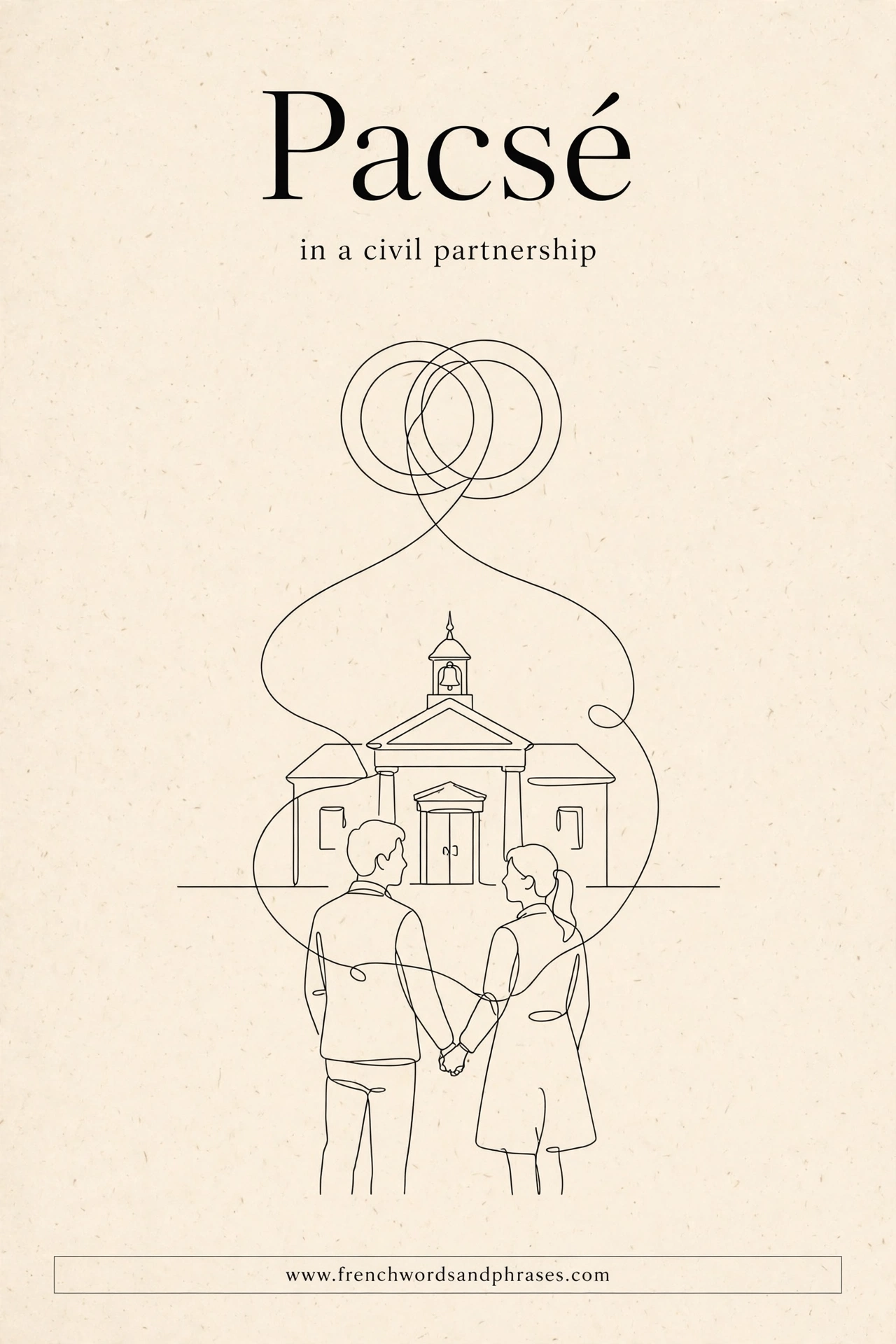
Pacsé means in a civil partnership.
A mairie in Lyon, a Saturday morning in spring. Two partners sign a slim folder at a desk while an official stamps it with a round, satisfying thump. No white dress, no rice — but from this minute, on every form in France, their situation familiale reads the same word: pacsé.
In this guide, you’ll learn what pacsé means in English, where it comes from — the PACS, France’s civil partnership — how its four forms agree, and how it differs from marié on the situation familiale line. Explore French examples, English translations, and practice quizzes.
Understanding the French Adjective Pacsé
Pacsé is a French adjective of civil status — born as the past participle of se pacser and promoted into the official word for partners united by a PACS, the pacte civil de solidarité created in 1999. It agrees in the regular -é way: pacsé, pacsée, pacsés, pacsées.
It means in a civil partnership — bound to a partner by a registered civil union that is not a marriage. On the situation familiale line of French forms it stands in a famous row: célibataire, marié, pacsé, divorcé, veuf. A couple pacsé shares taxes, housing rights and paperwork — without the wedding.
Type: Adjective of civil status — the situation familiale line
Answers the question: What is your marital status? — in a civil partnership
Changes form: Yes — pacsé, pacsée, pacsés, pacsées
English equivalents: In a civil partnership; in a registered partnership.
One important usage detail: pacsé describes a legal status, so it lives after être and on forms — ils sont pacsés, situation familiale : pacsé. The verb is se pacser: on se pacse à la mairie, you register your PACS at the town hall.
Experience the Word
Pacsé is the adjective of the signed folder — two signatures, one stamp, and a couple becomes official in the eyes of the French state.
Imagine two students in Bordeaux who have shared a tiny flat and a cat for five years. One spring morning they walk to the mairie with their identity cards, sign, and walk out pacsés — same love, new line on every form.
You have not just described a couple. You have named a legal bond that France invented — a step between single and married.
How to Use Pacsé in French: Complete Guide
Let’s explore how pacsé works in French, beginning with the whole word on one card.
Pacsé at a Glance
Before the details, here is the whole word on one card.
The Whole Word on One Card
Meaning, type, position and forms — pacsé in four lines.
| Point | Pacsé |
|---|---|
| Meaning | in a civil partnership |
| Type | adjective of civil status |
| Usual position | after être — ils sont pacsés |
| Form | pacsé / pacsée / pacsés / pacsées |
Example
Ils sont pacsés depuis deux ans.
They have been in a civil partnership for two years.
The Four Forms of Pacsé
Pacsé agrees with the person it describes, following the regular pattern of adjectives in -é: the feminine adds an e, the plurals add an s.
| Form | Pacsé | Example |
|---|---|---|
| Masculine singular | pacsé | un homme pacsé — a man in a civil partnership |
| Feminine singular | pacsée | une femme pacsée — a woman in a civil partnership |
| Masculine plural | pacsés | des couples pacsés — couples in civil partnerships |
| Feminine plural | pacsées | des femmes pacsées — women in civil partnerships |
Example
Elle est pacsée, et lui aussi.
She is in a civil partnership, and so is he.
Quick Quiz 1
What is the feminine of pacsé?
Reveal the answer
pacsée
Une femme pacsée.
A woman in a civil partnership.
Pacsée: The Regular Feminine in -ée
The feminine of pacsé is formed by adding a single e. It changes the spelling only — pacsé and pacsée sound exactly alike.
| Situation | Example |
|---|---|
| The rule | just add -e — pacsé → pacsée |
| The sound | pacsé and pacsée sound exactly the same |
| Masculine plural | pacsés — des hommes pacsés |
| Feminine plural | pacsées — des sœurs pacsées |
Example
Ma sœur est pacsée depuis 2021.
My sister has been in a civil partnership since 2021.
Where Pacsé Goes: After Être and on Forms
A legal status follows être, follows the noun, and above all sits in its little box on the form, in the situation familiale row.
| Pattern | Example |
|---|---|
| After être | ils sont pacsés — they are in a civil partnership |
| On a form | situation familiale : pacsé |
| After the noun | un couple pacsé — a couple in a civil partnership |
| Before the noun | un pacsé couple — not in French |
Example
C’est un couple pacsé.
They are a couple in a civil partnership.
Quick Quiz 2
Where does pacsé usually stand?
Reveal the answer
After être, or in its box on the form
Ils sont pacsés. Situation familiale : pacsé.
They are in a civil partnership.
Pacsé Does Not Compare: A Status, Not a Scale
Most adjectives climb a scale; pacsé does not. You cannot be a little pacsé or very pacsé — instead, French asks since when, and with whom.
| Question | Example |
|---|---|
| No degrees | on est pacsé ou on ne l’est pas — you are, or you aren’t |
| Since when | pacsé depuis 2019 — in a civil partnership since 2019 |
| With whom | pacsé avec Marie — in a partnership with Marie |
| Not this | plus pacsé — French never says it |
Example
Ils sont pacsés depuis 2019.
They have been in a civil partnership since 2019.
Everyday Expressions with Pacsé
Around pacsé gathers the small vocabulary of the PACS itself — the contract, the verb, and the couple it creates.
| Expression | In English |
|---|---|
| être pacsé | to be in a civil partnership |
| se pacser | to enter into a civil partnership — the verb |
| un couple pacsé | a couple in a civil partnership |
| un partenaire pacsé | a partner in a civil partnership |
| le PACS | the pacte civil de solidarité — the civil partnership itself |
Example
Ils vont se pacser au printemps.
They are going to enter into a civil partnership in spring.
Quick Quiz 3
What is a PACS?
Reveal the answer
The pacte civil de solidarité
France’s civil partnership contract, created in 1999.
Ils sont pacsés — they are in a civil partnership.
Pacsé and Its Neighbours: The Situation Familiale Row
On every French form, pacsé stands in a line of five statuses. Learn the row and you can read any French form at a glance.
| French | In English |
|---|---|
| célibataire | single |
| marié | married |
| divorcé | divorced |
| veuf | widowed |
| en couple | in a relationship — the informal neighbour |
Example
Sur le formulaire : célibataire, marié, pacsé, divorcé ou veuf.
On the form: single, married, in a civil partnership, divorced or widowed.
Watch Out: The Traps Around Pacsé
The traps here are a wedding that never happened, and a spelling that hides an abbreviation.
| Trap | The truth |
|---|---|
| Not married | pacsé is not marié — a PACS is a contract, not a marriage |
| The verb | se pacser — ils se sont pacsés en juin |
| Spelling | pacsé keeps the cs of PACS — never confuse it with passé |
| Ending it | a PACS ends by a simple declaration — no divorce court |
Example
Ils ne sont pas mariés, ils sont pacsés.
They are not married, they are in a civil partnership.
Quick Quiz 4
Is pacsé the same as marié?
Reveal the answer
No
A PACS is a civil contract, not a marriage.
Ils sont pacsés, pas mariés.
Pacsé in Everyday French: Real-Life Examples
Now that you know the word, let’s see how pacsé appears in everyday French.
Example 1 — At the mairie
Nous allons nous pacser samedi prochain.
We are going to enter into a civil partnership next Saturday.
Example 2 — A form
Situation familiale : je coche la case « pacsé ».
Marital status: I tick the ‘civil partnership’ box.
Example 3 — Family news
Ma sœur est pacsée depuis l’année dernière.
My sister has been in a civil partnership since last year.
Example 4 — Taxes
Les couples pacsés remplissent une déclaration commune.
Couples in a civil partnership file a joint tax return.
Example 5 — Small talk
Vous êtes mariés ? — Non, nous sommes pacsés.
Are you married? — No, we’re in a civil partnership.
Example 6 — An office file
Pour ce dossier, il faut une copie du PACS.
For this file, you need a copy of the PACS.
Beyond Translation: The Meaning of Pacsé
English says in a civil partnership — four words where French needs one, because France built the thing itself: the PACS, created in 1999, now chosen by nearly as many couples as marriage.
Pacsé is a whole French institution folded into a single adjective.
Tick it on a form and you declare a real legal bond — shared taxes, shared tenancy, mutual duties — signed in an afternoon, without a wedding.
How to Remember the French Adjective Pacsé
Remember it this way: Pacsé is the civil-status adjective of the PACS — one stamp at the mairie, and the word follows you on every form.
- You picture the stamp — PACS becomes pacsé, the status on the form.
- You agree it like any -é adjective — pacsée, pacsés, pacsées.
- You keep it apart from marié — a contract, not a marriage.
The key idea is pacsé means in a civil partnership (a PACS) — a legal status, not a marriage.
Test Your Knowledge of Pacsé
Let’s see how much you’ve learned. Try answering these questions before revealing the answers.
Question 1
What does pacsé mean?
Reveal the answer
In a civil partnership — united by a PACS, the pacte civil de solidarité.
Question 2
What is the feminine of pacsé?
Reveal the answer
pacsée — just add an e.
Question 3
Translate: They are in a civil partnership.
Reveal the answer
Ils sont pacsés.
Question 4
Complete the sentence:
Nous allons nous ______ à la mairie.
Reveal the answer
pacser
Nous allons nous pacser à la mairie.
We are going to register our civil partnership at the town hall.
Question 5
Is a couple pacsé a married couple?
Reveal the answer
No — a PACS is a civil contract, a different status from marriage.
Your Final Challenge
Can You Use It?
How would you say this in French?
“They are not married; they are in a civil partnership.”
Reveal the answer
Ils ne sont pas mariés ; ils sont pacsés.
They are not married; they are in a civil partnership.
A little French. A little curiosity. A richer everyday life.
LEARN FRENCH ONE WORD AT A TIME