A French Word to Live By
How to Conjugate Clore in French
/klɔʁ/
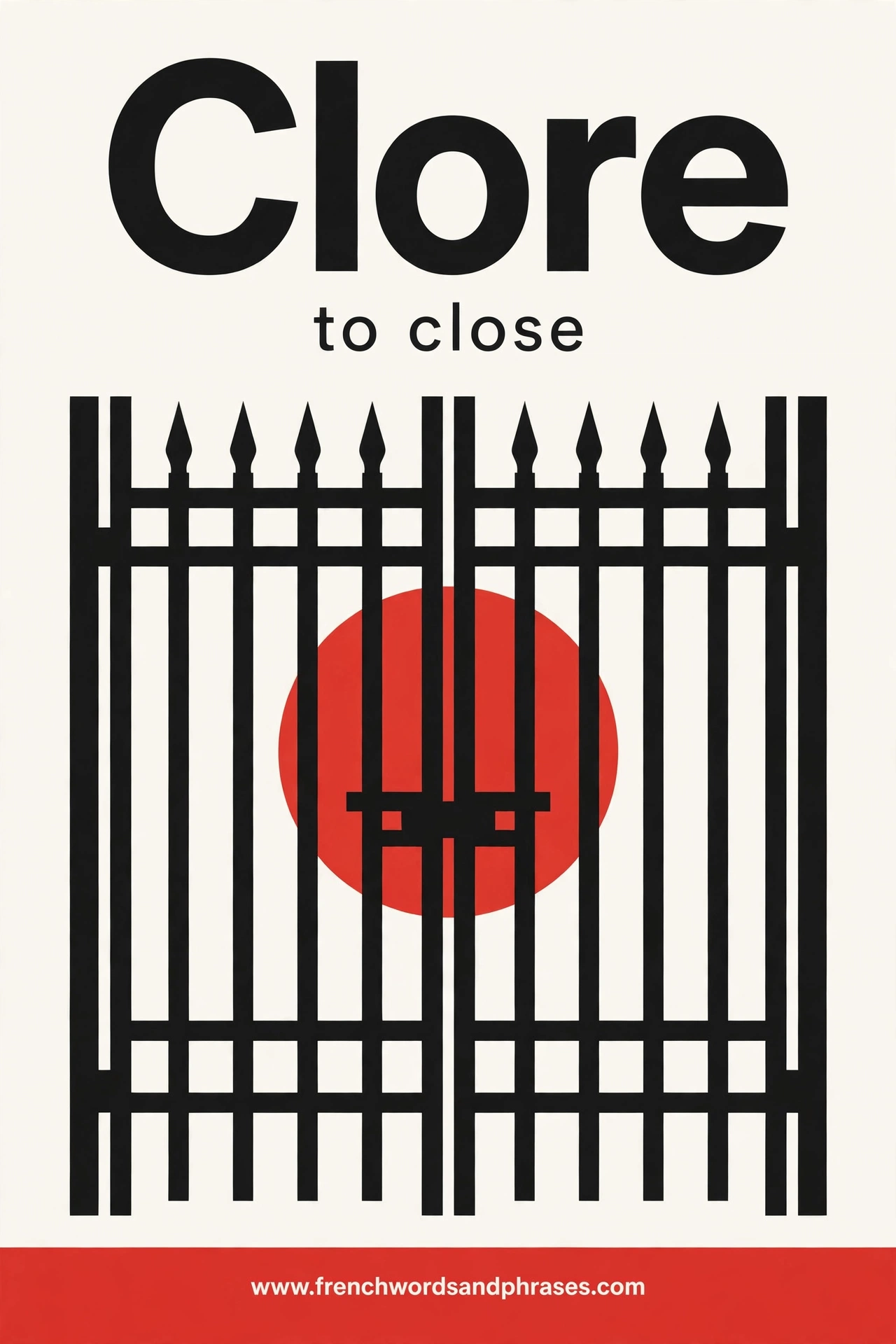
Clore means to close, to conclude — the formal, ceremonial way to bring a debate, a session, an account or a matter to its official end.
A chairman bringing down the gavel on a long debate, a bank quietly ending an account, a notary sealing a file marked affaire close — clore is the formal verb of official endings: where fermer shuts a door, clore closes a matter, in minutes, registers and ceremonies.
In this guide, you’ll learn how to conjugate clore in all the major French tenses and moods. Explore complete conjugation tables, French examples, English translations, and practice quizzes.
Understanding the French Verb Clore
Clore is a semi-defective irregular French verb ending in -re — it lives mostly in the infinitive, the past participle clos and the third person; several tenses are rare and literary.
It means to close, to conclude. The contrast with its partner fermer is total: fermer is the hand on the door handle, clore is the signature at the bottom of the minutes. You will meet clore in parliaments, banks, courts and universities — anywhere an ending must be official, dated and recorded.
Verb classification: Irregular (-re)
Auxiliary verb: Avoir
Past participle: clos
Present participle: closant
English equivalents: To close, to conclude, to wind up; clore le débat — to close the debate; clore une séance — to adjourn a session; clore un compte — to close an account; clore les inscriptions — to close registrations; une affaire close — a closed case.
Be honest with this verb: clore is semi-defective and formal. Its truly living forms are the infinitive clore, the past participle clos (feminine close) and the third person il clôt; much of the rest of the paradigm is rare and literary, and nobody says je clos la porte — for a door, everyday French says fermer, every time. Reserve clore for official paper: clore le débat, clore une séance, clore un compte, clore un exercice (an accounting year). The participle has its own quiet life: les yeux clos, eyes shut; à huis clos, behind closed doors.
Experience the Word
Clore is the verb of the gavel and the seal — the ending that goes in the record.
Imagine the last session of a long conference. Three days of speeches, amendments and coffee. At six o’clock the president looks over the room, thanks the interpreters, and brings down the gavel: la séance est close. Nobody would say fermée here — the ending is an act of office, and clore is its verb.
The door will be fermée by the caretaker later. The session is close — closed by authority, on the record.
How to Conjugate Clore: Complete French Conjugation Guide
Let’s explore every major conjugation of clore, beginning with the indicative mood.
How to Conjugate Clore in the Indicative Mood
The indicative mood is used to express facts, observations, actions, and events.
How to Conjugate Clore in the Present Tense (Présent)
Used for actions happening now, habitual actions, and general truths.
| Subject | Conjugation |
|---|---|
| je | clos |
| tu | clos |
| il / elle | clôt |
| nous | closons |
| vous | closez |
| ils / elles | closent |
Example
Le président clôt la séance à dix-huit heures précises.
The president closes the session at six o’clock sharp.
Quick Quiz 1
Complete the sentence:
Nous ______ les inscriptions vendredi soir.
Reveal the answer
clorons
Nous clorons les inscriptions vendredi soir.
We will close registrations on Friday evening.
How to Conjugate Clore in the Passé Composé
Used for completed actions in the past. Clore takes the auxiliary verb avoir.
| Subject | Conjugation |
|---|---|
| j’ | ai clos |
| tu | as clos |
| il / elle | a clos |
| nous | avons clos |
| vous | avez clos |
| ils / elles | ont clos |
Example
La banque a clos mon ancien compte le mois dernier.
The bank closed my old account last month.
How to Conjugate Clore in the Imparfait (Imperfect Tense)
Used for habitual past actions, descriptions, and ongoing situations in the past.
| Subject | Conjugation |
|---|---|
| je | closais |
| tu | closais |
| il / elle | closait |
| nous | closions |
| vous | closiez |
| ils / elles | closaient |
Example
Autrefois, le maire closait les débats d’un coup de marteau.
In the old days, the mayor used to close the debates with a blow of the gavel.
Quick Quiz 2
Choose the correct form:
The bank closed the account.
La banque ______ le compte. (a clos / est close)
Reveal the answer
a clos
La banque a clos le compte.
Clore takes avoir, and the participle is clos.
How to Conjugate Clore in the Plus-que-parfait
Used to describe an action that had already been completed before another past event.
| Subject | Conjugation |
|---|---|
| j’ | avais clos |
| tu | avais clos |
| il / elle | avait clos |
| nous | avions clos |
| vous | aviez clos |
| ils / elles | avaient clos |
Example
Le juge avait clos l’instruction avant l’été.
The judge had closed the investigation before the summer.
How to Conjugate Clore in the Passé Simple
Primarily used in formal writing, literature, and historical narratives. It is rarely used in everyday conversation.
| Subject | Conjugation |
|---|---|
| je | closis |
| tu | closis |
| il / elle | closit |
| nous | closîmes |
| vous | closîtes |
| ils / elles | closirent |
Example
Le notaire closit l’acte et le signa devant témoins.
The notary closed the deed and signed it before witnesses.
How to Conjugate Clore in the Passé Antérieur
A literary tense used to express an action completed immediately before another past action, generally in the passé simple.
| Subject | Conjugation |
|---|---|
| j’ | eus clos |
| tu | eus clos |
| il / elle | eut clos |
| nous | eûmes clos |
| vous | eûtes clos |
| ils / elles | eurent clos |
Example
Quand le président eut clos la séance, les députés quittèrent la salle.
When the president had closed the session, the deputies left the chamber.
How to Conjugate Clore in the Future Tense (Futur Simple)
Used to describe actions that will take place in the future.
| Subject | Conjugation |
|---|---|
| je | clorai |
| tu | cloras |
| il / elle | clora |
| nous | clorons |
| vous | clorez |
| ils / elles | cloront |
Example
Nous clorons les inscriptions vendredi soir.
We will close registrations on Friday evening.
How to Conjugate Clore in the Futur Antérieur (Future Perfect)
Used for an action that will have been completed before a particular point in the future.
| Subject | Conjugation |
|---|---|
| j’ | aurai clos |
| tu | auras clos |
| il / elle | aura clos |
| nous | aurons clos |
| vous | aurez clos |
| ils / elles | auront clos |
Example
À la fin du mois, la banque aura clos tous les comptes inactifs.
By the end of the month, the bank will have closed all the inactive accounts.
How to Conjugate Clore in the Near Future (Futur Proche)
Used to describe something that is going to happen soon. Formed with aller + infinitive.
| Subject | Conjugation |
|---|---|
| je | vais clore |
| tu | vas clore |
| il / elle | va clore |
| nous | allons clore |
| vous | allez clore |
| ils / elles | vont clore |
Example
Le président va clore le débat dans quelques minutes.
The president is going to close the debate in a few minutes.
How to Conjugate Clore in the Conditional Mood
The conditional mood expresses what would happen under certain circumstances. It is also frequently used to make polite requests or express wishes.
How to Conjugate Clore in the Present Conditional
| Subject | Conjugation |
|---|---|
| je | clorais |
| tu | clorais |
| il / elle | clorait |
| nous | clorions |
| vous | cloriez |
| ils / elles | cloraient |
Example
Sans objections, je clorais la discussion dès maintenant.
With no objections, I would close the discussion right now.
How to Conjugate Clore in the Past Conditional
| Subject | Conjugation |
|---|---|
| j’ | aurais clos |
| tu | aurais clos |
| il / elle | aurait clos |
| nous | aurions clos |
| vous | auriez clos |
| ils / elles | auraient clos |
Example
Ils auraient clos l’affaire plus tôt sans ce nouveau témoignage.
They would have closed the case sooner without this new testimony.
Clore in the Literary Past Conditional Form
This less common literary form uses the imperfect subjunctive of avoir.
| Subject | Conjugation |
|---|---|
| j’ | eusse clos |
| tu | eusses clos |
| il / elle | eût clos |
| nous | eussions clos |
| vous | eussiez clos |
| ils / elles | eussent clos |
Example
Le juge eût clos le dossier sans l’appel du procureur.
The judge would have closed the file without the prosecutor’s appeal.
How to Conjugate Clore in the Subjunctive Mood
The subjunctive is used to express wishes, emotions, doubts, necessity, and uncertainty. It frequently follows expressions such as il faut que (it is necessary that) or bien que (although).
How to Conjugate Clore in the Present Subjunctive
| Subject | Conjugation |
|---|---|
| que je | close |
| que tu | closes |
| qu’il / qu’elle | close |
| que nous | closions |
| que vous | closiez |
| qu’ils / qu’elles | closent |
Example
Il est temps que le président close la séance.
It is time for the president to close the session.
Quick Quiz 3
Complete the sentence using the subjunctive:
Il est temps que vous ______ le débat.
Reveal the answer
closiez
Il est temps que vous closiez le débat.
It is time for you to close the debate.
How to Conjugate Clore in the Imperfect Subjunctive
A literary tense, rarely encountered in modern spoken French.
| Subject | Conjugation |
|---|---|
| que je | closisse |
| que tu | closisses |
| qu’il / qu’elle | closît |
| que nous | closissions |
| que vous | closissiez |
| qu’ils / qu’elles | closissent |
Example
On souhaitait que le greffier closît le registre avant la nuit.
People wished the clerk would close the register before nightfall.
How to Conjugate Clore in the Pluperfect Subjunctive
A literary construction used to express an action completed before another past action.
| Subject | Conjugation |
|---|---|
| que j’ | eusse clos |
| que tu | eusses clos |
| qu’il / qu’elle | eût clos |
| que nous | eussions clos |
| que vous | eussiez clos |
| qu’ils / qu’elles | eussent clos |
Example
On pensait qu’ils eussent clos l’enquête depuis longtemps.
People thought they had closed the inquiry long ago.
How to Conjugate Clore in the Past Subjunctive
| Subject | Conjugation |
|---|---|
| que j’ | aie clos |
| que tu | aies clos |
| qu’il / qu’elle | ait clos |
| que nous | ayons clos |
| que vous | ayez clos |
| qu’ils / qu’elles | aient clos |
Example
Je suis surpris que la banque ait clos votre compte.
I am surprised the bank closed your account.
How to Conjugate Clore in the Imperative
The imperative is used to give commands, instructions, invitations, or suggestions. Subject pronouns are omitted.
How to Conjugate Clore in the Present Imperative
| Person | Conjugation |
|---|---|
| (tu) | clos |
| (nous) | closons |
| (vous) | closez |
Example
Clos le débat, nous avons assez entendu d’arguments !
Close the debate, we have heard enough arguments!
Quick Quiz 4
How would you say Close the debate (tu form)?
Reveal the answer
Clos le débat !
French Participles of Clore
Participles are verb forms that can be used in compound tenses and other grammatical constructions.
Present Participle of Clore
closant
En closant la séance, le président a remercié les membres.
As he closed the session, the president thanked the members.
Past Participle of Clore
clos
Close par le juge, l’affaire n’a jamais été rouverte.
Closed by the judge, the case was never reopened.
Clore in Everyday French: Real-Life Examples
Now that you know the conjugations, let’s see how clore appears in everyday French.
Example 1 — Present
Le président clôt la séance.
The president closes the session.
Example 2 — Passé composé
La banque a clos le compte.
The bank closed the account.
Example 3 — Imparfait
Le maire closait les débats à midi.
The mayor used to close the debates at noon.
Example 4 — Future
Nous clorons les inscriptions vendredi.
We will close registrations on Friday.
Example 5 — Conditional
Je clorais la discussion dès maintenant.
I would close the discussion right now.
Example 6 — Imperative
Closons le débat et passons au vote !
Let us close the debate and move to the vote!
Beyond Translation: The Meaning of Clore
English is full of this verb’s family — close, clause, conclude, cloister all descend from Latin claudere, to shut, the ancestor of clore.
Its participle keeps turning up in set phrases.
À huis clos — behind closed doors, where huis is an old word for door; un enclos is an enclosure; les yeux clos are eyes shut in sleep or in portraits. Clore may be rare, but clos is quietly everywhere.
How to Remember the French Verb Clore
Remember it this way: Clore is about the gavel coming down — the debate is officially closed.
- Think official paper: clore closes debates, sessions, accounts and cases — fermer closes doors.
- Its living forms: the infinitive clore, the participle clos/close, il clôt — the rest is rare and literary.
- Une affaire close is a closed case; à huis clos means behind closed doors.
The key idea is the gavel coming down — the debate is officially closed.
Test Your Knowledge of Clore
Let’s see how much you’ve learned. Try answering these questions before revealing the answers.
Question 1
Why is clore called semi-defective?
Reveal the answer
Only part of its paradigm is alive — the infinitive, the participle clos/close and il clôt; the rest is rare and literary, and everyday closing uses fermer.
Question 2
How do you say The bank closed my old account in French?
Reveal the answer
La banque a clos mon ancien compte.
Question 3
Translate: The president closes the session at six o’clock sharp.
Reveal the answer
Le président clôt la séance à dix-huit heures précises.
Question 4
What is the past participle of clore, masculine and feminine?
Reveal the answer
Clos / close.
Question 5
Complete the sentence:
Il est temps que le président ______ la séance.
Reveal the answer
close
Il est temps que le président close la séance.
It is time for the president to close the session.
Your Final Challenge
Can You Use It?
How would you say this in French?
The president closes the debate, and the silence that follows is worth all the speeches.
Reveal the answer
Le président clôt le débat, et le silence qui suit vaut tous les discours.
The president closes the debate, and the silence that follows is worth all the speeches.
A little French. A little curiosity. A richer everyday life.
LEARN FRENCH ONE WORD AT A TIME