A French Word to Live By
How to Conjugate Aider in French
/e.de/
Aider means to help — to lend your hands, your time or your strength to someone who needs them.
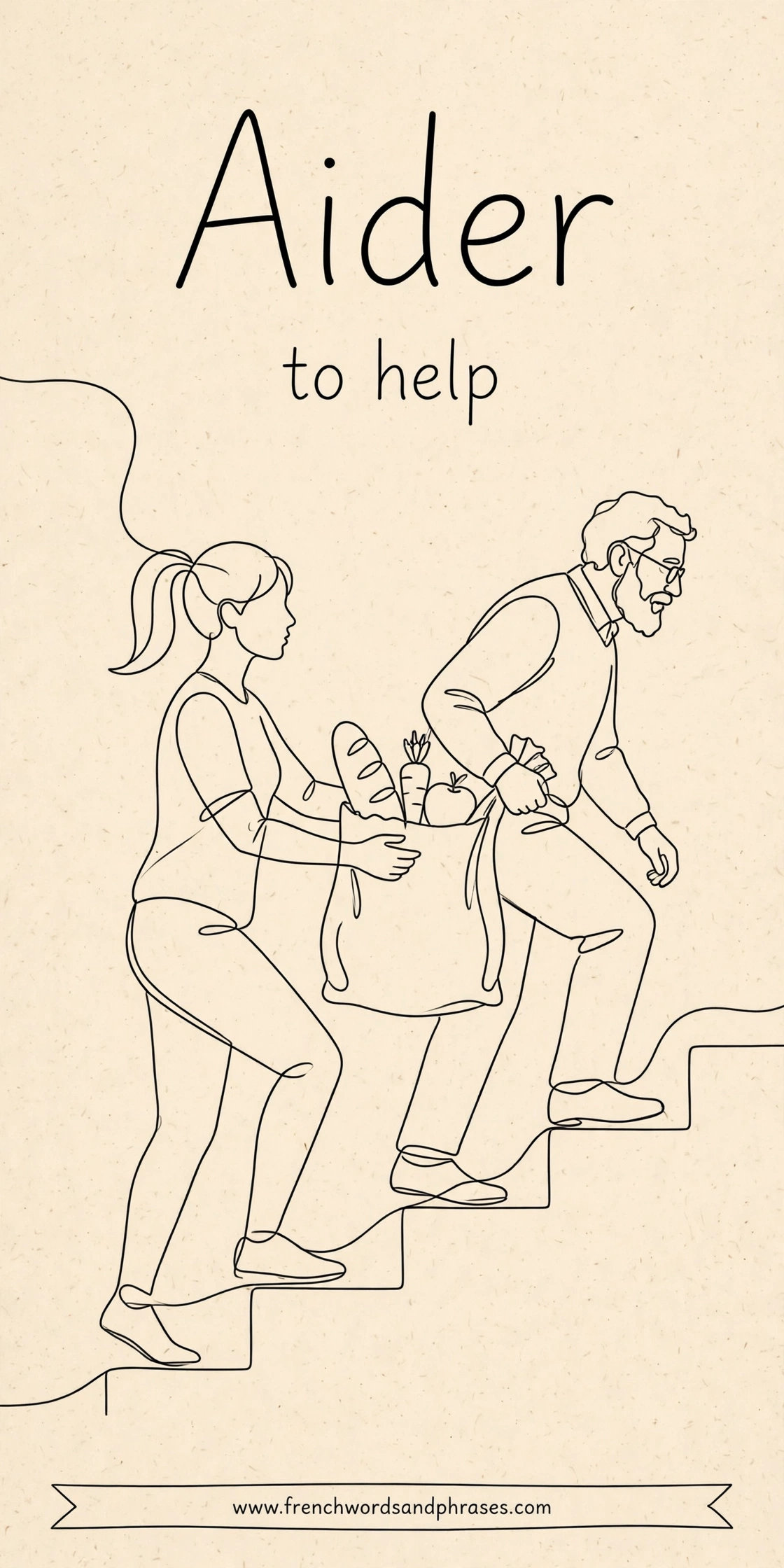
A neighbour carrying shopping up the stairs, a classmate explaining the maths problem, a stranger holding the door with a smile — aider is the everyday verb of help: small, constant, and woven through every day of French life.
In this guide, you’ll learn how to conjugate aider in all the major French tenses and moods. Explore complete conjugation tables, French examples, English translations, and practice quizzes.
Understanding the French Verb Aider
Aider is a regular French verb belonging to the first group of verbs, those ending in-er.
It means to help. It is the all-purpose help verb, used for everything from homework to house-moving — and in the synonym table it keeps strong company: secourir, its table synonym, is help in an emergency, the rescue services’ word, while aider is help in ordinary life. Soutenir, also on the site, is to support — to hold up a person, a cause or a family over time. Aider is the hand lent here and now.
Verb classification: First group (-er)
Auxiliary verb: Avoir
Past participle: aidé
Present participle: aidant
English equivalents: To help; aider quelqu’un à faire quelque chose — to help someone (to) do something; aider à la maison — to help at home; s’aider de quelque chose — to use something as an aid; aide-toi, le ciel t’aidera — God helps those who help themselves.
One important detail: aider builds its help with the preposition à before the infinitive — aider quelqu’un à faire quelque chose: elle aide son voisin à porter ses courses, she helps her neighbour to carry his shopping. English drops its ‘to’ half the time (help him carry); French never drops the à. The verb is a regular -er (j’aide, nous aidons, past participle aidé), and its noun is one of the commonest words in France: une aide, help, and les aides, the grants and benefits the state gives.
Experience the Word
Aider is the verb of the lent hand — the smallest unit of kindness in the language, spent a dozen times a day.
Imagine a stairwell in an old Paris building. Madame Fabre, eighty years old, climbs slowly with two bags; halfway up, a teenager she barely knows takes both bags without a word and aide her to the fourth floor — two minutes of his day, the whole of hers.
He has not rescued or saved anyone. He has helped — aidé — and that is quite enough.
How to Conjugate Aider: Complete French Conjugation Guide
Let’s explore every major conjugation of aider, beginning with the indicative mood.
How to Conjugate Aider in the Indicative Mood
The indicative mood is used to express facts, observations, actions, and events.
How to Conjugate Aider in the Present Tense (Présent)
Used for actions happening now, habitual actions, and general truths.
| Subject | Conjugation |
|---|---|
| je | aide |
| tu | aides |
| il / elle | aide |
| nous | aidons |
| vous | aidez |
| ils / elles | aident |
Example
Elle aide son voisin à porter ses courses.
She helps her neighbour carry his shopping.
Quick Quiz 1
Complete the sentence:
Nous ______ les bénévoles à installer les tentes.
Reveal the answer
aidons
Nous aidons les bénévoles à installer les tentes.
We are helping the volunteers put up the tents.
How to Conjugate Aider in the Passé Composé
Used for completed actions in the past. Aider takes the auxiliary verb avoir.
| Subject | Conjugation |
|---|---|
| j’ | ai aidé |
| tu | as aidé |
| il / elle | a aidé |
| nous | avons aidé |
| vous | avez aidé |
| ils / elles | ont aidé |
Example
Ils ont aidé les pompiers toute la nuit.
They helped the firefighters all night.
How to Conjugate Aider in the Imparfait (Imperfect Tense)
Used for habitual past actions, descriptions, and ongoing situations in the past.
| Subject | Conjugation |
|---|---|
| je | aidais |
| tu | aidais |
| il / elle | aidait |
| nous | aidions |
| vous | aidiez |
| ils / elles | aidaient |
Example
Grand-mère aidait toujours les voisins du village.
Grandmother always used to help the neighbours in the village.
Quick Quiz 2
Choose the correct form:
They helped the firefighters.
Ils ______ les pompiers. (ont aidé / sont aidé)
Reveal the answer
ont aidé
Ils ont aidé les pompiers.
Aider takes avoir.
How to Conjugate Aider in the Plus-que-parfait
Used to describe an action that had already been completed before another past event.
| Subject | Conjugation |
|---|---|
| j’ | avais aidé |
| tu | avais aidé |
| il / elle | avait aidé |
| nous | avions aidé |
| vous | aviez aidé |
| ils / elles | avaient aidé |
Example
Il avait aidé son frère à déménager la semaine précédente.
He had helped his brother move house the week before.
How to Conjugate Aider in the Passé Simple
Primarily used in formal writing, literature, and historical narratives. It is rarely used in everyday conversation.
| Subject | Conjugation |
|---|---|
| je | aidai |
| tu | aidas |
| il / elle | aida |
| nous | aidâmes |
| vous | aidâtes |
| ils / elles | aidèrent |
Example
Les villageois aidèrent les voyageurs perdus dans la neige.
The villagers helped the travellers lost in the snow.
How to Conjugate Aider in the Passé Antérieur
A literary tense used to express an action completed immediately before another past action, generally in the passé simple.
| Subject | Conjugation |
|---|---|
| j’ | eus aidé |
| tu | eus aidé |
| il / elle | eut aidé |
| nous | eûmes aidé |
| vous | eûtes aidé |
| ils / elles | eurent aidé |
Example
Quand elle eut aidé tout le monde, elle s’assit enfin.
When she had helped everyone, she finally sat down.
How to Conjugate Aider in the Future Tense (Futur Simple)
Used to describe actions that will take place in the future.
| Subject | Conjugation |
|---|---|
| je | aiderai |
| tu | aideras |
| il / elle | aidera |
| nous | aiderons |
| vous | aiderez |
| ils / elles | aideront |
Example
Demain, nous aiderons les bénévoles à installer les tentes.
Tomorrow, we will help the volunteers put up the tents.
How to Conjugate Aider in the Futur Antérieur (Future Perfect)
Used for an action that will have been completed before a particular point in the future.
| Subject | Conjugation |
|---|---|
| j’ | aurai aidé |
| tu | auras aidé |
| il / elle | aura aidé |
| nous | aurons aidé |
| vous | aurez aidé |
| ils / elles | auront aidé |
Example
À la fin de la journée, tu auras aidé dix familles.
By the end of the day, you will have helped ten families.
How to Conjugate Aider in the Near Future (Futur Proche)
Used to describe something that is going to happen soon. Formed with aller + infinitive.
| Subject | Conjugation |
|---|---|
| je | vais aider |
| tu | vas aider |
| il / elle | va aider |
| nous | allons aider |
| vous | allez aider |
| ils / elles | vont aider |
Example
Je vais t’aider à finir ce rapport.
I am going to help you finish this report.
How to Conjugate Aider in the Conditional Mood
The conditional mood expresses what would happen under certain circumstances. It is also frequently used to make polite requests or express wishes.
How to Conjugate Aider in the Present Conditional
| Subject | Conjugation |
|---|---|
| je | aiderais |
| tu | aiderais |
| il / elle | aiderait |
| nous | aiderions |
| vous | aideriez |
| ils / elles | aideraient |
Example
Je t’aiderais volontiers si j’avais le temps.
I would gladly help you if I had the time.
How to Conjugate Aider in the Past Conditional
| Subject | Conjugation |
|---|---|
| j’ | aurais aidé |
| tu | aurais aidé |
| il / elle | aurait aidé |
| nous | aurions aidé |
| vous | auriez aidé |
| ils / elles | auraient aidé |
Example
Elle aurait aidé son amie sans ce contretemps.
She would have helped her friend without that setback.
Aider in the Literary Past Conditional Form
This less common literary form uses the imperfect subjunctive of avoir.
| Subject | Conjugation |
|---|---|
| j’ | eusse aidé |
| tu | eusses aidé |
| il / elle | eût aidé |
| nous | eussions aidé |
| vous | eussiez aidé |
| ils / elles | eussent aidé |
Example
Il eût aidé les pauvres sans l’avarice de son maître.
He would have helped the poor without his master’s greed.
How to Conjugate Aider in the Subjunctive Mood
The subjunctive is used to express wishes, emotions, doubts, necessity, and uncertainty. It frequently follows expressions such as il faut que (it is necessary that) or bien que (although).
How to Conjugate Aider in the Present Subjunctive
| Subject | Conjugation |
|---|---|
| que je | aide |
| que tu | aides |
| qu’il / qu’elle | aide |
| que nous | aidions |
| que vous | aidiez |
| qu’ils / qu’elles | aident |
Example
Il faut que tu aides ton petit frère à faire ses devoirs.
You must help your little brother do his homework.
Quick Quiz 3
Complete the sentence using the subjunctive:
Il faut que vous ______ les nouveaux élèves.
Reveal the answer
aidiez
Il faut que vous aidiez les nouveaux élèves.
You must help the new pupils.
How to Conjugate Aider in the Imperfect Subjunctive
A literary tense, rarely encountered in modern spoken French.
| Subject | Conjugation |
|---|---|
| que je | aidasse |
| que tu | aidasses |
| qu’il / qu’elle | aidât |
| que nous | aidassions |
| que vous | aidassiez |
| qu’ils / qu’elles | aidassent |
Example
Elle souhaitait qu’il aidât les nouveaux élèves.
She wished he would help the new pupils.
How to Conjugate Aider in the Pluperfect Subjunctive
A literary construction used to express an action completed before another past action.
| Subject | Conjugation |
|---|---|
| que j’ | eusse aidé |
| que tu | eusses aidé |
| qu’il / qu’elle | eût aidé |
| que nous | eussions aidé |
| que vous | eussiez aidé |
| qu’ils / qu’elles | eussent aidé |
Example
On racontait qu’il eût aidé des centaines de réfugiés.
People said he had helped hundreds of refugees.
How to Conjugate Aider in the Past Subjunctive
| Subject | Conjugation |
|---|---|
| que j’ | aie aidé |
| que tu | aies aidé |
| qu’il / qu’elle | ait aidé |
| que nous | ayons aidé |
| que vous | ayez aidé |
| qu’ils / qu’elles | aient aidé |
Example
Je suis heureuse qu’elle ait aidé sa mère à se relever.
I am glad she helped her mother get back on her feet.
How to Conjugate Aider in the Imperative
The imperative is used to give commands, instructions, invitations, or suggestions. Subject pronouns are omitted.
How to Conjugate Aider in the Present Imperative
| Person | Conjugation |
|---|---|
| (tu) | aide |
| (nous) | aidons |
| (vous) | aidez |
Example
Aide-moi à ouvrir cette porte, elle est coincée !
Help me open this door, it is stuck!
Quick Quiz 4
How would you say Help me open this door (tu form)?
Reveal the answer
Aide-moi à ouvrir cette porte !
French Participles of Aider
Participles are verb forms that can be used in compound tenses and other grammatical constructions.
Present Participle of Aider
aidant
En aidant les autres, on s’aide souvent soi-même.
By helping others, we often help ourselves.
Past Participle of Aider
aidé
Aidée par ses voisins, elle a reconstruit sa grange en un été.
Helped by her neighbours, she rebuilt her barn in one summer.
Aider in Everyday French: Real-Life Examples
Now that you know the conjugations, let’s see how aider appears in everyday French.
Example 1 — Present
Elle aide son voisin à porter ses courses.
She helps her neighbour carry his shopping.
Example 2 — Passé composé
Ils ont aidé les pompiers toute la nuit.
They helped the firefighters all night.
Example 3 — Imparfait
Grand-mère aidait toujours les voisins.
Grandmother always used to help the neighbours.
Example 4 — Future
Nous aiderons les bénévoles demain.
We will help the volunteers tomorrow.
Example 5 — Conditional
Je t’aiderais volontiers, si je pouvais.
I would gladly help you, if I could.
Example 6 — Imperative
Aide-moi à ouvrir cette porte !
Help me open this door!
Beyond Translation: The Meaning of Aider
English aid is the direct cousin of aider — both come from Latin adjutare, to give help, and French keeps the family fully alive: une aide is help or an assistant, aide-toi, le ciel t’aidera is the proverb ‘God helps those who help themselves’.
Help, in French, is also paperwork.
The state gives des aides — grants, allowances, benefits — and an aide à domicile is the home help who comes to an elderly person’s house. The verb of the lent hand is also the verb of the welfare state.
How to Remember the French Verb Aider
Remember it this way: Aider is about the teenager carrying Madame Fabre’s bags up four floors.
- The pattern is aider quelqu’un À faire quelque chose — the à before the infinitive never drops.
- Everyday help is aider; emergency rescue is its grander synonym secourir.
- Regular -er: j’aide, nous aidons, past participle aidé; the noun is une aide.
The key idea is the teenager carrying Madame Fabre’s bags up four floors.
Test Your Knowledge of Aider
Let’s see how much you’ve learned. Try answering these questions before revealing the answers.
Question 1
Which preposition comes between aider quelqu’un and the infinitive?
Reveal the answer
À — aider quelqu’un à faire quelque chose: elle aide son voisin à porter ses courses.
Question 2
How do you say She helps her neighbour carry his shopping in French?
Reveal the answer
Elle aide son voisin à porter ses courses.
Question 3
Translate: They helped the firefighters all night.
Reveal the answer
Ils ont aidé les pompiers toute la nuit.
Question 4
What is the past participle of aider?
Reveal the answer
Aidé.
Question 5
Complete the sentence:
Il faut que tu ______ ton petit frère à faire ses devoirs.
Reveal the answer
aides
Il faut que tu aides ton petit frère à faire ses devoirs.
You must help your little brother do his homework.
Your Final Challenge
Can You Use It?
How would you say this in French?
Helping someone carry their shopping upstairs can sometimes give them back their whole day.
Reveal the answer
Aider quelqu’un à monter ses courses, c’est parfois lui rendre toute sa journée.
Helping someone carry their shopping upstairs can sometimes give them back their whole day.
A little French. A little curiosity. A richer everyday life.
LEARN FRENCH ONE WORD AT A TIME