A French Word to Live By
How to Conjugate Débuter in French
/de.by.te/
Débuter means to begin, to start — the moment something gets under way, a film, a career, a season.
The lights go down in a cinema, a young singer walks onto a stage for the very first time, the first page of a new school year turns — débuter is the verb of the starting line: things beginning, and people making their very first appearance.
In this guide, you’ll learn how to conjugate débuter in all the major French tenses and moods. Explore complete conjugation tables, French examples, English translations, and practice quizzes.
Understanding the French Verb Débuter
Débuter is a regular French verb belonging to the first group of verbs, those ending in-er.
It means to begin, to start. It is the standard verb for timetabled beginnings — films, matches, courses, seasons — and for first steps in a profession: débuter comme apprenti, débuter sur scène. Its noun un début (a beginning) and un débutant (a beginner) are everywhere, and English borrowed the person sense whole: a debut.
Verb classification: First group (-er)
Auxiliary verb: Avoir
Past participle: débuté
Present participle: débutant
English equivalents: To begin, to start, to open; le film débute à vingt heures — the film starts at eight; débuter dans un métier — to start out in a trade; débuter par quelque chose — to begin with something; un débutant — a beginner.
One important detail: débuter is usually intransitive — it is the event itself that débute: le cours débute à neuf heures, le spectacle a débuté en retard. For a person starting out, French adds dans: elle débute dans le journalisme, she is starting out in journalism. Its close neighbour commencer is more flexible — it happily takes an object (commencer un livre) and a following infinitive (commencer à pleuvoir) — while débuter keeps the elegance of the official start: the curtain rising, the season opening, the career launching.
Experience the Word
Débuter is the verb of the deep breath before the first note — everything is ready, and now it starts.
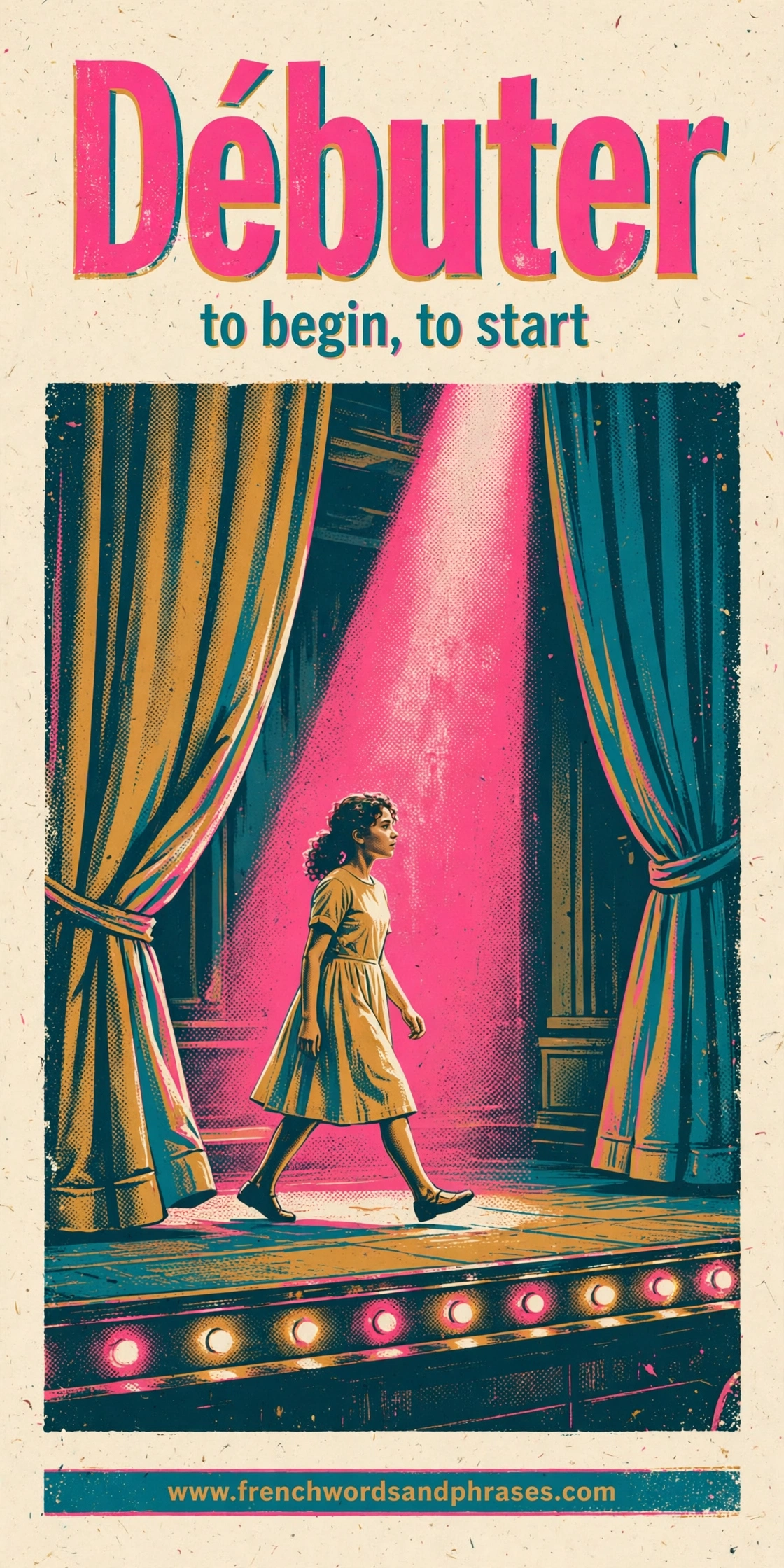
Imagine a village theatre on a Saturday night. Behind the curtain, a seventeen-year-old in a borrowed costume listens to the audience settling. The bell rings, the lights fall — le spectacle débute, and so, quietly, does her life on stage.
Nothing has happened yet, and everything has. It has begun — débuté, at last, for real.
How to Conjugate Débuter: Complete French Conjugation Guide
Let’s explore every major conjugation of débuter, beginning with the indicative mood.
How to Conjugate Débuter in the Indicative Mood
The indicative mood is used to express facts, observations, actions, and events.
How to Conjugate Débuter in the Present Tense (Présent)
Used for actions happening now, habitual actions, and general truths.
| Subject | Conjugation |
|---|---|
| je | débute |
| tu | débutes |
| il / elle | débute |
| nous | débutons |
| vous | débutez |
| ils / elles | débutent |
Example
Le spectacle débute à vingt heures précises.
The show starts at eight o’clock sharp.
Quick Quiz 1
Complete the sentence:
Le spectacle ______ à vingt heures.
Reveal the answer
débute
Le spectacle débute à vingt heures.
The show starts at eight o’clock.
How to Conjugate Débuter in the Passé Composé
Used for completed actions in the past. Débuter takes the auxiliary verb avoir.
| Subject | Conjugation |
|---|---|
| j’ | ai débuté |
| tu | as débuté |
| il / elle | a débuté |
| nous | avons débuté |
| vous | avez débuté |
| ils / elles | ont débuté |
Example
Sa carrière a débuté dans un petit théâtre de province.
Her career began in a small provincial theatre.
How to Conjugate Débuter in the Imparfait (Imperfect Tense)
Used for habitual past actions, descriptions, and ongoing situations in the past.
| Subject | Conjugation |
|---|---|
| je | débutais |
| tu | débutais |
| il / elle | débutait |
| nous | débutions |
| vous | débutiez |
| ils / elles | débutaient |
Example
Chaque matin débutait par un café et un journal.
Every morning used to begin with a coffee and a newspaper.
Quick Quiz 2
Choose the correct form:
The meeting started without him.
La réunion ______ sans lui. (a débuté / est débutée)
Reveal the answer
a débuté
La réunion a débuté sans lui.
Débuter takes avoir.
How to Conjugate Débuter in the Plus-que-parfait
Used to describe an action that had already been completed before another past event.
| Subject | Conjugation |
|---|---|
| j’ | avais débuté |
| tu | avais débuté |
| il / elle | avait débuté |
| nous | avions débuté |
| vous | aviez débuté |
| ils / elles | avaient débuté |
Example
La réunion avait débuté sans lui.
The meeting had started without him.
How to Conjugate Débuter in the Passé Simple
Primarily used in formal writing, literature, and historical narratives. It is rarely used in everyday conversation.
| Subject | Conjugation |
|---|---|
| je | débutai |
| tu | débutas |
| il / elle | débuta |
| nous | débutâmes |
| vous | débutâtes |
| ils / elles | débutèrent |
Example
Le concert débuta par un long silence.
The concert opened with a long silence.
How to Conjugate Débuter in the Passé Antérieur
A literary tense used to express an action completed immediately before another past action, generally in the passé simple.
| Subject | Conjugation |
|---|---|
| j’ | eus débuté |
| tu | eus débuté |
| il / elle | eut débuté |
| nous | eûmes débuté |
| vous | eûtes débuté |
| ils / elles | eurent débuté |
Example
Quand le film eut débuté, on éteignit les téléphones.
When the film had started, people switched off their phones.
How to Conjugate Débuter in the Future Tense (Futur Simple)
Used to describe actions that will take place in the future.
| Subject | Conjugation |
|---|---|
| je | débuterai |
| tu | débuteras |
| il / elle | débutera |
| nous | débuterons |
| vous | débuterez |
| ils / elles | débuteront |
Example
La saison débutera en septembre cette année.
The season will begin in September this year.
How to Conjugate Débuter in the Futur Antérieur (Future Perfect)
Used for an action that will have been completed before a particular point in the future.
| Subject | Conjugation |
|---|---|
| j’ | aurai débuté |
| tu | auras débuté |
| il / elle | aura débuté |
| nous | aurons débuté |
| vous | aurez débuté |
| ils / elles | auront débuté |
Example
À midi, les travaux auront débuté depuis longtemps.
By noon, the work will have started long ago.
How to Conjugate Débuter in the Near Future (Futur Proche)
Used to describe something that is going to happen soon. Formed with aller + infinitive.
| Subject | Conjugation |
|---|---|
| je | vais débuter |
| tu | vas débuter |
| il / elle | va débuter |
| nous | allons débuter |
| vous | allez débuter |
| ils / elles | vont débuter |
Example
Le cours va débuter dans cinq minutes.
The class is going to start in five minutes.
How to Conjugate Débuter in the Conditional Mood
The conditional mood expresses what would happen under certain circumstances. It is also frequently used to make polite requests or express wishes.
How to Conjugate Débuter in the Present Conditional
| Subject | Conjugation |
|---|---|
| je | débuterais |
| tu | débuterais |
| il / elle | débuterait |
| nous | débuterions |
| vous | débuteriez |
| ils / elles | débuteraient |
Example
Sans le retard du train, la visite débuterait plus tôt.
Without the train delay, the tour would start earlier.
How to Conjugate Débuter in the Past Conditional
| Subject | Conjugation |
|---|---|
| j’ | aurais débuté |
| tu | aurais débuté |
| il / elle | aurait débuté |
| nous | aurions débuté |
| vous | auriez débuté |
| ils / elles | auraient débuté |
Example
Le match aurait débuté à l’heure sans la pluie.
The match would have started on time without the rain.
Débuter in the Literary Past Conditional Form
This less common literary form uses the imperfect subjunctive of avoir.
| Subject | Conjugation |
|---|---|
| j’ | eusse débuté |
| tu | eusses débuté |
| il / elle | eût débuté |
| nous | eussions débuté |
| vous | eussiez débuté |
| ils / elles | eussent débuté |
Example
La pièce eût débuté plus tôt sans l’orage.
The play would have started earlier without the storm.
How to Conjugate Débuter in the Subjunctive Mood
The subjunctive is used to express wishes, emotions, doubts, necessity, and uncertainty. It frequently follows expressions such as il faut que (it is necessary that) or bien que (although).
How to Conjugate Débuter in the Present Subjunctive
| Subject | Conjugation |
|---|---|
| que je | débute |
| que tu | débutes |
| qu’il / qu’elle | débute |
| que nous | débutions |
| que vous | débutiez |
| qu’ils / qu’elles | débutent |
Example
Il faut que le cours débute à l’heure.
The class must start on time.
Quick Quiz 3
Complete the sentence using the subjunctive:
Il faut que le spectacle ______ à l’heure.
Reveal the answer
débute
Il faut que le spectacle débute à l’heure.
The show must start on time.
How to Conjugate Débuter in the Imperfect Subjunctive
A literary tense, rarely encountered in modern spoken French.
| Subject | Conjugation |
|---|---|
| que je | débutasse |
| que tu | débutasses |
| qu’il / qu’elle | débutât |
| que nous | débutassions |
| que vous | débutassiez |
| qu’ils / qu’elles | débutassent |
Example
On voulait que la fête débutât à la tombée de la nuit.
People wanted the party to begin at nightfall.
How to Conjugate Débuter in the Pluperfect Subjunctive
A literary construction used to express an action completed before another past action.
| Subject | Conjugation |
|---|---|
| que j’ | eusse débuté |
| que tu | eusses débuté |
| qu’il / qu’elle | eût débuté |
| que nous | eussions débuté |
| que vous | eussiez débuté |
| qu’ils / qu’elles | eussent débuté |
Example
On racontait que le procès eût débuté dans le plus grand secret.
People said the trial had begun in the greatest secrecy.
How to Conjugate Débuter in the Past Subjunctive
| Subject | Conjugation |
|---|---|
| que j’ | aie débuté |
| que tu | aies débuté |
| qu’il / qu’elle | ait débuté |
| que nous | ayons débuté |
| que vous | ayez débuté |
| qu’ils / qu’elles | aient débuté |
Example
Je suis content que les travaux aient débuté.
I am glad the work has started.
How to Conjugate Débuter in the Imperative
The imperative is used to give commands, instructions, invitations, or suggestions. Subject pronouns are omitted.
How to Conjugate Débuter in the Present Imperative
| Person | Conjugation |
|---|---|
| (tu) | débute |
| (nous) | débutons |
| (vous) | débutez |
Example
Débute doucement, le public écoute.
Start gently, the audience is listening.
Quick Quiz 4
How would you say Start gently (tu form)?
Reveal the answer
Débute doucement !
French Participles of Débuter
Participles are verb forms that can be used in compound tenses and other grammatical constructions.
Present Participle of Débuter
débutant
En débutant tôt, nous finirons tôt.
By starting early, we will finish early.
Past Participle of Débuter
débuté
Débutée en janvier, la saison s’est terminée en juin.
Begun in January, the season ended in June.
Débuter in Everyday French: Real-Life Examples
Now that you know the conjugations, let’s see how débuter appears in everyday French.
Example 1 — Present
Le film débute à vingt heures.
The film starts at eight.
Example 2 — Passé composé
Sa carrière a débuté à Paris.
Her career began in Paris.
Example 3 — Imparfait
Chaque journée débutait par un café.
Every day used to begin with a coffee.
Example 4 — Future
La saison débutera en septembre.
The season will begin in September.
Example 5 — Conditional
Le match débuterait plus tôt sans la pluie.
The match would start earlier without the rain.
Example 6 — Imperative
Débute doucement !
Start gently!
Beyond Translation: The Meaning of Débuter
English debut is this verb’s own child — French débuter crossed the Channel with actors and singers and kept its first-night glamour.
But at home it does humbler work too.
Un début is any beginning at all — au début, at first, is one of the most useful phrases in the language — and the débutant, the beginner, is simply the one who is débutant: standing at the start line where everything débute.
How to Remember the French Verb Débuter
Remember it this way: Débuter is about the curtain rising — the show, the season, the career, all starting at once.
- The event débute by itself: le film débute, le cours débute — usually no object after it.
- A person starting out takes dans: elle débute dans le journalisme.
- Regular -er: je débute, nous débutons, past participle débuté; family: un début, un débutant.
The key idea is the curtain rising — the show, the season, the career, all starting at once.
Test Your Knowledge of Débuter
Let’s see how much you’ve learned. Try answering these questions before revealing the answers.
Question 1
Which preposition does a person starting a career use with débuter?
Reveal the answer
Dans — elle débute dans le journalisme, she is starting out in journalism.
Question 2
How do you say The film starts at eight in French?
Reveal the answer
Le film débute à vingt heures.
Question 3
Translate: Her career began in Paris.
Reveal the answer
Sa carrière a débuté à Paris.
Question 4
What is the past participle of débuter?
Reveal the answer
Débuté.
Question 5
Complete the sentence:
Il faut que le cours ______ à l’heure.
Reveal the answer
débute
Il faut que le cours débute à l’heure.
The class must start on time.
Your Final Challenge
Can You Use It?
How would you say this in French?
Everything begins with a first step, even the longest journeys.
Reveal the answer
Tout débute par un premier pas, même les plus longs voyages.
Everything begins with a first step, even the longest journeys.
A little French. A little curiosity. A richer everyday life.
LEARN FRENCH ONE WORD AT A TIME