A French Word to Live By
How to Conjugate Entamer in French
/ɑ̃.ta.me/
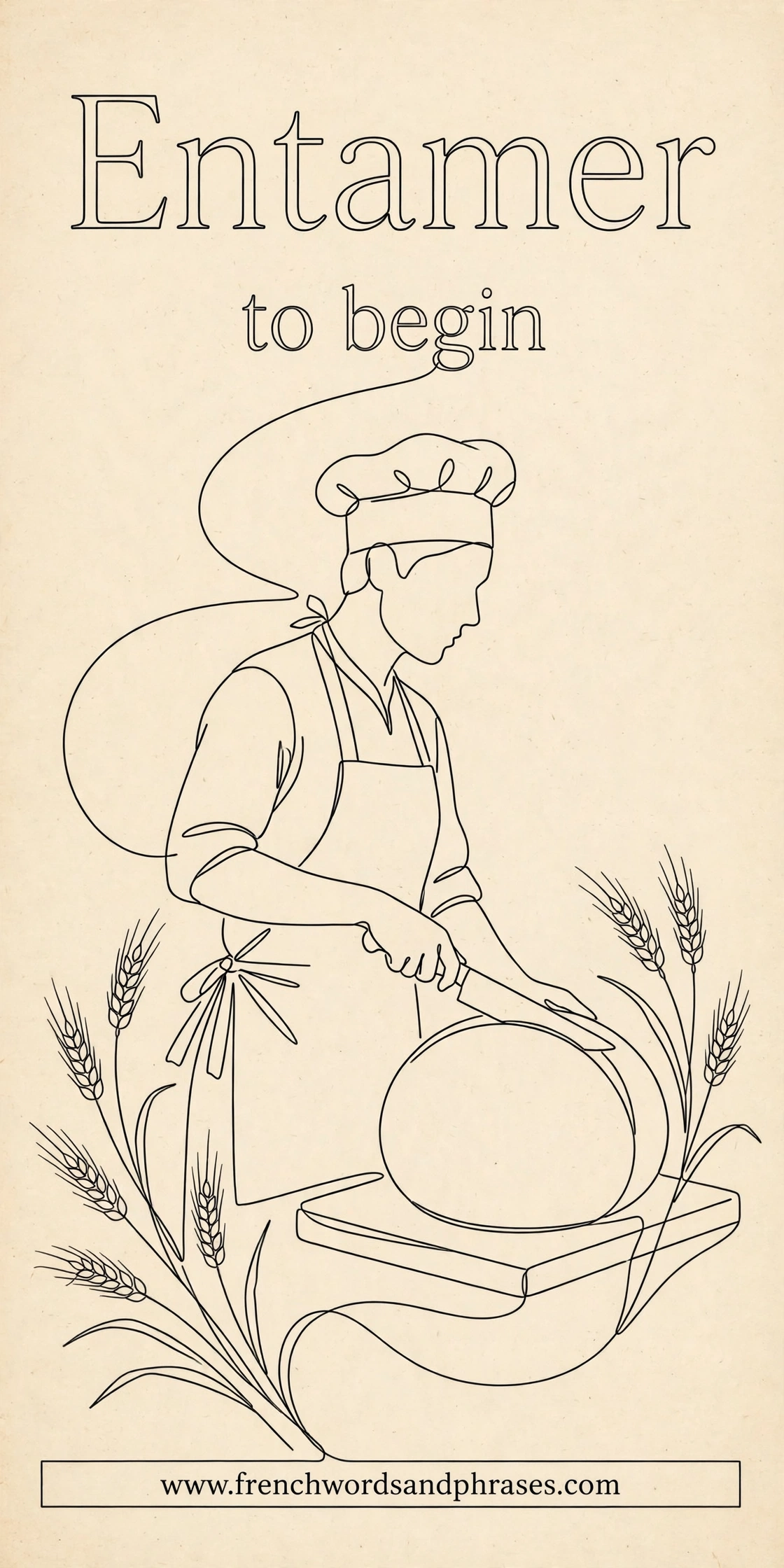
Entamer means to begin, to start on — to make the first cut into something: a loaf, a cheese, a conversation, a negotiation.
A knife sinking into the crust of a fresh loaf, a first question breaking the ice of a difficult meeting, a signature at the start of long negotiations — entamer is beginning with a bite taken out of it: the moment the untouched thing is finally opened.
In this guide, you’ll learn how to conjugate entamer in all the major French tenses and moods. Explore complete conjugation tables, French examples, English translations, and practice quizzes.
Understanding the French Verb Entamer
Entamer is a regular French verb belonging to the first group of verbs, those ending in-er.
It means to begin, to start on. It lives at the table (entamer le pain, le jambon, le gâteau), in diplomacy and business (entamer des pourparlers, des négociations), in conversation (entamer la discussion, entamer un sujet délicat), and in the bank account — entamer ses économies is to make the first withdrawal from a carefully guarded pile.
Verb classification: First group (-er)
Auxiliary verb: Avoir
Past participle: entamé
Present participle: entamant
English equivalents: To start on, to begin, to open; entamer un pain — to cut into a loaf; entamer une conversation — to strike up a conversation; entamer des négociations — to open negotiations; entamer ses économies — to dip into one’s savings.
One important detail: entamer always takes an object, and the object is something whole that you make a first dent in — entamer un fromage, entamer une bouteille, entamer un sujet difficile. That first-cut image is what separates it from commencer and débuter: those simply start things, while entamer starts into them, the way a knife starts into bread. The verb is perfectly regular: j’entame, nous entamons, ils entament.
Experience the Word
Entamer is beginning with commitment — once the loaf is cut, there is no going back to whole.
Imagine a farmhouse kitchen at noon. The loaf is still warm, its crust perfect and unbroken, and everyone watches as the grandfather draws the long knife: il entame le pain — and with that first slice, lunch has truly begun, the way negotiations begin with a first handshake.
The loaf is no longer untouched. It is started — entamé, opened, under way.
How to Conjugate Entamer: Complete French Conjugation Guide
Let’s explore every major conjugation of entamer, beginning with the indicative mood.
How to Conjugate Entamer in the Indicative Mood
The indicative mood is used to express facts, observations, actions, and events.
How to Conjugate Entamer in the Present Tense (Présent)
Used for actions happening now, habitual actions, and general truths.
| Subject | Conjugation |
|---|---|
| je | entame |
| tu | entames |
| il / elle | entame |
| nous | entamons |
| vous | entamez |
| ils / elles | entament |
Example
Elle entame une conversation avec son voisin de train.
She strikes up a conversation with her neighbour on the train.
Quick Quiz 1
Complete the sentence:
Nous ______ les négociations demain matin.
Reveal the answer
entamons
Nous entamons les négociations demain matin.
We open the negotiations tomorrow morning.
How to Conjugate Entamer in the Passé Composé
Used for completed actions in the past. Entamer takes the auxiliary verb avoir.
| Subject | Conjugation |
|---|---|
| j’ | ai entamé |
| tu | as entamé |
| il / elle | a entamé |
| nous | avons entamé |
| vous | avez entamé |
| ils / elles | ont entamé |
Example
Nous avons entamé le gâteau avant même le dîner.
We started on the cake before dinner even began.
How to Conjugate Entamer in the Imparfait (Imperfect Tense)
Used for habitual past actions, descriptions, and ongoing situations in the past.
| Subject | Conjugation |
|---|---|
| je | entamais |
| tu | entamais |
| il / elle | entamait |
| nous | entamions |
| vous | entamiez |
| ils / elles | entamaient |
Example
Chaque soir, il entamait un nouveau chapitre de son roman.
Every evening, he would start on a new chapter of his novel.
Quick Quiz 2
Choose the correct form:
They opened the negotiations on Monday.
Ils ______ les négociations lundi. (ont entamé / sont entamés)
Reveal the answer
ont entamé
Ils ont entamé les négociations lundi.
Entamer takes avoir.
How to Conjugate Entamer in the Plus-que-parfait
Used to describe an action that had already been completed before another past event.
| Subject | Conjugation |
|---|---|
| j’ | avais entamé |
| tu | avais entamé |
| il / elle | avait entamé |
| nous | avions entamé |
| vous | aviez entamé |
| ils / elles | avaient entamé |
Example
Ils avaient entamé les négociations dès le lundi matin.
They had opened the negotiations on Monday morning already.
How to Conjugate Entamer in the Passé Simple
Primarily used in formal writing, literature, and historical narratives. It is rarely used in everyday conversation.
| Subject | Conjugation |
|---|---|
| je | entamai |
| tu | entamas |
| il / elle | entama |
| nous | entamâmes |
| vous | entamâtes |
| ils / elles | entamèrent |
Example
Le boulanger entama la miche encore chaude.
The baker cut into the still-warm loaf.
How to Conjugate Entamer in the Passé Antérieur
A literary tense used to express an action completed immediately before another past action, generally in the passé simple.
| Subject | Conjugation |
|---|---|
| j’ | eus entamé |
| tu | eus entamé |
| il / elle | eut entamé |
| nous | eûmes entamé |
| vous | eûtes entamé |
| ils / elles | eurent entamé |
Example
Quand elle eut entamé son discours, la salle se tut.
When she had begun her speech, the room fell silent.
How to Conjugate Entamer in the Future Tense (Futur Simple)
Used to describe actions that will take place in the future.
| Subject | Conjugation |
|---|---|
| je | entamerai |
| tu | entameras |
| il / elle | entamera |
| nous | entamerons |
| vous | entamerez |
| ils / elles | entameront |
Example
Demain, nous entamerons la dernière étape du voyage.
Tomorrow, we will start on the last stage of the journey.
How to Conjugate Entamer in the Futur Antérieur (Future Perfect)
Used for an action that will have been completed before a particular point in the future.
| Subject | Conjugation |
|---|---|
| j’ | aurai entamé |
| tu | auras entamé |
| il / elle | aura entamé |
| nous | aurons entamé |
| vous | aurez entamé |
| ils / elles | auront entamé |
Example
À la fin du mois, ils auront entamé leurs économies.
By the end of the month, they will have dipped into their savings.
How to Conjugate Entamer in the Near Future (Futur Proche)
Used to describe something that is going to happen soon. Formed with aller + infinitive.
| Subject | Conjugation |
|---|---|
| je | vais entamer |
| tu | vas entamer |
| il / elle | va entamer |
| nous | allons entamer |
| vous | allez entamer |
| ils / elles | vont entamer |
Example
Allez, on va entamer le fromage !
Come on, let’s start on the cheese!
How to Conjugate Entamer in the Conditional Mood
The conditional mood expresses what would happen under certain circumstances. It is also frequently used to make polite requests or express wishes.
How to Conjugate Entamer in the Present Conditional
| Subject | Conjugation |
|---|---|
| je | entamerais |
| tu | entamerais |
| il / elle | entamerait |
| nous | entamerions |
| vous | entameriez |
| ils / elles | entameraient |
Example
Avec un peu plus de courage, elle entamerait cette discussion difficile.
With a little more courage, she would broach that difficult discussion.
How to Conjugate Entamer in the Past Conditional
| Subject | Conjugation |
|---|---|
| j’ | aurais entamé |
| tu | aurais entamé |
| il / elle | aurait entamé |
| nous | aurions entamé |
| vous | auriez entamé |
| ils / elles | auraient entamé |
Example
Il aurait entamé le pain s’il avait eu faim.
He would have cut into the loaf if he had been hungry.
Entamer in the Literary Past Conditional Form
This less common literary form uses the imperfect subjunctive of avoir.
| Subject | Conjugation |
|---|---|
| j’ | eusse entamé |
| tu | eusses entamé |
| il / elle | eût entamé |
| nous | eussions entamé |
| vous | eussiez entamé |
| ils / elles | eussent entamé |
Example
Elle eût entamé les pourparlers sans hésiter.
She would have opened the talks without hesitating.
How to Conjugate Entamer in the Subjunctive Mood
The subjunctive is used to express wishes, emotions, doubts, necessity, and uncertainty. It frequently follows expressions such as il faut que (it is necessary that) or bien que (although).
How to Conjugate Entamer in the Present Subjunctive
| Subject | Conjugation |
|---|---|
| que je | entame |
| que tu | entames |
| qu’il / qu’elle | entame |
| que nous | entamions |
| que vous | entamiez |
| qu’ils / qu’elles | entament |
Example
Il est temps que tu entames tes révisions.
It is time you started on your revision.
Quick Quiz 3
Complete the sentence using the subjunctive:
Je doute qu’elle ______ ce sujet devant ses parents.
Reveal the answer
entame
Je doute qu’elle entame ce sujet devant ses parents.
I doubt she will broach that subject in front of her parents.
How to Conjugate Entamer in the Imperfect Subjunctive
A literary tense, rarely encountered in modern spoken French.
| Subject | Conjugation |
|---|---|
| que je | entamasse |
| que tu | entamasses |
| qu’il / qu’elle | entamât |
| que nous | entamassions |
| que vous | entamassiez |
| qu’ils / qu’elles | entamassent |
Example
Je doutais qu’il entamât le sujet devant tout le monde.
I doubted he would broach the subject in front of everyone.
How to Conjugate Entamer in the Pluperfect Subjunctive
A literary construction used to express an action completed before another past action.
| Subject | Conjugation |
|---|---|
| que j’ | eusse entamé |
| que tu | eusses entamé |
| qu’il / qu’elle | eût entamé |
| que nous | eussions entamé |
| que vous | eussiez entamé |
| qu’ils / qu’elles | eussent entamé |
Example
On disait qu’ils eussent entamé les travaux en secret.
People said they had started on the work in secret.
How to Conjugate Entamer in the Past Subjunctive
| Subject | Conjugation |
|---|---|
| que j’ | aie entamé |
| que tu | aies entamé |
| qu’il / qu’elle | ait entamé |
| que nous | ayons entamé |
| que vous | ayez entamé |
| qu’ils / qu’elles | aient entamé |
Example
Je suis surpris qu’elle ait entamé ce sujet délicat.
I am surprised she broached that delicate subject.
How to Conjugate Entamer in the Imperative
The imperative is used to give commands, instructions, invitations, or suggestions. Subject pronouns are omitted.
How to Conjugate Entamer in the Present Imperative
| Person | Conjugation |
|---|---|
| (tu) | entame |
| (nous) | entamons |
| (vous) | entamez |
Example
Entame le pain, il est encore tiède !
Cut into the bread, it is still warm!
Quick Quiz 4
How would you say Cut into the bread (tu form)?
Reveal the answer
Entame le pain !
French Participles of Entamer
Participles are verb forms that can be used in compound tenses and other grammatical constructions.
Present Participle of Entamer
entamant
En entamant la deuxième bouteille, il raconta enfin son histoire.
As he opened the second bottle, he finally told his story.
Past Participle of Entamer
entamé
Entamée à peine, la miche fut terminée en dix minutes.
Barely started on, the loaf was finished in ten minutes.
Entamer in Everyday French: Real-Life Examples
Now that you know the conjugations, let’s see how entamer appears in everyday French.
Example 1 — Present
Elle entame la conversation.
She strikes up the conversation.
Example 2 — Passé composé
Nous avons entamé le fromage.
We started on the cheese.
Example 3 — Imparfait
Il entamait un nouveau chapitre chaque soir.
He would start a new chapter every evening.
Example 4 — Future
Nous entamerons les négociations demain.
We will open the negotiations tomorrow.
Example 5 — Conditional
Elle entamerait ce sujet avec plus de courage.
She would broach that subject with more courage.
Example 6 — Imperative
Entame le pain !
Cut into the bread!
Beyond Translation: The Meaning of Entamer
English has no exact twin for entamer — to start on comes closest, with its hint of a first bite.
The first cut is the whole idea.
An unopened bottle, an unspoken subject, an untouched savings account: all are whole until someone entame them. Diplomats chose the word for opening talks because it admits, honestly, that only the surface has been broken — the rest of the loaf is still to come.
How to Remember the French Verb Entamer
Remember it this way: Entamer is about the knife in the fresh loaf — the first cut that starts everything.
- Entamer takes an object you make a first dent in: un pain, un fromage, un sujet, des négociations.
- Commencer starts things; entamer starts INTO them — the knife going into the loaf.
- Regular -er: j’entame, nous entamons, past participle entamé.
The key idea is the knife in the fresh loaf — the first cut that starts everything.
Test Your Knowledge of Entamer
Let’s see how much you’ve learned. Try answering these questions before revealing the answers.
Question 1
What image separates entamer from commencer?
Reveal the answer
The first cut — entamer starts INTO something whole, like a knife into a loaf.
Question 2
How do you say We started on the cheese in French?
Reveal the answer
Nous avons entamé le fromage.
Question 3
Translate: She strikes up a conversation.
Reveal the answer
Elle entame une conversation.
Question 4
What is the past participle of entamer?
Reveal the answer
Entamé.
Question 5
Complete the sentence:
Il est temps que tu ______ tes révisions.
Reveal the answer
entames
Il est temps que tu entames tes révisions.
It is time you started on your revision.
Your Final Challenge
Can You Use It?
How would you say this in French?
He cuts into the still-warm bread, and the conversation begins by itself.
Reveal the answer
Il entame le pain encore chaud, et la conversation commence d’elle-même.
He cuts into the still-warm bread, and the conversation begins by itself.
A little French. A little curiosity. A richer everyday life.
LEARN FRENCH ONE WORD AT A TIME