A French Word to Live By
How to Conjugate Embosser in French
/ɑ̃.bɔ.se/
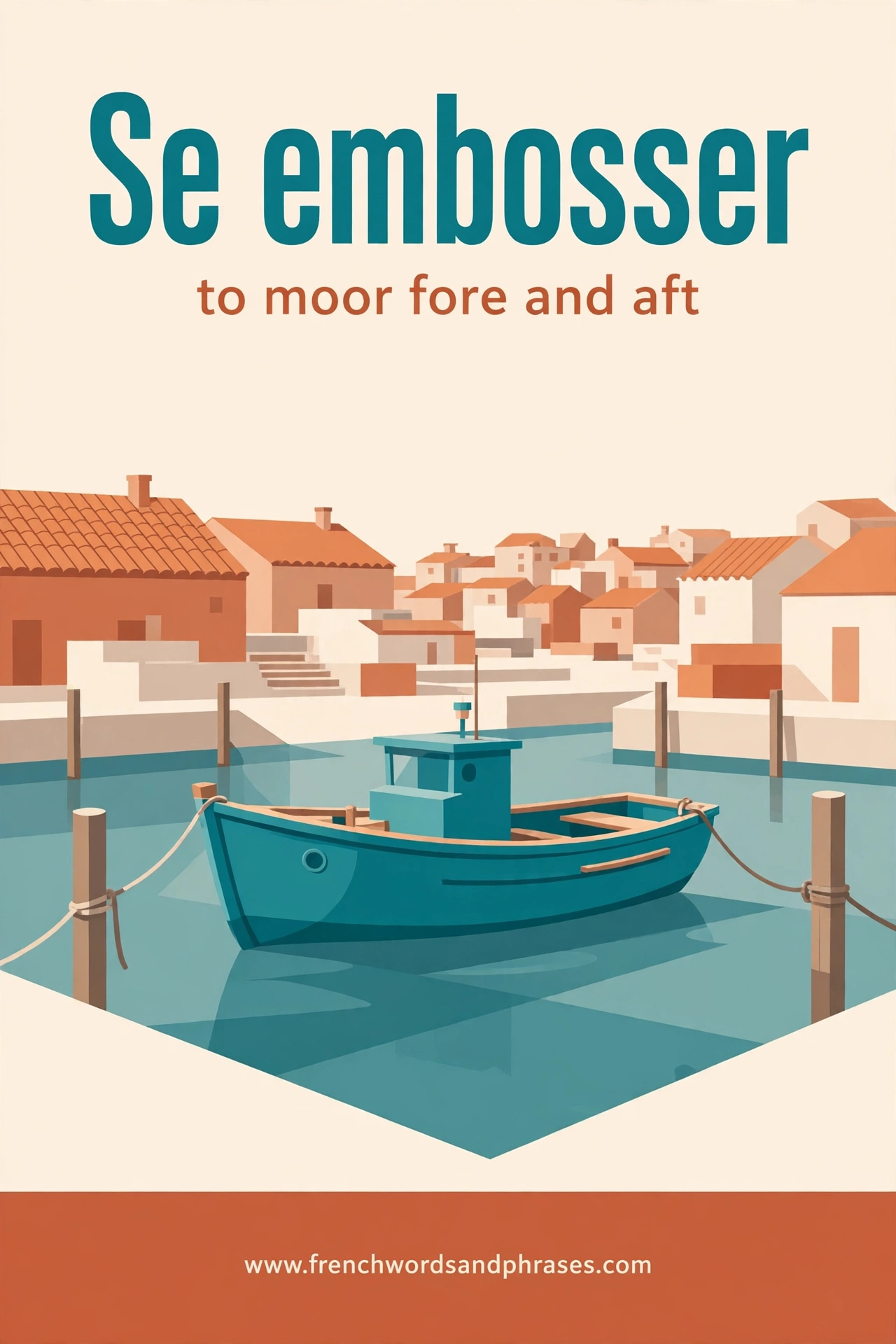
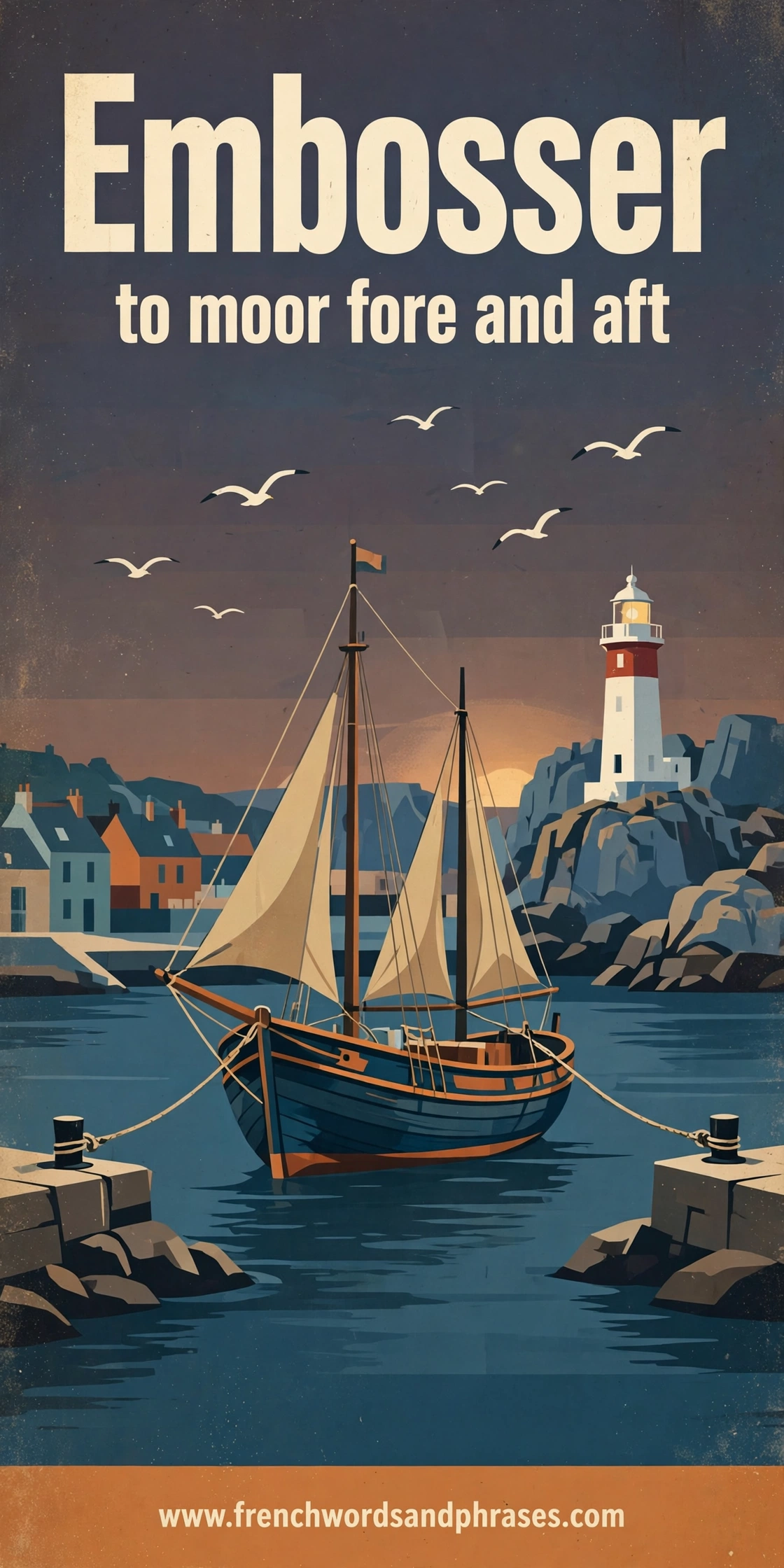
Embosser means to moor fore and aft — to hold a ship in place with an anchor at the bow and an anchor at the stern, so she cannot swing.
A frigate in a crowded roadstead, anchors going down at the bow and again at the stern, the ship settling into stillness between them — embosser is the sailor’s verb for mooring fore and aft: two anchors, one ship held fast, unable to swing with the wind or the tide.
In this guide, you’ll learn how to conjugate embosser in all the major French tenses and moods. Explore complete conjugation tables, French examples, English translations, and practice quizzes.
Understanding the French Verb Embosser
Embosser is a regular French verb belonging to the first group of verbs, those ending in-er.
It means to moor fore and aft. It is used by sailors and in naval and maritime writing, of warships in a roadstead, fishing boats in a harbour and barges in a river — anywhere a vessel must hold a fixed position and heading rather than ride to a single anchor.
Verb classification: First group (-er)
Auxiliary verb: Avoir
Past participle: embossé
Present participle: embossant
English equivalents: To moor fore and aft; embosser un navire — to moor a ship fore and aft; embosser une barque entre deux bouées — to moor a boat between two buoys; un embossage — a fore-and-aft mooring; être embossé — to lie moored fore and aft. Nautical vocabulary.
One important detail: embosser is nautical vocabulary, and its picture is precise — a ship at a single anchor swings in a wide circle with wind and tide, but a ship embossée, anchored from the bow and from the stern, stays exactly where she was put, facing one way. Captains embossent their ships in narrow channels, crowded roadsteads and river berths where swinging would mean collision. The verb itself is a plain regular -er: je embosse, nous embossons, ils embossent — not to be confused with the printer’s embosser of English, which French renders differently.
Experience the Word
Embosser is the verb of the ship that will not wander — pinned politely at both ends, bow and stern, while the tide does what it likes.
Imagine a frigate arriving in a busy roadstead at dusk. The first anchor splashes down from the bow; the boats carry a second anchor out astern; the cables tighten. Le capitaine a embossé son navire — and all night, while other ships swing slowly round their anchors, his frigate sleeps straight and still.
The wind pushes, the tide pulls, and nothing moves. The ship has been moored — embossée, fore and aft, for the night.
How to Conjugate Embosser: Complete French Conjugation Guide
Let’s explore every major conjugation of embosser, beginning with the indicative mood.
How to Conjugate Embosser in the Indicative Mood
The indicative mood is used to express facts, observations, actions, and events.
How to Conjugate Embosser in the Present Tense (Présent)
Used for actions happening now, habitual actions, and general truths.
| Subject | Conjugation |
|---|---|
| je | embosse |
| tu | embosses |
| il / elle | embosse |
| nous | embossons |
| vous | embossez |
| ils / elles | embossent |
Example
Le capitaine embosse son navire au milieu de la rade.
The captain moors his ship fore and aft in the middle of the roadstead.
Quick Quiz 1
Complete the sentence:
Nous ______ le bateau face au vent.
Reveal the answer
embossons
Nous embossons le bateau face au vent.
We moor the boat fore and aft facing the wind.
How to Conjugate Embosser in the Passé Composé
Used for completed actions in the past. Embosser takes the auxiliary verb avoir.
| Subject | Conjugation |
|---|---|
| j’ | ai embossé |
| tu | as embossé |
| il / elle | a embossé |
| nous | avons embossé |
| vous | avez embossé |
| ils / elles | ont embossé |
Example
Ils ont embossé le voilier entre deux bouées pour la nuit.
They moored the yacht fore and aft between two buoys for the night.
How to Conjugate Embosser in the Imparfait (Imperfect Tense)
Used for habitual past actions, descriptions, and ongoing situations in the past.
| Subject | Conjugation |
|---|---|
| je | embossais |
| tu | embossais |
| il / elle | embossait |
| nous | embossions |
| vous | embossiez |
| ils / elles | embossaient |
Example
Les pêcheurs embossaient leurs barques dans le petit port.
The fishermen used to moor their boats fore and aft in the little harbour.
Quick Quiz 2
Choose the correct form:
They moored the yacht for the night.
Ils ______ le voilier pour la nuit. (ont embossé / sont embossés)
Reveal the answer
ont embossé
Ils ont embossé le voilier pour la nuit.
Embosser takes avoir.
How to Conjugate Embosser in the Plus-que-parfait
Used to describe an action that had already been completed before another past event.
| Subject | Conjugation |
|---|---|
| j’ | avais embossé |
| tu | avais embossé |
| il / elle | avait embossé |
| nous | avions embossé |
| vous | aviez embossé |
| ils / elles | avaient embossé |
Example
Il avait embossé le chalutier bien avant l’arrivée de la tempête.
He had moored the trawler fore and aft well before the storm arrived.
How to Conjugate Embosser in the Passé Simple
Primarily used in formal writing, literature, and historical narratives. It is rarely used in everyday conversation.
| Subject | Conjugation |
|---|---|
| je | embossai |
| tu | embossas |
| il / elle | embossa |
| nous | embossâmes |
| vous | embossâtes |
| ils / elles | embossèrent |
Example
Le marin embossa la frégate au centre du bassin.
The sailor moored the frigate fore and aft in the centre of the basin.
How to Conjugate Embosser in the Passé Antérieur
A literary tense used to express an action completed immediately before another past action, generally in the passé simple.
| Subject | Conjugation |
|---|---|
| j’ | eus embossé |
| tu | eus embossé |
| il / elle | eut embossé |
| nous | eûmes embossé |
| vous | eûtes embossé |
| ils / elles | eurent embossé |
Example
Quand il eut embossé le navire, il descendit enfin à terre.
When he had moored the ship fore and aft, he finally went ashore.
How to Conjugate Embosser in the Future Tense (Futur Simple)
Used to describe actions that will take place in the future.
| Subject | Conjugation |
|---|---|
| je | embosserai |
| tu | embosseras |
| il / elle | embossera |
| nous | embosserons |
| vous | embosserez |
| ils / elles | embosseront |
Example
Nous embosserons le bateau face au vent, près de la jetée.
We will moor the boat fore and aft facing the wind, near the jetty.
How to Conjugate Embosser in the Futur Antérieur (Future Perfect)
Used for an action that will have been completed before a particular point in the future.
| Subject | Conjugation |
|---|---|
| j’ | aurai embossé |
| tu | auras embossé |
| il / elle | aura embossé |
| nous | aurons embossé |
| vous | aurez embossé |
| ils / elles | auront embossé |
Example
À la tombée de la nuit, ils auront embossé toutes les barques du port.
By nightfall, they will have moored all the harbour boats fore and aft.
How to Conjugate Embosser in the Near Future (Futur Proche)
Used to describe something that is going to happen soon. Formed with aller + infinitive.
| Subject | Conjugation |
|---|---|
| je | vais embosser |
| tu | vas embosser |
| il / elle | va embosser |
| nous | allons embosser |
| vous | allez embosser |
| ils / elles | vont embosser |
Example
Le capitaine va embosser le navire avant la marée.
The captain is going to moor the ship fore and aft before the tide.
How to Conjugate Embosser in the Conditional Mood
The conditional mood expresses what would happen under certain circumstances. It is also frequently used to make polite requests or express wishes.
How to Conjugate Embosser in the Present Conditional
| Subject | Conjugation |
|---|---|
| je | embosserais |
| tu | embosserais |
| il / elle | embosserait |
| nous | embosserions |
| vous | embosseriez |
| ils / elles | embosseraient |
Example
Avec deux bonnes ancres, on embosserait le bateau plus sûrement.
With two good anchors, we would moor the boat more safely fore and aft.
How to Conjugate Embosser in the Past Conditional
| Subject | Conjugation |
|---|---|
| j’ | aurais embossé |
| tu | aurais embossé |
| il / elle | aurait embossé |
| nous | aurions embossé |
| vous | auriez embossé |
| ils / elles | auraient embossé |
Example
Tu aurais embossé la barque si le courant l’avait permis.
You would have moored the boat fore and aft if the current had allowed it.
Embosser in the Literary Past Conditional Form
This less common literary form uses the imperfect subjunctive of avoir.
| Subject | Conjugation |
|---|---|
| j’ | eusse embossé |
| tu | eusses embossé |
| il / elle | eût embossé |
| nous | eussions embossé |
| vous | eussiez embossé |
| ils / elles | eussent embossé |
Example
Il eût embossé sa frégate au milieu de la rade.
He would have moored his frigate fore and aft in the middle of the roadstead.
How to Conjugate Embosser in the Subjunctive Mood
The subjunctive is used to express wishes, emotions, doubts, necessity, and uncertainty. It frequently follows expressions such as il faut que (it is necessary that) or bien que (although).
How to Conjugate Embosser in the Present Subjunctive
| Subject | Conjugation |
|---|---|
| que je | embosse |
| que tu | embosses |
| qu’il / qu’elle | embosse |
| que nous | embossions |
| que vous | embossiez |
| qu’ils / qu’elles | embossent |
Example
Il faut que le pilote embosse le navire avant la marée montante.
The pilot must moor the ship fore and aft before the rising tide.
Quick Quiz 3
Complete the sentence using the subjunctive:
Il faut que vous ______ le navire avant la tempête.
Reveal the answer
embossiez
Il faut que vous embossiez le navire avant la tempête.
You must moor the ship fore and aft before the storm.
How to Conjugate Embosser in the Imperfect Subjunctive
A literary tense, rarely encountered in modern spoken French.
| Subject | Conjugation |
|---|---|
| que je | embossasse |
| que tu | embossasses |
| qu’il / qu’elle | embossât |
| que nous | embossassions |
| que vous | embossassiez |
| qu’ils / qu’elles | embossassent |
Example
Le capitaine ordonna que l’équipage embossât le voilier.
The captain ordered the crew to moor the yacht fore and aft.
How to Conjugate Embosser in the Pluperfect Subjunctive
A literary construction used to express an action completed before another past action.
| Subject | Conjugation |
|---|---|
| que j’ | eusse embossé |
| que tu | eusses embossé |
| qu’il / qu’elle | eût embossé |
| que nous | eussions embossé |
| que vous | eussiez embossé |
| qu’ils / qu’elles | eussent embossé |
Example
On racontait que le marin eût embossé son bateau en pleine tempête.
People said the sailor had moored his boat fore and aft in the middle of the storm.
How to Conjugate Embosser in the Past Subjunctive
| Subject | Conjugation |
|---|---|
| que j’ | aie embossé |
| que tu | aies embossé |
| qu’il / qu’elle | ait embossé |
| que nous | ayons embossé |
| que vous | ayez embossé |
| qu’ils / qu’elles | aient embossé |
Example
Je suis rassuré qu’ils aient embossé le bateau avant la nuit.
I am relieved they moored the boat fore and aft before nightfall.
How to Conjugate Embosser in the Imperative
The imperative is used to give commands, instructions, invitations, or suggestions. Subject pronouns are omitted.
How to Conjugate Embosser in the Present Imperative
| Person | Conjugation |
|---|---|
| (tu) | embosse |
| (nous) | embossons |
| (vous) | embossez |
Example
Embossez le navire, matelots, et faites vite !
Moor the ship fore and aft, sailors, and be quick about it!
Quick Quiz 4
How would you say Moor the ship fore and aft, sailors (vous form)?
Reveal the answer
Embossez le navire, matelots !
French Participles of Embosser
Participles are verb forms that can be used in compound tenses and other grammatical constructions.
Present Participle of Embosser
embossant
En embossant le navire, on l’empêche de tourner avec le vent.
By mooring the ship fore and aft, you stop her swinging with the wind.
Past Participle of Embosser
embossé
Embossé entre ses deux ancres, le navire ne bougea pas de toute la nuit.
Moored fore and aft between its two anchors, the ship did not move all night.
Embosser in Everyday French: Real-Life Examples
Now that you know the conjugations, let’s see how embosser appears in everyday French.
Example 1 — Present
Le capitaine embosse son navire dans la rade.
The captain moors his ship fore and aft in the roadstead.
Example 2 — Passé composé
Ils ont embossé le voilier pour la nuit.
They moored the yacht fore and aft for the night.
Example 3 — Imparfait
Les pêcheurs embossaient leurs barques au port.
The fishermen used to moor their boats fore and aft in harbour.
Example 4 — Future
Nous embosserons le bateau face au vent.
We will moor the boat fore and aft facing the wind.
Example 5 — Conditional
On embosserait plus sûrement avec deux ancres.
We would moor more safely with two anchors.
Example 6 — Imperative
Embossez le navire, matelots !
Moor the ship fore and aft, sailors!
Beyond Translation: The Meaning of Embosser
English seamanship says to moor fore and aft in four words; French embosser does it in one, and keeps the harbour picture whole.
One anchor is a leash; two anchors are an address.
A ship riding to a single anchor wanders in circles all night; a ship embossée has a fixed place in the world, bow one way, stern the other — which is why navies in crowded roadsteads, and fishermen in narrow ports, have always bothered with the second anchor.
How to Remember the French Verb Embosser
Remember it this way: Embosser is about the frigate pinned at both ends, sleeping straight while others swing.
- Nautical: two anchors, bow and stern, so the ship cannot swing.
- The opposite picture is the single anchor — a ship that swings with wind and tide.
- Regular -er: je embosse, nous embossons, past participle embossé.
The key idea is the frigate pinned at both ends, sleeping straight while others swing.
Test Your Knowledge of Embosser
Let’s see how much you’ve learned. Try answering these questions before revealing the answers.
Question 1
Why does a captain embosser his ship instead of using one anchor?
Reveal the answer
So she cannot swing — anchored at bow and stern, the ship holds her position and heading.
Question 2
How do you say The captain moors his ship in the roadstead in French?
Reveal the answer
Le capitaine embosse son navire dans la rade.
Question 3
Translate: They moored the yacht for the night.
Reveal the answer
Ils ont embossé le voilier pour la nuit.
Question 4
What is the past participle of embosser?
Reveal the answer
Embossé.
Question 5
Complete the sentence:
Il faut que le pilote ______ le navire avant la marée.
Reveal the answer
embosse
Il faut que le pilote embosse le navire avant la marée.
The pilot must moor the ship fore and aft before the tide.
Your Final Challenge
Can You Use It?
How would you say this in French?
He moors his ship fore and aft between two anchors, and the whole roadstead can sleep.
Reveal the answer
Il embosse son navire entre deux ancres, et la rade entière peut dormir.
He moors his ship fore and aft between two anchors, and the whole roadstead can sleep.
A little French. A little curiosity. A richer everyday life.
LEARN FRENCH ONE WORD AT A TIME