A French Word to Live By
How to Conjugate Se embosser in French
/sɑ̃.bɔ.se/
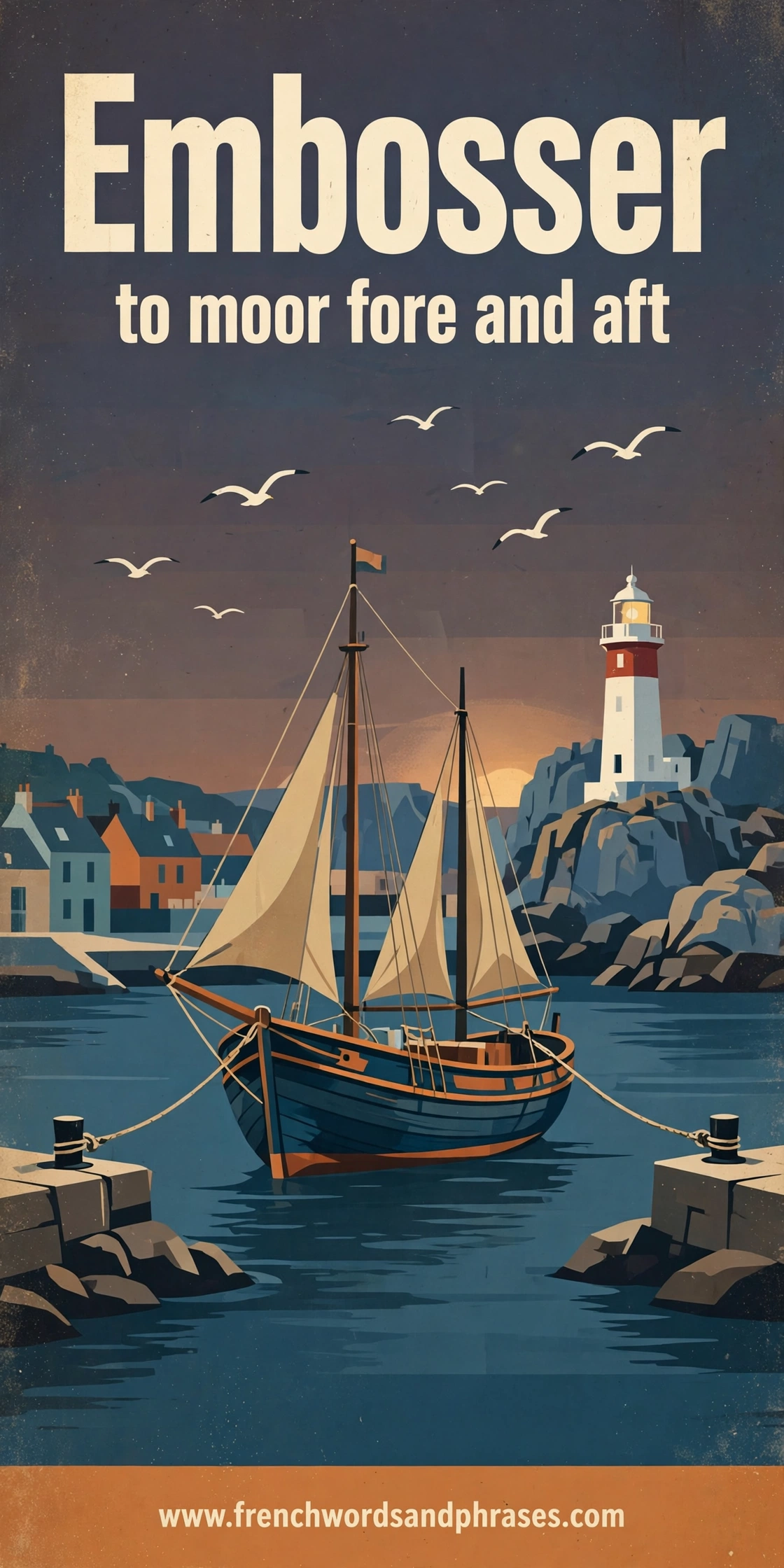
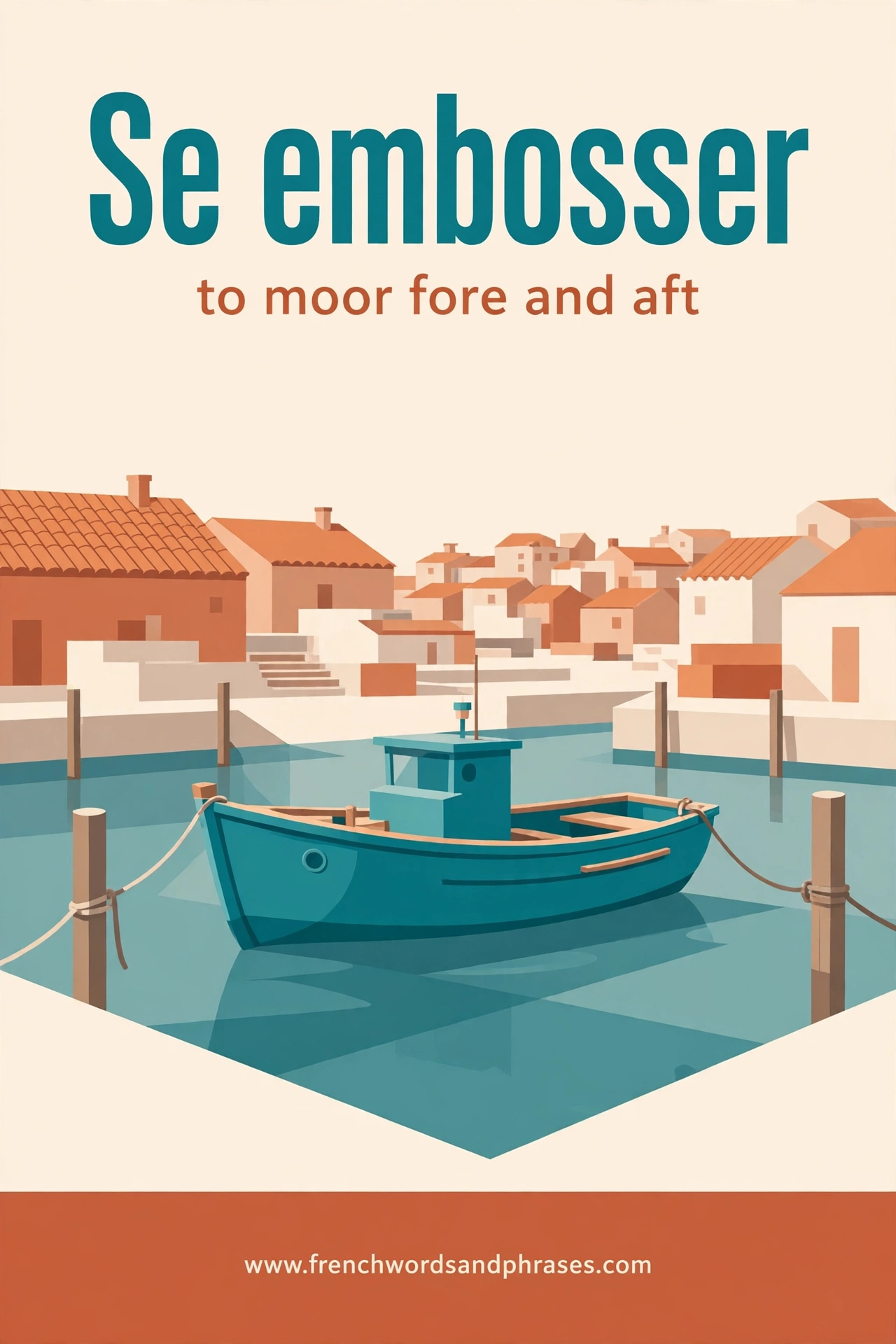
Se embosser means to moor fore and aft — a ship taking up her fixed position, anchored at bow and stern, and settling into stillness.
The manoeuvre is over: anchors down ahead and astern, cables taut, the great hull easing into line with the wind and then stopping — se embosser is the reflexive, nautical verb for a ship mooring herself fore and aft, told from the ship’s side of the story.
In this guide, you’ll learn how to conjugate se embosser in all the major French tenses and moods. Explore complete conjugation tables, French examples, English translations, and practice quizzes.
Understanding the French Verb Se embosser
Se embosser is a regular French verb belonging to the first group of verbs, those ending in-er.
It means to moor fore and aft. It is used of warships settling in a roadstead, trawlers in a harbour and sailing boats between buoys — always of the vessel herself, and always with the fore-and-aft picture: two anchors, a fixed heading, no swinging.
Verb classification: First group (-er), reflexive
Auxiliary verb: Être
Past participle: embossé
Present participle: embossant
English equivalents: To moor fore and aft (of a ship); le navire s’embosse — the ship moors fore and aft, takes up her mooring; se embosser face au vent — to moor fore and aft facing the wind; se embosser entre deux bouées — to moor between two buoys. Nautical vocabulary.
One important detail: se embosser is the same mooring as embosser, seen from the ship instead of the crew — le capitaine embosse le navire, but le navire s’embosse. It lives in nautical writing, logbooks and seamanship manuals; in the marina, people more often say s’amarrer for everyday tying-up. Being reflexive, it takes être and the participle agrees: la barque s’est embossée, les voiliers se sont embossés. The verb underneath is a plain regular -er: il s’embosse, nous nous embossons.
Experience the Word
Se embosser is the verb of the ship coming to rest — the slow end of the manoeuvre, when movement gives way to stillness.
Imagine a three-master entering a foreign roadstead at dusk. Boats row out the stern anchor, the bow anchor is already down, and for a few minutes the great ship drifts, turns a fraction, sighs against her cables — puis elle s’embosse, straight and motionless, while the lights of the port come on around her.
The voyage is over, the wandering done. She has moored — embossée, fore and aft, for the night.
How to Conjugate Se embosser: Complete French Conjugation Guide
Let’s explore every major conjugation of se embosser, beginning with the indicative mood.
How to Conjugate Se embosser in the Indicative Mood
The indicative mood is used to express facts, observations, actions, and events.
How to Conjugate Se embosser in the Present Tense (Présent)
Used for actions happening now, habitual actions, and general truths.
| Subject | Conjugation |
|---|---|
| je | m’embosse |
| tu | t’embosses |
| il / elle | s’embosse |
| nous | nous embossons |
| vous | vous embossez |
| ils / elles | s’embossent |
Example
Le voilier s’embosse tranquillement au milieu de la baie.
The yacht moors fore and aft peacefully in the middle of the bay.
Quick Quiz 1
Complete the sentence:
Les barques ______ toujours au même endroit.
Reveal the answer
s’embossent
Les barques s’embossent toujours au même endroit.
The boats always moor fore and aft at the same spot.
How to Conjugate Se embosser in the Passé Composé
Used for completed actions in the past. Se embosser takes the auxiliary verb être.
| Subject | Conjugation |
|---|---|
| je | me suis embossé / me suis embossée |
| tu | t’es embossé / t’es embossée |
| il / elle | s’est embossé / s’est embossée |
| nous | nous sommes embossés / nous sommes embossées |
| vous | vous êtes embossés / vous êtes embossées / vous êtes embossé / vous êtes embossée |
| ils / elles | se sont embossés / se sont embossées |
Example
Le navire s’est embossé face au vent avant la nuit.
The ship moored fore and aft facing the wind before nightfall.
How to Conjugate Se embosser in the Imparfait (Imperfect Tense)
Used for habitual past actions, descriptions, and ongoing situations in the past.
| Subject | Conjugation |
|---|---|
| je | m’embossais |
| tu | t’embossais |
| il / elle | s’embossait |
| nous | nous embossions |
| vous | vous embossiez |
| ils / elles | s’embossaient |
Example
Les barques s’embossaient toujours au même endroit du port.
The boats always used to moor fore and aft at the same spot in the harbour.
Quick Quiz 2
Choose the correct form:
The boat moored safely.
La barque ______. (s’est embossée / a embossé)
Reveal the answer
s’est embossée
La barque s’est embossée.
Se embosser is reflexive, takes être, and the participle agrees: embossée.
How to Conjugate Se embosser in the Plus-que-parfait
Used to describe an action that had already been completed before another past event.
| Subject | Conjugation |
|---|---|
| je | m’étais embossé / m’étais embossée |
| tu | t’étais embossé / t’étais embossée |
| il / elle | s’était embossé / s’était embossée |
| nous | nous étions embossés / nous étions embossées |
| vous | vous étiez embossés / vous étiez embossées / vous étiez embossé / vous étiez embossée |
| ils / elles | s’étaient embossés / s’étaient embossées |
Example
Le chalutier s’était embossé bien avant l’arrivée de la tempête.
The trawler had moored fore and aft well before the storm arrived.
How to Conjugate Se embosser in the Passé Simple
Primarily used in formal writing, literature, and historical narratives. It is rarely used in everyday conversation.
| Subject | Conjugation |
|---|---|
| je | m’embossai |
| tu | t’embossas |
| il / elle | s’embossa |
| nous | nous embossâmes |
| vous | vous embossâtes |
| ils / elles | s’embossèrent |
Example
La frégate s’embossa lentement au centre de la rade.
The frigate slowly moored fore and aft in the centre of the roadstead.
How to Conjugate Se embosser in the Passé Antérieur
A literary tense used to express an action completed immediately before another past action, generally in the passé simple.
| Subject | Conjugation |
|---|---|
| je | me fus embossé / me fus embossée |
| tu | te fus embossé / te fus embossée |
| il / elle | se fut embossé / se fut embossée |
| nous | nous fûmes embossés / nous fûmes embossées |
| vous | vous fûtes embossés / vous fûtes embossées / vous fûtes embossé / vous fûtes embossée |
| ils / elles | se furent embossés / se furent embossées |
Example
Dès que le navire se fut embossé, l’équipage descendit à terre.
As soon as the ship had moored fore and aft, the crew went ashore.
How to Conjugate Se embosser in the Future Tense (Futur Simple)
Used to describe actions that will take place in the future.
| Subject | Conjugation |
|---|---|
| je | m’embosserai |
| tu | t’embosseras |
| il / elle | s’embossera |
| nous | nous embosserons |
| vous | vous embosserez |
| ils / elles | s’embosseront |
Example
Le bateau s’embossera près de la jetée, face au vent.
The boat will moor fore and aft near the jetty, facing the wind.
How to Conjugate Se embosser in the Futur Antérieur (Future Perfect)
Used for an action that will have been completed before a particular point in the future.
| Subject | Conjugation |
|---|---|
| je | me serai embossé / me serai embossée |
| tu | te seras embossé / te seras embossée |
| il / elle | se sera embossé / se sera embossée |
| nous | nous serons embossés / nous serons embossées |
| vous | vous serez embossés / vous serez embossées / vous serez embossé / vous serez embossée |
| ils / elles | se seront embossés / se seront embossées |
Example
À la nuit tombée, tous les voiliers se seront embossés dans la baie.
By nightfall, all the yachts will have moored fore and aft in the bay.
How to Conjugate Se embosser in the Near Future (Futur Proche)
Used to describe something that is going to happen soon. Formed with aller + infinitive.
| Subject | Conjugation |
|---|---|
| je | vais m’embosser |
| tu | vas t’embosser |
| il / elle | va s’embosser |
| nous | allons nous embosser |
| vous | allez vous embosser |
| ils / elles | vont s’embosser |
Example
Le trois-mâts va s’embosser devant le port, regarde.
The three-master is going to moor fore and aft in front of the port, look.
How to Conjugate Se embosser in the Conditional Mood
The conditional mood expresses what would happen under certain circumstances. It is also frequently used to make polite requests or express wishes.
How to Conjugate Se embosser in the Present Conditional
| Subject | Conjugation |
|---|---|
| je | m’embosserais |
| tu | t’embosserais |
| il / elle | s’embosserait |
| nous | nous embosserions |
| vous | vous embosseriez |
| ils / elles | s’embosseraient |
Example
Sans ce courant, le navire s’embosserait beaucoup plus facilement.
Without that current, the ship would moor fore and aft much more easily.
How to Conjugate Se embosser in the Past Conditional
| Subject | Conjugation |
|---|---|
| je | me serais embossé / me serais embossée |
| tu | te serais embossé / te serais embossée |
| il / elle | se serait embossé / se serait embossée |
| nous | nous serions embossés / nous serions embossées |
| vous | vous seriez embossés / vous seriez embossées / vous seriez embossé / vous seriez embossée |
| ils / elles | se seraient embossés / se seraient embossées |
Example
La barque se serait embossée ici même sans ce rocher.
The boat would have moored fore and aft right here without that rock.
Se embosser in the Literary Past Conditional Form
This less common literary form uses the imperfect subjunctive of être.
| Subject | Conjugation |
|---|---|
| je | me fusse embossé / me fusse embossée |
| tu | te fusses embossé / te fusses embossée |
| il / elle | se fût embossé / se fût embossée |
| nous | nous fussions embossés / nous fussions embossées |
| vous | vous fussiez embossés / vous fussiez embossées / vous fussiez embossé / vous fussiez embossée |
| ils / elles | se fussent embossés / se fussent embossées |
Example
Le vaisseau se fût embossé au centre du bassin.
The vessel would have moored fore and aft in the centre of the basin.
How to Conjugate Se embosser in the Subjunctive Mood
The subjunctive is used to express wishes, emotions, doubts, necessity, and uncertainty. It frequently follows expressions such as il faut que (it is necessary that) or bien que (although).
How to Conjugate Se embosser in the Present Subjunctive
| Subject | Conjugation |
|---|---|
| que je | m’embosse |
| que tu | t’embosses |
| qu’il / qu’elle | s’embosse |
| que nous | nous embossions |
| que vous | vous embossiez |
| qu’ils / qu’elles | s’embossent |
Example
Il faut que le voilier s’embosse avant la tempête.
The yacht must moor fore and aft before the storm.
Quick Quiz 3
Complete the sentence using the subjunctive:
Il faut que le navire ______ face au vent.
Reveal the answer
s’embosse
Il faut que le navire s’embosse face au vent.
The ship must moor fore and aft facing the wind.
How to Conjugate Se embosser in the Imperfect Subjunctive
A literary tense, rarely encountered in modern spoken French.
| Subject | Conjugation |
|---|---|
| que je | m’embossasse |
| que tu | t’embossasses |
| qu’il / qu’elle | s’embossât |
| que nous | nous embossassions |
| que vous | vous embossassiez |
| qu’ils / qu’elles | s’embossassent |
Example
Le capitaine voulait que le navire s’embossât face au vent.
The captain wanted the ship to moor fore and aft facing the wind.
How to Conjugate Se embosser in the Pluperfect Subjunctive
A literary construction used to express an action completed before another past action.
| Subject | Conjugation |
|---|---|
| que je | me fusse embossé / me fusse embossée |
| que tu | te fusses embossé / te fusses embossée |
| qu’il / qu’elle | se fût embossé / se fût embossée |
| que nous | nous fussions embossés / nous fussions embossées |
| que vous | vous fussiez embossés / vous fussiez embossées / vous fussiez embossé / vous fussiez embossée |
| qu’ils / qu’elles | se fussent embossés / se fussent embossées |
Example
On disait que la frégate se fût embossée dès la veille au soir.
People said the frigate had moored fore and aft the evening before.
How to Conjugate Se embosser in the Past Subjunctive
| Subject | Conjugation |
|---|---|
| que je | me sois embossé / me sois embossée |
| que tu | te sois embossé / te sois embossée |
| qu’il / qu’elle | se soit embossé / se soit embossée |
| que nous | nous soyons embossés / nous soyons embossées |
| que vous | vous soyez embossés / vous soyez embossées / vous soyez embossé / vous soyez embossée |
| qu’ils / qu’elles | se soient embossés / se soient embossées |
Example
Je suis content que le bateau se soit embossé en sécurité.
I am glad the boat moored fore and aft safely.
How to Conjugate Se embosser in the Imperative
The imperative is used to give commands, instructions, invitations, or suggestions. Subject pronouns are omitted.
How to Conjugate Se embosser in the Present Imperative
| Person | Conjugation |
|---|---|
| (tu) | embosse-toi |
| (nous) | embossons-nous |
| (vous) | embossez-vous |
Example
Embosse-toi là, mon vieux bateau, et tiens bon toute la nuit !
Moor yourself fore and aft there, my old boat, and hold fast all night!
Quick Quiz 4
How would you say Moor yourself there and hold fast (tu form)?
Reveal the answer
Embosse-toi là et tiens bon !
French Participles of Se embosser
Participles are verb forms that can be used in compound tenses and other grammatical constructions.
Present Participle of Se embosser
embossant
En s’embossant, le navire cesse de tourner sur son ancre.
By mooring fore and aft, the ship stops swinging round her anchor.
Past Participle of Se embosser
embossé
Embossée entre deux bouées, la barque dormait sur l’eau calme.
Moored fore and aft between two buoys, the boat slept on the calm water.
Se embosser in Everyday French: Real-Life Examples
Now that you know the conjugations, let’s see how se embosser appears in everyday French.
Example 1 — Present
Le voilier s’embosse au milieu de la baie.
The yacht moors fore and aft in the middle of the bay.
Example 2 — Passé composé
Le navire s’est embossé face au vent.
The ship moored fore and aft facing the wind.
Example 3 — Imparfait
Les barques s’embossaient au même endroit.
The boats used to moor fore and aft at the same spot.
Example 4 — Future
Le bateau s’embossera près de la jetée.
The boat will moor fore and aft near the jetty.
Example 5 — Conditional
Le navire s’embosserait mieux sans ce courant.
The ship would moor better without that current.
Example 6 — Imperative
Embosse-toi là et tiens bon !
Moor yourself fore and aft there and hold fast!
Beyond Translation: The Meaning of Se embosser
English keeps the crew in charge — they moored her fore and aft; French se embosser hands the verb to the ship herself, and the harbour scene changes completely.
The ship arrives, settles, and sleeps.
It is the same tender grammar French uses for sunsets and seasons — le jour se lève, la nuit tombe — the world doing things in its own person. A logbook that writes le navire s’est embossé à dix-huit heures is not being poetic; it is being precise about who, in the end, lies still.
How to Remember the French Verb Se embosser
Remember it this way: Se embosser is about the frigate at dusk, settling straight and still between her two anchors.
- The ship is the subject: le navire s’embosse — the crew disappears from the sentence.
- Reflexive, so être and agreement: la barque s’est embossée, les voiliers se sont embossés.
- Regular -er underneath: il s’embosse, nous nous embossons, past participle embossé.
The key idea is the frigate at dusk, settling straight and still between her two anchors.
Test Your Knowledge of Se embosser
Let’s see how much you’ve learned. Try answering these questions before revealing the answers.
Question 1
What changes between embosser and se embosser?
Reveal the answer
The point of view — le capitaine embosse le navire (the crew moors her), but le navire s’embosse (the ship moors, takes up her position).
Question 2
How do you say The yacht moors in the middle of the bay in French?
Reveal the answer
Le voilier s’embosse au milieu de la baie.
Question 3
Translate: The ship moored facing the wind.
Reveal the answer
Le navire s’est embossé face au vent.
Question 4
What is the past participle of se embosser?
Reveal the answer
Embossé — agreeing: embossée, embossés, embossées.
Question 5
Complete the sentence:
Il faut que le voilier ______ avant la tempête.
Reveal the answer
s’embosse
Il faut que le voilier s’embosse avant la tempête.
The yacht must moor fore and aft before the storm.
Your Final Challenge
Can You Use It?
How would you say this in French?
The ship moors fore and aft facing the wind, and the roadstead becomes a room to sleep in.
Reveal the answer
Le navire s’embosse face au vent, et la rade devient une chambre où dormir.
The ship moors fore and aft facing the wind, and the roadstead becomes a room to sleep in.
A little French. A little curiosity. A richer everyday life.
LEARN FRENCH ONE WORD AT A TIME