A French Word to Live By
How to Conjugate Embastionner in French
/ɑ̃.bas.tjɔ.ne/
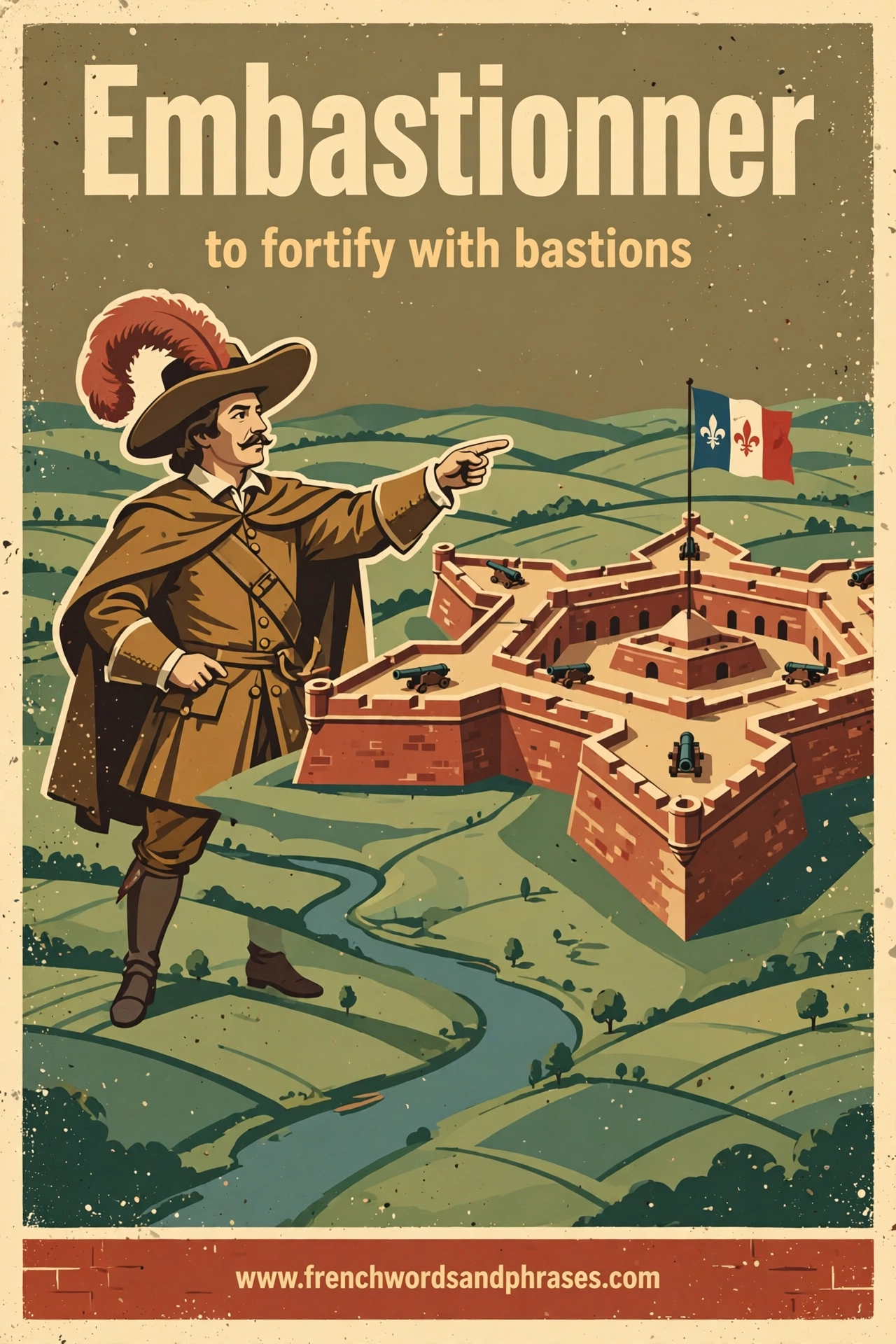
Embastionner means to fortify with bastions — to ring a town or citadel with the great angled strongpoints of old siege warfare.
Vauban’s star-shaped citadels on the French frontier, their walls zigzagging so that no attacker could hide from the guns — to build those jutting bastions into a fortress wall was to embastionner it, the military engineer’s verb of the age of sieges.
In this guide, you’ll learn how to conjugate embastionner in all the major French tenses and moods. Explore complete conjugation tables, French examples, English translations, and practice quizzes.
Understanding the French Verb Embastionner
Embastionner is a regular French verb belonging to the first group of verbs, those ending in-er.
It means to fortify with bastions. It is a rare, specialised verb: historians use it for the great age of fortress-building, when towns across Europe were ringed with bastioned walls designed to resist artillery. The everyday French for strengthening defences is fortifier or renforcer — embastionner names the very specific act of adding bastions.
Verb classification: First group (-er)
Auxiliary verb: Avoir
Past participle: embastionné
Present participle: embastionnant
English equivalents: To fortify with bastions; embastionner une citadelle — to ring a citadel with bastions; embastionner une place forte — to bastion a stronghold; une enceinte embastionnée — a bastioned rampart; un bastion — a bastion.
One important detail: embastionner is built directly on the noun un bastion, a bastion — the angled strongpoint that juts out of a fortress wall so defenders can fire along the ditch. The verb is a perfectly regular -er verb: j’embastionne, nous embastionnons, past participle embastionné. It belongs to the technical language of military engineering and history; outside descriptions of Vauban’s fortresses and the sieges of the seventeenth and eighteenth centuries, you will rarely meet it.
Experience the Word
Embastionner is the verb of the siege age — the moment a plain wall becomes a star of stone and gunfire.
Imagine Vauban unrolling his plans before the king: a frontier town drawn as a perfect star, each point a bastion watching the next. The masons will embastionner the old medieval wall, and when they finish, no enemy will find a single blind corner in which to shelter.
The town has not just been walled. It has been bastioned — embastionnée, point by point, like a star.
How to Conjugate Embastionner: Complete French Conjugation Guide
Let’s explore every major conjugation of embastionner, beginning with the indicative mood.
How to Conjugate Embastionner in the Indicative Mood
The indicative mood is used to express facts, observations, actions, and events.
How to Conjugate Embastionner in the Present Tense (Présent)
Used for actions happening now, habitual actions, and general truths.
| Subject | Conjugation |
|---|---|
| je | embastionne |
| tu | embastionnes |
| il / elle | embastionne |
| nous | embastionnons |
| vous | embastionnez |
| ils / elles | embastionnent |
Example
Les ingénieurs embastionnent la citadelle du côté de la mer.
The engineers are fortifying the citadel with bastions on the seaward side.
Quick Quiz 1
Complete the sentence:
Nous ______ la citadelle du côté de la mer.
Reveal the answer
embastionnons
Nous embastionnons la citadelle du côté de la mer.
We are fortifying the citadel with bastions on the seaward side.
How to Conjugate Embastionner in the Passé Composé
Used for completed actions in the past. Embastionner takes the auxiliary verb avoir.
| Subject | Conjugation |
|---|---|
| j’ | ai embastionné |
| tu | as embastionné |
| il / elle | a embastionné |
| nous | avons embastionné |
| vous | avez embastionné |
| ils / elles | ont embastionné |
Example
Vauban a embastionné les places fortes de la frontière du nord.
Vauban fortified the strongholds of the northern frontier with bastions.
How to Conjugate Embastionner in the Imparfait (Imperfect Tense)
Used for habitual past actions, descriptions, and ongoing situations in the past.
| Subject | Conjugation |
|---|---|
| je | embastionnais |
| tu | embastionnais |
| il / elle | embastionnait |
| nous | embastionnions |
| vous | embastionniez |
| ils / elles | embastionnaient |
Example
Au dix-septième siècle, on embastionnait toutes les villes exposées aux invasions.
In the seventeenth century, every town exposed to invasion was being ringed with bastions.
Quick Quiz 2
Choose the correct form:
Vauban fortified the town with bastions.
Vauban ______ la ville. (a embastionné / est embastionné)
Reveal the answer
a embastionné
Vauban a embastionné la ville.
Embastionner takes avoir.
How to Conjugate Embastionner in the Plus-que-parfait
Used to describe an action that had already been completed before another past event.
| Subject | Conjugation |
|---|---|
| j’ | avais embastionné |
| tu | avais embastionné |
| il / elle | avait embastionné |
| nous | avions embastionné |
| vous | aviez embastionné |
| ils / elles | avaient embastionné |
Example
Les Espagnols avaient embastionné le port avant l’arrivée de la flotte française.
The Spanish had bastioned the harbour before the French fleet arrived.
How to Conjugate Embastionner in the Passé Simple
Primarily used in formal writing, literature, and historical narratives. It is rarely used in everyday conversation.
| Subject | Conjugation |
|---|---|
| je | embastionnai |
| tu | embastionnas |
| il / elle | embastionna |
| nous | embastionnâmes |
| vous | embastionnâtes |
| ils / elles | embastionnèrent |
Example
Le roi embastionna la ville et y plaça une garnison.
The king fortified the town with bastions and placed a garrison there.
How to Conjugate Embastionner in the Passé Antérieur
A literary tense used to express an action completed immediately before another past action, generally in the passé simple.
| Subject | Conjugation |
|---|---|
| j’ | eus embastionné |
| tu | eus embastionné |
| il / elle | eut embastionné |
| nous | eûmes embastionné |
| vous | eûtes embastionné |
| ils / elles | eurent embastionné |
Example
Dès que les maçons eurent embastionné l’enceinte, l’armée se retira.
As soon as the masons had bastioned the rampart, the army withdrew.
How to Conjugate Embastionner in the Future Tense (Futur Simple)
Used to describe actions that will take place in the future.
| Subject | Conjugation |
|---|---|
| je | embastionnerai |
| tu | embastionneras |
| il / elle | embastionnera |
| nous | embastionnerons |
| vous | embastionnerez |
| ils / elles | embastionneront |
Example
L’architecte embastionnera les quatre angles de la forteresse.
The architect will fortify the four corners of the fortress with bastions.
How to Conjugate Embastionner in the Futur Antérieur (Future Perfect)
Used for an action that will have been completed before a particular point in the future.
| Subject | Conjugation |
|---|---|
| j’ | aurai embastionné |
| tu | auras embastionné |
| il / elle | aura embastionné |
| nous | aurons embastionné |
| vous | aurez embastionné |
| ils / elles | auront embastionné |
Example
À l’automne, les ouvriers auront embastionné tout le front de mer.
By autumn, the workmen will have bastioned the whole seafront.
How to Conjugate Embastionner in the Near Future (Futur Proche)
Used to describe something that is going to happen soon. Formed with aller + infinitive.
| Subject | Conjugation |
|---|---|
| je | vais embastionner |
| tu | vas embastionner |
| il / elle | va embastionner |
| nous | allons embastionner |
| vous | allez embastionner |
| ils / elles | vont embastionner |
Example
On va embastionner la vieille citadelle pour le film historique.
They are going to add bastions to the old citadel for the historical film.
How to Conjugate Embastionner in the Conditional Mood
The conditional mood expresses what would happen under certain circumstances. It is also frequently used to make polite requests or express wishes.
How to Conjugate Embastionner in the Present Conditional
| Subject | Conjugation |
|---|---|
| je | embastionnerais |
| tu | embastionnerais |
| il / elle | embastionnerait |
| nous | embastionnerions |
| vous | embastionneriez |
| ils / elles | embastionneraient |
Example
Avec plus de crédits, le gouverneur embastionnerait aussi le port.
With more funding, the governor would bastion the harbour as well.
How to Conjugate Embastionner in the Past Conditional
| Subject | Conjugation |
|---|---|
| j’ | aurais embastionné |
| tu | aurais embastionné |
| il / elle | aurait embastionné |
| nous | aurions embastionné |
| vous | auriez embastionné |
| ils / elles | auraient embastionné |
Example
Ils auraient embastionné la place si la guerre n’avait pas éclaté.
They would have bastioned the stronghold if war had not broken out.
Embastionner in the Literary Past Conditional Form
This less common literary form uses the imperfect subjunctive of avoir.
| Subject | Conjugation |
|---|---|
| j’ | eusse embastionné |
| tu | eusses embastionné |
| il / elle | eût embastionné |
| nous | eussions embastionné |
| vous | eussiez embastionné |
| ils / elles | eussent embastionné |
Example
Le ministre eût embastionné toutes les frontières du royaume.
The minister would have bastioned all the frontiers of the kingdom.
How to Conjugate Embastionner in the Subjunctive Mood
The subjunctive is used to express wishes, emotions, doubts, necessity, and uncertainty. It frequently follows expressions such as il faut que (it is necessary that) or bien que (although).
How to Conjugate Embastionner in the Present Subjunctive
| Subject | Conjugation |
|---|---|
| que je | embastionne |
| que tu | embastionnes |
| qu’il / qu’elle | embastionne |
| que nous | embastionnions |
| que vous | embastionniez |
| qu’ils / qu’elles | embastionnent |
Example
Il faut que l’on embastionne ce front avant l’hiver.
This front must be fortified with bastions before winter.
Quick Quiz 3
Complete the sentence using the subjunctive:
Il faut que vous ______ l’angle nord.
Reveal the answer
embastionniez
Il faut que vous embastionniez l’angle nord.
You must bastion the north corner.
How to Conjugate Embastionner in the Imperfect Subjunctive
A literary tense, rarely encountered in modern spoken French.
| Subject | Conjugation |
|---|---|
| que je | embastionnasse |
| que tu | embastionnasses |
| qu’il / qu’elle | embastionnât |
| que nous | embastionnassions |
| que vous | embastionnassiez |
| qu’ils / qu’elles | embastionnassent |
Example
Le roi exigeait que l’ingénieur embastionnât la ville en deux ans.
The king demanded that the engineer bastion the town within two years.
How to Conjugate Embastionner in the Pluperfect Subjunctive
A literary construction used to express an action completed before another past action.
| Subject | Conjugation |
|---|---|
| que j’ | eusse embastionné |
| que tu | eusses embastionné |
| qu’il / qu’elle | eût embastionné |
| que nous | eussions embastionné |
| que vous | eussiez embastionné |
| qu’ils / qu’elles | eussent embastionné |
Example
On racontait que les Vénitiens eussent embastionné l’île dès le siècle précédent.
It was said that the Venetians had bastioned the island as early as the previous century.
How to Conjugate Embastionner in the Past Subjunctive
| Subject | Conjugation |
|---|---|
| que j’ | aie embastionné |
| que tu | aies embastionné |
| qu’il / qu’elle | ait embastionné |
| que nous | ayons embastionné |
| que vous | ayez embastionné |
| qu’ils / qu’elles | aient embastionné |
Example
Je suis surpris que l’on ait embastionné une si petite place.
I am surprised that such a small stronghold was fortified with bastions.
How to Conjugate Embastionner in the Imperative
The imperative is used to give commands, instructions, invitations, or suggestions. Subject pronouns are omitted.
How to Conjugate Embastionner in the Present Imperative
| Person | Conjugation |
|---|---|
| (tu) | embastionne |
| (nous) | embastionnons |
| (vous) | embastionnez |
Example
Embastionnez d’abord l’angle nord, c’est le plus exposé !
Bastion the north corner first, it is the most exposed!
Quick Quiz 4
How would you say Bastion the north corner first (tu form)?
Reveal the answer
Embastionne l’angle nord d’abord !
French Participles of Embastionner
Participles are verb forms that can be used in compound tenses and other grammatical constructions.
Present Participle of Embastionner
embastionnant
En embastionnant la citadelle, Vauban inventa une nouvelle géométrie de la guerre.
By fortifying the citadel with bastions, Vauban invented a new geometry of war.
Past Participle of Embastionner
embastionné
Embastionnée par Vauban, la citadelle domine encore la plaine.
Fortified with bastions by Vauban, the citadel still dominates the plain.
Embastionner in Everyday French: Real-Life Examples
Now that you know the conjugations, let’s see how embastionner appears in everyday French.
Example 1 — Present
Les ingénieurs embastionnent la citadelle.
The engineers are bastioning the citadel.
Example 2 — Passé composé
Vauban a embastionné cette place forte.
Vauban fortified this stronghold with bastions.
Example 3 — Imparfait
On embastionnait les villes de la frontière.
Towns along the frontier were being ringed with bastions.
Example 4 — Future
L’architecte embastionnera les quatre angles.
The architect will bastion the four corners.
Example 5 — Conditional
Le gouverneur embastionnerait aussi le port.
The governor would bastion the harbour too.
Example 6 — Imperative
Embastionnez l’angle nord d’abord !
Bastion the north corner first!
Beyond Translation: The Meaning of Embastionner
A bastion in English is no longer just stone: a bastion of tradition, a bastion of free speech. French keeps the same figurative word — un bastion de la laïcité — but the verb embastionner stayed behind in the engineer’s workshop.
It names an act, not a metaphor.
To embastionner is to do Vauban’s work with Vauban’s tools: angled walls, overlapping fire, and not one blind corner left for the enemy.
How to Remember the French Verb Embastionner
Remember it this way: Embastionner is about Vauban’s star fortresses, bastion by bastion.
- Built on un bastion: embastionner is what Vauban did to the strongholds of France.
- A word of military history — fortresses, sieges and star-shaped walls, not everyday speech.
- Regular -er: j’embastionne, nous embastionnons, past participle embastionné.
The key idea is Vauban’s star fortresses, bastion by bastion.
Test Your Knowledge of Embastionner
Let’s see how much you’ve learned. Try answering these questions before revealing the answers.
Question 1
What is a bastion?
Reveal the answer
A strongpoint jutting out of a fortress wall — un bastion — placed so defenders can fire along the ditch.
Question 2
How do you say Vauban fortified this stronghold with bastions in French?
Reveal the answer
Vauban a embastionné cette place forte.
Question 3
Translate: The engineers are fortifying the citadel with bastions.
Reveal the answer
Les ingénieurs embastionnent la citadelle.
Question 4
What is the past participle of embastionner?
Reveal the answer
Embastionné.
Question 5
Complete the sentence:
Il faut que l’on ______ ce front avant l’hiver.
Reveal the answer
embastionne
Il faut que l’on embastionne ce front avant l’hiver.
This front must be fortified with bastions before winter.
Your Final Challenge
Can You Use It?
How would you say this in French?
Vauban bastioned the frontier, and his stars of stone still guard the northern plains.
Reveal the answer
Vauban embastionna la frontière, et ses étoiles de pierre gardent encore les plaines du nord.
Vauban bastioned the frontier, and his stars of stone still guard the northern plains.
A little French. A little curiosity. A richer everyday life.
LEARN FRENCH ONE WORD AT A TIME