A French Word to Live By
How to Conjugate Embâter in French
/ɑ̃.bɑ.te/
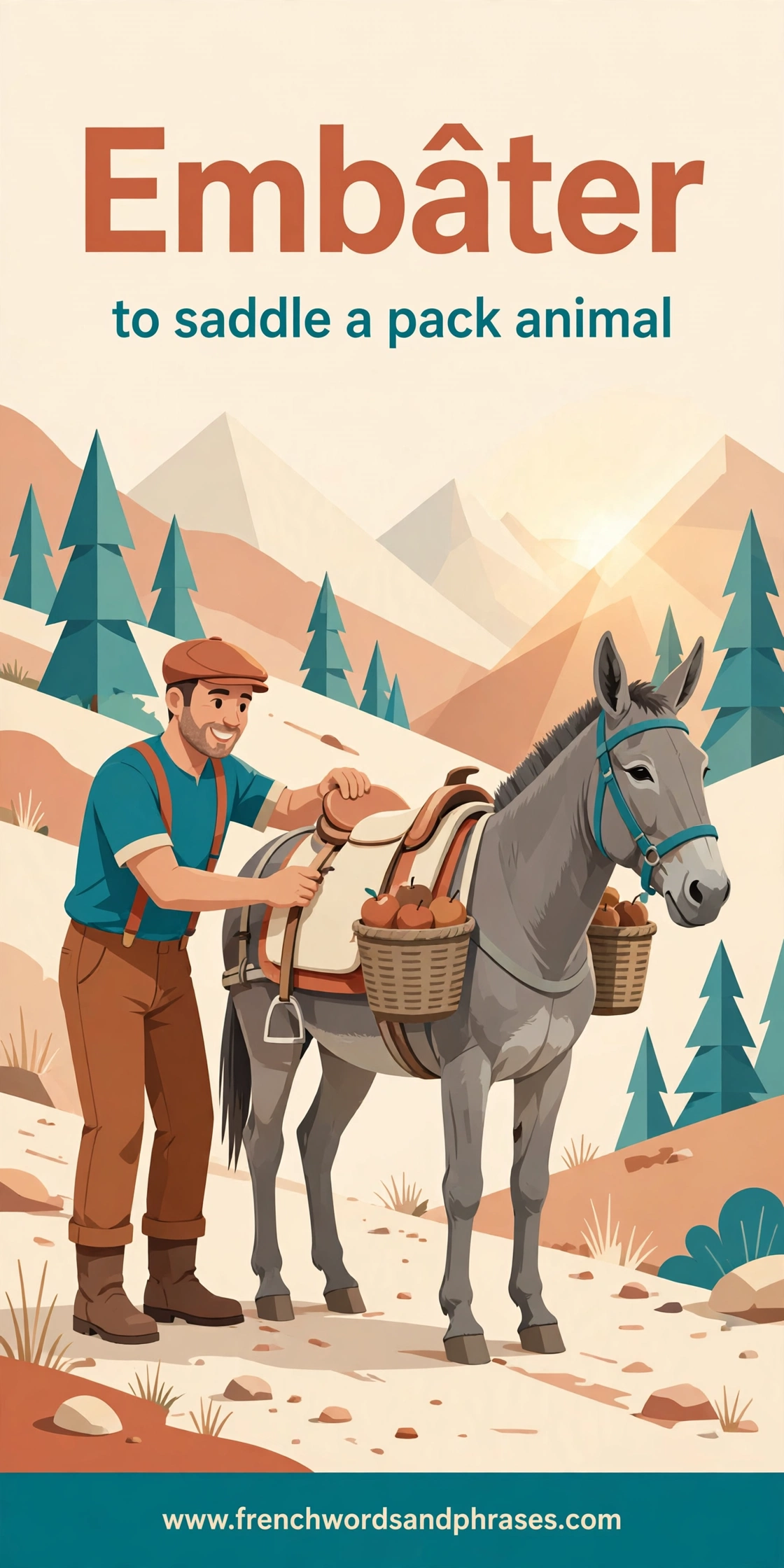
Embâter means to saddle a pack animal — to strap the wooden packsaddle onto a mule or donkey before loading it for the road.
A muleteer at dawn in a mountain inn yard, tightening the straps of the packsaddle before the salt and wine go on — embâter is the pack-train verb: fitting the bât, the wooden frame a beast of burden wears instead of a rider’s saddle.
In this guide, you’ll learn how to conjugate embâter in all the major French tenses and moods. Explore complete conjugation tables, French examples, English translations, and practice quizzes.
Understanding the French Verb Embâter
Embâter is a regular French verb belonging to the first group of verbs, those ending in-er.
It means to saddle a pack animal. It belongs to the world of muleteers, mountain paths and pack trains — the transport system of France before the lorry. Today it survives among riders and farmers who still load donkeys and mules for treks, and in the history books that describe how goods once crossed the Alps and the Pyrenees.
Verb classification: First group (-er)
Auxiliary verb: Avoir
Past participle: embâté
Present participle: embâtant
English equivalents: To saddle a pack animal, to put the packsaddle on; embâter un mulet — to packsaddle a mule; embâter un âne — to put the packsaddle on a donkey; le bât — the packsaddle; une bête de somme — a beast of burden.
One important detail: embâter wears its circumflex proudly — the â comes from its noun le bât, the wooden packsaddle, and the accent is the only thing separating this verb from its famous neighbour embêter, to annoy. Embâter un mulet is to saddle a mule; embêter un mulet would merely be to bother it. The verb itself is a regular -er: j’embâte, nous embâtons, past participle embâté.
Experience the Word
Embâter is the verb of the last minute before the mountain road — no packsaddle, no journey.
Imagine a dawn departure in the Pyrenees a century ago. The mule stands patiently while the muleteer embâte: first the blanket, then the wooden bât, then the straps pulled tight and tested twice. Only then do the sacks of salt go on, balanced left and right like the pans of a scale.
Nothing is loaded yet. But the mule has been packsaddled — embâté — and the day’s work can begin.
How to Conjugate Embâter: Complete French Conjugation Guide
Let’s explore every major conjugation of embâter, beginning with the indicative mood.
How to Conjugate Embâter in the Indicative Mood
The indicative mood is used to express facts, observations, actions, and events.
How to Conjugate Embâter in the Present Tense (Présent)
Used for actions happening now, habitual actions, and general truths.
| Subject | Conjugation |
|---|---|
| je | embâte |
| tu | embâtes |
| il / elle | embâte |
| nous | embâtons |
| vous | embâtez |
| ils / elles | embâtent |
Example
Le muletier embâte les mules avant le lever du soleil.
The muleteer puts the packsaddles on the mules before sunrise.
Quick Quiz 1
Complete the sentence:
Nous ______ les ânes avant le départ.
Reveal the answer
embâtons
Nous embâtons les ânes avant le départ.
We put the packsaddles on the donkeys before leaving.
How to Conjugate Embâter in the Passé Composé
Used for completed actions in the past. Embâter takes the auxiliary verb avoir.
| Subject | Conjugation |
|---|---|
| j’ | ai embâté |
| tu | as embâté |
| il / elle | a embâté |
| nous | avons embâté |
| vous | avez embâté |
| ils / elles | ont embâté |
Example
Il a embâté l’âne et chargé les sacs de farine.
He put the packsaddle on the donkey and loaded the sacks of flour.
How to Conjugate Embâter in the Imparfait (Imperfect Tense)
Used for habitual past actions, descriptions, and ongoing situations in the past.
| Subject | Conjugation |
|---|---|
| je | embâtais |
| tu | embâtais |
| il / elle | embâtait |
| nous | embâtions |
| vous | embâtiez |
| ils / elles | embâtaient |
Example
Chaque matin, le fermier embâtait ses deux mulets pour descendre au marché.
Every morning, the farmer used to packsaddle his two mules to go down to market.
Quick Quiz 2
Choose the correct form:
He saddled the mule.
Il ______ le mulet. (a embâté / est embâté)
Reveal the answer
a embâté
Il a embâté le mulet.
Embâter takes avoir.
How to Conjugate Embâter in the Plus-que-parfait
Used to describe an action that had already been completed before another past event.
| Subject | Conjugation |
|---|---|
| j’ | avais embâté |
| tu | avais embâté |
| il / elle | avait embâté |
| nous | avions embâté |
| vous | aviez embâté |
| ils / elles | avaient embâté |
Example
Elle avait déjà embâté les bêtes quand la pluie a commencé.
She had already saddled the pack animals when the rain began.
How to Conjugate Embâter in the Passé Simple
Primarily used in formal writing, literature, and historical narratives. It is rarely used in everyday conversation.
| Subject | Conjugation |
|---|---|
| je | embâtai |
| tu | embâtas |
| il / elle | embâta |
| nous | embâtâmes |
| vous | embâtâtes |
| ils / elles | embâtèrent |
Example
Le guide embâta les mules et le convoi se mit en route.
The guide put the packsaddles on the mules and the convoy set off.
How to Conjugate Embâter in the Passé Antérieur
A literary tense used to express an action completed immediately before another past action, generally in the passé simple.
| Subject | Conjugation |
|---|---|
| j’ | eus embâté |
| tu | eus embâté |
| il / elle | eut embâté |
| nous | eûmes embâté |
| vous | eûtes embâté |
| ils / elles | eurent embâté |
Example
Dès qu’il eut embâté le dernier mulet, il siffla le départ.
As soon as he had saddled the last mule, he whistled for departure.
How to Conjugate Embâter in the Future Tense (Futur Simple)
Used to describe actions that will take place in the future.
| Subject | Conjugation |
|---|---|
| je | embâterai |
| tu | embâteras |
| il / elle | embâtera |
| nous | embâterons |
| vous | embâterez |
| ils / elles | embâteront |
Example
Demain, nous embâterons les ânes pour monter au refuge.
Tomorrow, we will put the packsaddles on the donkeys to climb to the refuge.
How to Conjugate Embâter in the Futur Antérieur (Future Perfect)
Used for an action that will have been completed before a particular point in the future.
| Subject | Conjugation |
|---|---|
| j’ | aurai embâté |
| tu | auras embâté |
| il / elle | aura embâté |
| nous | aurons embâté |
| vous | aurez embâté |
| ils / elles | auront embâté |
Example
À sept heures, le muletier aura embâté tout le convoi.
By seven o’clock, the muleteer will have saddled the whole convoy.
How to Conjugate Embâter in the Near Future (Futur Proche)
Used to describe something that is going to happen soon. Formed with aller + infinitive.
| Subject | Conjugation |
|---|---|
| je | vais embâter |
| tu | vas embâter |
| il / elle | va embâter |
| nous | allons embâter |
| vous | allez embâter |
| ils / elles | vont embâter |
Example
Va embâter le mulet, on part dans dix minutes !
Go and saddle the mule, we leave in ten minutes!
How to Conjugate Embâter in the Conditional Mood
The conditional mood expresses what would happen under certain circumstances. It is also frequently used to make polite requests or express wishes.
How to Conjugate Embâter in the Present Conditional
| Subject | Conjugation |
|---|---|
| je | embâterais |
| tu | embâterais |
| il / elle | embâterait |
| nous | embâterions |
| vous | embâteriez |
| ils / elles | embâteraient |
Example
Avec un âne plus docile, on embâterait en cinq minutes.
With a more docile donkey, we would have the packsaddle on in five minutes.
How to Conjugate Embâter in the Past Conditional
| Subject | Conjugation |
|---|---|
| j’ | aurais embâté |
| tu | aurais embâté |
| il / elle | aurait embâté |
| nous | aurions embâté |
| vous | auriez embâté |
| ils / elles | auraient embâté |
Example
Il aurait embâté les mules plus tôt sans cette averse.
He would have saddled the mules earlier without that downpour.
Embâter in the Literary Past Conditional Form
This less common literary form uses the imperfect subjunctive of avoir.
| Subject | Conjugation |
|---|---|
| j’ | eusse embâté |
| tu | eusses embâté |
| il / elle | eût embâté |
| nous | eussions embâté |
| vous | eussiez embâté |
| ils / elles | eussent embâté |
Example
Le muletier eût embâté ses bêtes avant l’aube, comme toujours.
The muleteer would have saddled his animals before dawn, as always.
How to Conjugate Embâter in the Subjunctive Mood
The subjunctive is used to express wishes, emotions, doubts, necessity, and uncertainty. It frequently follows expressions such as il faut que (it is necessary that) or bien que (although).
How to Conjugate Embâter in the Present Subjunctive
| Subject | Conjugation |
|---|---|
| que je | embâte |
| que tu | embâtes |
| qu’il / qu’elle | embâte |
| que nous | embâtions |
| que vous | embâtiez |
| qu’ils / qu’elles | embâtent |
Example
Il faut que tu embâtes le mulet avant de charger les sacs.
You must put the packsaddle on the mule before loading the sacks.
Quick Quiz 3
Complete the sentence using the subjunctive:
Il faut que vous ______ les bêtes avant sept heures.
Reveal the answer
embâtiez
Il faut que vous embâtiez les bêtes avant sept heures.
You must saddle the animals before seven o’clock.
How to Conjugate Embâter in the Imperfect Subjunctive
A literary tense, rarely encountered in modern spoken French.
| Subject | Conjugation |
|---|---|
| que je | embâtasse |
| que tu | embâtasses |
| qu’il / qu’elle | embâtât |
| que nous | embâtassions |
| que vous | embâtassiez |
| qu’ils / qu’elles | embâtassent |
Example
Le patron voulait que l’apprenti embâtât les ânes tout seul.
The boss wanted the apprentice to saddle the donkeys all by himself.
How to Conjugate Embâter in the Pluperfect Subjunctive
A literary construction used to express an action completed before another past action.
| Subject | Conjugation |
|---|---|
| que j’ | eusse embâté |
| que tu | eusses embâté |
| qu’il / qu’elle | eût embâté |
| que nous | eussions embâté |
| que vous | eussiez embâté |
| qu’ils / qu’elles | eussent embâté |
Example
On disait que le vieux muletier eût embâté mille mules dans sa vie.
It was said that the old muleteer had saddled a thousand mules in his life.
How to Conjugate Embâter in the Past Subjunctive
| Subject | Conjugation |
|---|---|
| que j’ | aie embâté |
| que tu | aies embâté |
| qu’il / qu’elle | ait embâté |
| que nous | ayons embâté |
| que vous | ayez embâté |
| qu’ils / qu’elles | aient embâté |
Example
Je suis content que vous ayez embâté les bêtes si vite.
I am glad you saddled the animals so quickly.
How to Conjugate Embâter in the Imperative
The imperative is used to give commands, instructions, invitations, or suggestions. Subject pronouns are omitted.
How to Conjugate Embâter in the Present Imperative
| Person | Conjugation |
|---|---|
| (tu) | embâte |
| (nous) | embâtons |
| (vous) | embâtez |
Example
Embâte les mules et vérifie les sangles !
Put the packsaddles on the mules and check the straps!
Quick Quiz 4
How would you say Saddle the mule (tu form)?
Reveal the answer
Embâte le mulet !
French Participles of Embâter
Participles are verb forms that can be used in compound tenses and other grammatical constructions.
Present Participle of Embâter
embâtant
En embâtant l’âne, il vérifie toujours l’équilibre des charges.
While putting the packsaddle on the donkey, he always checks the balance of the loads.
Past Participle of Embâter
embâté
Embâtée dès l’aube, la mule attendait patiemment son chargement.
Saddled since dawn, the mule waited patiently for her load.
Embâter in Everyday French: Real-Life Examples
Now that you know the conjugations, let’s see how embâter appears in everyday French.
Example 1 — Present
Le muletier embâte les mules à l’aube.
The muleteer saddles the mules at dawn.
Example 2 — Passé composé
Il a embâté l’âne avant le départ.
He put the packsaddle on the donkey before leaving.
Example 3 — Imparfait
Le fermier embâtait ses mulets chaque matin.
The farmer used to saddle his mules every morning.
Example 4 — Future
Nous embâterons les ânes pour monter au refuge.
We will saddle the donkeys to climb to the refuge.
Example 5 — Conditional
On embâterait plus vite avec un âne docile.
We would saddle faster with a docile donkey.
Example 6 — Imperative
Embâte le mulet, on part !
Saddle the mule, we’re leaving!
Beyond Translation: The Meaning of Embâter
The noun inside the verb, le bât, gave French a famous saying: c’est là que le bât blesse — that is where the packsaddle rubs — the exact spot where things hurt or go wrong.
Embâter is the quiet first act of every pack journey.
Before the salt, the wine and the mountain pass, someone had to fit the wooden frame to the animal’s back — and a badly fitted bât, like a badly chosen word, blesses nothing and blesse everything.
How to Remember the French Verb Embâter
Remember it this way: Embâter is about the muleteer at dawn, fitting the wooden packsaddle.
- Le bât is the packsaddle; embâter is putting it on — blanket, frame, straps, in that order.
- Mind the circumflex: embâter (saddle a mule) is not embêter (to annoy).
- Regular -er: j’embâte, nous embâtons, past participle embâté.
The key idea is the muleteer at dawn, fitting the wooden packsaddle.
Test Your Knowledge of Embâter
Let’s see how much you’ve learned. Try answering these questions before revealing the answers.
Question 1
What is le bât?
Reveal the answer
The packsaddle — the wooden frame a mule or donkey wears so loads can be strapped to its back.
Question 2
How do you say He put the packsaddle on the donkey in French?
Reveal the answer
Il a embâté l’âne.
Question 3
Translate: The muleteer saddles the mules at dawn.
Reveal the answer
Le muletier embâte les mules à l’aube.
Question 4
What is the past participle of embâter?
Reveal the answer
Embâté.
Question 5
Complete the sentence:
Il faut que tu ______ le mulet avant de charger les sacs.
Reveal the answer
embâtes
Il faut que tu embâtes le mulet avant de charger les sacs.
You must put the packsaddle on the mule before loading the sacks.
Your Final Challenge
Can You Use It?
How would you say this in French?
The muleteer saddles his mules in the cold yard, and the mountain can wait for its salt.
Reveal the answer
Le muletier embâte ses mules dans la cour froide, et la montagne peut attendre son sel.
The muleteer saddles his mules in the cold yard, and the mountain can wait for its salt.
A little French. A little curiosity. A richer everyday life.
LEARN FRENCH ONE WORD AT A TIME