A French Word to Live By
How to Conjugate Embarquer in French
/ɑ̃.baʁ.ke/
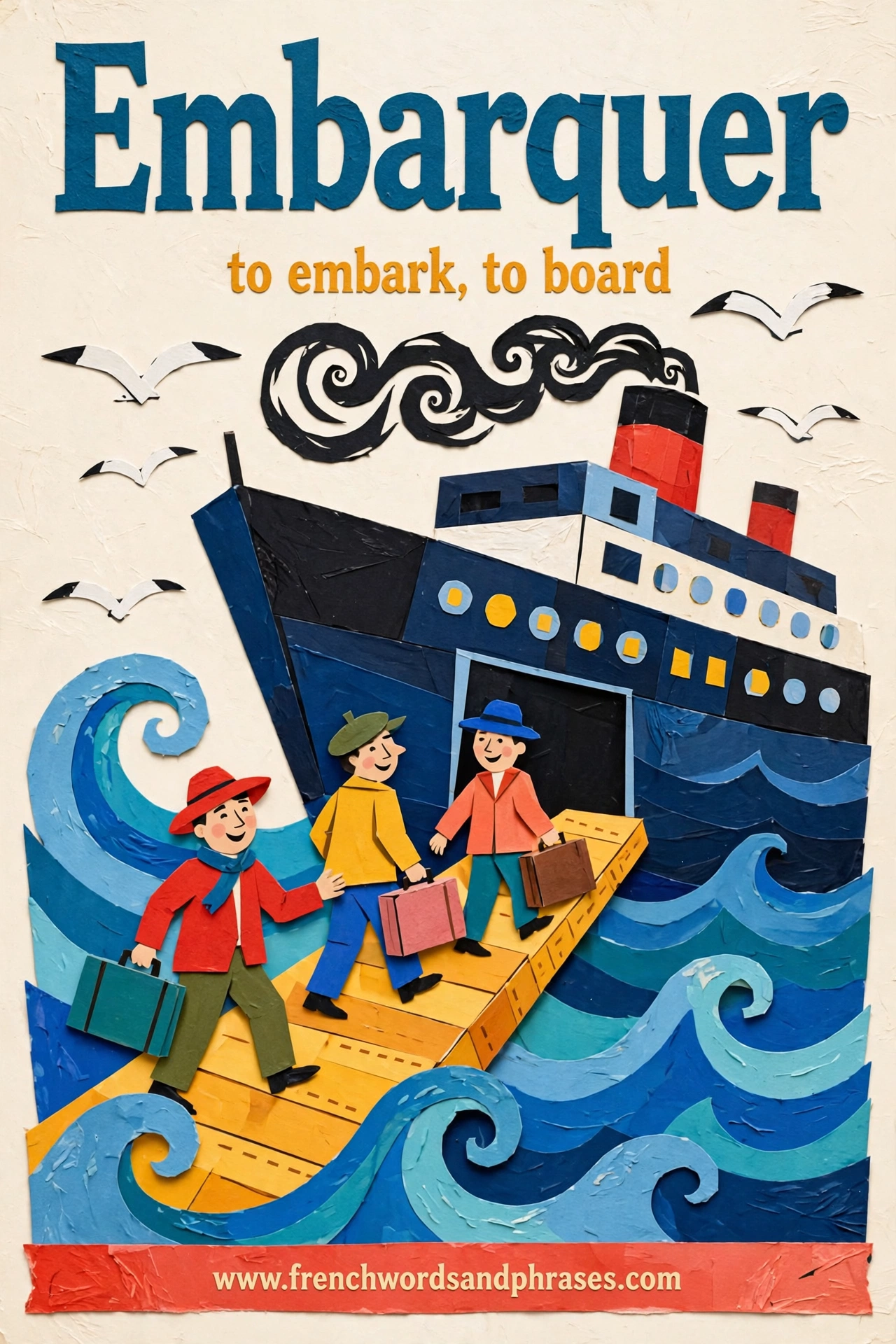
Embarquer means to embark, to board — to go on board a ship, a train or a plane, or to take goods and people on board.
A queue at the ferry gate in Marseille, suitcases rolling towards a train, troops filing up a gangway at dawn — embarquer is the verb of going aboard: the moment land ends, the journey begins, and there is no stepping back off the gangway.
In this guide, you’ll learn how to conjugate embarquer in all the major French tenses and moods. Explore complete conjugation tables, French examples, English translations, and practice quizzes.
Understanding the French Verb Embarquer
Embarquer is a regular French verb belonging to the first group of verbs, those ending in-er.
It means to embark, to board. It is the standard verb for boarding ships, ferries, trains and planes — embarquer is what the announcement calls passengers to do — and, from the crew’s side, for loading cargo, water and supplies. Figuratively, one can be embarqué in an affair, swept along into something, which is exactly the bridge to its reflexive twin.
Verb classification: First group (-er)
Auxiliary verb: Avoir
Past participle: embarqué
Present participle: embarquant
English equivalents: To embark, to board, to go on board; embarquer à bord d’un navire — to embark on a ship; embarquer des marchandises — to load goods on board; embarquer des passagers — to take passengers on board; l’embarquement — boarding; embarquer pour Marseille — to sail for Marseille.
One important detail: embarquer works in both directions — passengers embarquent (they board), and the ship or the crew embarque them, along with water, provisions and cargo: le navire a embarqué huit cents passagers et vingt tonnes de vivres. Watch the spelling of the stem: the qu never changes, j’embarque, nous embarquons, in every tense. In familiar language it also means to take someone along or make off with something: on l’a embarqué au poste — they took him off to the station.
Experience the Word
Embarquer is the verb of the gangway — one foot on land, one foot on the ship, and the whole journey hanging in that step.
Imagine the ferry terminal at dawn. The loudspeaker crackles, the queue shuffles forward with its suitcases and dogs and bicycles, and one by one the travellers embarquent — up the ramp, across the little iron bridge, into the white ship that will carry them over the water before breakfast.
The port is already behind them. They have embarked — embarqué, aboard, committed to the crossing.
How to Conjugate Embarquer: Complete French Conjugation Guide
Let’s explore every major conjugation of embarquer, beginning with the indicative mood.
How to Conjugate Embarquer in the Indicative Mood
The indicative mood is used to express facts, observations, actions, and events.
How to Conjugate Embarquer in the Present Tense (Présent)
Used for actions happening now, habitual actions, and general truths.
| Subject | Conjugation |
|---|---|
| je | embarque |
| tu | embarques |
| il / elle | embarque |
| nous | embarquons |
| vous | embarquez |
| ils / elles | embarquent |
Example
Les passagers embarquent par la porte avant.
The passengers are boarding through the front gate.
Quick Quiz 1
Complete the sentence:
Nous ______ à Marseille à l’aube.
Reveal the answer
embarquons
Nous embarquons à Marseille à l’aube.
We are embarking at Marseille at dawn.
How to Conjugate Embarquer in the Passé Composé
Used for completed actions in the past. Embarquer takes the auxiliary verb avoir.
| Subject | Conjugation |
|---|---|
| j’ | ai embarqué |
| tu | as embarqué |
| il / elle | a embarqué |
| nous | avons embarqué |
| vous | avez embarqué |
| ils / elles | ont embarqué |
Example
Nous avons embarqué à Marseille à l’aube.
We embarked at Marseille at dawn.
How to Conjugate Embarquer in the Imparfait (Imperfect Tense)
Used for habitual past actions, descriptions, and ongoing situations in the past.
| Subject | Conjugation |
|---|---|
| je | embarquais |
| tu | embarquais |
| il / elle | embarquait |
| nous | embarquions |
| vous | embarquiez |
| ils / elles | embarquaient |
Example
Chaque été, ils embarquaient pour la Corse.
Every summer, they used to sail for Corsica.
Quick Quiz 2
Choose the correct form:
The ship took on eight hundred passengers.
Le navire ______ huit cents passagers. (a embarqué / est embarqué)
Reveal the answer
a embarqué
Le navire a embarqué huit cents passagers.
Embarquer takes avoir.
How to Conjugate Embarquer in the Plus-que-parfait
Used to describe an action that had already been completed before another past event.
| Subject | Conjugation |
|---|---|
| j’ | avais embarqué |
| tu | avais embarqué |
| il / elle | avait embarqué |
| nous | avions embarqué |
| vous | aviez embarqué |
| ils / elles | avaient embarqué |
Example
Le capitaine avait embarqué des vivres pour un mois.
The captain had taken on a month’s supplies.
How to Conjugate Embarquer in the Passé Simple
Primarily used in formal writing, literature, and historical narratives. It is rarely used in everyday conversation.
| Subject | Conjugation |
|---|---|
| je | embarquai |
| tu | embarquas |
| il / elle | embarqua |
| nous | embarquâmes |
| vous | embarquâtes |
| ils / elles | embarquèrent |
Example
Le navire embarqua huit cents passagers.
The ship took on eight hundred passengers.
How to Conjugate Embarquer in the Passé Antérieur
A literary tense used to express an action completed immediately before another past action, generally in the passé simple.
| Subject | Conjugation |
|---|---|
| j’ | eus embarqué |
| tu | eus embarqué |
| il / elle | eut embarqué |
| nous | eûmes embarqué |
| vous | eûtes embarqué |
| ils / elles | eurent embarqué |
Example
Quand le ferry eut embarqué les voitures, on leva la passerelle.
When the ferry had loaded the cars, the ramp was raised.
How to Conjugate Embarquer in the Future Tense (Futur Simple)
Used to describe actions that will take place in the future.
| Subject | Conjugation |
|---|---|
| je | embarquerai |
| tu | embarqueras |
| il / elle | embarquera |
| nous | embarquerons |
| vous | embarquerez |
| ils / elles | embarqueront |
Example
Vous embarquerez à vingt heures précises.
You will board at eight o’clock sharp.
How to Conjugate Embarquer in the Futur Antérieur (Future Perfect)
Used for an action that will have been completed before a particular point in the future.
| Subject | Conjugation |
|---|---|
| j’ | aurai embarqué |
| tu | auras embarqué |
| il / elle | aura embarqué |
| nous | aurons embarqué |
| vous | aurez embarqué |
| ils / elles | auront embarqué |
Example
À minuit, l’avion aura embarqué tous ses passagers.
By midnight, the plane will have boarded all its passengers.
How to Conjugate Embarquer in the Near Future (Futur Proche)
Used to describe something that is going to happen soon. Formed with aller + infinitive.
| Subject | Conjugation |
|---|---|
| je | vais embarquer |
| tu | vas embarquer |
| il / elle | va embarquer |
| nous | allons embarquer |
| vous | allez embarquer |
| ils / elles | vont embarquer |
Example
On va embarquer dans cinq minutes.
We are going to board in five minutes.
How to Conjugate Embarquer in the Conditional Mood
The conditional mood expresses what would happen under certain circumstances. It is also frequently used to make polite requests or express wishes.
How to Conjugate Embarquer in the Present Conditional
| Subject | Conjugation |
|---|---|
| je | embarquerais |
| tu | embarquerais |
| il / elle | embarquerait |
| nous | embarquerions |
| vous | embarqueriez |
| ils / elles | embarqueraient |
Example
Sans ce retard, nous embarquerions déjà.
Without this delay, we would already be boarding.
How to Conjugate Embarquer in the Past Conditional
| Subject | Conjugation |
|---|---|
| j’ | aurais embarqué |
| tu | aurais embarqué |
| il / elle | aurait embarqué |
| nous | aurions embarqué |
| vous | auriez embarqué |
| ils / elles | auraient embarqué |
Example
Ils auraient embarqué plus tôt avec moins de bagages.
They would have boarded earlier with less luggage.
Embarquer in the Literary Past Conditional Form
This less common literary form uses the imperfect subjunctive of avoir.
| Subject | Conjugation |
|---|---|
| j’ | eusse embarqué |
| tu | eusses embarqué |
| il / elle | eût embarqué |
| nous | eussions embarqué |
| vous | eussiez embarqué |
| ils / elles | eussent embarqué |
Example
La flotte eût embarqué ses troupes avant la marée.
The fleet would have embarked its troops before the tide.
How to Conjugate Embarquer in the Subjunctive Mood
The subjunctive is used to express wishes, emotions, doubts, necessity, and uncertainty. It frequently follows expressions such as il faut que (it is necessary that) or bien que (although).
How to Conjugate Embarquer in the Present Subjunctive
| Subject | Conjugation |
|---|---|
| que je | embarque |
| que tu | embarques |
| qu’il / qu’elle | embarque |
| que nous | embarquions |
| que vous | embarquiez |
| qu’ils / qu’elles | embarquent |
Example
Il faut que tout le monde embarque à l’heure.
Everyone must board on time.
Quick Quiz 3
Complete the sentence using the subjunctive:
Il faut que vous ______ avant la tempête.
Reveal the answer
embarquiez
Il faut que vous embarquiez avant la tempête.
You must embark before the storm.
How to Conjugate Embarquer in the Imperfect Subjunctive
A literary tense, rarely encountered in modern spoken French.
| Subject | Conjugation |
|---|---|
| que je | embarquasse |
| que tu | embarquasses |
| qu’il / qu’elle | embarquât |
| que nous | embarquassions |
| que vous | embarquassiez |
| qu’ils / qu’elles | embarquassent |
Example
L’officier voulait que l’équipage embarquât avant la tempête.
The officer wanted the crew to embark before the storm.
How to Conjugate Embarquer in the Pluperfect Subjunctive
A literary construction used to express an action completed before another past action.
| Subject | Conjugation |
|---|---|
| que j’ | eusse embarqué |
| que tu | eusses embarqué |
| qu’il / qu’elle | eût embarqué |
| que nous | eussions embarqué |
| que vous | eussiez embarqué |
| qu’ils / qu’elles | eussent embarqué |
Example
On espérait que le navire eût embarqué assez de vivres.
People hoped the ship had taken on enough supplies.
How to Conjugate Embarquer in the Past Subjunctive
| Subject | Conjugation |
|---|---|
| que j’ | aie embarqué |
| que tu | aies embarqué |
| qu’il / qu’elle | ait embarqué |
| que nous | ayons embarqué |
| que vous | ayez embarqué |
| qu’ils / qu’elles | aient embarqué |
Example
Je suis content que vous ayez embarqué sans encombre.
I am glad you boarded without trouble.
How to Conjugate Embarquer in the Imperative
The imperative is used to give commands, instructions, invitations, or suggestions. Subject pronouns are omitted.
How to Conjugate Embarquer in the Present Imperative
| Person | Conjugation |
|---|---|
| (tu) | embarque |
| (nous) | embarquons |
| (vous) | embarquez |
Example
Embarquez, messieurs, le train va partir !
All aboard, gentlemen, the train is about to leave!
Quick Quiz 4
How would you say Board now, the ship is leaving (tu form)?
Reveal the answer
Embarque maintenant, le navire part !
French Participles of Embarquer
Participles are verb forms that can be used in compound tenses and other grammatical constructions.
Present Participle of Embarquer
embarquant
En embarquant tôt, on évite la foule.
By boarding early, you avoid the crowd.
Past Participle of Embarquer
embarqué
Embarqués dès l’aube, les passagers dormaient déjà.
Embarked at dawn, the passengers were already asleep.
Embarquer in Everyday French: Real-Life Examples
Now that you know the conjugations, let’s see how embarquer appears in everyday French.
Example 1 — Present
Les passagers embarquent par la porte avant.
The passengers are boarding through the front gate.
Example 2 — Passé composé
Nous avons embarqué à Marseille à l’aube.
We embarked at Marseille at dawn.
Example 3 — Imparfait
Ils embarquaient pour la Corse chaque été.
They used to sail for Corsica every summer.
Example 4 — Future
Vous embarquerez à vingt heures précises.
You will board at eight o’clock sharp.
Example 5 — Conditional
Sans ce retard, nous embarquerions déjà.
Without this delay, we would already be boarding.
Example 6 — Imperative
Embarquez, le train va partir !
All aboard, the train is about to leave!
Beyond Translation: The Meaning of Embarquer
English embark is the same word wearing a uniform — both come from putting things into a barque, a boat.
To embark is to trust the vessel.
French keeps that faith visible: one embarque for a crossing, and by extension for any venture whose gangway lifts behind you. The airport loudspeaker still says it a hundred times a day — embarquement immédiat — the boat is now a plane, but the step aboard is the same.
How to Remember the French Verb Embarquer
Remember it this way: Embarquer is about the dawn queue at the ferry gate, filing up the gangway.
- Two directions: passengers embarquent (board), and the ship embarque passengers, cars and cargo (takes them aboard).
- The qu never changes: j’embarque, nous embarquons, ils embarquent — in every tense.
- Regular -er with avoir: j’embarque, nous embarquons, past participle embarqué; the noun is l’embarquement, boarding.
The key idea is the dawn queue at the ferry gate, filing up the gangway.
Test Your Knowledge of Embarquer
Let’s see how much you’ve learned. Try answering these questions before revealing the answers.
Question 1
In which two directions can embarquer be used?
Reveal the answer
Both ways — passengers board (ils embarquent), and the ship takes people and goods aboard (le navire a embarqué des vivres).
Question 2
How do you say We embarked at Marseille at dawn in French?
Reveal the answer
Nous avons embarqué à Marseille à l’aube.
Question 3
Translate: The passengers are boarding through the front gate.
Reveal the answer
Les passagers embarquent par la porte avant.
Question 4
What is the past participle of embarquer?
Reveal the answer
Embarqué.
Question 5
Complete the sentence:
Il faut que tout le monde ______ à l’heure.
Reveal the answer
embarque
Il faut que tout le monde embarque à l’heure.
Everyone must board on time.
Your Final Challenge
Can You Use It?
How would you say this in French?
The passengers embark in the morning mist, and the harbour disappears behind them.
Reveal the answer
Les passagers embarquent dans la brume du matin, et le port disparaît derrière eux.
The passengers embark in the morning mist, and the harbour disappears behind them.
A little French. A little curiosity. A richer everyday life.
LEARN FRENCH ONE WORD AT A TIME