A French Word to Live By
How to Conjugate Se embarder in French
/sə ɑ̃.baʁ.de/
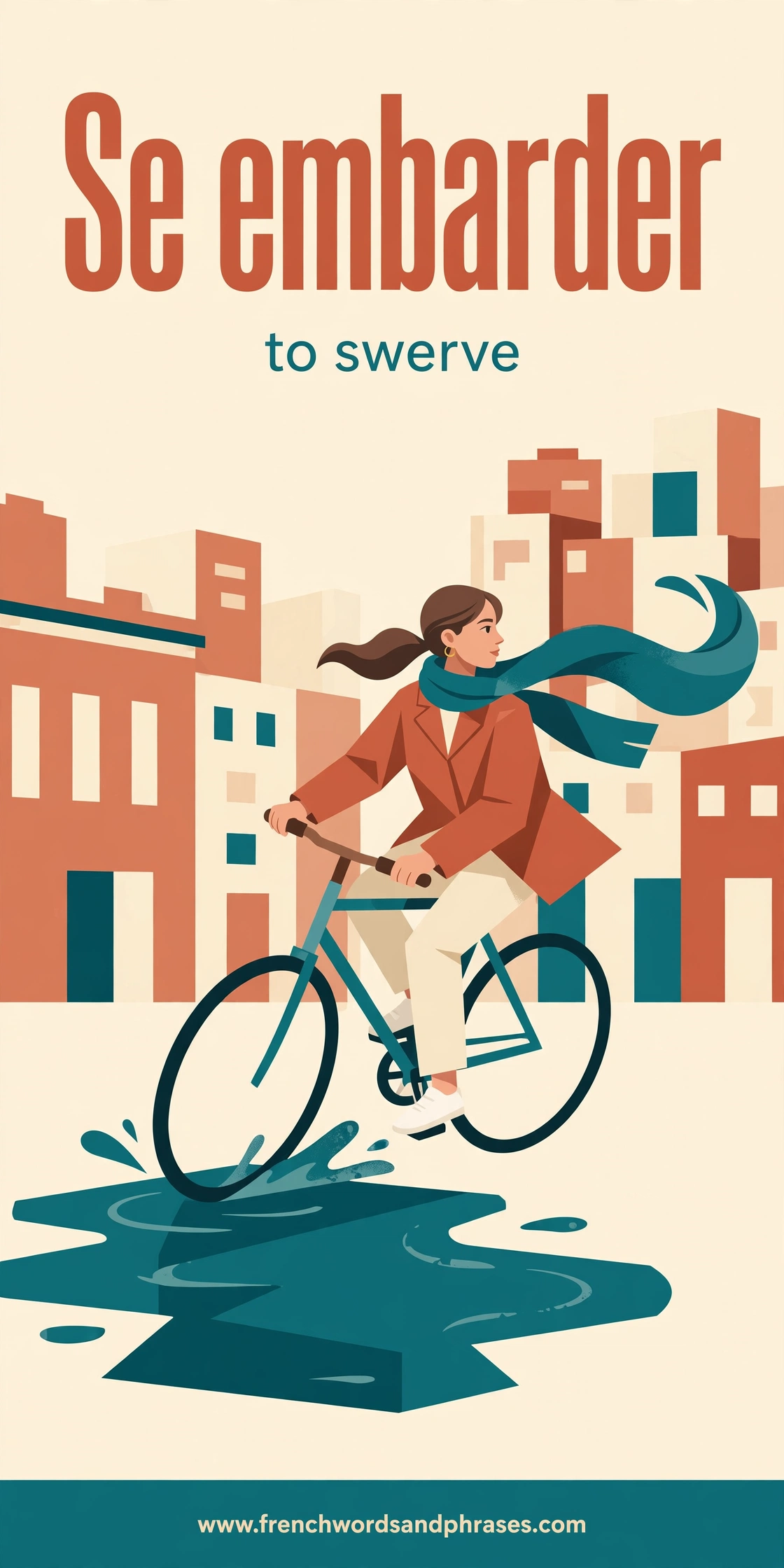
Se embarder means to swerve — to swing off course of one’s own motion, as a boat does when wind and wave take charge of it.
A dinghy at the harbour mouth, a barge caught by the current where two rivers meet — se embarder is the reflexive face of the swerve: the vessel does not get pushed so much as it throws itself sideways, and the helm answers too late.
In this guide, you’ll learn how to conjugate se embarder in all the major French tenses and moods. Explore complete conjugation tables, French examples, English translations, and practice quizzes.
Understanding the French Verb Se embarder
Se embarder is a regular French verb belonging to the first group of verbs, those ending in-er.
It means to swerve. It is used almost exclusively of boats and ships swinging off their course — in gusts, cross-currents and tide races — and occasionally, in older road language, of a vehicle lurching sideways. The reflexive form puts the vessel centre stage: the swerve is something the boat does, all at once, of itself.
Verb classification: First group (-er), reflexive
Auxiliary verb: Être
Past participle: embardé
Present participle: embardant
English equivalents: To swerve, to sheer off, to swing round; le bateau s’embarde — the boat swings off course; s’embarder contre le courant — to swing round against the current; s’embarder vers le large — to sheer off towards the open sea; s’embarder sur un banc de sable — to swing onto a sandbank.
One important detail: se embarder is the reflexive twin of embarder, used when the boat or vehicle itself is the thing swinging — the subject performs the swerve rather than suffering a driver. Being reflexive, it takes être in every compound tense and the past participle agrees: la barque s’est embardée, les voiliers se sont embardés. It is a working sailor’s word, far commoner in harbour talk and sea stories than in everyday conversation, where faire une embardée does most of the work.
Experience the Word
Se embarder is the verb of the helm losing the argument — the boat decides, suddenly, to go sideways.
Imagine a laden barge entering a tide race at dusk. The current catches her bow, the stern swings wide, and in three seconds elle s’est embardée across the channel, facing the way she came, while the crew shout and the ropes strain.
No one steered her there. She has swerved — embardée, swung round by wind and water acting as one.
How to Conjugate Se embarder: Complete French Conjugation Guide
Let’s explore every major conjugation of se embarder, beginning with the indicative mood.
How to Conjugate Se embarder in the Indicative Mood
The indicative mood is used to express facts, observations, actions, and events.
How to Conjugate Se embarder in the Present Tense (Présent)
Used for actions happening now, habitual actions, and general truths.
| Subject | Conjugation |
|---|---|
| je | m’embarde |
| tu | t’embardes |
| il / elle | s’embarde |
| nous | nous embardons |
| vous | vous embardez |
| ils / elles | s’embardent |
Example
Quand le vent fraîchit, le voilier s’embarde vers le large.
When the wind freshens, the yacht sheers off towards the open sea.
Quick Quiz 1
Complete the sentence:
Dans le chenal, les bateaux ______ au premier coup de vent.
Reveal the answer
s’embardent
Dans le chenal, les bateaux s’embardent au premier coup de vent.
In the channel, boats swing off at the first gust of wind.
How to Conjugate Se embarder in the Passé Composé
Used for completed actions in the past. Se embarder takes the auxiliary verb être.
| Subject | Conjugation |
|---|---|
| je | me suis embardé / me suis embardée |
| tu | t’es embardé / t’es embardée |
| il / elle | s’est embardé / s’est embardée |
| nous | nous sommes embardés / nous sommes embardées |
| vous | vous êtes embardés / vous êtes embardées / vous êtes embardé / vous êtes embardée |
| ils / elles | se sont embardés / se sont embardées |
Example
La barque s’est embardée contre le courant.
The boat swung round against the current.
How to Conjugate Se embarder in the Imparfait (Imperfect Tense)
Used for habitual past actions, descriptions, and ongoing situations in the past.
| Subject | Conjugation |
|---|---|
| je | m’embardais |
| tu | t’embardais |
| il / elle | s’embardait |
| nous | nous embardions |
| vous | vous embardiez |
| ils / elles | s’embardaient |
Example
À chaque marée, la péniche s’embardait près de l’écluse.
At every tide, the barge used to swing round near the lock.
Quick Quiz 2
Choose the correct form:
The barge swung round near the lock.
La péniche ______ près de l’écluse. (s’est embardée / a embardé)
Reveal the answer
s’est embardée
La péniche s’est embardée près de l’écluse.
Se embarder is reflexive, takes être, and the participle agrees: embardée.
How to Conjugate Se embarder in the Plus-que-parfait
Used to describe an action that had already been completed before another past event.
| Subject | Conjugation |
|---|---|
| je | m’étais embardé / m’étais embardée |
| tu | t’étais embardé / t’étais embardée |
| il / elle | s’était embardé / s’était embardée |
| nous | nous étions embardés / nous étions embardées |
| vous | vous étiez embardés / vous étiez embardées / vous étiez embardé / vous étiez embardée |
| ils / elles | s’étaient embardés / s’étaient embardées |
Example
Le chalutier s’était embardé avant de toucher le banc de sable.
The trawler had swung off course before hitting the sandbank.
How to Conjugate Se embarder in the Passé Simple
Primarily used in formal writing, literature, and historical narratives. It is rarely used in everyday conversation.
| Subject | Conjugation |
|---|---|
| je | m’embardai |
| tu | t’embardas |
| il / elle | s’embarda |
| nous | nous embardâmes |
| vous | vous embardâtes |
| ils / elles | s’embardèrent |
Example
Le navire s’embarda dans le chenal et bloqua le passage.
The ship swung across the channel and blocked the way.
How to Conjugate Se embarder in the Passé Antérieur
A literary tense used to express an action completed immediately before another past action, generally in the passé simple.
| Subject | Conjugation |
|---|---|
| je | me fus embardé / me fus embardée |
| tu | te fus embardé / te fus embardée |
| il / elle | se fut embardé / se fut embardée |
| nous | nous fûmes embardés / nous fûmes embardées |
| vous | vous fûtes embardés / vous fûtes embardées / vous fûtes embardé / vous fûtes embardée |
| ils / elles | se furent embardés / se furent embardées |
Example
Dès que la barque se fut embardée, les marins sautèrent à l’eau.
As soon as the boat had swung round, the sailors jumped into the water.
How to Conjugate Se embarder in the Future Tense (Futur Simple)
Used to describe actions that will take place in the future.
| Subject | Conjugation |
|---|---|
| je | m’embarderai |
| tu | t’embarderas |
| il / elle | s’embardera |
| nous | nous embarderons |
| vous | vous embarderez |
| ils / elles | s’embarderont |
Example
Si la rafale tient, le voilier s’embardera encore.
If the gust holds, the yacht will sheer off again.
How to Conjugate Se embarder in the Futur Antérieur (Future Perfect)
Used for an action that will have been completed before a particular point in the future.
| Subject | Conjugation |
|---|---|
| je | me serai embardé / me serai embardée |
| tu | te seras embardé / te seras embardée |
| il / elle | se sera embardé / se sera embardée |
| nous | nous serons embardés / nous serons embardées |
| vous | vous serez embardés / vous serez embardées / vous serez embardé / vous serez embardée |
| ils / elles | se seront embardés / se seront embardées |
Example
À la nuit, le bateau se sera embardé deux fois dans le chenal.
By nightfall, the boat will have swung off course twice in the channel.
How to Conjugate Se embarder in the Near Future (Futur Proche)
Used to describe something that is going to happen soon. Formed with aller + infinitive.
| Subject | Conjugation |
|---|---|
| je | vais m’embarder |
| tu | vas t’embarder |
| il / elle | va s’embarder |
| nous | allons nous embarder |
| vous | allez vous embarder |
| ils / elles | vont s’embarder |
Example
Attention, la barque va s’embarder !
Watch out, the boat is going to swing round!
How to Conjugate Se embarder in the Conditional Mood
The conditional mood expresses what would happen under certain circumstances. It is also frequently used to make polite requests or express wishes.
How to Conjugate Se embarder in the Present Conditional
| Subject | Conjugation |
|---|---|
| je | m’embarderais |
| tu | t’embarderais |
| il / elle | s’embarderait |
| nous | nous embarderions |
| vous | vous embarderiez |
| ils / elles | s’embarderaient |
Example
Avec un meilleur gouvernail, le bateau s’embarderait moins.
With a better rudder, the boat would swing off less.
How to Conjugate Se embarder in the Past Conditional
| Subject | Conjugation |
|---|---|
| je | me serais embardé / me serais embardée |
| tu | te serais embardé / te serais embardée |
| il / elle | se serait embardé / se serait embardée |
| nous | nous serions embardés / nous serions embardées |
| vous | vous seriez embardés / vous seriez embardées / vous seriez embardé / vous seriez embardée |
| ils / elles | se seraient embardés / se seraient embardées |
Example
La péniche se serait embardée sans son pilote expérimenté.
The barge would have swung round without its experienced pilot.
Se embarder in the Literary Past Conditional Form
This less common literary form uses the imperfect subjunctive of être.
| Subject | Conjugation |
|---|---|
| je | me fusse embardé / me fusse embardée |
| tu | te fusses embardé / te fusses embardée |
| il / elle | se fût embardé / se fût embardée |
| nous | nous fussions embardés / nous fussions embardées |
| vous | vous fussiez embardés / vous fussiez embardées / vous fussiez embardé / vous fussiez embardée |
| ils / elles | se fussent embardés / se fussent embardées |
Example
Le navire se fût embardé sur les rochers sans le phare.
The ship would have swung onto the rocks without the lighthouse.
How to Conjugate Se embarder in the Subjunctive Mood
The subjunctive is used to express wishes, emotions, doubts, necessity, and uncertainty. It frequently follows expressions such as il faut que (it is necessary that) or bien que (although).
How to Conjugate Se embarder in the Present Subjunctive
| Subject | Conjugation |
|---|---|
| que je | m’embarde |
| que tu | t’embardes |
| qu’il / qu’elle | s’embarde |
| que nous | nous embardions |
| que vous | vous embardiez |
| qu’ils / qu’elles | s’embardent |
Example
Il est à craindre que le voilier s’embarde dans la passe.
It is to be feared the yacht may sheer off in the channel.
Quick Quiz 3
Complete the sentence using the subjunctive:
Il est à craindre que vous vous ______ dans la passe.
Reveal the answer
embardiez
Il est à craindre que vous vous embardiez dans la passe.
It is to be feared you may sheer off in the channel.
How to Conjugate Se embarder in the Imperfect Subjunctive
A literary tense, rarely encountered in modern spoken French.
| Subject | Conjugation |
|---|---|
| que je | m’embardasse |
| que tu | t’embardasses |
| qu’il / qu’elle | s’embardât |
| que nous | nous embardassions |
| que vous | vous embardassiez |
| qu’ils / qu’elles | s’embardassent |
Example
Le capitaine craignait que le navire s’embardât contre la digue.
The captain feared the ship might swing against the breakwater.
How to Conjugate Se embarder in the Pluperfect Subjunctive
A literary construction used to express an action completed before another past action.
| Subject | Conjugation |
|---|---|
| que je | me fusse embardé / me fusse embardée |
| que tu | te fusses embardé / te fusses embardée |
| qu’il / qu’elle | se fût embardé / se fût embardée |
| que nous | nous fussions embardés / nous fussions embardées |
| que vous | vous fussiez embardés / vous fussiez embardées / vous fussiez embardé / vous fussiez embardée |
| qu’ils / qu’elles | se fussent embardés / se fussent embardées |
Example
On racontait que la barque se fût embardée en pleine tempête.
People said the boat had swung round in the middle of the storm.
How to Conjugate Se embarder in the Past Subjunctive
| Subject | Conjugation |
|---|---|
| que je | me sois embardé / me sois embardée |
| que tu | te sois embardé / te sois embardée |
| qu’il / qu’elle | se soit embardé / se soit embardée |
| que nous | nous soyons embardés / nous soyons embardées |
| que vous | vous soyez embardés / vous soyez embardées / vous soyez embardé / vous soyez embardée |
| qu’ils / qu’elles | se soient embardés / se soient embardées |
Example
Je suis surpris que le chalutier se soit embardé si près du port.
I am surprised the trawler swung off course so near the harbour.
How to Conjugate Se embarder in the Imperative
The imperative is used to give commands, instructions, invitations, or suggestions. Subject pronouns are omitted.
How to Conjugate Se embarder in the Present Imperative
| Person | Conjugation |
|---|---|
| (tu) | embarde-toi |
| (nous) | embardons-nous |
| (vous) | embardez-vous |
Example
Ne t’embarde pas vers ces rochers !
Do not swing off towards those rocks!
Quick Quiz 4
How would you say Do not swing off towards those rocks (tu form)?
Reveal the answer
Ne t’embarde pas vers ces rochers !
French Participles of Se embarder
Participles are verb forms that can be used in compound tenses and other grammatical constructions.
Present Participle of Se embarder
embardant
En s’embardant, la péniche a raclé la berge.
As it swung round, the barge scraped the bank.
Past Participle of Se embarder
embardé
Embardée par la rafale, la barque a failli chavirer.
Swung round by the gust, the boat nearly capsized.
Se embarder in Everyday French: Real-Life Examples
Now that you know the conjugations, let’s see how se embarder appears in everyday French.
Example 1 — Present
Le voilier s’embarde vers le large.
The yacht sheers off towards the open sea.
Example 2 — Passé composé
La barque s’est embardée contre le courant.
The boat swung round against the current.
Example 3 — Imparfait
La péniche s’embardait près de l’écluse.
The barge used to swing round near the lock.
Example 4 — Future
Le bateau s’embardera si le vent tient.
The boat will sheer off if the wind holds.
Example 5 — Conditional
Sans le courant, elle ne se serait pas embardée.
Without the current, it would not have swung round.
Example 6 — Imperative
Ne t’embarde pas vers ces rochers !
Do not swing off towards those rocks!
Beyond Translation: The Meaning of Se embarder
French has two ways to watch a boat misbehave: embarder states the fact, se embarder puts the boat itself in the dock — the reflexive pronoun makes the vessel the author of its own swerve.
The reflexive is the sailor’s shrug.
Elle s’est embardée, says the old hand: she swung, that is what boats do in a tide race, and no helmsman alive could have held her. Grammar itself shares the blame around.
How to Remember the French Verb Se embarder
Remember it this way: Se embarder is about the barge in the tide race, swinging round despite the helm.
- Reflexive and nautical: la barque s’embarde — the boat swings off course of itself.
- Être in compound tenses, with agreement: elle s’est embardée, ils se sont embardés.
- Regular -er underneath: je m’embarde, nous nous embardons, past participle embardé.
The key idea is the barge in the tide race, swinging round despite the helm.
Test Your Knowledge of Se embarder
Let’s see how much you’ve learned. Try answering these questions before revealing the answers.
Question 1
Why does se embarder take être in compound tenses?
Reveal the answer
Because it is reflexive — la barque s’est embardée contre le courant.
Question 2
How do you say The boat swung round against the current in French?
Reveal the answer
La barque s’est embardée contre le courant.
Question 3
Translate: When the wind freshens, the yacht sheers off towards the open sea.
Reveal the answer
Quand le vent fraîchit, le voilier s’embarde vers le large.
Question 4
What is the past participle of se embarder?
Reveal the answer
Embardé — agreeing: embardée, embardés, embardées.
Question 5
Complete the sentence:
Il est à craindre que le voilier ______ dans la passe.
Reveal the answer
s’embarde
Il est à craindre que le voilier s’embarde dans la passe.
It is to be feared the yacht may sheer off in the channel.
Your Final Challenge
Can You Use It?
How would you say this in French?
The boat swings round in the current, then the wind gently sets it back along the channel.
Reveal the answer
La barque s’embarde dans le courant, puis le vent la remet doucement dans l’axe du chenal.
The boat swings round in the current, then the wind gently sets it back along the channel.
A little French. A little curiosity. A richer everyday life.
LEARN FRENCH ONE WORD AT A TIME