A French Word to Live By
How to Conjugate Se émacier in French
/sə e.ma.sje/
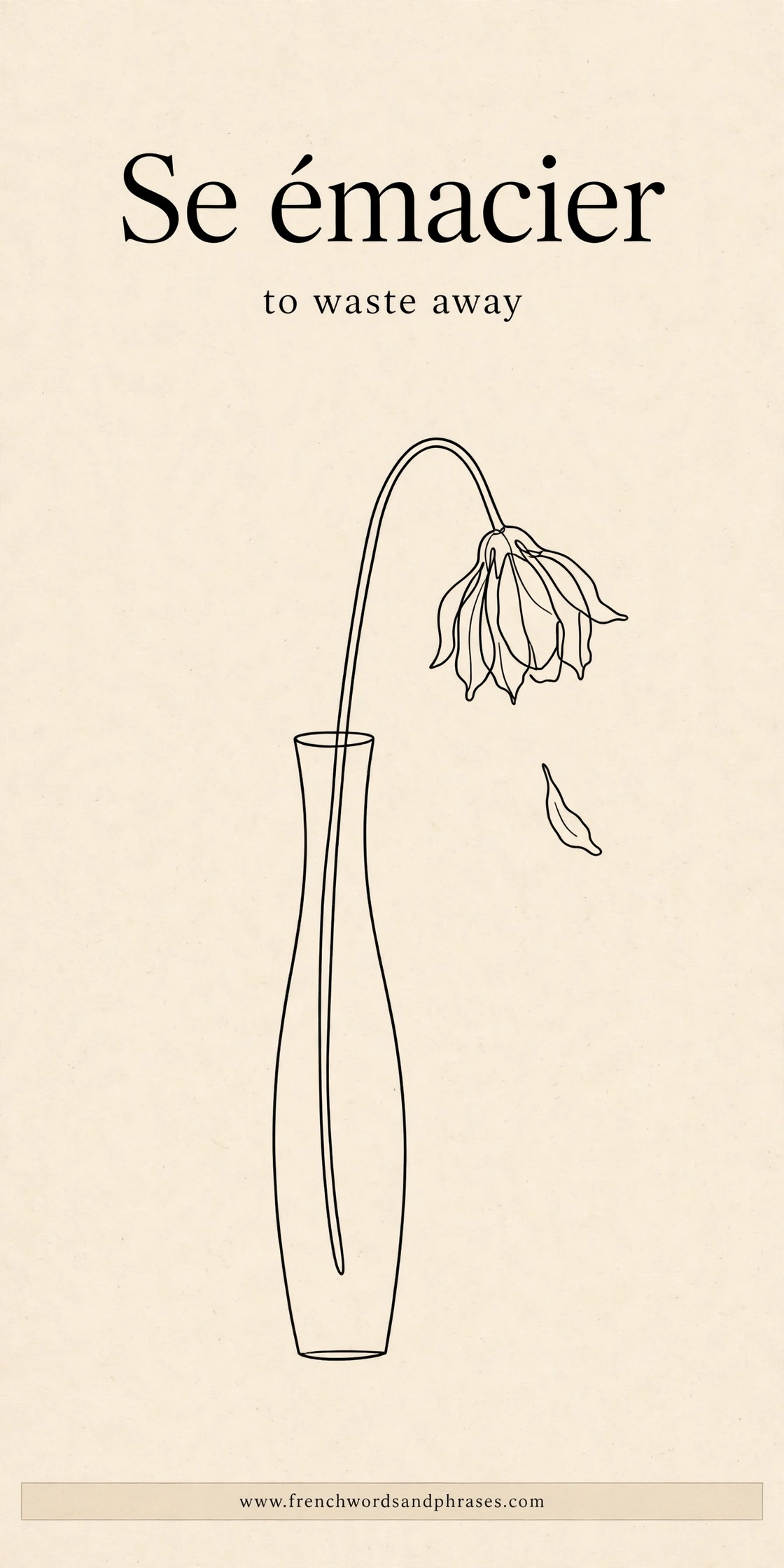
Se émacier means to waste away — to grow slowly, terribly thin, as a body consumed by illness, hunger or grief loses its flesh week by week.
A convalescent’s face thinner at every visit, a prisoner in an old novel refusing his bread, a plant of a man reduced to cheekbones and eyes — s’émacier is the grave, literary verb of wasting: the body quietly giving up its substance.
In this guide, you’ll learn how to conjugate se émacier in all the major French tenses and moods. Explore complete conjugation tables, French examples, English translations, and practice quizzes.
Understanding the French Verb Se émacier
Se émacier is a regular French verb belonging to the first group of verbs, those ending in-er.
It means to waste away. It is used in literature, medicine and careful prose for the slow thinning of a body under illness, hunger or sorrow — never for ordinary dieting. Where maigrir is neutral, s’émacier is always grave: something is consuming the person.
Verb classification: First group (-er), reflexive
Auxiliary verb: Être
Past participle: émacié
Present participle: émaciant
English equivalents: To waste away, to become emaciated; un visage émacié — an emaciated face; s’émacier de chagrin — to waste away with grief; le corps s’émacie — the body wastes away; émacié par la maladie — emaciated by illness.
One important detail: s’émacier is a literary, medical word — everyday French says maigrir — and its best-known form is the adjective-like participle émacié: un visage émacié, a gaunt, wasted face. It is a -cier verb, so the nous and vous forms of the imperfect and the subjunctive double the i: nous nous émaciions, que vous vous émaciiez. Being reflexive, it takes être and the participle agrees: elle s’est émaciée, ils se sont émaciés. Its world is the sickroom and the nineteenth-century novel: illness, hunger, prison and grief.
Experience the Word
S’émacier is the verb of the loosening collar — week by week, the face in the mirror is less than it was.
Imagine a village doctor in 1880, visiting a farmhouse through one long winter. Each Sunday the farmer’s wife is thinner: the soup untouched, the chair closer to the fire, the cheekbones rising. Elle s’émacie — and everyone at the table understands what the doctor’s silence means.
No single day was the turning point. She has wasted away — émaciée — a little at a time, like a candle.
How to Conjugate Se émacier: Complete French Conjugation Guide
Let’s explore every major conjugation of se émacier, beginning with the indicative mood.
How to Conjugate Se émacier in the Indicative Mood
The indicative mood is used to express facts, observations, actions, and events.
How to Conjugate Se émacier in the Present Tense (Présent)
Used for actions happening now, habitual actions, and general truths.
| Subject | Conjugation |
|---|---|
| je | m’émacie |
| tu | t’émacies |
| il / elle | s’émacie |
| nous | nous émacions |
| vous | vous émaciez |
| ils / elles | s’émacient |
Example
Le malade s’émacie de jour en jour.
The patient is wasting away day by day.
Quick Quiz 1
Complete the sentence:
Nous prions pour qu’il ne ______ pas davantage.
Reveal the answer
s’émacie
Nous prions pour qu’il ne s’émacie pas davantage.
We pray that he does not waste away further.
How to Conjugate Se émacier in the Passé Composé
Used for completed actions in the past. Se émacier takes the auxiliary verb être.
| Subject | Conjugation |
|---|---|
| je | me suis émacié / me suis émaciée |
| tu | t’es émacié / t’es émaciée |
| il / elle | s’est émacié / s’est émaciée |
| nous | nous sommes émaciés / nous sommes émaciées |
| vous | vous êtes émaciés / vous êtes émaciées / vous êtes émacié / vous êtes émaciée |
| ils / elles | se sont émaciés / se sont émaciées |
Example
Elle s’est émaciée pendant sa longue maladie.
She wasted away during her long illness.
How to Conjugate Se émacier in the Imparfait (Imperfect Tense)
Used for habitual past actions, descriptions, and ongoing situations in the past.
| Subject | Conjugation |
|---|---|
| je | m’émaciais |
| tu | t’émaciais |
| il / elle | s’émaciait |
| nous | nous émaciions |
| vous | vous émaciiez |
| ils / elles | s’émaciaient |
Example
Il s’émaciait lentement, sans se plaindre.
He was slowly wasting away, without complaining.
Quick Quiz 2
Choose the correct form:
She wasted away during her illness.
Elle ______ pendant sa maladie. (s’est émaciée / a émacié)
Reveal the answer
s’est émaciée
Elle s’est émaciée pendant sa maladie.
S’émacier is reflexive, takes être, and the participle agrees: émaciée.
How to Conjugate Se émacier in the Plus-que-parfait
Used to describe an action that had already been completed before another past event.
| Subject | Conjugation |
|---|---|
| je | m’étais émacié / m’étais émaciée |
| tu | t’étais émacié / t’étais émaciée |
| il / elle | s’était émacié / s’était émaciée |
| nous | nous étions émaciés / nous étions émaciées |
| vous | vous étiez émaciés / vous étiez émaciées / vous étiez émacié / vous étiez émaciée |
| ils / elles | s’étaient émaciés / s’étaient émaciées |
Example
Le prisonnier s’était émacié après des mois de famine.
The prisoner had wasted away after months of famine.
How to Conjugate Se émacier in the Passé Simple
Primarily used in formal writing, literature, and historical narratives. It is rarely used in everyday conversation.
| Subject | Conjugation |
|---|---|
| je | m’émaciai |
| tu | t’émacias |
| il / elle | s’émacia |
| nous | nous émaciâmes |
| vous | vous émaciâtes |
| ils / elles | s’émacièrent |
Example
Le vieillard s’émacia tout l’hiver et mourut au printemps.
The old man wasted away all winter and died in the spring.
How to Conjugate Se émacier in the Passé Antérieur
A literary tense used to express an action completed immediately before another past action, generally in the passé simple.
| Subject | Conjugation |
|---|---|
| je | me fus émacié / me fus émaciée |
| tu | te fus émacié / te fus émaciée |
| il / elle | se fut émacié / se fut émaciée |
| nous | nous fûmes émaciés / nous fûmes émaciées |
| vous | vous fûtes émaciés / vous fûtes émaciées / vous fûtes émacié / vous fûtes émaciée |
| ils / elles | se furent émaciés / se furent émaciées |
Example
Dès qu’elle se fut émaciée, on appela le médecin du chef-lieu.
As soon as she had wasted away, the doctor from the county town was called.
How to Conjugate Se émacier in the Future Tense (Futur Simple)
Used to describe actions that will take place in the future.
| Subject | Conjugation |
|---|---|
| je | m’émacierai |
| tu | t’émacieras |
| il / elle | s’émaciera |
| nous | nous émacierons |
| vous | vous émacierez |
| ils / elles | s’émacieront |
Example
Sans nourriture, il s’émaciera en quelques semaines.
Without food, he will waste away within a few weeks.
How to Conjugate Se émacier in the Futur Antérieur (Future Perfect)
Used for an action that will have been completed before a particular point in the future.
| Subject | Conjugation |
|---|---|
| je | me serai émacié / me serai émaciée |
| tu | te seras émacié / te seras émaciée |
| il / elle | se sera émacié / se sera émaciée |
| nous | nous serons émaciés / nous serons émaciées |
| vous | vous serez émaciés / vous serez émaciées / vous serez émacié / vous serez émaciée |
| ils / elles | se seront émaciés / se seront émaciées |
Example
À ce rythme, elle se sera émaciée avant l’été.
At this rate, she will have wasted away before the summer.
How to Conjugate Se émacier in the Near Future (Futur Proche)
Used to describe something that is going to happen soon. Formed with aller + infinitive.
| Subject | Conjugation |
|---|---|
| je | vais m’émacier |
| tu | vas t’émacier |
| il / elle | va s’émacier |
| nous | allons nous émacier |
| vous | allez vous émacier |
| ils / elles | vont s’émacier |
Example
Regarde ses joues, il va s’émacier si cela continue.
Look at his cheeks, he is going to waste away if this goes on.
How to Conjugate Se émacier in the Conditional Mood
The conditional mood expresses what would happen under certain circumstances. It is also frequently used to make polite requests or express wishes.
How to Conjugate Se émacier in the Present Conditional
| Subject | Conjugation |
|---|---|
| je | m’émacierais |
| tu | t’émacierais |
| il / elle | s’émacierait |
| nous | nous émacierions |
| vous | vous émacieriez |
| ils / elles | s’émacieraient |
Example
Avec un meilleur régime, le malade ne s’émacierait pas ainsi.
With a better diet, the patient would not waste away like this.
How to Conjugate Se émacier in the Past Conditional
| Subject | Conjugation |
|---|---|
| je | me serais émacié / me serais émaciée |
| tu | te serais émacié / te serais émaciée |
| il / elle | se serait émacié / se serait émaciée |
| nous | nous serions émaciés / nous serions émaciées |
| vous | vous seriez émaciés / vous seriez émaciées / vous seriez émacié / vous seriez émaciée |
| ils / elles | se seraient émaciés / se seraient émaciées |
Example
Elle ne se serait pas émaciée si on l’avait soignée plus tôt.
She would not have wasted away if she had been treated sooner.
Se émacier in the Literary Past Conditional Form
This less common literary form uses the imperfect subjunctive of être.
| Subject | Conjugation |
|---|---|
| je | me fusse émacié / me fusse émaciée |
| tu | te fusses émacié / te fusses émaciée |
| il / elle | se fût émacié / se fût émaciée |
| nous | nous fussions émaciés / nous fussions émaciées |
| vous | vous fussiez émaciés / vous fussiez émaciées / vous fussiez émacié / vous fussiez émaciée |
| ils / elles | se fussent émaciés / se fussent émaciées |
Example
Il se fût émacié de chagrin sans les visites de sa fille.
He would have wasted away with grief without his daughter’s visits.
How to Conjugate Se émacier in the Subjunctive Mood
The subjunctive is used to express wishes, emotions, doubts, necessity, and uncertainty. It frequently follows expressions such as il faut que (it is necessary that) or bien que (although).
How to Conjugate Se émacier in the Present Subjunctive
| Subject | Conjugation |
|---|---|
| que je | m’émacie |
| que tu | t’émacies |
| qu’il / qu’elle | s’émacie |
| que nous | nous émaciions |
| que vous | vous émaciiez |
| qu’ils / qu’elles | s’émacient |
Example
Je crains que le malade ne s’émacie davantage.
I fear the patient may waste away further.
Quick Quiz 3
Complete the sentence using the subjunctive:
Je crains que tu ne ______ de chagrin.
Reveal the answer
t’émacies
Je crains que tu ne t’émacies de chagrin.
I fear you may waste away with grief.
How to Conjugate Se émacier in the Imperfect Subjunctive
A literary tense, rarely encountered in modern spoken French.
| Subject | Conjugation |
|---|---|
| que je | m’émaciasse |
| que tu | t’émaciasses |
| qu’il / qu’elle | s’émaciât |
| que nous | nous émaciassions |
| que vous | vous émaciassiez |
| qu’ils / qu’elles | s’émaciassent |
Example
On craignait qu’elle ne s’émaciât avant l’arrivée du médecin.
People feared she might waste away before the doctor arrived.
How to Conjugate Se émacier in the Pluperfect Subjunctive
A literary construction used to express an action completed before another past action.
| Subject | Conjugation |
|---|---|
| que je | me fusse émacié / me fusse émaciée |
| que tu | te fusses émacié / te fusses émaciée |
| qu’il / qu’elle | se fût émacié / se fût émaciée |
| que nous | nous fussions émaciés / nous fussions émaciées |
| que vous | vous fussiez émaciés / vous fussiez émaciées / vous fussiez émacié / vous fussiez émaciée |
| qu’ils / qu’elles | se fussent émaciés / se fussent émaciées |
Example
Les romans racontent qu’il se fût émacié de chagrin.
The novels tell that he had wasted away with grief.
How to Conjugate Se émacier in the Past Subjunctive
| Subject | Conjugation |
|---|---|
| que je | me sois émacié / me sois émaciée |
| que tu | te sois émacié / te sois émaciée |
| qu’il / qu’elle | se soit émacié / se soit émaciée |
| que nous | nous soyons émaciés / nous soyons émaciées |
| que vous | vous soyez émaciés / vous soyez émaciées / vous soyez émacié / vous soyez émaciée |
| qu’ils / qu’elles | se soient émaciés / se soient émaciées |
Example
Je suis triste qu’elle se soit émaciée si vite.
I am sad she wasted away so quickly.
How to Conjugate Se émacier in the Imperative
The imperative is used to give commands, instructions, invitations, or suggestions. Subject pronouns are omitted.
How to Conjugate Se émacier in the Present Imperative
| Person | Conjugation |
|---|---|
| (tu) | émacie-toi |
| (nous) | émacions-nous |
| (vous) | émaciez-vous |
Example
Ne t’émacie pas de chagrin, mange quelque chose !
Do not waste away with grief, eat something!
Quick Quiz 4
How would you say Do not waste away with grief (tu form)?
Reveal the answer
Ne t’émacie pas de chagrin !
French Participles of Se émacier
Participles are verb forms that can be used in compound tenses and other grammatical constructions.
Present Participle of Se émacier
émaciant
En s’émaciant, le malade perdait ses forces de semaine en semaine.
As he wasted away, the patient lost his strength week by week.
Past Participle of Se émacier
émacié
Émaciée par la fièvre, elle ne quittait plus son lit.
Wasted away by fever, she no longer left her bed.
Se émacier in Everyday French: Real-Life Examples
Now that you know the conjugations, let’s see how se émacier appears in everyday French.
Example 1 — Present
Le malade s’émacie de jour en jour.
The patient is wasting away day by day.
Example 2 — Passé composé
Elle s’est émaciée pendant sa longue maladie.
She wasted away during her long illness.
Example 3 — Imparfait
Il s’émaciait lentement, sans se plaindre.
He was slowly wasting away, without complaining.
Example 4 — Future
Sans nourriture, il s’émaciera en quelques semaines.
Without food, he will waste away within a few weeks.
Example 5 — Conditional
Elle ne se serait pas émaciée si on l’avait soignée plus tôt.
She would not have wasted away if she had been treated sooner.
Example 6 — Imperative
Ne t’émacie pas de chagrin, mange !
Do not waste away with grief, eat!
Beyond Translation: The Meaning of Se émacier
English emaciated is the same Latin word — e-maciare, to make thoroughly thin — and it keeps the same gravity in both languages.
Maigrir loses weight; s’émacier loses substance.
That is why the verb lives in novels and sickrooms rather than in diet talk: un visage émacié is not a slim face but a face the illness has redrawn, all bone and eye, and French reaches for this word precisely when thinness has become a story.
How to Remember the French Verb Se émacier
Remember it this way: Se émacier is about the loosening collar and the rising cheekbones, week by week.
- A grave, literary word: to waste away — illness, hunger, grief; everyday French says maigrir.
- Its famous form is the participle: un visage émacié, a gaunt, wasted face.
- Reflexive with être and agreement — elle s’est émaciée — and a -cier verb: nous nous émaciions, with double i.
The key idea is the loosening collar and the rising cheekbones, week by week.
Test Your Knowledge of Se émacier
Let’s see how much you’ve learned. Try answering these questions before revealing the answers.
Question 1
How does s’émacier differ from maigrir?
Reveal the answer
Gravity — maigrir is neutral weight loss; s’émacier is wasting away under illness, hunger or grief.
Question 2
How do you say The patient is wasting away day by day in French?
Reveal the answer
Le malade s’émacie de jour en jour.
Question 3
Translate: She wasted away during her long illness.
Reveal the answer
Elle s’est émaciée pendant sa longue maladie.
Question 4
What is the past participle of s’émacier?
Reveal the answer
Émacié — agreeing: émaciée, émaciés, émaciées; un visage émacié is a gaunt face.
Question 5
Complete the sentence:
Je crains que le malade ne ______ davantage.
Reveal the answer
s’émacie
Je crains que le malade ne s’émacie davantage.
I fear the patient may waste away further.
Your Final Challenge
Can You Use It?
How would you say this in French?
She wasted away all winter, but in the spring she began to eat again.
Reveal the answer
Elle s’est émaciée tout l’hiver, mais au printemps, elle a recommencé à manger.
She wasted away all winter, but in the spring she began to eat again.
A little French. A little curiosity. A richer everyday life.
LEARN FRENCH ONE WORD AT A TIME