A French Word to Live By
How to Conjugate Émailler in French
/e.ma.je/
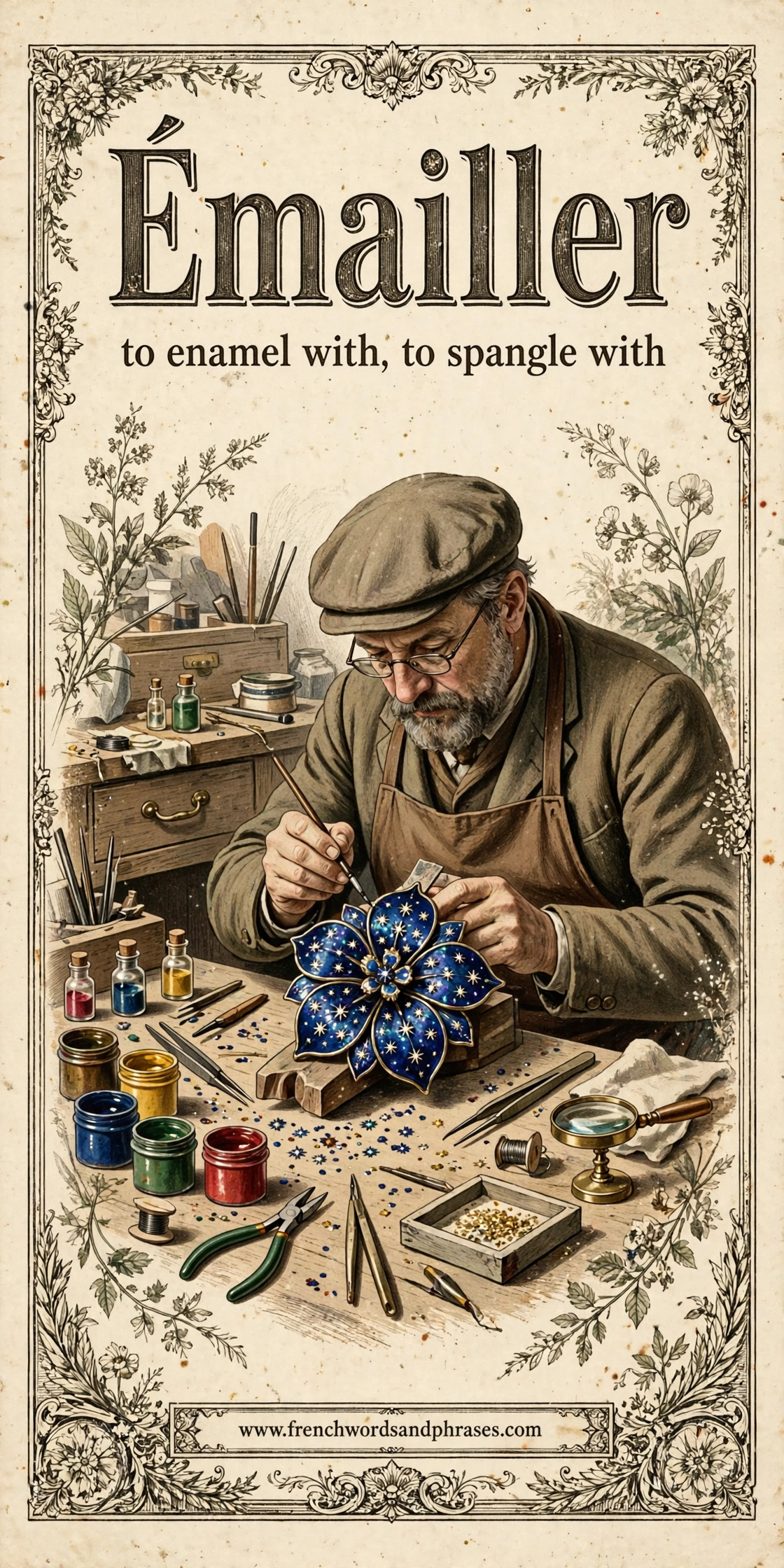
Émailler means to enamel with, to spangle with — to scatter bright touches across a surface, as a potter lays enamel colours on clay or spring scatters poppies across a meadow.
A potter’s workshop where coloured glazes wait in little bowls, a hillside meadow flecked red and yellow in June — émailler is the verb of the bright scattered touch: enamel on pottery, flowers on grass, quotations through a speech.
In this guide, you’ll learn how to conjugate émailler in all the major French tenses and moods. Explore complete conjugation tables, French examples, English translations, and practice quizzes.
Understanding the French Verb Émailler
Émailler is a regular French verb belonging to the first group of verbs, those ending in-er.
It means to enamel with, to spangle with. It is used literally by potters and jewellers for enamel work, and figuratively everywhere else: meadows spangled with flowers, speeches sprinkled with Latin, reports peppered with errors — whenever bright or noticeable points are scattered thickly over a ground, émailler de is the elegant verb.
Verb classification: First group (-er)
Auxiliary verb: Avoir
Past participle: émaillé
Present participle: émaillant
English equivalents: To enamel, to spangle, to stud; émailler une poterie — to enamel a piece of pottery; émailler de fleurs — to spangle with flowers; un pré émaillé de coquelicots — a meadow spangled with poppies; émailler un discours de citations — to sprinkle a speech with quotations; un texte émaillé de fautes — a text peppered with mistakes.
One important detail: émailler almost always works with the preposition de — you state what is spangled and then what it is spangled with: émailler un vase de motifs bleus, un pré émaillé de fleurs. In the passive picture the construction stays: le texte est émaillé de fautes, the text is peppered with errors. The noun behind it is l’émail, enamel — the hard coloured coating fired onto pottery and metal — and the verb is regular: j’émaille, nous émaillons, past participle émaillé.
Experience the Word
Émailler is the verb of the scattered jewel — nothing is covered, everything is dotted with colour.
Imagine a June meadow above the village. The grass alone would be pleasant; but someone has émaillé the whole slope — poppies here, cornflowers there, a drift of daisies along the path — and the field looks worked, jewelled, deliberate, like enamel on a brooch.
The meadow is not painted. It is spangled — émaillé de fleurs, one bright touch at a time.
How to Conjugate Émailler: Complete French Conjugation Guide
Let’s explore every major conjugation of émailler, beginning with the indicative mood.
How to Conjugate Émailler in the Indicative Mood
The indicative mood is used to express facts, observations, actions, and events.
How to Conjugate Émailler in the Present Tense (Présent)
Used for actions happening now, habitual actions, and general truths.
| Subject | Conjugation |
|---|---|
| je | émaille |
| tu | émailles |
| il / elle | émaille |
| nous | émaillons |
| vous | émaillez |
| ils / elles | émaillent |
Example
La potière émaille ses vases de motifs bleus et verts.
The potter enamels her vases with blue and green patterns.
Quick Quiz 1
Complete the sentence:
Nous ______ le jardin de marguerites.
Reveal the answer
émaillons
Nous émaillons le jardin de marguerites.
We spangle the garden with daisies.
How to Conjugate Émailler in the Passé Composé
Used for completed actions in the past. Émailler takes the auxiliary verb avoir.
| Subject | Conjugation |
|---|---|
| j’ | ai émaillé |
| tu | as émaillé |
| il / elle | a émaillé |
| nous | avons émaillé |
| vous | avez émaillé |
| ils / elles | ont émaillé |
Example
Ils ont émaillé le pré de fleurs pour la fête du village.
They spangled the meadow with flowers for the village festival.
How to Conjugate Émailler in the Imparfait (Imperfect Tense)
Used for habitual past actions, descriptions, and ongoing situations in the past.
| Subject | Conjugation |
|---|---|
| je | émaillais |
| tu | émaillais |
| il / elle | émaillait |
| nous | émaillions |
| vous | émailliez |
| ils / elles | émaillaient |
Example
Autrefois, les artisans émaillaient les bijoux à la main.
In the old days, craftsmen used to enamel jewellery by hand.
Quick Quiz 2
Choose the correct form:
The poppies spangled the field.
Les coquelicots ______ le champ. (ont émaillé / sont émaillés)
Reveal the answer
ont émaillé
Les coquelicots ont émaillé le champ.
Émailler takes avoir.
How to Conjugate Émailler in the Plus-que-parfait
Used to describe an action that had already been completed before another past event.
| Subject | Conjugation |
|---|---|
| j’ | avais émaillé |
| tu | avais émaillé |
| il / elle | avait émaillé |
| nous | avions émaillé |
| vous | aviez émaillé |
| ils / elles | avaient émaillé |
Example
Elle avait émaillé son discours de citations latines.
She had sprinkled her speech with Latin quotations.
How to Conjugate Émailler in the Passé Simple
Primarily used in formal writing, literature, and historical narratives. It is rarely used in everyday conversation.
| Subject | Conjugation |
|---|---|
| je | émaillai |
| tu | émaillas |
| il / elle | émailla |
| nous | émaillâmes |
| vous | émaillâtes |
| ils / elles | émaillèrent |
Example
Le peintre émailla la toile de touches dorées.
The painter spangled the canvas with golden touches.
How to Conjugate Émailler in the Passé Antérieur
A literary tense used to express an action completed immediately before another past action, generally in the passé simple.
| Subject | Conjugation |
|---|---|
| j’ | eus émaillé |
| tu | eus émaillé |
| il / elle | eut émaillé |
| nous | eûmes émaillé |
| vous | eûtes émaillé |
| ils / elles | eurent émaillé |
Example
Quand l’artisan eut émaillé le coffret, il le mit au four.
When the craftsman had enamelled the little box, he put it in the kiln.
How to Conjugate Émailler in the Future Tense (Futur Simple)
Used to describe actions that will take place in the future.
| Subject | Conjugation |
|---|---|
| je | émaillerai |
| tu | émailleras |
| il / elle | émaillera |
| nous | émaillerons |
| vous | émaillerez |
| ils / elles | émailleront |
Example
Au printemps, les coquelicots émailleront les champs.
In spring, the poppies will spangle the fields.
How to Conjugate Émailler in the Futur Antérieur (Future Perfect)
Used for an action that will have been completed before a particular point in the future.
| Subject | Conjugation |
|---|---|
| j’ | aurai émaillé |
| tu | auras émaillé |
| il / elle | aura émaillé |
| nous | aurons émaillé |
| vous | aurez émaillé |
| ils / elles | auront émaillé |
Example
À la fin de la semaine, elle aura émaillé toutes les assiettes de la commande.
By the end of the week, she will have enamelled all the plates in the order.
How to Conjugate Émailler in the Near Future (Futur Proche)
Used to describe something that is going to happen soon. Formed with aller + infinitive.
| Subject | Conjugation |
|---|---|
| je | vais émailler |
| tu | vas émailler |
| il / elle | va émailler |
| nous | allons émailler |
| vous | allez émailler |
| ils / elles | vont émailler |
Example
Regarde, le soleil va émailler la rivière d’étincelles.
Look, the sun is going to spangle the river with sparkles.
How to Conjugate Émailler in the Conditional Mood
The conditional mood expresses what would happen under certain circumstances. It is also frequently used to make polite requests or express wishes.
How to Conjugate Émailler in the Present Conditional
| Subject | Conjugation |
|---|---|
| je | émaillerais |
| tu | émaillerais |
| il / elle | émaillerait |
| nous | émaillerions |
| vous | émailleriez |
| ils / elles | émailleraient |
Example
Avec plus de temps, j’émaillerais ce rapport d’exemples concrets.
With more time, I would sprinkle this report with concrete examples.
How to Conjugate Émailler in the Past Conditional
| Subject | Conjugation |
|---|---|
| j’ | aurais émaillé |
| tu | aurais émaillé |
| il / elle | aurait émaillé |
| nous | aurions émaillé |
| vous | auriez émaillé |
| ils / elles | auraient émaillé |
Example
Il aurait émaillé son livre de dessins si l’éditeur l’avait permis.
He would have spangled his book with drawings if the publisher had allowed it.
Émailler in the Literary Past Conditional Form
This less common literary form uses the imperfect subjunctive of avoir.
| Subject | Conjugation |
|---|---|
| j’ | eusse émaillé |
| tu | eusses émaillé |
| il / elle | eût émaillé |
| nous | eussions émaillé |
| vous | eussiez émaillé |
| ils / elles | eussent émaillé |
Example
Le poète eût émaillé ses vers de fleurs rares.
The poet would have spangled his verses with rare flowers.
How to Conjugate Émailler in the Subjunctive Mood
The subjunctive is used to express wishes, emotions, doubts, necessity, and uncertainty. It frequently follows expressions such as il faut que (it is necessary that) or bien que (although).
How to Conjugate Émailler in the Present Subjunctive
| Subject | Conjugation |
|---|---|
| que je | émaille |
| que tu | émailles |
| qu’il / qu’elle | émaille |
| que nous | émaillions |
| que vous | émailliez |
| qu’ils / qu’elles | émaillent |
Example
Il faut que tu émailles ton exposé d’anecdotes.
You must sprinkle your presentation with anecdotes.
Quick Quiz 3
Complete the sentence using the subjunctive:
Il faut que vous ______ votre rapport d’exemples.
Reveal the answer
émailliez
Il faut que vous émailliez votre rapport d’exemples.
You must sprinkle your report with examples.
How to Conjugate Émailler in the Imperfect Subjunctive
A literary tense, rarely encountered in modern spoken French.
| Subject | Conjugation |
|---|---|
| que je | émaillasse |
| que tu | émaillasses |
| qu’il / qu’elle | émaillât |
| que nous | émaillassions |
| que vous | émaillassiez |
| qu’ils / qu’elles | émaillassent |
Example
Elle souhaitait que le jardinier émaillât la pelouse de crocus.
She wished the gardener would spangle the lawn with crocuses.
How to Conjugate Émailler in the Pluperfect Subjunctive
A literary construction used to express an action completed before another past action.
| Subject | Conjugation |
|---|---|
| que j’ | eusse émaillé |
| que tu | eusses émaillé |
| qu’il / qu’elle | eût émaillé |
| que nous | eussions émaillé |
| que vous | eussiez émaillé |
| qu’ils / qu’elles | eussent émaillé |
Example
On admirait que l’orfèvre eût émaillé le calice de pierres fines.
People admired that the goldsmith had enamelled the chalice with precious stones.
How to Conjugate Émailler in the Past Subjunctive
| Subject | Conjugation |
|---|---|
| que j’ | aie émaillé |
| que tu | aies émaillé |
| qu’il / qu’elle | ait émaillé |
| que nous | ayons émaillé |
| que vous | ayez émaillé |
| qu’ils / qu’elles | aient émaillé |
Example
Je suis ravi que les enfants aient émaillé le jardin de marguerites.
I am delighted the children spangled the garden with daisies.
How to Conjugate Émailler in the Imperative
The imperative is used to give commands, instructions, invitations, or suggestions. Subject pronouns are omitted.
How to Conjugate Émailler in the Present Imperative
| Person | Conjugation |
|---|---|
| (tu) | émaille |
| (nous) | émaillons |
| (vous) | émaillez |
Example
Émaille ton discours de citations, il n’en sera que plus vivant !
Sprinkle your speech with quotations, it will only be livelier for it!
Quick Quiz 4
How would you say Sprinkle your speech with quotations (tu form)?
Reveal the answer
Émaille ton discours de citations !
French Participles of Émailler
Participles are verb forms that can be used in compound tenses and other grammatical constructions.
Present Participle of Émailler
émaillant
En émaillant ses vases de motifs anciens, elle fait revivre un art perdu.
By enamelling her vases with old patterns, she brings a lost art back to life.
Past Participle of Émailler
émaillé
Émaillé de fautes, son devoir a été refait entièrement.
Peppered with mistakes, his homework had to be done all over again.
Émailler in Everyday French: Real-Life Examples
Now that you know the conjugations, let’s see how émailler appears in everyday French.
Example 1 — Present
La potière émaille ses vases de motifs bleus.
The potter enamels her vases with blue patterns.
Example 2 — Passé composé
Les coquelicots ont émaillé le champ.
The poppies spangled the field.
Example 3 — Imparfait
Les artisans émaillaient les bijoux à la main.
The craftsmen used to enamel jewellery by hand.
Example 4 — Future
Le printemps émaillera les prés de fleurs.
Spring will spangle the meadows with flowers.
Example 5 — Conditional
J’émaillerais mon discours de citations.
I would sprinkle my speech with quotations.
Example 6 — Imperative
Émaille ton texte d’exemples !
Sprinkle your text with examples!
Beyond Translation: The Meaning of Émailler
French émailler comes from émail, enamel — the glassy coloured skin fired onto metal and clay, itself an old Germanic word for something melted.
Enamel is colour that stays.
That is why the figurative use feels so exact: flowers émaillent a meadow the way enamel dots a brooch, and errors émaillent a bad text just as permanently — little hard points of colour, or of shame, fixed into the surface.
How to Remember the French Verb Émailler
Remember it this way: Émailler is about a meadow treated like enamel — poppies dotted over grass.
- It works with de: émailler quelque chose de fleurs, de citations, de fautes — the thing, then what it is spangled with.
- Think enamel: l’émail is the coloured coating on pottery, and émailler lays those bright touches down.
- Regular -er: j’émaille, nous émaillons, past participle émaillé.
The key idea is a meadow treated like enamel — poppies dotted over grass.
Test Your Knowledge of Émailler
Let’s see how much you’ve learned. Try answering these questions before revealing the answers.
Question 1
Which preposition follows émailler, and where does it go?
Reveal the answer
De — émailler un pré de fleurs: the thing first, then what it is spangled with.
Question 2
How do you say The potter enamels her vases with blue patterns in French?
Reveal the answer
La potière émaille ses vases de motifs bleus.
Question 3
Translate: His text is peppered with mistakes.
Reveal the answer
Son texte est émaillé de fautes.
Question 4
What is the past participle of émailler?
Reveal the answer
Émaillé.
Question 5
Complete the sentence:
Il faut que tu ______ ton exposé d’anecdotes.
Reveal the answer
émailles
Il faut que tu émailles ton exposé d’anecdotes.
You must sprinkle your presentation with anecdotes.
Your Final Challenge
Can You Use It?
How would you say this in French?
In June, the poppies spangle the wheat, and the whole field becomes a jewel.
Reveal the answer
En juin, les coquelicots émaillent les blés, et tout le champ devient bijou.
In June, the poppies spangle the wheat, and the whole field becomes a jewel.
A little French. A little curiosity. A richer everyday life.
LEARN FRENCH ONE WORD AT A TIME