A French Word to Live By
How to Conjugate Éluder in French
/e.ly.de/
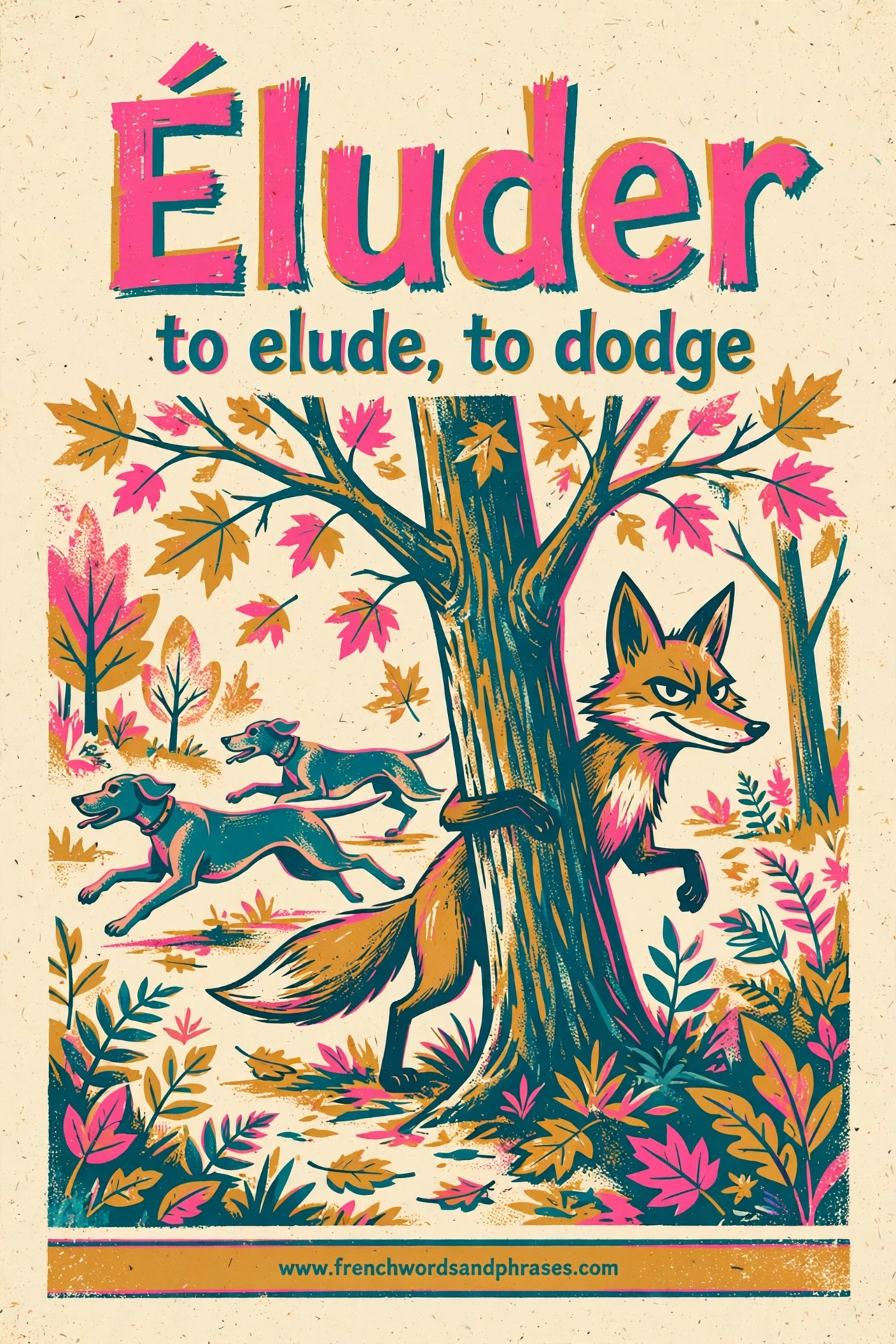
Éluder means to elude, to dodge — to slip gracefully around a question, a duty or a pursuer without ever quite facing it.
A politician smiling his way around a journalist’s question, a cat vanishing the moment the vet’s bag appears, a debtor who is never home when the landlord calls — éluder is the verb of the elegant sidestep: the blow, the question, the duty never lands.
In this guide, you’ll learn how to conjugate éluder in all the major French tenses and moods. Explore complete conjugation tables, French examples, English translations, and practice quizzes.
Understanding the French Verb Éluder
Éluder is a regular French verb belonging to the first group of verbs, those ending in-er.
It means to elude, to dodge. It is commonly used of questions and problems skilfully avoided in debate and interviews, of duties and taxes evaded, and, in stories, of people and animals who slip away from pursuit. The noun for the move itself is une esquive; the person who élude is insaisissable — uncatchable.
Verb classification: First group (-er)
Auxiliary verb: Avoir
Past participle: éludé
Present participle: éludant
English equivalents: To elude, to dodge, to evade; éluder une question — to dodge a question; éluder un problème — to sidestep a problem; éluder ses responsabilités — to evade one’s responsibilities; éluder la surveillance — to elude surveillance.
One important detail: éluder never touches what it avoids — it takes a direct object and no preposition: éluder une question, éluder un rendez-vous, éluder l’impôt. It is a slightly formal, written verb, at home in politics and the press: a minister élude a question rather than answering it. It is perfectly regular — j’élude, nous éludons — and must not be confused with its near-neighbour élucider: one dodges the light, the other brings it.
Experience the Word
Éluder is the verb of the unanswered question — the interview ends, the smiles were perfect, and nothing was ever said.
Imagine a press conference in Paris. A journalist asks the minister the one dangerous question, clearly, twice. The minister nods, speaks warmly for three minutes about something else entirely, and sits down to applause. Il a éludé — completely, elegantly, and everyone in the room knows it.
The question was never refused. It was dodged — éludée — and that is not the same thing at all.
How to Conjugate Éluder: Complete French Conjugation Guide
Let’s explore every major conjugation of éluder, beginning with the indicative mood.
How to Conjugate Éluder in the Indicative Mood
The indicative mood is used to express facts, observations, actions, and events.
How to Conjugate Éluder in the Present Tense (Présent)
Used for actions happening now, habitual actions, and general truths.
| Subject | Conjugation |
|---|---|
| je | élude |
| tu | éludes |
| il / elle | élude |
| nous | éludons |
| vous | éludez |
| ils / elles | éludent |
Example
Le ministre élude toutes les questions des journalistes.
The minister dodges all the journalists’ questions.
Quick Quiz 1
Complete the sentence:
Nous n’______ jamais nos responsabilités.
Reveal the answer
éludons
Nous n’éludons jamais nos responsabilités.
We never evade our responsibilities.
How to Conjugate Éluder in the Passé Composé
Used for completed actions in the past. Éluder takes the auxiliary verb avoir.
| Subject | Conjugation |
|---|---|
| j’ | ai éludé |
| tu | as éludé |
| il / elle | a éludé |
| nous | avons éludé |
| vous | avez éludé |
| ils / elles | ont éludé |
Example
Il a éludé la question avec un sourire.
He dodged the question with a smile.
How to Conjugate Éluder in the Imparfait (Imperfect Tense)
Used for habitual past actions, descriptions, and ongoing situations in the past.
| Subject | Conjugation |
|---|---|
| je | éludais |
| tu | éludais |
| il / elle | éludait |
| nous | éludions |
| vous | éludiez |
| ils / elles | éludaient |
Example
Elle éludait toujours les rendez-vous désagréables.
She always used to dodge unpleasant appointments.
Quick Quiz 2
Choose the correct form:
He dodged the question with a smile.
Il ______ la question avec un sourire. (a éludé / est éludé)
Reveal the answer
a éludé
Il a éludé la question avec un sourire.
Éluder takes avoir.
How to Conjugate Éluder in the Plus-que-parfait
Used to describe an action that had already been completed before another past event.
| Subject | Conjugation |
|---|---|
| j’ | avais éludé |
| tu | avais éludé |
| il / elle | avait éludé |
| nous | avions éludé |
| vous | aviez éludé |
| ils / elles | avaient éludé |
Example
Ils avaient éludé le problème pendant des années.
They had sidestepped the problem for years.
How to Conjugate Éluder in the Passé Simple
Primarily used in formal writing, literature, and historical narratives. It is rarely used in everyday conversation.
| Subject | Conjugation |
|---|---|
| je | éludai |
| tu | éludas |
| il / elle | éluda |
| nous | éludâmes |
| vous | éludâtes |
| ils / elles | éludèrent |
Example
Le renard éluda les chiens et disparut dans le bois.
The fox eluded the dogs and disappeared into the wood.
How to Conjugate Éluder in the Passé Antérieur
A literary tense used to express an action completed immediately before another past action, generally in the passé simple.
| Subject | Conjugation |
|---|---|
| j’ | eus éludé |
| tu | eus éludé |
| il / elle | eut éludé |
| nous | eûmes éludé |
| vous | eûtes éludé |
| ils / elles | eurent éludé |
Example
Quand il eut éludé la dernière question, la séance se termina.
When he had dodged the last question, the session ended.
How to Conjugate Éluder in the Future Tense (Futur Simple)
Used to describe actions that will take place in the future.
| Subject | Conjugation |
|---|---|
| je | éluderai |
| tu | éluderas |
| il / elle | éludera |
| nous | éluderons |
| vous | éluderez |
| ils / elles | éluderont |
Example
Demain, il éludera encore les journalistes, vous verrez.
Tomorrow, he will dodge the journalists again, you will see.
How to Conjugate Éluder in the Futur Antérieur (Future Perfect)
Used for an action that will have been completed before a particular point in the future.
| Subject | Conjugation |
|---|---|
| j’ | aurai éludé |
| tu | auras éludé |
| il / elle | aura éludé |
| nous | aurons éludé |
| vous | aurez éludé |
| ils / elles | auront éludé |
Example
À la fin de l’interview, elle aura éludé toutes les questions difficiles.
By the end of the interview, she will have dodged all the difficult questions.
How to Conjugate Éluder in the Near Future (Futur Proche)
Used to describe something that is going to happen soon. Formed with aller + infinitive.
| Subject | Conjugation |
|---|---|
| je | vais éluder |
| tu | vas éluder |
| il / elle | va éluder |
| nous | allons éluder |
| vous | allez éluder |
| ils / elles | vont éluder |
Example
Attention, il va éluder la question, écoutez bien.
Careful, he is going to dodge the question, listen closely.
How to Conjugate Éluder in the Conditional Mood
The conditional mood expresses what would happen under certain circumstances. It is also frequently used to make polite requests or express wishes.
How to Conjugate Éluder in the Present Conditional
| Subject | Conjugation |
|---|---|
| je | éluderais |
| tu | éluderais |
| il / elle | éluderait |
| nous | éluderions |
| vous | éluderiez |
| ils / elles | éluderaient |
Example
Un bon orateur éluderait cette question sans effort.
A good speaker would dodge this question effortlessly.
How to Conjugate Éluder in the Past Conditional
| Subject | Conjugation |
|---|---|
| j’ | aurais éludé |
| tu | aurais éludé |
| il / elle | aurait éludé |
| nous | aurions éludé |
| vous | auriez éludé |
| ils / elles | auraient éludé |
Example
Elle aurait éludé le contrôle sans ce chien de garde.
She would have eluded the checkpoint without that guard dog.
Éluder in the Literary Past Conditional Form
This less common literary form uses the imperfect subjunctive of avoir.
| Subject | Conjugation |
|---|---|
| j’ | eusse éludé |
| tu | eusses éludé |
| il / elle | eût éludé |
| nous | eussions éludé |
| vous | eussiez éludé |
| ils / elles | eussent éludé |
Example
Il eût éludé ses créanciers sans la lettre du notaire.
He would have evaded his creditors without the notary’s letter.
How to Conjugate Éluder in the Subjunctive Mood
The subjunctive is used to express wishes, emotions, doubts, necessity, and uncertainty. It frequently follows expressions such as il faut que (it is necessary that) or bien que (although).
How to Conjugate Éluder in the Present Subjunctive
| Subject | Conjugation |
|---|---|
| que je | élude |
| que tu | éludes |
| qu’il / qu’elle | élude |
| que nous | éludions |
| que vous | éludiez |
| qu’ils / qu’elles | éludent |
Example
Il est évident qu’il élude la vraie question.
It is obvious he is dodging the real question.
Quick Quiz 3
Complete the sentence using the subjunctive:
Il est évident que vous ______ la vraie question.
Reveal the answer
éludiez
Il est évident que vous éludiez la vraie question.
It is obvious you are dodging the real question.
How to Conjugate Éluder in the Imperfect Subjunctive
A literary tense, rarely encountered in modern spoken French.
| Subject | Conjugation |
|---|---|
| que je | éludasse |
| que tu | éludasses |
| qu’il / qu’elle | éludât |
| que nous | éludassions |
| que vous | éludassiez |
| qu’ils / qu’elles | éludassent |
Example
On s’étonnait qu’elle éludât si habilement ses responsabilités.
People were astonished that she evaded her responsibilities so skilfully.
How to Conjugate Éluder in the Pluperfect Subjunctive
A literary construction used to express an action completed before another past action.
| Subject | Conjugation |
|---|---|
| que j’ | eusse éludé |
| que tu | eusses éludé |
| qu’il / qu’elle | eût éludé |
| que nous | eussions éludé |
| que vous | eussiez éludé |
| qu’ils / qu’elles | eussent éludé |
Example
On racontait qu’il eût éludé la police pendant des mois.
People said he had eluded the police for months.
How to Conjugate Éluder in the Past Subjunctive
| Subject | Conjugation |
|---|---|
| que j’ | aie éludé |
| que tu | aies éludé |
| qu’il / qu’elle | ait éludé |
| que nous | ayons éludé |
| que vous | ayez éludé |
| qu’ils / qu’elles | aient éludé |
Example
Je suis sûr qu’il a éludé la question exprès.
I am sure he dodged the question on purpose.
How to Conjugate Éluder in the Imperative
The imperative is used to give commands, instructions, invitations, or suggestions. Subject pronouns are omitted.
How to Conjugate Éluder in the Present Imperative
| Person | Conjugation |
|---|---|
| (tu) | élude |
| (nous) | éludons |
| (vous) | éludez |
Example
N’élude pas la question, réponds franchement !
Do not dodge the question, answer frankly!
Quick Quiz 4
How would you say Do not dodge the question (tu form)?
Reveal the answer
N’élude pas la question !
French Participles of Éluder
Participles are verb forms that can be used in compound tenses and other grammatical constructions.
Present Participle of Éluder
éludant
En éludant le problème, le gouvernement l’a rendu plus grave.
By sidestepping the problem, the government made it worse.
Past Participle of Éluder
éludé
Éludée trois fois, la question est revenue une quatrième.
Dodged three times, the question came back a fourth time.
Éluder in Everyday French: Real-Life Examples
Now that you know the conjugations, let’s see how éluder appears in everyday French.
Example 1 — Present
Le ministre élude les questions difficiles.
The minister dodges the difficult questions.
Example 2 — Passé composé
Il a éludé la question avec un sourire.
He dodged the question with a smile.
Example 3 — Imparfait
Elle éludait toujours les rendez-vous désagréables.
She always used to dodge unpleasant appointments.
Example 4 — Future
Il éludera encore les journalistes demain.
He will dodge the journalists again tomorrow.
Example 5 — Conditional
Un bon orateur éluderait cette question sans effort.
A good speaker would dodge this question effortlessly.
Example 6 — Imperative
N’élude pas la question !
Do not dodge the question!
Beyond Translation: The Meaning of Éluder
English elude is the same Latin escape artist — e-ludere, to slip out of the game.
The dodge is a kind of play.
Inside éluder sits ludere, to play: the fox plays with the hounds, the minister plays with the question, and the pleasure of the verb is that the quarry is never caught and never even touched. Its opposite number is affronter — to face head-on, everything éluder refuses to do.
How to Remember the French Verb Éluder
Remember it this way: Éluder is about the minister smiling through three warm minutes that answer nothing.
- The sidestep verb: éluder une question — to dodge it without refusing it, direct object, no preposition.
- Do not confuse the neighbours: élucider brings the light, éluder dodges it.
- Regular -er: j’élude, nous éludons, past participle éludé; slightly formal, at home in politics and the press.
The key idea is the minister smiling through three warm minutes that answer nothing.
Test Your Knowledge of Éluder
Let’s see how much you’ve learned. Try answering these questions before revealing the answers.
Question 1
What is the difference between éluder and élucider?
Reveal the answer
Élucider clears a mystery up; éluder dodges it — one brings the light, the other slips away from it.
Question 2
How do you say He dodged the question with a smile in French?
Reveal the answer
Il a éludé la question avec un sourire.
Question 3
Translate: The minister dodges all the difficult questions.
Reveal the answer
Le ministre élude toutes les questions difficiles.
Question 4
What is the past participle of éluder?
Reveal the answer
Éludé.
Question 5
Complete the sentence:
On s’étonnait qu’elle ______ si habilement ses responsabilités.
Reveal the answer
éludât
On s’étonnait qu’elle éludât si habilement ses responsabilités.
People were astonished that she evaded her responsibilities so skilfully.
Your Final Challenge
Can You Use It?
How would you say this in French?
The minister dodged the question once again, and the journalists put away their notebooks.
Reveal the answer
Le ministre a éludé la question une fois de plus, et les journalistes ont rangé leurs carnets.
The minister dodged the question once again, and the journalists put away their notebooks.
A little French. A little curiosity. A richer everyday life.
LEARN FRENCH ONE WORD AT A TIME