A French Word to Live By
How to Conjugate Élucubrer in French
/e.ly.ky.bʁe/
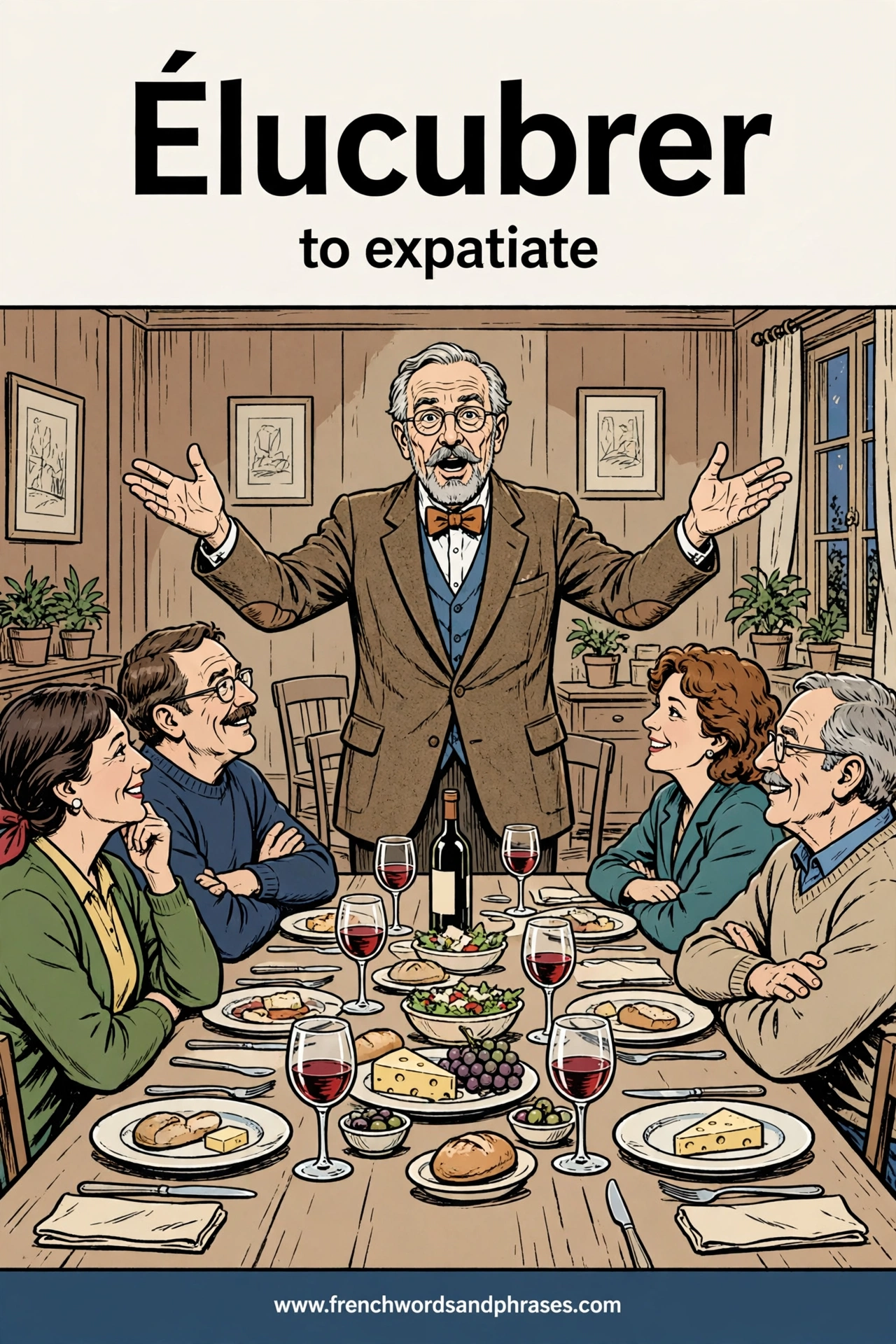
Élucubrer means to expatiate — to write or speak at great length, laboriously and often obscurely, the way a scholar burns the midnight oil over a vast and tangled subject.
A scholar alone at midnight, surrounded by candles of notes, producing page after page on a question nobody else can quite see — élucubrer is the verb of laborious, long-winded production: thought worked on by lamplight, at length, and not always to the reader’s benefit.
In this guide, you’ll learn how to conjugate élucubrer in all the major French tenses and moods. Explore complete conjugation tables, French examples, English translations, and practice quizzes.
Understanding the French Verb Élucubrer
Élucubrer is a regular French verb belonging to the first group of verbs, those ending in-er.
It means to expatiate. It is used almost entirely in literary or gently mocking contexts, of philosophers, essayists and late-night theorists who hold forth at length on abstruse questions. To say someone élucubre is rarely a compliment — the length is real, the clarity is not guaranteed.
Verb classification: First group (-er)
Auxiliary verb: Avoir
Past participle: élucubré
Present participle: élucubrant
English equivalents: To expatiate, to write at laborious length; élucubrer sur un sujet — to expatiate on a subject; des élucubrations — lucubrations, long-winded ramblings; élucubrer toute la nuit — to labour away all night.
One important detail: élucubrer is a rare, bookish verb, and its noun is far commoner than the verb itself: des élucubrations — lucubrations — usually said with a smile or a sigh about someone’s endless, foggy theorizing. The word comes from working by lamplight (Latin lucubrare, to work by night), and the hint of the lamp is still in it: what is élucubré is produced slowly, at night, at great length. The verb itself is a regular -er: j’élucubre, nous élucubrons.
Experience the Word
Élucubrer is the verb of the lamp at 2 a.m. — pages multiplying in the dark while the subject grows no clearer.
Imagine an old professor in a garret in the Latin Quarter. Every night for eleven years he has written on the same question — the nature of time, or of dust — filling notebooks no publisher has ever accepted. Il élucubre, fidèlement, and the pile of notebooks is now higher than the desk.
The work is enormous. He has expatiated — élucubré — for eleven years, and the night is not over.
How to Conjugate Élucubrer: Complete French Conjugation Guide
Let’s explore every major conjugation of élucubrer, beginning with the indicative mood.
How to Conjugate Élucubrer in the Indicative Mood
The indicative mood is used to express facts, observations, actions, and events.
How to Conjugate Élucubrer in the Present Tense (Présent)
Used for actions happening now, habitual actions, and general truths.
| Subject | Conjugation |
|---|---|
| je | élucubre |
| tu | élucubres |
| il / elle | élucubre |
| nous | élucubrons |
| vous | élucubrez |
| ils / elles | élucubrent |
Example
Le vieux philosophe élucubre sur la nature du temps.
The old philosopher expatiates on the nature of time.
Quick Quiz 1
Complete the sentence:
Nous ______ sur des questions que personne ne pose.
Reveal the answer
élucubrons
Nous élucubrons sur des questions que personne ne pose.
We expatiate on questions nobody asks.
How to Conjugate Élucubrer in the Passé Composé
Used for completed actions in the past. Élucubrer takes the auxiliary verb avoir.
| Subject | Conjugation |
|---|---|
| j’ | ai élucubré |
| tu | as élucubré |
| il / elle | a élucubré |
| nous | avons élucubré |
| vous | avez élucubré |
| ils / elles | ont élucubré |
Example
Il a élucubré toute la nuit sur son manuscrit.
He laboured away all night over his manuscript.
How to Conjugate Élucubrer in the Imparfait (Imperfect Tense)
Used for habitual past actions, descriptions, and ongoing situations in the past.
| Subject | Conjugation |
|---|---|
| je | élucubrais |
| tu | élucubrais |
| il / elle | élucubrait |
| nous | élucubrions |
| vous | élucubriez |
| ils / elles | élucubraient |
Example
Dans sa mansarde, il élucubrait jusqu’à l’aube.
In his garret, he used to work away until dawn.
Quick Quiz 2
Choose the correct form:
He laboured all night over his manuscript.
Il ______ toute la nuit sur son manuscrit. (a élucubré / est élucubré)
Reveal the answer
a élucubré
Il a élucubré toute la nuit sur son manuscrit.
Élucubrer takes avoir.
How to Conjugate Élucubrer in the Plus-que-parfait
Used to describe an action that had already been completed before another past event.
| Subject | Conjugation |
|---|---|
| j’ | avais élucubré |
| tu | avais élucubré |
| il / elle | avait élucubré |
| nous | avions élucubré |
| vous | aviez élucubré |
| ils / elles | avaient élucubré |
Example
Elle avait élucubré des années sur cette question sans la résoudre.
She had expatiated for years on this question without solving it.
How to Conjugate Élucubrer in the Passé Simple
Primarily used in formal writing, literature, and historical narratives. It is rarely used in everyday conversation.
| Subject | Conjugation |
|---|---|
| je | élucubrai |
| tu | élucubras |
| il / elle | élucubra |
| nous | élucubrâmes |
| vous | élucubrâtes |
| ils / elles | élucubrèrent |
Example
Le savant élucubra longtemps, puis s’endormit sur ses notes.
The scholar expatiated at length, then fell asleep over his notes.
How to Conjugate Élucubrer in the Passé Antérieur
A literary tense used to express an action completed immediately before another past action, generally in the passé simple.
| Subject | Conjugation |
|---|---|
| j’ | eus élucubré |
| tu | eus élucubré |
| il / elle | eut élucubré |
| nous | eûmes élucubré |
| vous | eûtes élucubré |
| ils / elles | eurent élucubré |
Example
Quand il eut élucubré toute la nuit, il souffla sa lampe.
When he had laboured all night, he blew out his lamp.
How to Conjugate Élucubrer in the Future Tense (Futur Simple)
Used to describe actions that will take place in the future.
| Subject | Conjugation |
|---|---|
| je | élucubrerai |
| tu | élucubreras |
| il / elle | élucubrera |
| nous | élucubrerons |
| vous | élucubrerez |
| ils / elles | élucubreront |
Example
Ce soir encore, il élucubrera sur le même chapitre.
This evening again, he will expatiate on the same chapter.
How to Conjugate Élucubrer in the Futur Antérieur (Future Perfect)
Used for an action that will have been completed before a particular point in the future.
| Subject | Conjugation |
|---|---|
| j’ | aurai élucubré |
| tu | auras élucubré |
| il / elle | aura élucubré |
| nous | aurons élucubré |
| vous | aurez élucubré |
| ils / elles | auront élucubré |
Example
À l’aube, il aura élucubré huit heures sans pause.
By dawn, he will have laboured for eight hours without a break.
How to Conjugate Élucubrer in the Near Future (Futur Proche)
Used to describe something that is going to happen soon. Formed with aller + infinitive.
| Subject | Conjugation |
|---|---|
| je | vais élucubrer |
| tu | vas élucubrer |
| il / elle | va élucubrer |
| nous | allons élucubrer |
| vous | allez élucubrer |
| ils / elles | vont élucubrer |
Example
Ne le dérange pas, il va élucubrer jusqu’au matin.
Do not disturb him, he is going to work away until morning.
How to Conjugate Élucubrer in the Conditional Mood
The conditional mood expresses what would happen under certain circumstances. It is also frequently used to make polite requests or express wishes.
How to Conjugate Élucubrer in the Present Conditional
| Subject | Conjugation |
|---|---|
| je | élucubrerais |
| tu | élucubrerais |
| il / elle | élucubrerait |
| nous | élucubrerions |
| vous | élucubreriez |
| ils / elles | élucubreraient |
Example
Avec un éditeur, il élucubrerait moins et publierait plus.
With a publisher, he would ramble less and publish more.
How to Conjugate Élucubrer in the Past Conditional
| Subject | Conjugation |
|---|---|
| j’ | aurais élucubré |
| tu | aurais élucubré |
| il / elle | aurait élucubré |
| nous | aurions élucubré |
| vous | auriez élucubré |
| ils / elles | auraient élucubré |
Example
Il aurait élucubré toute sa vie sans cette rencontre.
He would have expatiated all his life without that meeting.
Élucubrer in the Literary Past Conditional Form
This less common literary form uses the imperfect subjunctive of avoir.
| Subject | Conjugation |
|---|---|
| j’ | eusse élucubré |
| tu | eusses élucubré |
| il / elle | eût élucubré |
| nous | eussions élucubré |
| vous | eussiez élucubré |
| ils / elles | eussent élucubré |
Example
Elle eût élucubré encore sans l’incendie de sa bibliothèque.
She would have gone on expatiating without the fire in her library.
How to Conjugate Élucubrer in the Subjunctive Mood
The subjunctive is used to express wishes, emotions, doubts, necessity, and uncertainty. It frequently follows expressions such as il faut que (it is necessary that) or bien que (although).
How to Conjugate Élucubrer in the Present Subjunctive
| Subject | Conjugation |
|---|---|
| que je | élucubre |
| que tu | élucubres |
| qu’il / qu’elle | élucubre |
| que nous | élucubrions |
| que vous | élucubriez |
| qu’ils / qu’elles | élucubrent |
Example
Je doute qu’il élucubre encore sur ce vieux sujet.
I doubt he still expatiates on that old subject.
Quick Quiz 3
Complete the sentence using the subjunctive:
Je doute que vous ______ encore sur ce sujet.
Reveal the answer
élucubriez
Je doute que vous élucubriez encore sur ce sujet.
I doubt you still expatiate on this subject.
How to Conjugate Élucubrer in the Imperfect Subjunctive
A literary tense, rarely encountered in modern spoken French.
| Subject | Conjugation |
|---|---|
| que je | élucubrasse |
| que tu | élucubrasses |
| qu’il / qu’elle | élucubrât |
| que nous | élucubrassions |
| que vous | élucubrassiez |
| qu’ils / qu’elles | élucubrassent |
Example
On craignait qu’il élucubrât jusqu’à l’aube devant ses étudiants.
People feared he might hold forth until dawn in front of his students.
How to Conjugate Élucubrer in the Pluperfect Subjunctive
A literary construction used to express an action completed before another past action.
| Subject | Conjugation |
|---|---|
| que j’ | eusse élucubré |
| que tu | eusses élucubré |
| qu’il / qu’elle | eût élucubré |
| que nous | eussions élucubré |
| que vous | eussiez élucubré |
| qu’ils / qu’elles | eussent élucubré |
Example
On souriait qu’il eût élucubré tant d’années sur un mot.
People smiled that he had expatiated so many years on a single word.
How to Conjugate Élucubrer in the Past Subjunctive
| Subject | Conjugation |
|---|---|
| que j’ | aie élucubré |
| que tu | aies élucubré |
| qu’il / qu’elle | ait élucubré |
| que nous | ayons élucubré |
| que vous | ayez élucubré |
| qu’ils / qu’elles | aient élucubré |
Example
Je suis étonné qu’elle ait élucubré toute la nuit pour ce résultat.
I am amazed she laboured all night for this result.
How to Conjugate Élucubrer in the Imperative
The imperative is used to give commands, instructions, invitations, or suggestions. Subject pronouns are omitted.
How to Conjugate Élucubrer in the Present Imperative
| Person | Conjugation |
|---|---|
| (tu) | élucubre |
| (nous) | élucubrons |
| (vous) | élucubrez |
Example
Élucubre si tu veux, mais résume à la fin !
Expatiate if you must, but sum up at the end!
Quick Quiz 4
How would you say Expatiate if you must (tu form)?
Reveal the answer
Élucubre si tu veux !
French Participles of Élucubrer
Participles are verb forms that can be used in compound tenses and other grammatical constructions.
Present Participle of Élucubrer
élucubrant
En élucubrant sur le temps, il a oublié de vivre dans le sien.
By expatiating on time, he forgot to live in his own.
Past Participle of Élucubrer
élucubré
Élucubrées à la lueur d’une lampe, ces pages n’ont jamais trouvé d’éditeur.
Laboured over by lamplight, these pages never found a publisher.
Élucubrer in Everyday French: Real-Life Examples
Now that you know the conjugations, let’s see how élucubrer appears in everyday French.
Example 1 — Present
Le philosophe élucubre sur la nature du temps.
The philosopher expatiates on the nature of time.
Example 2 — Passé composé
Il a élucubré toute la nuit sur son manuscrit.
He laboured away all night over his manuscript.
Example 3 — Imparfait
Il élucubrait jusqu’à l’aube dans sa mansarde.
He used to work away until dawn in his garret.
Example 4 — Future
Ce soir encore, il élucubrera sur le même chapitre.
This evening again, he will expatiate on the same chapter.
Example 5 — Conditional
Avec un éditeur, il élucubrerait moins.
With a publisher, he would ramble less.
Example 6 — Imperative
Élucubre si tu veux, mais résume à la fin !
Expatiate if you must, but sum up at the end!
Beyond Translation: The Meaning of Élucubrer
English owns the exact twin — lucubrate, and its noun lucubrations — and in both languages the word carries the same raised eyebrow.
Work done by lamplight, judged by daylight.
Latin lucubrare meant honest night work, and the sweat is still honoured in the French word; but des élucubrations in modern French almost always means pages and pages of fog. The lamp was real; the light, alas, was not guaranteed.
How to Remember the French Verb Élucubrer
Remember it this way: Élucubrer is about the scholar’s lamp at 2 a.m. and the pile of unpublished notebooks.
- A rare, bookish verb: to expatiate — to write or speak at laborious, foggy length.
- The noun is commoner than the verb: des élucubrations = long-winded ramblings, said with a smile.
- Born by lamplight (Latin lucubrare): regular -er, j’élucubre, nous élucubrons, participle élucubré.
The key idea is the scholar’s lamp at 2 a.m. and the pile of unpublished notebooks.
Test Your Knowledge of Élucubrer
Let’s see how much you’ve learned. Try answering these questions before revealing the answers.
Question 1
What does des élucubrations usually mean in modern French?
Reveal the answer
Long-winded ramblings — pages of laborious, foggy theorizing, said with a smile or a sigh.
Question 2
How do you say The old philosopher expatiates on the nature of time in French?
Reveal the answer
Le vieux philosophe élucubre sur la nature du temps.
Question 3
Translate: He laboured away all night over his manuscript.
Reveal the answer
Il a élucubré toute la nuit sur son manuscrit.
Question 4
What is the past participle of élucubrer?
Reveal the answer
Élucubré.
Question 5
Complete the sentence:
Je doute qu’il ______ encore sur ce vieux sujet.
Reveal the answer
élucubre
Je doute qu’il élucubre encore sur ce vieux sujet.
I doubt he still expatiates on that old subject.
Your Final Challenge
Can You Use It?
How would you say this in French?
In his garret, the old philosopher is still expatiating, and his notebooks are piling higher than the desk.
Reveal the answer
Dans sa mansarde, le vieux philosophe élucubre encore, et ses cahiers montent plus haut que le bureau.
In his garret, the old philosopher is still expatiating, and his notebooks are piling higher than the desk.
A little French. A little curiosity. A richer everyday life.
LEARN FRENCH ONE WORD AT A TIME