A French Word to Live By
How to Conjugate Élimer in French
/e.li.me/
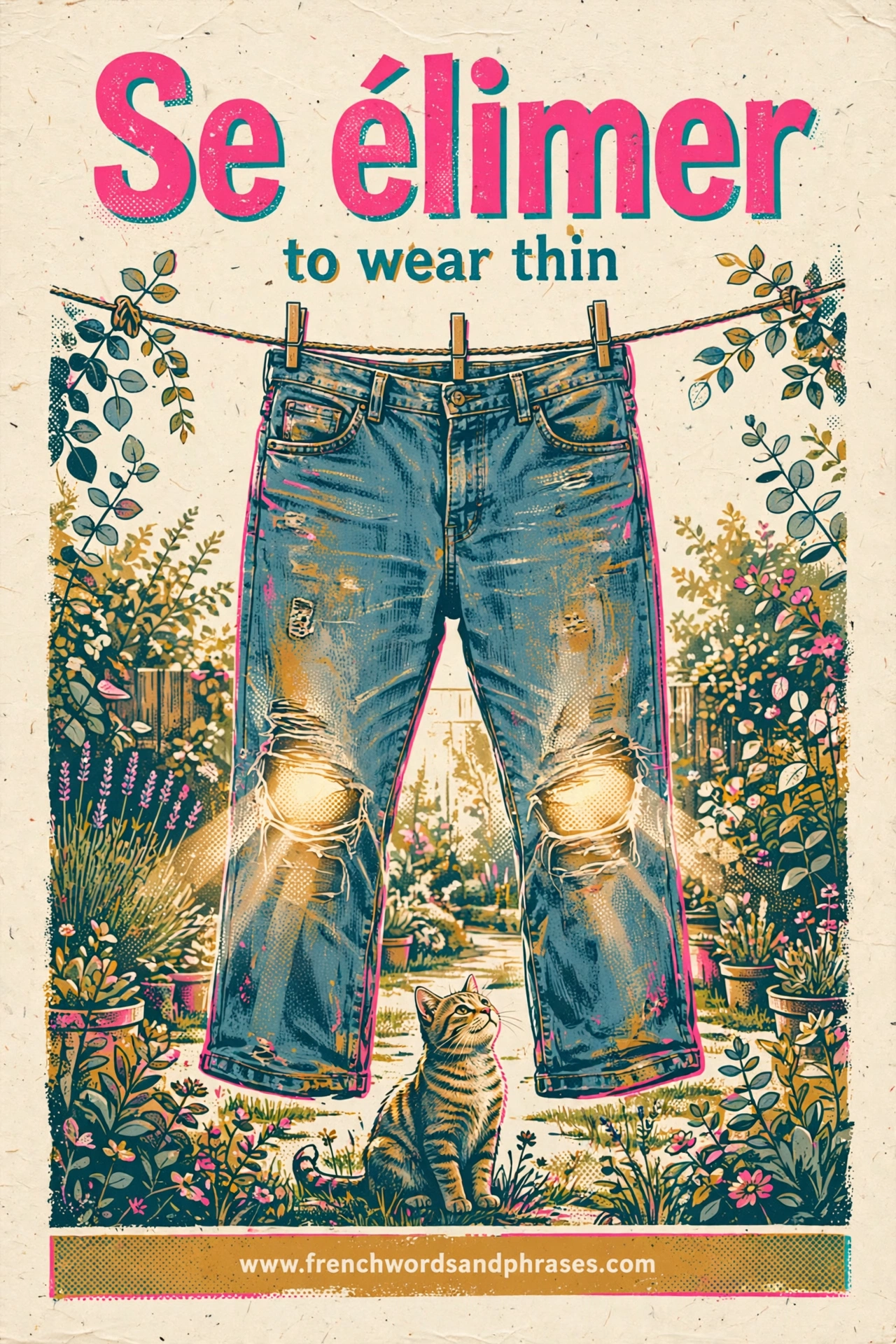
Élimer means to wear thin — to rub a fabric, a rope or a sole down by use until it is threadbare.
A favourite jumper thinning at the elbows, a rope fraying fibre by fibre against a stone, shoe soles going papery on the pavement — élimer is the quiet verb of friction: nothing tears, nothing breaks, things simply wear thin, day after day.
In this guide, you’ll learn how to conjugate élimer in all the major French tenses and moods. Explore complete conjugation tables, French examples, English translations, and practice quizzes.
Understanding the French Verb Élimer
Élimer is a regular French verb belonging to the first group of verbs, those ending in-er.
It means to wear thin. It is commonly used of clothes, linen, ropes and soles worn down by use — élimer un pull aux coudes, élimer ses semelles — and of anything friction slowly thins, from stair treads to old tapestries. Its reflexive twin, se élimer, is just as common: the thing wearing thin becomes its own subject.
Verb classification: First group (-er)
Auxiliary verb: Avoir
Past participle: élimé
Present participle: élimant
English equivalents: To wear thin, to wear out by rubbing; élimer ses chaussures — to wear one’s shoes thin; élimer un tissu — to wear a fabric threadbare; les coudes élimés — elbows worn thin; la corde s’élime — the rope is wearing thin.
One important detail: élimer lives one letter away from two traps. It is not éliminer, to eliminate — nothing is removed or knocked out here, only rubbed thinner. And it is not limer, to file with a tool: no file ever touches what friction élimes. The culprit is always slow rubbing — le frottement élime le tissu. The verb is regular, j’élime, nous élimons, ils éliminent (a form that looks like éliminer’s and must be read by context), and its participle is a wardrobe diagnosis: un manteau élimé aux manches, a coat worn thin at the sleeves.
Experience the Word
Élimer is the verb of slow disappearance — wear measured not in holes, but in thinness.
Imagine a fisherman’s rope on a stone quay. Every tide drags it a few centimetres across the same rough edge. No single pull cuts it; but season by season the fibres pale and flatten where the stone kisses them — le frottement élime la corde, until one morning the rope is half the rope it was.
Nothing dramatic has happened to it. It has been worn thin — élimée — by a thousand small rubbings.
How to Conjugate Élimer: Complete French Conjugation Guide
Let’s explore every major conjugation of élimer, beginning with the indicative mood.
How to Conjugate Élimer in the Indicative Mood
The indicative mood is used to express facts, observations, actions, and events.
How to Conjugate Élimer in the Present Tense (Présent)
Used for actions happening now, habitual actions, and general truths.
| Subject | Conjugation |
|---|---|
| je | élime |
| tu | élimes |
| il / elle | élime |
| nous | élimons |
| vous | élimez |
| ils / elles | éliment |
Example
Le frottement élime les semelles en quelques mois.
Friction wears soles thin in a few months.
Quick Quiz 1
Complete the sentence:
Nous ______ nos semelles sur ces chemins de pierre.
Reveal the answer
élimons
Nous élimons nos semelles sur ces chemins de pierre.
We wear our soles thin on these stone paths.
How to Conjugate Élimer in the Passé Composé
Used for completed actions in the past. Élimer takes the auxiliary verb avoir.
| Subject | Conjugation |
|---|---|
| j’ | ai élimé |
| tu | as élimé |
| il / elle | a élimé |
| nous | avons élimé |
| vous | avez élimé |
| ils / elles | ont élimé |
Example
Tu as élimé les coudes de ton pull préféré.
You have worn thin the elbows of your favourite jumper.
How to Conjugate Élimer in the Imparfait (Imperfect Tense)
Used for habitual past actions, descriptions, and ongoing situations in the past.
| Subject | Conjugation |
|---|---|
| je | élimais |
| tu | élimais |
| il / elle | élimait |
| nous | élimions |
| vous | élimiez |
| ils / elles | élimaient |
Example
Le sable élimait lentement les inscriptions du vieux mur.
The sand slowly wore thin the inscriptions on the old wall.
Quick Quiz 2
Choose the correct form:
You have worn thin the elbows of your jumper.
Tu ______ les coudes de ton pull. (as élimé / es élimé)
Reveal the answer
as élimé
Tu as élimé les coudes de ton pull.
Élimer takes avoir.
How to Conjugate Élimer in the Plus-que-parfait
Used to describe an action that had already been completed before another past event.
| Subject | Conjugation |
|---|---|
| j’ | avais élimé |
| tu | avais élimé |
| il / elle | avait élimé |
| nous | avions élimé |
| vous | aviez élimé |
| ils / elles | avaient élimé |
Example
Les années avaient élimé le tissu aux genoux.
The years had worn the fabric thin at the knees.
How to Conjugate Élimer in the Passé Simple
Primarily used in formal writing, literature, and historical narratives. It is rarely used in everyday conversation.
| Subject | Conjugation |
|---|---|
| je | élimai |
| tu | élimas |
| il / elle | élima |
| nous | élimâmes |
| vous | élimâtes |
| ils / elles | élimèrent |
Example
L’usage élima les marches de l’escalier de pierre.
Use wore thin the steps of the stone staircase.
How to Conjugate Élimer in the Passé Antérieur
A literary tense used to express an action completed immediately before another past action, generally in the passé simple.
| Subject | Conjugation |
|---|---|
| j’ | eus élimé |
| tu | eus élimé |
| il / elle | eut élimé |
| nous | eûmes élimé |
| vous | eûtes élimé |
| ils / elles | eurent élimé |
Example
Quand le frottement eut élimé la corde, elle céda.
When the rubbing had worn the rope thin, it gave way.
How to Conjugate Élimer in the Future Tense (Futur Simple)
Used to describe actions that will take place in the future.
| Subject | Conjugation |
|---|---|
| je | élimerai |
| tu | élimeras |
| il / elle | élimera |
| nous | élimerons |
| vous | élimerez |
| ils / elles | élimeront |
Example
À ce rythme, tu élimeras tes chaussures avant l’été.
At this rate, you will wear your shoes thin before the summer.
How to Conjugate Élimer in the Futur Antérieur (Future Perfect)
Used for an action that will have been completed before a particular point in the future.
| Subject | Conjugation |
|---|---|
| j’ | aurai élimé |
| tu | auras élimé |
| il / elle | aura élimé |
| nous | aurons élimé |
| vous | aurez élimé |
| ils / elles | auront élimé |
Example
En décembre, elle aura élimé deux paires de gants.
By December, she will have worn thin two pairs of gloves.
How to Conjugate Élimer in the Near Future (Futur Proche)
Used to describe something that is going to happen soon. Formed with aller + infinitive.
| Subject | Conjugation |
|---|---|
| je | vais élimer |
| tu | vas élimer |
| il / elle | va élimer |
| nous | allons élimer |
| vous | allez élimer |
| ils / elles | vont élimer |
Example
Ce sac va élimer l’épaule de ta veste.
This bag is going to wear thin the shoulder of your jacket.
How to Conjugate Élimer in the Conditional Mood
The conditional mood expresses what would happen under certain circumstances. It is also frequently used to make polite requests or express wishes.
How to Conjugate Élimer in the Present Conditional
| Subject | Conjugation |
|---|---|
| je | élimerais |
| tu | élimerais |
| il / elle | élimerait |
| nous | élimerions |
| vous | élimeriez |
| ils / elles | élimeraient |
Example
Le frottement élimerait la doublure en une saison.
Friction would wear the lining thin in one season.
How to Conjugate Élimer in the Past Conditional
| Subject | Conjugation |
|---|---|
| j’ | aurais élimé |
| tu | aurais élimé |
| il / elle | aurait élimé |
| nous | aurions élimé |
| vous | auriez élimé |
| ils / elles | auraient élimé |
Example
Sans les renforts, le frottement aurait élimé les genoux du pantalon.
Without the reinforcements, friction would have worn the trousers thin at the knees.
Élimer in the Literary Past Conditional Form
This less common literary form uses the imperfect subjunctive of avoir.
| Subject | Conjugation |
|---|---|
| j’ | eusse élimé |
| tu | eusses élimé |
| il / elle | eût élimé |
| nous | eussions élimé |
| vous | eussiez élimé |
| ils / elles | eussent élimé |
Example
L’usage eût élimé ces marches sans l’entretien des moines.
Use would have worn these steps thin without the monks’ upkeep.
How to Conjugate Élimer in the Subjunctive Mood
The subjunctive is used to express wishes, emotions, doubts, necessity, and uncertainty. It frequently follows expressions such as il faut que (it is necessary that) or bien que (although).
How to Conjugate Élimer in the Present Subjunctive
| Subject | Conjugation |
|---|---|
| que je | élime |
| que tu | élimes |
| qu’il / qu’elle | élime |
| que nous | élimions |
| que vous | élimiez |
| qu’ils / qu’elles | éliment |
Example
Je ne veux pas que le sac élime ta veste.
I do not want the bag to wear your jacket thin.
Quick Quiz 3
Complete the sentence using the subjunctive:
On craignait que le frottement ______ la corde.
Reveal the answer
élime
On craignait que le frottement élime la corde.
People feared the rubbing might wear the rope thin.
How to Conjugate Élimer in the Imperfect Subjunctive
A literary tense, rarely encountered in modern spoken French.
| Subject | Conjugation |
|---|---|
| que je | élimasse |
| que tu | élimasses |
| qu’il / qu’elle | élimât |
| que nous | élimassions |
| que vous | élimassiez |
| qu’ils / qu’elles | élimassent |
Example
On craignait que le frottement élimât la corde pendant la nuit.
People feared the rubbing might wear the rope thin during the night.
How to Conjugate Élimer in the Pluperfect Subjunctive
A literary construction used to express an action completed before another past action.
| Subject | Conjugation |
|---|---|
| que j’ | eusse élimé |
| que tu | eusses élimé |
| qu’il / qu’elle | eût élimé |
| que nous | eussions élimé |
| que vous | eussiez élimé |
| qu’ils / qu’elles | eussent élimé |
Example
On voyait que le temps eût élimé les couleurs de la tapisserie.
You could see that time had worn thin the colours of the tapestry.
How to Conjugate Élimer in the Past Subjunctive
| Subject | Conjugation |
|---|---|
| que j’ | aie élimé |
| que tu | aies élimé |
| qu’il / qu’elle | ait élimé |
| que nous | ayons élimé |
| que vous | ayez élimé |
| qu’ils / qu’elles | aient élimé |
Example
Je suis surpris que tu aies élimé ce pull en un hiver.
I am surprised you wore this jumper thin in one winter.
How to Conjugate Élimer in the Imperative
The imperative is used to give commands, instructions, invitations, or suggestions. Subject pronouns are omitted.
How to Conjugate Élimer in the Present Imperative
| Person | Conjugation |
|---|---|
| (tu) | élime |
| (nous) | élimons |
| (vous) | élimez |
Example
N’élime pas ton manteau sur ce mur, il est rugueux !
Do not wear your coat thin on that wall, it is rough!
Quick Quiz 4
How would you say Do not wear your coat thin on that wall (tu form)?
Reveal the answer
N’élime pas ton manteau sur ce mur !
French Participles of Élimer
Participles are verb forms that can be used in compound tenses and other grammatical constructions.
Present Participle of Élimer
élimant
En élimant les semelles sur le bitume, il a usé ses chaussures en un mois.
By wearing the soles thin on the tarmac, he wore out his shoes in a month.
Past Participle of Élimer
élimé
Élimée aux coudes, la veste ne peut plus être portée au bureau.
Worn thin at the elbows, the jacket can no longer be worn to the office.
Élimer in Everyday French: Real-Life Examples
Now that you know the conjugations, let’s see how élimer appears in everyday French.
Example 1 — Present
Le frottement élime les semelles.
Friction wears soles thin.
Example 2 — Passé composé
Tu as élimé les coudes de ton pull.
You have worn thin the elbows of your jumper.
Example 3 — Imparfait
L’usage élimait les marches de pierre.
Use used to wear the stone steps thin.
Example 4 — Future
Tu élimeras tes chaussures avant l’été.
You will wear your shoes thin before the summer.
Example 5 — Conditional
Le frottement élimerait la doublure en une saison.
Friction would wear the lining thin in one season.
Example 6 — Imperative
N’élime pas ton manteau sur ce mur rugueux !
Do not wear your coat thin on that rough wall!
Beyond Translation: The Meaning of Élimer
English wear thin is an exact portrait of élimer — the same patience, the same friction, the same sad wardrobe.
It is the verb of the almost-transparent.
Hold an élimé sheet up to the light and you see the whole philosophy: nothing was ever torn or cut; the thing simply gave a little of itself to every day that used it, until light came through. French even keeps the judgement in its participle — élimé on a coat means loved too long and replaced too late.
How to Remember the French Verb Élimer
Remember it this way: Élimer is about the rope on the stone quay — thinner every tide, until the light comes through.
- Friction is always the culprit: le frottement élime — nothing is cut, nothing is filed, things are rubbed thin.
- Two near-traps: éliminer removes altogether, limer works with a file — élimer is slower and softer than both.
- Regular -er: j’élime, nous élimons, past participle élimé — un manteau élimé aux coudes.
The key idea is the rope on the stone quay — thinner every tide, until the light comes through.
Test Your Knowledge of Élimer
Let’s see how much you’ve learned. Try answering these questions before revealing the answers.
Question 1
What is the difference between élimer and éliminer?
Reveal the answer
Élimer wears a thing thin by rubbing; éliminer removes it altogether. A coat is élimé, a rival is éliminé.
Question 2
How do you say Friction wears soles thin in French?
Reveal the answer
Le frottement élime les semelles.
Question 3
Translate: You have worn thin the elbows of your favourite jumper.
Reveal the answer
Tu as élimé les coudes de ton pull préféré.
Question 4
What is the past participle of élimer?
Reveal the answer
Élimé — un manteau élimé aux manches, a coat worn thin at the sleeves.
Question 5
Complete the sentence:
Je ne veux pas que le sac ______ ta veste.
Reveal the answer
élime
Je ne veux pas que le sac élime ta veste.
I do not want the bag to wear your jacket thin.
Your Final Challenge
Can You Use It?
How would you say this in French?
Time wears thin stones, ropes and coats, but never in the same place twice.
Reveal the answer
Le temps élime les pierres, les cordes et les manteaux, mais jamais au même endroit deux fois.
Time wears thin stones, ropes and coats, but never in the same place twice.
A little French. A little curiosity. A richer everyday life.
LEARN FRENCH ONE WORD AT A TIME