A French Word to Live By
How to Conjugate Se élimer in French
/sə e.li.me/
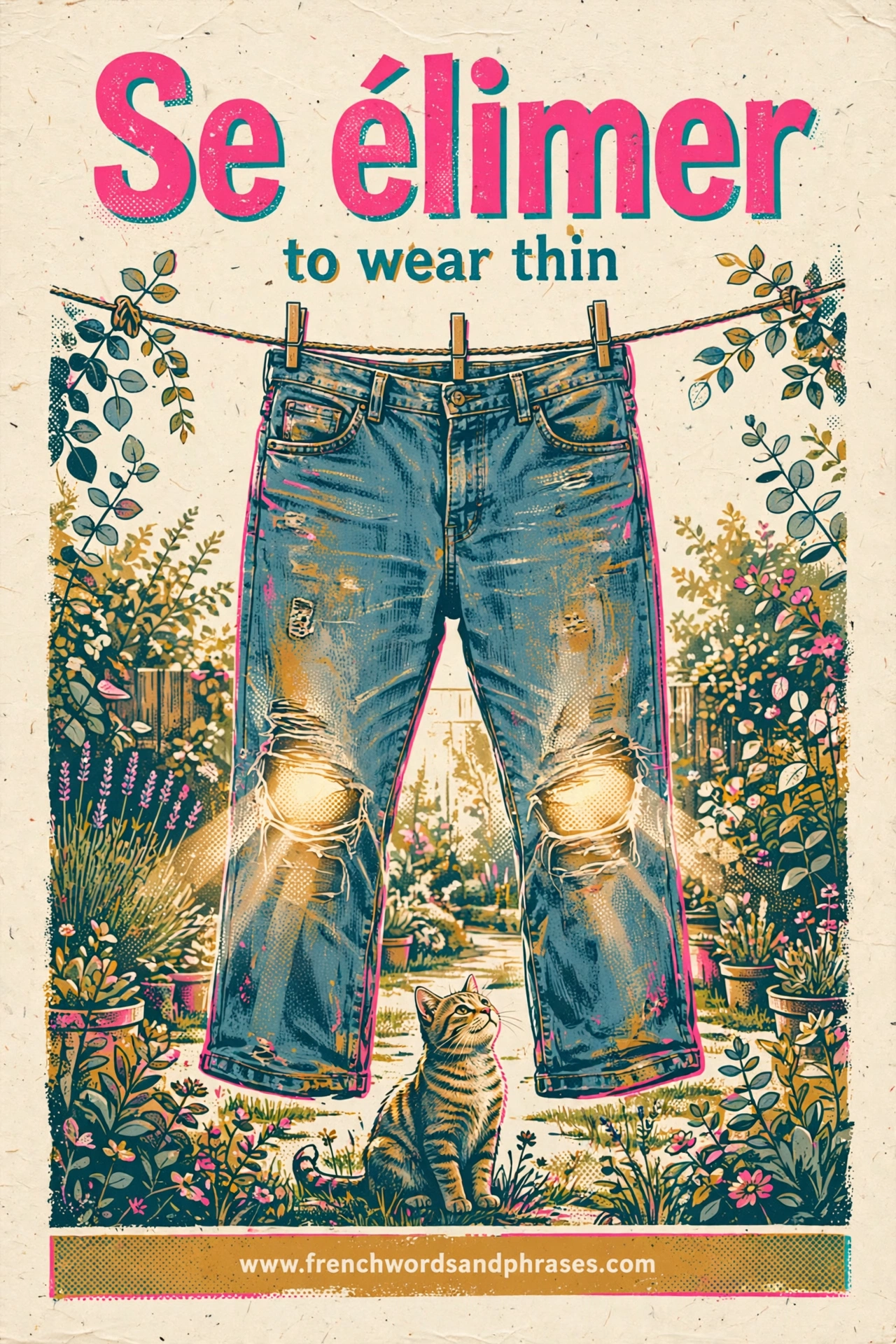
Se élimer means to wear thin — to grow threadbare all by yourself, rubbed down by your own daily use.
A bedsheet going transparent at the fold, a collar thinning against a beard, a rope paling where it crosses the same stone — se élimer is élimer turned inward: the fabric, the rope and the sole become their own story, wearing thin with nobody to blame but time and friction.
In this guide, you’ll learn how to conjugate se élimer in all the major French tenses and moods. Explore complete conjugation tables, French examples, English translations, and practice quizzes.
Understanding the French Verb Se élimer
Se élimer is a regular French verb belonging to the first group of verbs, those ending in-er.
It means to wear thin. It is commonly used of fabrics, linen, collars, straps and ropes wearing thin at the point of greatest friction — s’élimer aux coudes, aux genoux, aux plis — and its participle is the standard word for threadbare: un col élimé, une serviette élimée. Where user, user is the everyday alternative for things generally wearing out, s’élimer is precise: thinner, specifically, by rubbing.
Verb classification: First group (-er), reflexive
Auxiliary verb: Être
Past participle: élimé
Present participle: élimant
English equivalents: To wear thin, to grow threadbare; le tissu s’élime — the fabric is wearing thin; les manches s’éliminent — the sleeves are wearing thin; un drap élimé — a sheet worn thin; s’élimer aux coudes — to wear thin at the elbows.
One important detail: se élimer is the reflexive of élimer — the plain verb needs a culprit (le frottement élime le tissu), while the reflexive lets the thing wear thin on its own stage: le tissu s’élime. Being reflexive, it takes être in every compound tense and the participle agrees: la nappe s’est élimée, les gants se sont élimés. Watch the third person plural: les manches s’éliminent looks exactly like the verb éliminer at work — context, and the sleeves, tell you it is only wearing thin, not eliminating anything.
Experience the Word
Se élimer is the verb of the threadbare — the moment a thing has given so much of itself that the light comes through.
Imagine a grandmother’s tablecloth, washed a thousand times. In the middle, where the hot dishes have always landed, the pattern has faded to a ghost and the cloth is nearly transparent. La nappe s’est élimée exactly where life touched it most — the wear is a map of every family dinner it ever served.
Nobody has torn or ruined it. It has worn thin — élimée — at the very places it was loved most.
How to Conjugate Se élimer: Complete French Conjugation Guide
Let’s explore every major conjugation of se élimer, beginning with the indicative mood.
How to Conjugate Se élimer in the Indicative Mood
The indicative mood is used to express facts, observations, actions, and events.
How to Conjugate Se élimer in the Present Tense (Présent)
Used for actions happening now, habitual actions, and general truths.
| Subject | Conjugation |
|---|---|
| je | m’élime |
| tu | t’élimes |
| il / elle | s’élime |
| nous | nous élimons |
| vous | vous élimez |
| ils / elles | s’éliment |
Example
Ce tissu s’élime toujours aux coudes.
This fabric always wears thin at the elbows.
Quick Quiz 1
Complete the sentence:
Nous nous ______ aux genoux, disent les vieux pantalons.
Reveal the answer
élimons
Nous nous élimons aux genoux.
We wear thin at the knees.
How to Conjugate Se élimer in the Passé Composé
Used for completed actions in the past. Se élimer takes the auxiliary verb être.
| Subject | Conjugation |
|---|---|
| je | me suis élimé / me suis élimée |
| tu | t’es élimé / t’es élimée |
| il / elle | s’est élimé / s’est élimée |
| nous | nous sommes élimés / nous sommes élimées |
| vous | vous êtes élimés / vous êtes élimées / vous êtes élimé / vous êtes élimée |
| ils / elles | se sont élimés / se sont élimées |
Example
Ton pull s’est élimé aux manches en un seul hiver.
Your jumper wore thin at the sleeves in a single winter.
How to Conjugate Se élimer in the Imparfait (Imperfect Tense)
Used for habitual past actions, descriptions, and ongoing situations in the past.
| Subject | Conjugation |
|---|---|
| je | m’élimais |
| tu | t’élimais |
| il / elle | s’élimait |
| nous | nous élimions |
| vous | vous élimiez |
| ils / elles | s’élimaient |
Example
Le linge s’élimait à force de lavages.
The linen used to wear thin from so much washing.
Quick Quiz 2
Choose the correct form:
The tablecloth had worn thin.
La nappe ______ au milieu. (s’était élimée / avait élimé)
Reveal the answer
s’était élimée
La nappe s’était élimée au milieu.
Se élimer is reflexive, takes être, and the participle agrees: élimée.
How to Conjugate Se élimer in the Plus-que-parfait
Used to describe an action that had already been completed before another past event.
| Subject | Conjugation |
|---|---|
| je | m’étais élimé / m’étais élimée |
| tu | t’étais élimé / t’étais élimée |
| il / elle | s’était élimé / s’était élimée |
| nous | nous étions élimés / nous étions élimées |
| vous | vous étiez élimés / vous étiez élimées / vous étiez élimé / vous étiez élimée |
| ils / elles | s’étaient élimés / s’étaient élimées |
Example
La nappe s’était élimée là où l’on posait les plats chauds.
The tablecloth had worn thin where the hot dishes were put down.
How to Conjugate Se élimer in the Passé Simple
Primarily used in formal writing, literature, and historical narratives. It is rarely used in everyday conversation.
| Subject | Conjugation |
|---|---|
| je | m’élimai |
| tu | t’élimas |
| il / elle | s’élima |
| nous | nous élimâmes |
| vous | vous élimâtes |
| ils / elles | s’élimèrent |
Example
Le drap s’élima en une saison d’usage quotidien.
The sheet wore thin in one season of daily use.
How to Conjugate Se élimer in the Passé Antérieur
A literary tense used to express an action completed immediately before another past action, generally in the passé simple.
| Subject | Conjugation |
|---|---|
| je | me fus élimé / me fus élimée |
| tu | te fus élimé / te fus élimée |
| il / elle | se fut élimé / se fut élimée |
| nous | nous fûmes élimés / nous fûmes élimées |
| vous | vous fûtes élimés / vous fûtes élimées / vous fûtes élimé / vous fûtes élimée |
| ils / elles | se furent élimés / se furent élimées |
Example
Dès que la corde se fut élimée, elle rompit sous la charge.
As soon as the rope had worn thin, it snapped under the load.
How to Conjugate Se élimer in the Future Tense (Futur Simple)
Used to describe actions that will take place in the future.
| Subject | Conjugation |
|---|---|
| je | m’élimerai |
| tu | t’élimeras |
| il / elle | s’élimera |
| nous | nous élimerons |
| vous | vous élimerez |
| ils / elles | s’élimeront |
Example
Avec ce frottement, la sangle s’élimera vite.
With this rubbing, the strap will wear thin quickly.
How to Conjugate Se élimer in the Futur Antérieur (Future Perfect)
Used for an action that will have been completed before a particular point in the future.
| Subject | Conjugation |
|---|---|
| je | me serai élimé / me serai élimée |
| tu | te seras élimé / te seras élimée |
| il / elle | se sera élimé / se sera élimée |
| nous | nous serons élimés / nous serons élimées |
| vous | vous serez élimés / vous serez élimées / vous serez élimé / vous serez élimée |
| ils / elles | se seront élimés / se seront élimées |
Example
À la fin de l’hiver, tes gants se seront élimés aux doigts.
By the end of winter, your gloves will have worn thin at the fingers.
How to Conjugate Se élimer in the Near Future (Futur Proche)
Used to describe something that is going to happen soon. Formed with aller + infinitive.
| Subject | Conjugation |
|---|---|
| je | vais m’élimer |
| tu | vas t’élimer |
| il / elle | va s’élimer |
| nous | allons nous élimer |
| vous | allez vous élimer |
| ils / elles | vont s’élimer |
Example
Regarde, ton col va s’élimer contre ta barbe.
Look, your collar is going to wear thin against your beard.
How to Conjugate Se élimer in the Conditional Mood
The conditional mood expresses what would happen under certain circumstances. It is also frequently used to make polite requests or express wishes.
How to Conjugate Se élimer in the Present Conditional
| Subject | Conjugation |
|---|---|
| je | m’élimerais |
| tu | t’élimerais |
| il / elle | s’élimerait |
| nous | nous élimerions |
| vous | vous élimeriez |
| ils / elles | s’élimeraient |
Example
Un coton épais s’élimerait moins vite.
A thick cotton would wear thin less quickly.
How to Conjugate Se élimer in the Past Conditional
| Subject | Conjugation |
|---|---|
| je | me serais élimé / me serais élimée |
| tu | te serais élimé / te serais élimée |
| il / elle | se serait élimé / se serait élimée |
| nous | nous serions élimés / nous serions élimées |
| vous | vous seriez élimés / vous seriez élimées / vous seriez élimé / vous seriez élimée |
| ils / elles | se seraient élimés / se seraient élimées |
Example
La doublure se serait élimée sans le renfort de cuir.
The lining would have worn thin without the leather reinforcement.
Se élimer in the Literary Past Conditional Form
This less common literary form uses the imperfect subjunctive of être.
| Subject | Conjugation |
|---|---|
| je | me fusse élimé / me fusse élimée |
| tu | te fusses élimé / te fusses élimée |
| il / elle | se fût élimé / se fût élimée |
| nous | nous fussions élimés / nous fussions élimées |
| vous | vous fussiez élimés / vous fussiez élimées / vous fussiez élimé / vous fussiez élimée |
| ils / elles | se fussent élimés / se fussent élimées |
Example
La tapisserie se fût élimée en dix ans sans les volets.
The tapestry would have worn thin in ten years without the shutters.
How to Conjugate Se élimer in the Subjunctive Mood
The subjunctive is used to express wishes, emotions, doubts, necessity, and uncertainty. It frequently follows expressions such as il faut que (it is necessary that) or bien que (although).
How to Conjugate Se élimer in the Present Subjunctive
| Subject | Conjugation |
|---|---|
| que je | m’élime |
| que tu | t’élimes |
| qu’il / qu’elle | s’élime |
| que nous | nous élimions |
| que vous | vous élimiez |
| qu’ils / qu’elles | s’éliment |
Example
Il est dommage que ce beau tissu s’élime si vite.
It is a pity this fine fabric wears thin so quickly.
Quick Quiz 3
Complete the sentence using the subjunctive:
On craignait que la corde ______ avant la traversée.
Reveal the answer
s’élime
On craignait que la corde s’élime avant la traversée.
People feared the rope might wear thin before the crossing.
How to Conjugate Se élimer in the Imperfect Subjunctive
A literary tense, rarely encountered in modern spoken French.
| Subject | Conjugation |
|---|---|
| que je | m’élimasse |
| que tu | t’élimasses |
| qu’il / qu’elle | s’élimât |
| que nous | nous élimassions |
| que vous | vous élimassiez |
| qu’ils / qu’elles | s’élimassent |
Example
On craignait que la corde s’élimât avant la fin de la traversée.
People feared the rope might wear thin before the end of the crossing.
How to Conjugate Se élimer in the Pluperfect Subjunctive
A literary construction used to express an action completed before another past action.
| Subject | Conjugation |
|---|---|
| que je | me fusse élimé / me fusse élimée |
| que tu | te fusses élimé / te fusses élimée |
| qu’il / qu’elle | se fût élimé / se fût élimée |
| que nous | nous fussions élimés / nous fussions élimées |
| que vous | vous fussiez élimés / vous fussiez élimées / vous fussiez élimé / vous fussiez élimée |
| qu’ils / qu’elles | se fussent élimés / se fussent élimées |
Example
On voyait que la nappe se fût élimée en quelques mois d’usage.
You could see the tablecloth had worn thin in a few months of use.
How to Conjugate Se élimer in the Past Subjunctive
| Subject | Conjugation |
|---|---|
| que je | me sois élimé / me sois élimée |
| que tu | te sois élimé / te sois élimée |
| qu’il / qu’elle | se soit élimé / se soit élimée |
| que nous | nous soyons élimés / nous soyons élimées |
| que vous | vous soyez élimés / vous soyez élimées / vous soyez élimé / vous soyez élimée |
| qu’ils / qu’elles | se soient élimés / se soient élimées |
Example
Je suis étonné que la veste se soit élimée si vite.
I am surprised the jacket wore thin so quickly.
How to Conjugate Se élimer in the Imperative
The imperative is used to give commands, instructions, invitations, or suggestions. Subject pronouns are omitted.
How to Conjugate Se élimer in the Present Imperative
| Person | Conjugation |
|---|---|
| (tu) | élime-toi |
| (nous) | élimons-nous |
| (vous) | élimez-vous |
Example
Ne t’élime pas si vite, vieux drap !
Do not wear thin so fast, old sheet!
Quick Quiz 4
How would you say Do not wear thin so fast (tu form)?
Reveal the answer
Ne t’élime pas si vite !
French Participles of Se élimer
Participles are verb forms that can be used in compound tenses and other grammatical constructions.
Present Participle of Se élimer
élimant
En s’élimant aux plis, le drap finit par se déchirer.
By wearing thin at the folds, the sheet ends up tearing.
Past Participle of Se élimer
élimé
Élimée par les lavages, la serviette est devenue transparente.
Worn thin by washing, the towel has become transparent.
Se élimer in Everyday French: Real-Life Examples
Now that you know the conjugations, let’s see how se élimer appears in everyday French.
Example 1 — Present
Ce tissu s’élime aux coudes.
This fabric wears thin at the elbows.
Example 2 — Passé composé
Ton pull s’est élimé aux manches.
Your jumper wore thin at the sleeves.
Example 3 — Imparfait
Le linge s’élimait à force de lavages.
The linen used to wear thin from washing.
Example 4 — Future
La sangle s’élimera vite avec ce frottement.
The strap will wear thin quickly with this rubbing.
Example 5 — Conditional
Un coton épais s’élimerait moins vite.
A thick cotton would wear thin less quickly.
Example 6 — Imperative
Ne t’élime pas si vite, vieux drap !
Do not wear thin so fast, old sheet!
Beyond Translation: The Meaning of Se élimer
Between élimer and se élimer lies the whole difference between blame and biography: the plain verb accuses the friction, the reflexive simply tells the thing’s own story.
What s’élime wears its history on its surface.
The tablecloth thins where the dishes landed, the collar where the beard rubs, the rope where the stone waits — hold any of them to the light and you can read, in the transparent patch, exactly how the thing was used and loved.
How to Remember the French Verb Se élimer
Remember it this way: Se élimer is about the grandmother’s tablecloth — transparent exactly where the hot dishes landed.
- Reflexive and être: la nappe s’est élimée — and the participle agrees with the thing that thinned.
- Élimer blames the friction; se élimer lets the fabric tell its own story — le tissu s’élime aux coudes.
- Regular -er underneath: je m’élime, nous nous élimons, past participle élimé.
The key idea is the grandmother’s tablecloth — transparent exactly where the hot dishes landed.
Test Your Knowledge of Se élimer
Let’s see how much you’ve learned. Try answering these questions before revealing the answers.
Question 1
Which auxiliary does se élimer use, and why?
Reveal the answer
Être — it is a reflexive verb: la nappe s’est élimée.
Question 2
How do you say This fabric wears thin at the elbows in French?
Reveal the answer
Ce tissu s’élime aux coudes.
Question 3
Translate: Your jumper wore thin at the sleeves in a single winter.
Reveal the answer
Ton pull s’est élimé aux manches en un seul hiver.
Question 4
What is the past participle of se élimer?
Reveal the answer
Élimé — agreeing: élimée, élimés, élimées.
Question 5
Complete the sentence:
Il est dommage que ce beau tissu ______ si vite.
Reveal the answer
s’élime
Il est dommage que ce beau tissu s’élime si vite.
It is a pity this fine fabric wears thin so quickly.
Your Final Challenge
Can You Use It?
How would you say this in French?
The sheet wore thin at the folds, where a thousand nights touched it with their dreams.
Reveal the answer
Le drap s’est élimé aux plis, là où mille nuits l’ont touché de leurs rêves.
The sheet wore thin at the folds, where a thousand nights touched it with their dreams.
A little French. A little curiosity. A richer everyday life.
LEARN FRENCH ONE WORD AT A TIME