A French Word to Live By
How to Conjugate Élaborer in French
/e.la.bɔ.ʁe/
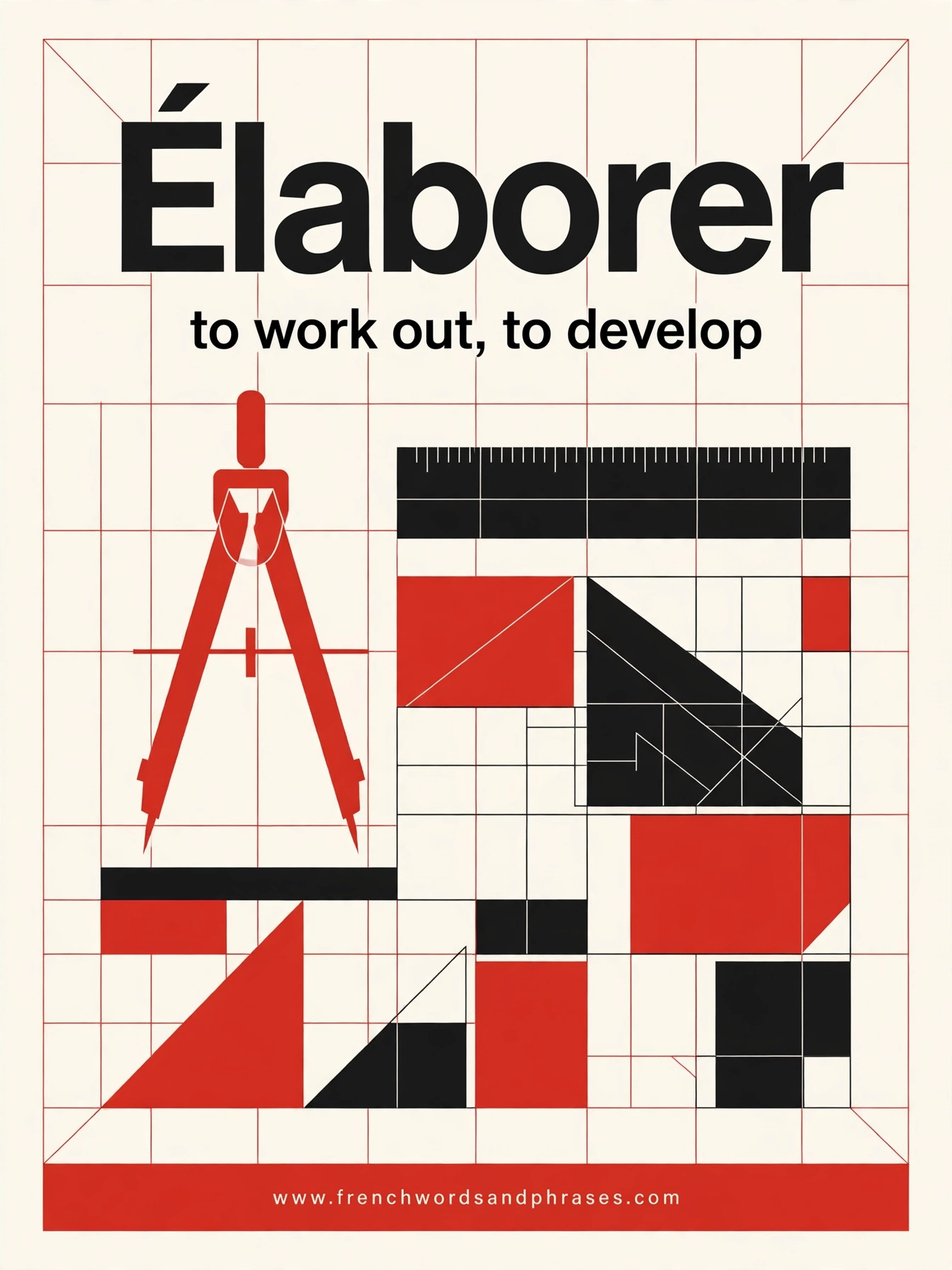
Élaborer means to work out, to develop — to build something slowly and carefully, idea by idea, until a rough notion becomes a finished plan, theory or law.
A committee drafting a law clause by clause, a scientist shaping a theory over ten years, a Champagne house blending a cuvée — élaborer is the verb of careful construction: nothing about it is quick, and everything about it is deliberate.
In this guide, you’ll learn how to conjugate élaborer in all the major French tenses and moods. Explore complete conjugation tables, French examples, English translations, and practice quizzes.
Understanding the French Verb Élaborer
Élaborer is a regular French verb belonging to the first group of verbs, those ending in-er.
It means to work out, to develop. It is the standard verb for drawing up plans, strategies, laws and theories, and in the wine world of Champagne it means the whole craft of making the wine, from pressing to blending. Its reflexive twin, s’élaborer, describes the same work seen from inside — an idea taking shape — and has its own page.
Verb classification: First group (-er)
Auxiliary verb: Avoir
Past participle: élaboré
Present participle: élaborant
English equivalents: To work out, to develop, to draw up; élaborer un plan — to work out a plan; élaborer une théorie — to develop a theory; élaborer une loi — to draft a law; élaborer un vin — to make, to craft a wine; un produit élaboré — a processed, sophisticated product.
One important detail: élaborer is work done slowly and in stages — you do not élaborer in a hurry, and the word itself says so, since it contains labor, work. It is perfectly regular: j’élabore, nous élaborons, past participle élaboré. Watch the family: un plan élaboré is a carefully worked-out plan, and in food French un plat élaboré is a sophisticated, elaborate dish — the adjective always praises the work inside the thing.
Experience the Word
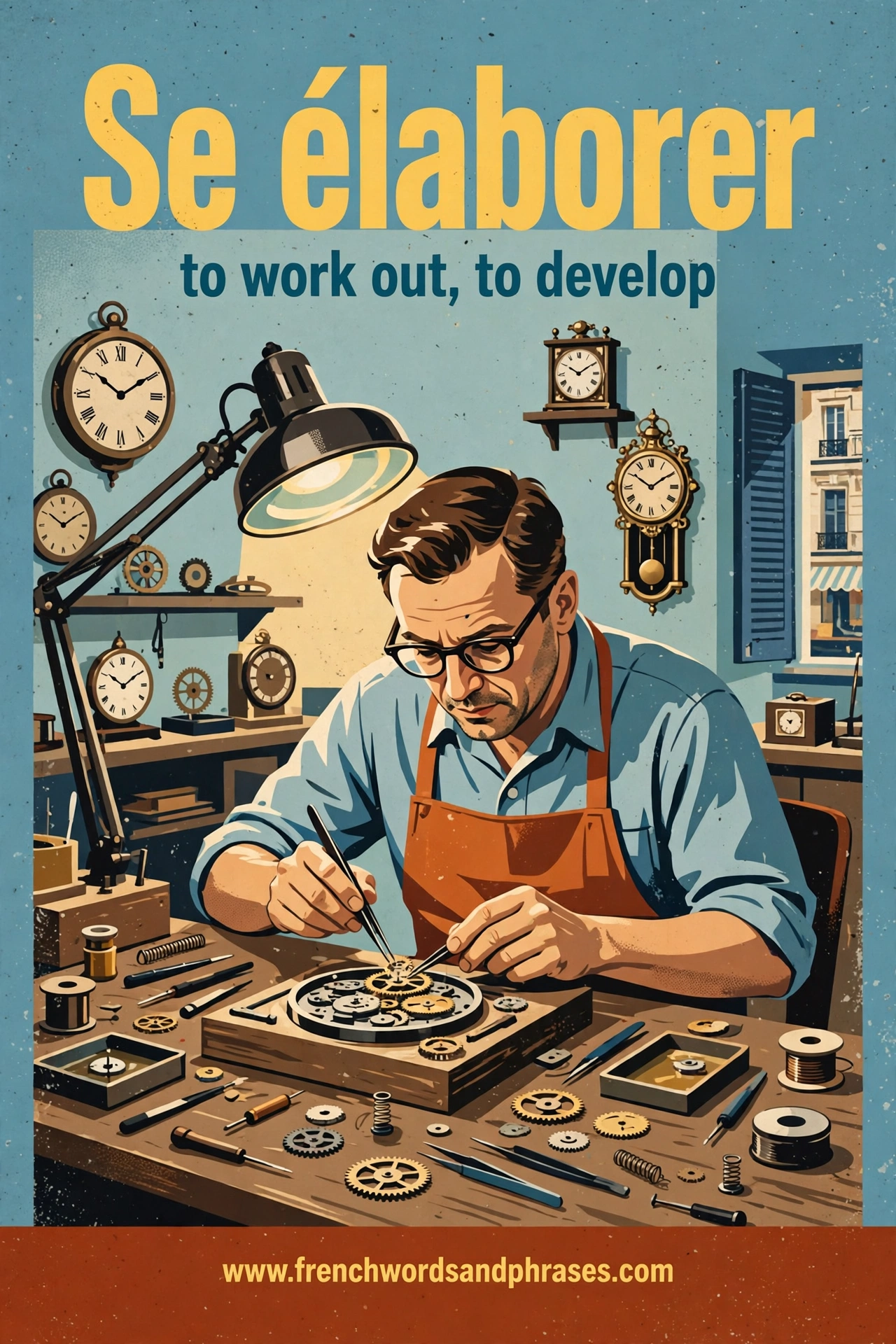
Élaborer is the verb of the long table — papers spread out, coffee going cold, and a plan being built line by line.
Imagine a small team in a Paris office in January. The idea arrived in one excited sentence before Christmas; now it must become real. Week after week, ils élaborent le projet — a budget here, a doubt removed there, a page rewritten ten times — until one morning the rough sentence has become a plan that can survive the world.
Nothing was invented in a flash. It was worked out — élaboré, patiently, by hand and mind.
How to Conjugate Élaborer: Complete French Conjugation Guide
Let’s explore every major conjugation of élaborer, beginning with the indicative mood.
How to Conjugate Élaborer in the Indicative Mood
The indicative mood is used to express facts, observations, actions, and events.
How to Conjugate Élaborer in the Present Tense (Présent)
Used for actions happening now, habitual actions, and general truths.
| Subject | Conjugation |
|---|---|
| je | élabore |
| tu | élabores |
| il / elle | élabore |
| nous | élaborons |
| vous | élaborez |
| ils / elles | élaborent |
Example
Le comité élabore un plan pour réduire les coûts.
The committee is working out a plan to cut costs.
Quick Quiz 1
Complete the sentence:
Nous ______ une stratégie pour l’hiver.
Reveal the answer
élaborons
Nous élaborons une stratégie pour l’hiver.
We are working out a strategy for the winter.
How to Conjugate Élaborer in the Passé Composé
Used for completed actions in the past. Élaborer takes the auxiliary verb avoir.
| Subject | Conjugation |
|---|---|
| j’ | ai élaboré |
| tu | as élaboré |
| il / elle | a élaboré |
| nous | avons élaboré |
| vous | avez élaboré |
| ils / elles | ont élaboré |
Example
Elle a élaboré une théorie nouvelle sur le climat.
She developed a new theory about the climate.
How to Conjugate Élaborer in the Imparfait (Imperfect Tense)
Used for habitual past actions, descriptions, and ongoing situations in the past.
| Subject | Conjugation |
|---|---|
| je | élaborais |
| tu | élaborais |
| il / elle | élaborait |
| nous | élaborions |
| vous | élaboriez |
| ils / elles | élaboraient |
Example
Nous élaborions la loi article par article.
We were drafting the law article by article.
Quick Quiz 2
Choose the correct form:
She developed a new theory.
Elle ______ une théorie nouvelle. (a élaboré / est élaborée)
Reveal the answer
a élaboré
Elle a élaboré une théorie nouvelle.
Élaborer takes avoir.
How to Conjugate Élaborer in the Plus-que-parfait
Used to describe an action that had already been completed before another past event.
| Subject | Conjugation |
|---|---|
| j’ | avais élaboré |
| tu | avais élaboré |
| il / elle | avait élaboré |
| nous | avions élaboré |
| vous | aviez élaboré |
| ils / elles | avaient élaboré |
Example
Il avait élaboré son projet pendant des années.
He had been developing his project for years.
How to Conjugate Élaborer in the Passé Simple
Primarily used in formal writing, literature, and historical narratives. It is rarely used in everyday conversation.
| Subject | Conjugation |
|---|---|
| je | élaborai |
| tu | élaboras |
| il / elle | élabora |
| nous | élaborâmes |
| vous | élaborâtes |
| ils / elles | élaborèrent |
Example
Darwin élabora sa théorie après son voyage.
Darwin worked out his theory after his voyage.
How to Conjugate Élaborer in the Passé Antérieur
A literary tense used to express an action completed immediately before another past action, generally in the passé simple.
| Subject | Conjugation |
|---|---|
| j’ | eus élaboré |
| tu | eus élaboré |
| il / elle | eut élaboré |
| nous | eûmes élaboré |
| vous | eûtes élaboré |
| ils / elles | eurent élaboré |
Example
Quand ils eurent élaboré le plan, ils le présentèrent au maire.
When they had worked out the plan, they presented it to the mayor.
How to Conjugate Élaborer in the Future Tense (Futur Simple)
Used to describe actions that will take place in the future.
| Subject | Conjugation |
|---|---|
| je | élaborerai |
| tu | élaboreras |
| il / elle | élaborera |
| nous | élaborerons |
| vous | élaborerez |
| ils / elles | élaboreront |
Example
L’équipe élaborera une stratégie avant l’été.
The team will develop a strategy before the summer.
How to Conjugate Élaborer in the Futur Antérieur (Future Perfect)
Used for an action that will have been completed before a particular point in the future.
| Subject | Conjugation |
|---|---|
| j’ | aurai élaboré |
| tu | auras élaboré |
| il / elle | aura élaboré |
| nous | aurons élaboré |
| vous | aurez élaboré |
| ils / elles | auront élaboré |
Example
À la fin du mois, nous aurons élaboré le programme complet.
By the end of the month, we will have worked out the full programme.
How to Conjugate Élaborer in the Near Future (Futur Proche)
Used to describe something that is going to happen soon. Formed with aller + infinitive.
| Subject | Conjugation |
|---|---|
| je | vais élaborer |
| tu | vas élaborer |
| il / elle | va élaborer |
| nous | allons élaborer |
| vous | allez élaborer |
| ils / elles | vont élaborer |
Example
Je vais élaborer un plan plus simple.
I am going to work out a simpler plan.
How to Conjugate Élaborer in the Conditional Mood
The conditional mood expresses what would happen under certain circumstances. It is also frequently used to make polite requests or express wishes.
How to Conjugate Élaborer in the Present Conditional
| Subject | Conjugation |
|---|---|
| je | élaborerais |
| tu | élaborerais |
| il / elle | élaborerait |
| nous | élaborerions |
| vous | élaboreriez |
| ils / elles | élaboreraient |
Example
Avec plus de temps, on élaborerait un meilleur système.
With more time, we would develop a better system.
How to Conjugate Élaborer in the Past Conditional
| Subject | Conjugation |
|---|---|
| j’ | aurais élaboré |
| tu | aurais élaboré |
| il / elle | aurait élaboré |
| nous | aurions élaboré |
| vous | auriez élaboré |
| ils / elles | auraient élaboré |
Example
Elle aurait élaboré le projet différemment avec plus d’argent.
She would have worked out the project differently with more money.
Élaborer in the Literary Past Conditional Form
This less common literary form uses the imperfect subjunctive of avoir.
| Subject | Conjugation |
|---|---|
| j’ | eusse élaboré |
| tu | eusses élaboré |
| il / elle | eût élaboré |
| nous | eussions élaboré |
| vous | eussiez élaboré |
| ils / elles | eussent élaboré |
Example
Le ministre eût élaboré la réforme sans la crise.
The minister would have drafted the reform without the crisis.
How to Conjugate Élaborer in the Subjunctive Mood
The subjunctive is used to express wishes, emotions, doubts, necessity, and uncertainty. It frequently follows expressions such as il faut que (it is necessary that) or bien que (although).
How to Conjugate Élaborer in the Present Subjunctive
| Subject | Conjugation |
|---|---|
| que je | élabore |
| que tu | élabores |
| qu’il / qu’elle | élabore |
| que nous | élaborions |
| que vous | élaboriez |
| qu’ils / qu’elles | élaborent |
Example
Il faut que tu élabores un plan avant vendredi.
You must work out a plan before Friday.
Quick Quiz 3
Complete the sentence using the subjunctive:
Il faut que vous ______ le programme ensemble.
Reveal the answer
élaboriez
Il faut que vous élaboriez le programme ensemble.
You must work out the programme together.
How to Conjugate Élaborer in the Imperfect Subjunctive
A literary tense, rarely encountered in modern spoken French.
| Subject | Conjugation |
|---|---|
| que je | élaborasse |
| que tu | élaborasses |
| qu’il / qu’elle | élaborât |
| que nous | élaborassions |
| que vous | élaborassiez |
| qu’ils / qu’elles | élaborassent |
Example
On souhaitait que la commission élaborât un texte plus clair.
People wanted the commission to draw up a clearer text.
How to Conjugate Élaborer in the Pluperfect Subjunctive
A literary construction used to express an action completed before another past action.
| Subject | Conjugation |
|---|---|
| que j’ | eusse élaboré |
| que tu | eusses élaboré |
| qu’il / qu’elle | eût élaboré |
| que nous | eussions élaboré |
| que vous | eussiez élaboré |
| qu’ils / qu’elles | eussent élaboré |
Example
On admirait qu’il eût élaboré cette théorie tout seul.
People admired that he had developed this theory all alone.
How to Conjugate Élaborer in the Past Subjunctive
| Subject | Conjugation |
|---|---|
| que j’ | aie élaboré |
| que tu | aies élaboré |
| qu’il / qu’elle | ait élaboré |
| que nous | ayons élaboré |
| que vous | ayez élaboré |
| qu’ils / qu’elles | aient élaboré |
Example
Je suis fier que nous ayons élaboré ce programme ensemble.
I am proud that we worked out this programme together.
How to Conjugate Élaborer in the Imperative
The imperative is used to give commands, instructions, invitations, or suggestions. Subject pronouns are omitted.
How to Conjugate Élaborer in the Present Imperative
| Person | Conjugation |
|---|---|
| (tu) | élabore |
| (nous) | élaborons |
| (vous) | élaborez |
Example
Élaborez d’abord le plan, nous discuterons après !
Work out the plan first, we will discuss it afterwards!
Quick Quiz 4
How would you say Work out a plan (tu form)?
Reveal the answer
Élabore un plan !
French Participles of Élaborer
Participles are verb forms that can be used in compound tenses and other grammatical constructions.
Present Participle of Élaborer
élaborant
En élaborant son vin, le vigneron goûte chaque cuve.
In making his wine, the winemaker tastes every vat.
Past Participle of Élaborer
élaboré
Élaboré avec soin, le plan a convaincu tout le monde.
Carefully worked out, the plan convinced everyone.
Élaborer in Everyday French: Real-Life Examples
Now that you know the conjugations, let’s see how élaborer appears in everyday French.
Example 1 — Present
Le comité élabore un plan de secours.
The committee is working out an emergency plan.
Example 2 — Passé composé
Elle a élaboré une théorie nouvelle.
She developed a new theory.
Example 3 — Imparfait
Nous élaborions la loi article par article.
We were drafting the law article by article.
Example 4 — Future
L’équipe élaborera une stratégie avant l’été.
The team will develop a strategy before the summer.
Example 5 — Conditional
On élaborerait un meilleur système avec plus de temps.
We would develop a better system with more time.
Example 6 — Imperative
Élabore un plan avant vendredi !
Work out a plan before Friday!
Beyond Translation: The Meaning of Élaborer
English elaborate is the same word grown lazy — in English it mostly means ‘detailed’, or ‘to say more’; French élaborer kept the workbench.
Inside the word sits labor — work.
To élaborer is to labour something into existence: a law, a theory, a wine. That is why French reaches for it whenever the making was slow, skilled and staged — and why un produit élaboré on a food label promises something more than merely assembled.
How to Remember the French Verb Élaborer
Remember it this way: Élaborer is about the long table — a plan built line by line, coffee going cold.
- Labor is inside the word: élaborer is labouring something into shape — a plan, a theory, a law, a wine.
- Its adjective praises careful work: un plan élaboré, un plat élaboré — worked out, sophisticated.
- Regular -er: j’élabore, nous élaborons, past participle élaboré.
The key idea is the long table — a plan built line by line, coffee going cold.
Test Your Knowledge of Élaborer
Let’s see how much you’ve learned. Try answering these questions before revealing the answers.
Question 1
What Latin word hides inside élaborer, and what does it tell you?
Reveal the answer
Labor — work: to élaborer is to work something out slowly and carefully.
Question 2
How do you say She developed a new theory in French?
Reveal the answer
Elle a élaboré une théorie nouvelle.
Question 3
Translate: We were drafting the law article by article.
Reveal the answer
Nous élaborions la loi article par article.
Question 4
What is the past participle of élaborer?
Reveal the answer
Élaboré.
Question 5
Complete the sentence:
Il faut que tu ______ un plan avant vendredi.
Reveal the answer
élabores
Il faut que tu élabores un plan avant vendredi.
You must work out a plan before Friday.
Your Final Challenge
Can You Use It?
How would you say this in French?
They worked out the plan over six months, meeting after meeting, and when the day came, it held.
Reveal the answer
Ils ont élaboré le plan pendant six mois, réunion après réunion, et le jour venu, il a tenu.
They worked out the plan over six months, meeting after meeting, and when the day came, it held.
A little French. A little curiosity. A richer everyday life.
LEARN FRENCH ONE WORD AT A TIME