A French Word to Live By
How to Conjugate Éjointer in French
/e.ʒwɛ̃.te/
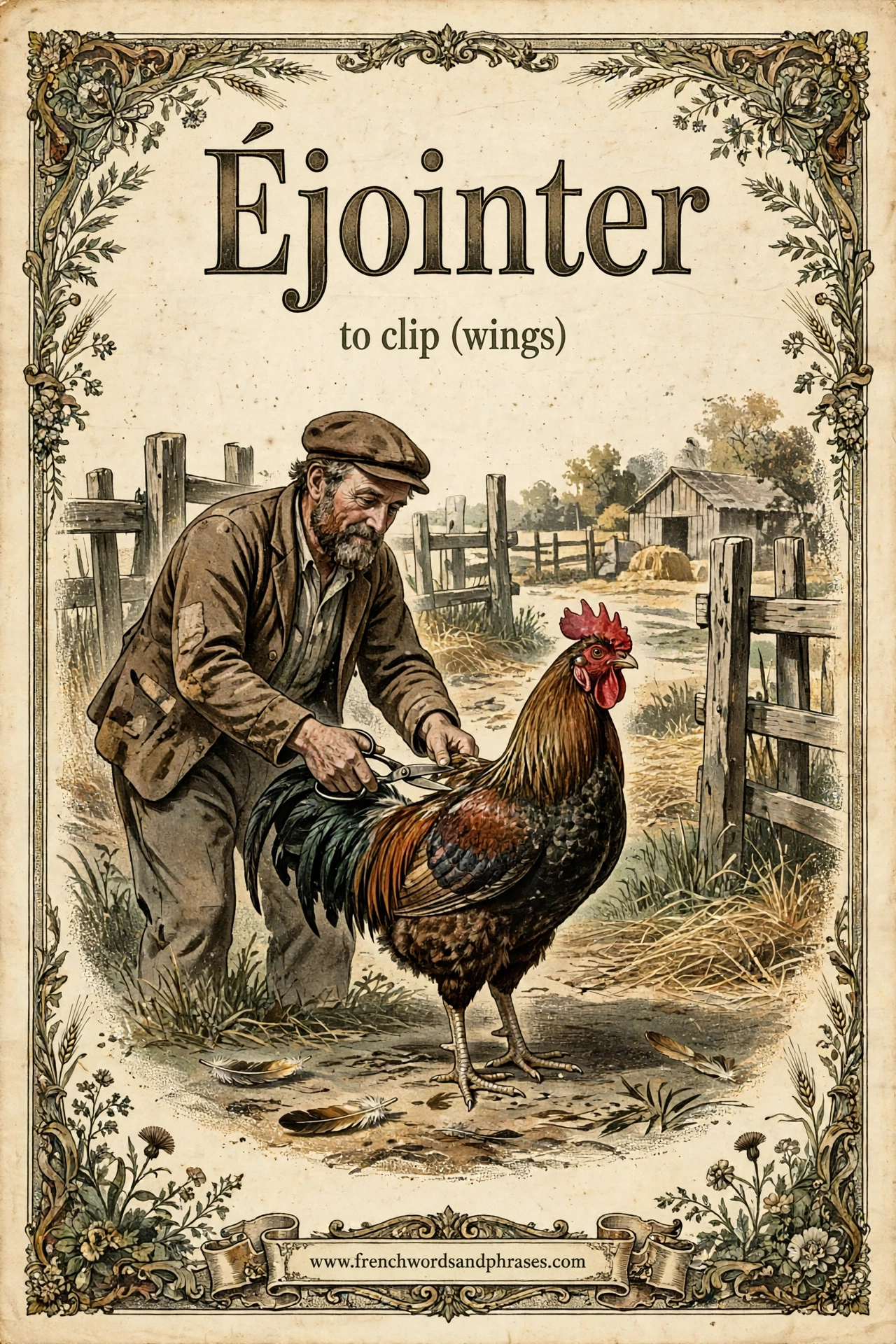
Éjointer means to clip a bird’s wings — to cut the flight feathers of one wing so the bird can no longer fly away, a falconer’s and poultry-keeper’s word.
A falconer with small sharp scissors, a farmer catching a hen that keeps escaping over the fence — éjointer is the precise, old verb for clipping the flight feathers of one wing, so a bird stays grounded but unharmed.
In this guide, you’ll learn how to conjugate éjointer in all the major French tenses and moods. Explore complete conjugation tables, French examples, English translations, and practice quizzes.
Understanding the French Verb Éjointer
Éjointer is a regular French verb belonging to the first group of verbs, those ending in-er.
It means to clip (wings). It is used by falconers for young or newly caught birds, by poultry keepers for hens and ducks that fly the fence, and in zoos and parks for ornamental birds kept on open water. Figuratively it is almost never used — French says couper les ailes à quelqu’un for clipping a person’s wings.
Verb classification: First group (-er)
Auxiliary verb: Avoir
Past participle: éjointé
Present participle: éjointant
English equivalents: To clip (a bird’s wings); éjointer un faucon — to clip a falcon’s wing; éjointer une poule — to clip a hen’s wing; les rémiges (f.) — the flight feathers; un oiseau éjointé — a bird with a clipped wing.
One important detail: éjointer clips ONE wing, not two — cutting the flight feathers (les rémiges) of a single wing unbalances the bird, which is exactly the point; clipping both would let it fly straight, only weaker. The verb is rare and technical, at home in falconry and poultry-keeping, and perfectly regular: j’éjointe, nous éjointons, past participle éjointé.
Experience the Word
Éjointer is the verb of the careful scissors — one wing shortened, and the sky is closed to the bird, gently.
Imagine a falconer at dawn, a young falcon hooded on his glove. Before training begins, he takes his small scissors and éjointe the bird — snip, snip, the long flight feathers of the left wing fall like dark ribbons. The falcon can flutter, hop and glide, but the open sky will wait until it is trained and trusted.
Nothing is broken, nothing bleeds. The wing has been clipped — éjointé — and the bird stays.
How to Conjugate Éjointer: Complete French Conjugation Guide
Let’s explore every major conjugation of éjointer, beginning with the indicative mood.
How to Conjugate Éjointer in the Indicative Mood
The indicative mood is used to express facts, observations, actions, and events.
How to Conjugate Éjointer in the Present Tense (Présent)
Used for actions happening now, habitual actions, and general truths.
| Subject | Conjugation |
|---|---|
| je | éjointe |
| tu | éjointes |
| il / elle | éjointe |
| nous | éjointons |
| vous | éjointez |
| ils / elles | éjointent |
Example
Le fauconnier éjointe le jeune faucon avant le dressage.
The falconer clips the young falcon’s wing before training.
Quick Quiz 1
Complete the sentence:
Nous ______ les poules qui s’envolent du jardin.
Reveal the answer
éjointons
Nous éjointons les poules qui s’envolent du jardin.
We clip the wings of the hens that fly out of the garden.
How to Conjugate Éjointer in the Passé Composé
Used for completed actions in the past. Éjointer takes the auxiliary verb avoir.
| Subject | Conjugation |
|---|---|
| j’ | ai éjointé |
| tu | as éjointé |
| il / elle | a éjointé |
| nous | avons éjointé |
| vous | avez éjointé |
| ils / elles | ont éjointé |
Example
Elle a éjointé les poules qui passaient la clôture.
She clipped the wings of the hens that kept getting over the fence.
How to Conjugate Éjointer in the Imparfait (Imperfect Tense)
Used for habitual past actions, descriptions, and ongoing situations in the past.
| Subject | Conjugation |
|---|---|
| je | éjointais |
| tu | éjointais |
| il / elle | éjointait |
| nous | éjointions |
| vous | éjointiez |
| ils / elles | éjointaient |
Example
Autrefois, on éjointait les canards des étangs publics.
In the old days, people clipped the wings of the ducks on public ponds.
Quick Quiz 2
Choose the correct form:
She clipped the hens’ wings.
Elle ______ les poules. (a éjointé / est éjointée)
Reveal the answer
a éjointé
Elle a éjointé les poules.
Éjointer takes avoir.
How to Conjugate Éjointer in the Plus-que-parfait
Used to describe an action that had already been completed before another past event.
| Subject | Conjugation |
|---|---|
| j’ | avais éjointé |
| tu | avais éjointé |
| il / elle | avait éjointé |
| nous | avions éjointé |
| vous | aviez éjointé |
| ils / elles | avaient éjointé |
Example
Il avait éjointé l’oie avant de la lâcher dans le pré.
He had clipped the goose’s wing before letting it loose in the meadow.
How to Conjugate Éjointer in the Passé Simple
Primarily used in formal writing, literature, and historical narratives. It is rarely used in everyday conversation.
| Subject | Conjugation |
|---|---|
| je | éjointai |
| tu | éjointas |
| il / elle | éjointa |
| nous | éjointâmes |
| vous | éjointâtes |
| ils / elles | éjointèrent |
Example
Le garde éjointa les deux paons du parc.
The keeper clipped the wings of the park’s two peacocks.
How to Conjugate Éjointer in the Passé Antérieur
A literary tense used to express an action completed immediately before another past action, generally in the passé simple.
| Subject | Conjugation |
|---|---|
| j’ | eus éjointé |
| tu | eus éjointé |
| il / elle | eut éjointé |
| nous | eûmes éjointé |
| vous | eûtes éjointé |
| ils / elles | eurent éjointé |
Example
Quand il eut éjointé le faucon, il commença le dressage.
When he had clipped the falcon’s wing, he began the training.
How to Conjugate Éjointer in the Future Tense (Futur Simple)
Used to describe actions that will take place in the future.
| Subject | Conjugation |
|---|---|
| je | éjointerai |
| tu | éjointeras |
| il / elle | éjointera |
| nous | éjointerons |
| vous | éjointerez |
| ils / elles | éjointeront |
Example
Demain, nous éjointerons les jeunes canards.
Tomorrow, we will clip the young ducks’ wings.
How to Conjugate Éjointer in the Futur Antérieur (Future Perfect)
Used for an action that will have been completed before a particular point in the future.
| Subject | Conjugation |
|---|---|
| j’ | aurai éjointé |
| tu | auras éjointé |
| il / elle | aura éjointé |
| nous | aurons éjointé |
| vous | aurez éjointé |
| ils / elles | auront éjointé |
Example
À la fin de la semaine, le fauconnier aura éjointé tous les jeunes oiseaux.
By the end of the week, the falconer will have clipped all the young birds’ wings.
How to Conjugate Éjointer in the Near Future (Futur Proche)
Used to describe something that is going to happen soon. Formed with aller + infinitive.
| Subject | Conjugation |
|---|---|
| je | vais éjointer |
| tu | vas éjointer |
| il / elle | va éjointer |
| nous | allons éjointer |
| vous | allez éjointer |
| ils / elles | vont éjointer |
Example
Je vais éjointer cette poule, elle s’envole partout.
I am going to clip this hen’s wing, she flies everywhere.
How to Conjugate Éjointer in the Conditional Mood
The conditional mood expresses what would happen under certain circumstances. It is also frequently used to make polite requests or express wishes.
How to Conjugate Éjointer in the Present Conditional
| Subject | Conjugation |
|---|---|
| je | éjointerais |
| tu | éjointerais |
| il / elle | éjointerait |
| nous | éjointerions |
| vous | éjointeriez |
| ils / elles | éjointeraient |
Example
Sans ciseaux adaptés, on éjointerait mal les oiseaux.
Without proper scissors, you would clip the birds’ wings badly.
How to Conjugate Éjointer in the Past Conditional
| Subject | Conjugation |
|---|---|
| j’ | aurais éjointé |
| tu | aurais éjointé |
| il / elle | aurait éjointé |
| nous | aurions éjointé |
| vous | auriez éjointé |
| ils / elles | auraient éjointé |
Example
Elle aurait éjointé les canards si elle avait eu le temps.
She would have clipped the ducks’ wings if she had had the time.
Éjointer in the Literary Past Conditional Form
This less common literary form uses the imperfect subjunctive of avoir.
| Subject | Conjugation |
|---|---|
| j’ | eusse éjointé |
| tu | eusses éjointé |
| il / elle | eût éjointé |
| nous | eussions éjointé |
| vous | eussiez éjointé |
| ils / elles | eussent éjointé |
Example
Le garde eût éjointé les paons avant la fête du village.
The keeper would have clipped the peacocks’ wings before the village fête.
How to Conjugate Éjointer in the Subjunctive Mood
The subjunctive is used to express wishes, emotions, doubts, necessity, and uncertainty. It frequently follows expressions such as il faut que (it is necessary that) or bien que (although).
How to Conjugate Éjointer in the Present Subjunctive
| Subject | Conjugation |
|---|---|
| que je | éjointe |
| que tu | éjointes |
| qu’il / qu’elle | éjointe |
| que nous | éjointions |
| que vous | éjointiez |
| qu’ils / qu’elles | éjointent |
Example
Il faut que tu éjointes une seule aile, jamais les deux.
You must clip one wing only, never both.
Quick Quiz 3
Complete the sentence using the subjunctive:
Il faut que vous ______ une seule aile.
Reveal the answer
éjointiez
Il faut que vous éjointiez une seule aile.
You must clip one wing only.
How to Conjugate Éjointer in the Imperfect Subjunctive
A literary tense, rarely encountered in modern spoken French.
| Subject | Conjugation |
|---|---|
| que je | éjointasse |
| que tu | éjointasses |
| qu’il / qu’elle | éjointât |
| que nous | éjointassions |
| que vous | éjointassiez |
| qu’ils / qu’elles | éjointassent |
Example
Le fauconnier voulait qu’on éjointât l’oiseau avant l’hiver.
The falconer wanted the bird’s wing clipped before winter.
How to Conjugate Éjointer in the Pluperfect Subjunctive
A literary construction used to express an action completed before another past action.
| Subject | Conjugation |
|---|---|
| que j’ | eusse éjointé |
| que tu | eusses éjointé |
| qu’il / qu’elle | eût éjointé |
| que nous | eussions éjointé |
| que vous | eussiez éjointé |
| qu’ils / qu’elles | eussent éjointé |
Example
On disait qu’il eût éjointé les faucons du roi lui-même.
People said he had clipped the king’s own falcons’ wings.
How to Conjugate Éjointer in the Past Subjunctive
| Subject | Conjugation |
|---|---|
| que j’ | aie éjointé |
| que tu | aies éjointé |
| qu’il / qu’elle | ait éjointé |
| que nous | ayons éjointé |
| que vous | ayez éjointé |
| qu’ils / qu’elles | aient éjointé |
Example
Je suis content qu’elle ait éjointé les poules proprement.
I am glad she clipped the hens’ wings neatly.
How to Conjugate Éjointer in the Imperative
The imperative is used to give commands, instructions, invitations, or suggestions. Subject pronouns are omitted.
How to Conjugate Éjointer in the Present Imperative
| Person | Conjugation |
|---|---|
| (tu) | éjointe |
| (nous) | éjointons |
| (vous) | éjointez |
Example
Éjointez l’aile gauche, doucement !
Clip the left wing, gently!
Quick Quiz 4
How would you say Clip one wing only (tu form)?
Reveal the answer
Éjointe une seule aile !
French Participles of Éjointer
Participles are verb forms that can be used in compound tenses and other grammatical constructions.
Present Participle of Éjointer
éjointant
En éjointant la poule, elle lui parle pour la calmer.
While clipping the hen’s wing, she talks to it to keep it calm.
Past Participle of Éjointer
éjointé
Éjointée d’une aile, la cane reste près de l’étang.
With one wing clipped, the duck stays near the pond.
Éjointer in Everyday French: Real-Life Examples
Now that you know the conjugations, let’s see how éjointer appears in everyday French.
Example 1 — Present
Le fauconnier éjointe le jeune faucon.
The falconer clips the young falcon’s wing.
Example 2 — Passé composé
Elle a éjointé les poules du jardin.
She clipped the garden hens’ wings.
Example 3 — Imparfait
On éjointait les canards des étangs publics.
People used to clip the wings of the ducks on public ponds.
Example 4 — Future
Nous éjointerons les jeunes canards demain.
We will clip the young ducks’ wings tomorrow.
Example 5 — Conditional
On éjointerait mal les oiseaux sans bons ciseaux.
You would clip the birds’ wings badly without good scissors.
Example 6 — Imperative
Éjointe une seule aile, jamais les deux !
Clip one wing only, never both!
Beyond Translation: The Meaning of Éjointer
English says to clip a bird’s wings with a phrase; French has this single, exact verb, inherited from the centuries when falconry was a science and a sport of kings.
One wing, never two — the detail is inside the verb.
Clip one wing and the bird is unbalanced and grounded; the word carries the whole technique in its definition, the way old specialist vocabularies do — a tool made of language, from the days of hooded falcons and walled gardens.
How to Remember the French Verb Éjointer
Remember it this way: Éjointer is about the falconer’s scissors — one wing clipped, and the sky waits.
- A falconer’s word: éjointer is clipping the flight feathers of ONE wing so a bird cannot fly away.
- One wing only — clip both and the bird can still fly straight; the unbalance is the technique.
- Regular -er: j’éjointe, nous éjointons, past participle éjointé.
The key idea is the falconer’s scissors — one wing clipped, and the sky waits.
Test Your Knowledge of Éjointer
Let’s see how much you’ve learned. Try answering these questions before revealing the answers.
Question 1
Why does éjointer clip only one wing?
Reveal the answer
To unbalance the bird — with both wings clipped it could still fly straight, only more weakly.
Question 2
How do you say She clipped the garden hens’ wings in French?
Reveal the answer
Elle a éjointé les poules du jardin.
Question 3
Translate: You must clip one wing only, never both.
Reveal the answer
Il faut que tu éjointes une seule aile, jamais les deux.
Question 4
What is the past participle of éjointer?
Reveal the answer
Éjointé — agreeing: éjointée, éjointés.
Question 5
Complete the sentence:
Demain, nous ______ les jeunes canards.
Reveal the answer
éjointerons
Demain, nous éjointerons les jeunes canards.
Tomorrow, we will clip the young ducks’ wings.
Your Final Challenge
Can You Use It?
How would you say this in French?
The falconer clips the young bird’s wing with a steady hand: freedom will come later, when trust is there.
Reveal the answer
Le fauconnier éjointe le jeune oiseau d’une main sûre : la liberté viendra plus tard, quand la confiance sera là.
The falconer clips the young bird’s wing with a steady hand: freedom will come later, when trust is there.
A little French. A little curiosity. A richer everyday life.
LEARN FRENCH ONE WORD AT A TIME