A French Word to Live By
How to Conjugate Égriser in French
/e.ɡʁi.ze/
Égriser means to grind — to rub a rough precious stone down with abrasive powder, the diamond-cutter’s slow first work before the facets can begin.
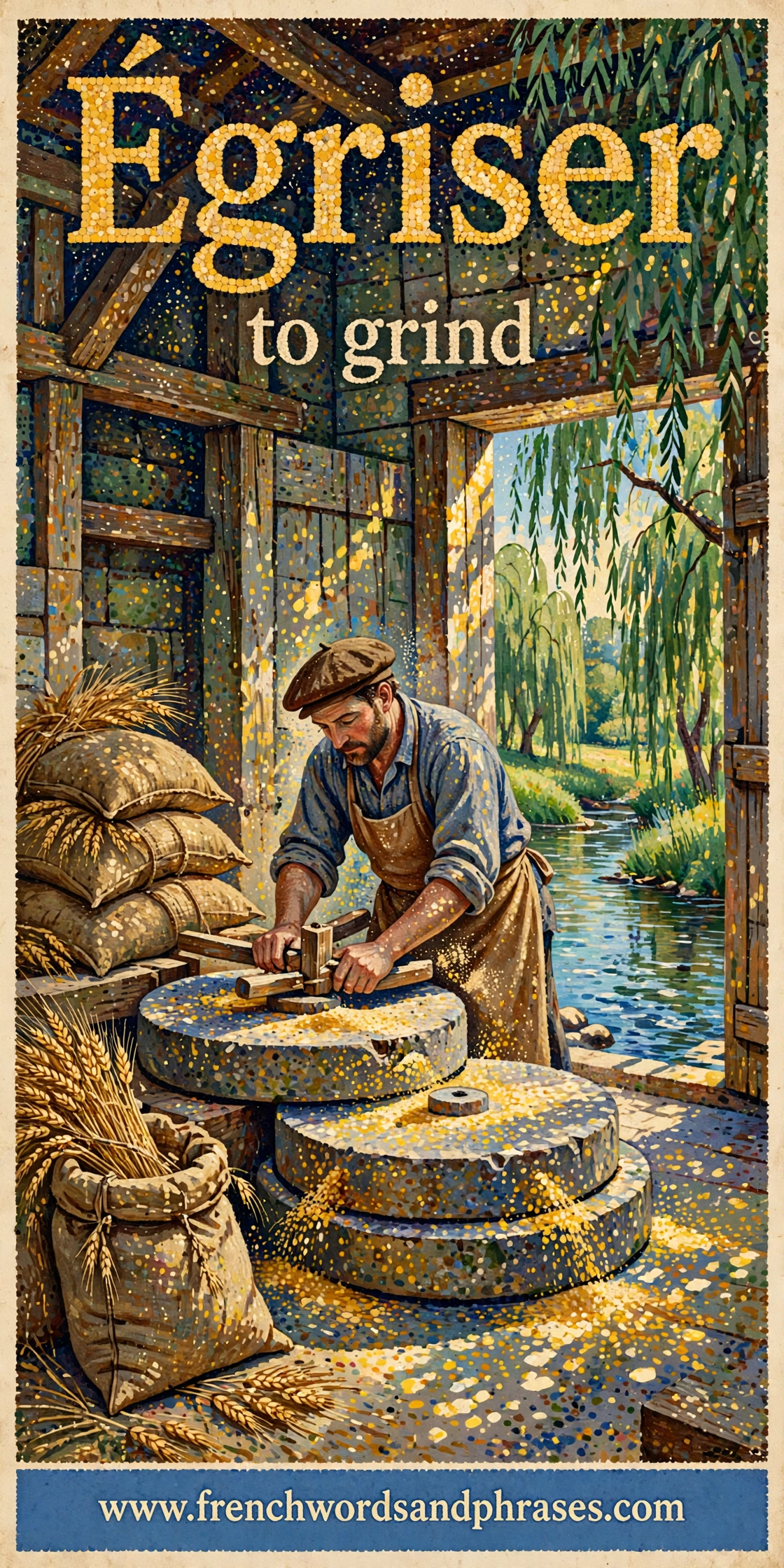
In a diamond workshop, before any brilliance, there is a grey wheel, a pot of diamond dust and a man leaning over a rough stone for days. Égriser is that first, patient grinding: the stone is shaped by being rubbed against its own powder, until the lump that came out of the earth is ready to be cut.
In this guide, you’ll learn how to conjugate égriser in all the major French tenses and moods. Explore complete conjugation tables, French examples, English translations, and practice quizzes.
Understanding the French Verb Égriser
Égriser is a regular French verb belonging to the first group of verbs, those ending in-er.
It means to grind. It is used almost exclusively of precious stones — diamonds above all, but also sapphires, rubies and glass — in the workshops where rough gems are first rounded and smoothed before the cutter facets them. Outside the trade it is rare, and a French reader meets it in novels and histories of the diamond world rather than in the street.
Verb classification: First group (-er)
Auxiliary verb: Avoir
Past participle: égrisé
Present participle: égrisant
English equivalents: To grind (a precious stone); égriser un diamant — to grind a rough diamond; un égriseur — a diamond grinder; l’égrisée — diamond dust, the powder the grinding produces and uses; égriser le verre — to grind glass.
One important detail: égriser is a trade word, and it does not mean every kind of grinding. Coffee and grain are moulus, hard materials are broyés; égriser belongs to the lapidary’s bench, where a stone is ground down with abrasive powder — traditionally the diamond’s own dust, l’égrisée, the only powder hard enough to bite it. The verb itself is a model regular -er: j’égrise, nous égrisons, j’égrisais, égrisé — no traps but its narrow, glittering world.
Experience the Word
Égriser is the verb of brilliance in its slowest form — a stone becoming a gem by being patiently rubbed away.
Imagine a workshop above a jeweller’s shop, a century ago. The égriseur sits at his wheel from dawn, the rough diamond cemented to its holder, turning, turning against the disc charged with diamond dust. Nothing sparkles yet; there is only grey powder and patience. Il égrise — and in three days the stone will have lost its skin and found its shape.
No flash, no finished jewel. The stone has been ground — égrisé, slowly, with its own dust.
How to Conjugate Égriser: Complete French Conjugation Guide
Let’s explore every major conjugation of égriser, beginning with the indicative mood.
How to Conjugate Égriser in the Indicative Mood
The indicative mood is used to express facts, observations, actions, and events.
How to Conjugate Égriser in the Present Tense (Présent)
Used for actions happening now, habitual actions, and general truths.
| Subject | Conjugation |
|---|---|
| je | égrise |
| tu | égrises |
| il / elle | égrise |
| nous | égrisons |
| vous | égrisez |
| ils / elles | égrisent |
Example
L’égriseur égrise le diamant brut avec patience.
The grinder grinds the rough diamond with patience.
Quick Quiz 1
Complete the sentence:
Nous ______ les pierres brutes.
Reveal the answer
égrisons
Nous égrisons les pierres brutes.
We grind the rough stones.
How to Conjugate Égriser in the Passé Composé
Used for completed actions in the past. Égriser takes the auxiliary verb avoir.
| Subject | Conjugation |
|---|---|
| j’ | ai égrisé |
| tu | as égrisé |
| il / elle | a égrisé |
| nous | avons égrisé |
| vous | avez égrisé |
| ils / elles | ont égrisé |
Example
Il a égrisé la pierre pendant trois jours.
He ground the stone for three days.
How to Conjugate Égriser in the Imparfait (Imperfect Tense)
Used for habitual past actions, descriptions, and ongoing situations in the past.
| Subject | Conjugation |
|---|---|
| je | égrisais |
| tu | égrisais |
| il / elle | égrisait |
| nous | égrisions |
| vous | égrisiez |
| ils / elles | égrisaient |
Example
Autrefois, on égrisait les diamants entièrement à la main.
In the old days, diamonds were ground entirely by hand.
Quick Quiz 2
Choose the correct form:
He ground the stone in three days.
Il ______ la pierre en trois jours. (a égrisé / est égrisé)
Reveal the answer
a égrisé
Il a égrisé la pierre en trois jours.
Égriser takes avoir.
How to Conjugate Égriser in the Plus-que-parfait
Used to describe an action that had already been completed before another past event.
| Subject | Conjugation |
|---|---|
| j’ | avais égrisé |
| tu | avais égrisé |
| il / elle | avait égrisé |
| nous | avions égrisé |
| vous | aviez égrisé |
| ils / elles | avaient égrisé |
Example
Elle avait égrisé le saphir avant de le tailler.
She had ground the sapphire before cutting it.
How to Conjugate Égriser in the Passé Simple
Primarily used in formal writing, literature, and historical narratives. It is rarely used in everyday conversation.
| Subject | Conjugation |
|---|---|
| je | égrisai |
| tu | égrisas |
| il / elle | égrisa |
| nous | égrisâmes |
| vous | égrisâtes |
| ils / elles | égrisèrent |
Example
Le maître égrisa le rubis sous les yeux de l’apprenti.
The master ground the ruby under the apprentice’s eyes.
How to Conjugate Égriser in the Passé Antérieur
A literary tense used to express an action completed immediately before another past action, generally in the passé simple.
| Subject | Conjugation |
|---|---|
| j’ | eus égrisé |
| tu | eus égrisé |
| il / elle | eut égrisé |
| nous | eûmes égrisé |
| vous | eûtes égrisé |
| ils / elles | eurent égrisé |
Example
Quand il eut égrisé la pierre, il la montra au tailleur.
When he had ground the stone, he showed it to the cutter.
How to Conjugate Égriser in the Future Tense (Futur Simple)
Used to describe actions that will take place in the future.
| Subject | Conjugation |
|---|---|
| je | égriserai |
| tu | égriseras |
| il / elle | égrisera |
| nous | égriserons |
| vous | égriserez |
| ils / elles | égriseront |
Example
Demain, l’atelier égrisera les pierres arrivées d’Afrique.
Tomorrow, the workshop will grind the stones that arrived from Africa.
How to Conjugate Égriser in the Futur Antérieur (Future Perfect)
Used for an action that will have been completed before a particular point in the future.
| Subject | Conjugation |
|---|---|
| j’ | aurai égrisé |
| tu | auras égrisé |
| il / elle | aura égrisé |
| nous | aurons égrisé |
| vous | aurez égrisé |
| ils / elles | auront égrisé |
Example
À la fin de la semaine, nous aurons égrisé toutes les pierres brutes.
By the end of the week, we will have ground all the rough stones.
How to Conjugate Égriser in the Near Future (Futur Proche)
Used to describe something that is going to happen soon. Formed with aller + infinitive.
| Subject | Conjugation |
|---|---|
| je | vais égriser |
| tu | vas égriser |
| il / elle | va égriser |
| nous | allons égriser |
| vous | allez égriser |
| ils / elles | vont égriser |
Example
Je vais égriser ce diamant cet après-midi.
I am going to grind this diamond this afternoon.
How to Conjugate Égriser in the Conditional Mood
The conditional mood expresses what would happen under certain circumstances. It is also frequently used to make polite requests or express wishes.
How to Conjugate Égriser in the Present Conditional
| Subject | Conjugation |
|---|---|
| je | égriserais |
| tu | égriserais |
| il / elle | égriserait |
| nous | égriserions |
| vous | égriseriez |
| ils / elles | égriseraient |
Example
Avec une meule plus fine, on égriserait la pierre sans la rayer.
With a finer wheel, one would grind the stone without scratching it.
How to Conjugate Égriser in the Past Conditional
| Subject | Conjugation |
|---|---|
| j’ | aurais égrisé |
| tu | aurais égrisé |
| il / elle | aurait égrisé |
| nous | aurions égrisé |
| vous | auriez égrisé |
| ils / elles | auraient égrisé |
Example
Il aurait égrisé le diamant lui-même si la machine était tombée en panne.
He would have ground the diamond himself if the machine had broken down.
Égriser in the Literary Past Conditional Form
This less common literary form uses the imperfect subjunctive of avoir.
| Subject | Conjugation |
|---|---|
| j’ | eusse égrisé |
| tu | eusses égrisé |
| il / elle | eût égrisé |
| nous | eussions égrisé |
| vous | eussiez égrisé |
| ils / elles | eussent égrisé |
Example
L’ouvrier eût égrisé la pierre à la main, comme autrefois.
The workman would have ground the stone by hand, as in the old days.
How to Conjugate Égriser in the Subjunctive Mood
The subjunctive is used to express wishes, emotions, doubts, necessity, and uncertainty. It frequently follows expressions such as il faut que (it is necessary that) or bien que (although).
How to Conjugate Égriser in the Present Subjunctive
| Subject | Conjugation |
|---|---|
| que je | égrise |
| que tu | égrises |
| qu’il / qu’elle | égrise |
| que nous | égrisions |
| que vous | égrisiez |
| qu’ils / qu’elles | égrisent |
Example
Il faut que tu égrises cette pierre avec précaution.
You must grind this stone with care.
Quick Quiz 3
Complete the sentence using the subjunctive:
Il faut que tu ______ cette pierre avec soin.
Reveal the answer
égrises
Il faut que tu égrises cette pierre avec soin.
You must grind this stone with care.
How to Conjugate Égriser in the Imperfect Subjunctive
A literary tense, rarely encountered in modern spoken French.
| Subject | Conjugation |
|---|---|
| que je | égrisasse |
| que tu | égrisasses |
| qu’il / qu’elle | égrisât |
| que nous | égrisassions |
| que vous | égrisassiez |
| qu’ils / qu’elles | égrisassent |
Example
Le maître voulait que l’apprenti égrisât le saphir lentement.
The master wanted the apprentice to grind the sapphire slowly.
How to Conjugate Égriser in the Pluperfect Subjunctive
A literary construction used to express an action completed before another past action.
| Subject | Conjugation |
|---|---|
| que j’ | eusse égrisé |
| que tu | eusses égrisé |
| qu’il / qu’elle | eût égrisé |
| que nous | eussions égrisé |
| que vous | eussiez égrisé |
| qu’ils / qu’elles | eussent égrisé |
Example
On admirait qu’il eût égrisé tant de pierres sans une erreur.
People admired that he had ground so many stones without a single mistake.
How to Conjugate Égriser in the Past Subjunctive
| Subject | Conjugation |
|---|---|
| que j’ | aie égrisé |
| que tu | aies égrisé |
| qu’il / qu’elle | ait égrisé |
| que nous | ayons égrisé |
| que vous | ayez égrisé |
| qu’ils / qu’elles | aient égrisé |
Example
Je suis content que vous ayez égrisé le diamant à temps.
I am glad you ground the diamond in time.
How to Conjugate Égriser in the Imperative
The imperative is used to give commands, instructions, invitations, or suggestions. Subject pronouns are omitted.
How to Conjugate Égriser in the Present Imperative
| Person | Conjugation |
|---|---|
| (tu) | égrise |
| (nous) | égrisons |
| (vous) | égrisez |
Example
Égrise la pierre doucement, sans appuyer.
Grind the stone gently, without pressing.
Quick Quiz 4
How would you say Grind the stone gently (tu form)?
Reveal the answer
Égrise la pierre doucement !
French Participles of Égriser
Participles are verb forms that can be used in compound tenses and other grammatical constructions.
Present Participle of Égriser
égrisant
En égrisant le diamant, il ne faut jamais se presser.
When grinding a diamond, one must never hurry.
Past Participle of Égriser
égrisé
Égrisé avec soin, le diamant attend la taille.
Ground with care, the diamond awaits the cut.
Égriser in Everyday French: Real-Life Examples
Now that you know the conjugations, let’s see how égriser appears in everyday French.
Example 1 — Present
L’égriseur égrise le diamant brut.
The grinder grinds the rough diamond.
Example 2 — Passé composé
Il a égrisé la pierre en trois jours.
He ground the stone in three days.
Example 3 — Imparfait
On égrisait les diamants à la main.
Diamonds used to be ground by hand.
Example 4 — Future
L’atelier égrisera les pierres demain.
The workshop will grind the stones tomorrow.
Example 5 — Conditional
On égriserait mieux avec une meule fine.
One would grind better with a fine wheel.
Example 6 — Imperative
Égrisez la pierre sans appuyer !
Grind the stone without pressing!
Beyond Translation: The Meaning of Égriser
The trade hides a small paradox in this word: the powder that grinds the diamond, l’égrisée, is made of diamonds — the hardest stone can only be worked by itself.
Égriser is the diamond defeating the diamond.
Before the famous cutters of Amsterdam and Antwerp could give a stone its fifty-eight facets, the égriseur had already spent days at this grey, unglamorous verb — the brilliance of every great gem begins as dust and patience.
How to Remember the French Verb Égriser
Remember it this way: Égriser is about the diamond ground down with its own dust.
- A trade word: égriser grinds precious stones, not coffee — that is moudre; crushing is broyer.
- The stone is ground with its own dust, l’égrisée — remember the pair together.
- Regular -er, auxiliary avoir: il a égrisé la pierre, past participle égrisé.
The key idea is the diamond ground down with its own dust.
Test Your Knowledge of Égriser
Let’s see how much you’ve learned. Try answering these questions before revealing the answers.
Question 1
Which auxiliary does égriser use?
Reveal the answer
Avoir — il a égrisé la pierre pendant trois jours.
Question 2
How do you say The grinder grinds the rough diamond in French?
Reveal the answer
L’égriseur égrise le diamant brut.
Question 3
Translate: He ground the stone for three days.
Reveal the answer
Il a égrisé la pierre pendant trois jours.
Question 4
What is the past participle of égriser?
Reveal the answer
Égrisé.
Question 5
Complete the sentence:
Il faut que tu ______ cette pierre avec précaution.
Reveal the answer
égrises
Il faut que tu égrises cette pierre avec précaution.
You must grind this stone with care.
Your Final Challenge
Can You Use It?
How would you say this in French?
He has been grinding the diamond since dawn, and the stone is only just beginning to answer the light.
Reveal the answer
Il égrise le diamant depuis l’aube, et la pierre commence à peine à répondre à la lumière.
He has been grinding the diamond since dawn, and the stone is only just beginning to answer the light.
A little French. A little curiosity. A richer everyday life.
LEARN FRENCH ONE WORD AT A TIME