A French Word to Live By
How to Conjugate Égruger in French
/e.ɡʁy.ʒe/
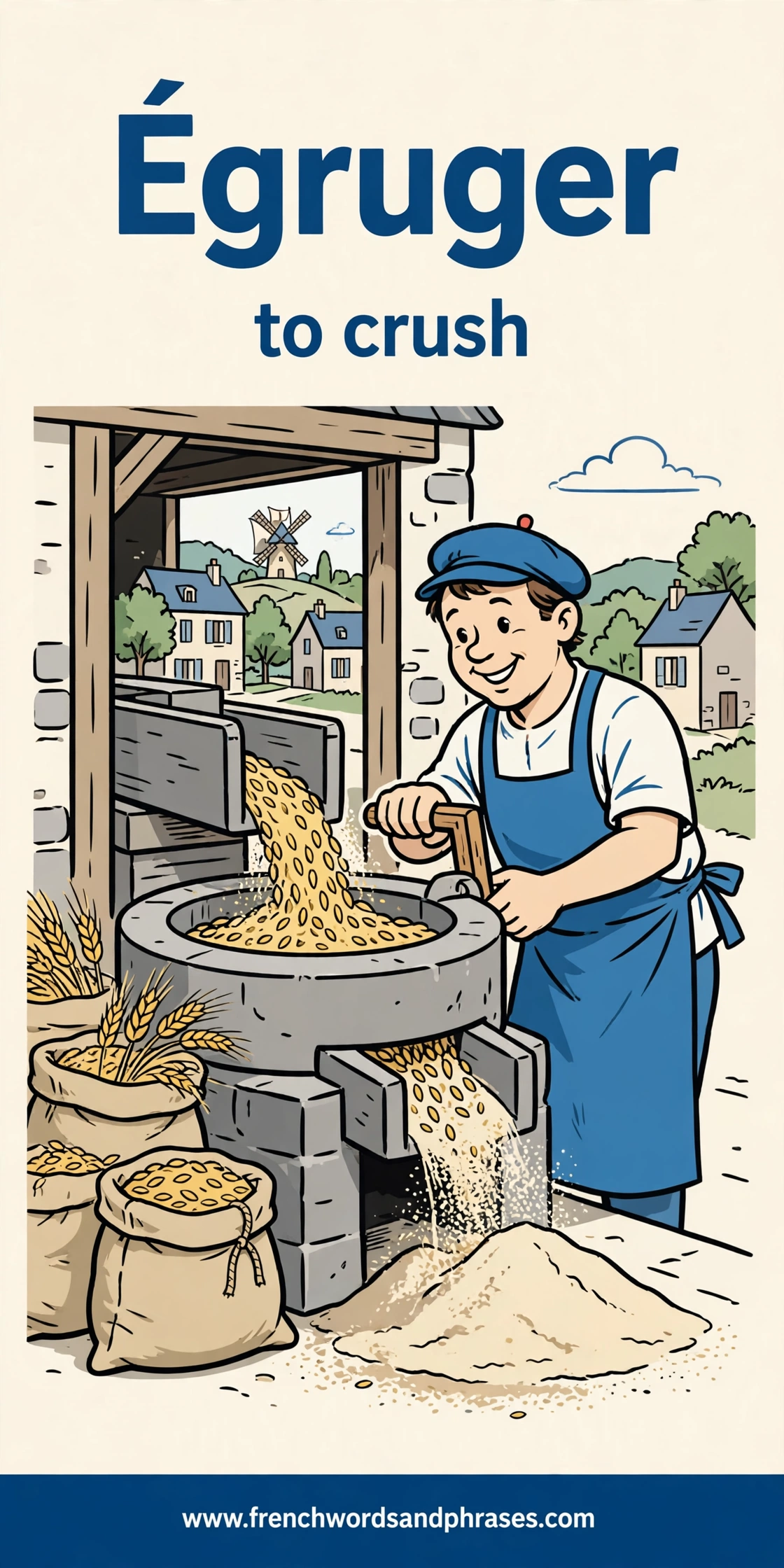
Égruger means to crush — to grind something coarse, like salt or pepper, down to powder in a small hand mill.
A wooden mill on an old kitchen table, a pharmacist’s mortar, peppercorns and rock salt waiting to be ground — égruger is the old, precise verb for crushing coarse grains into powder by hand, before electric grinders did the work.
In this guide, you’ll learn how to conjugate égruger in all the major French tenses and moods. Explore complete conjugation tables, French examples, English translations, and practice quizzes.
Understanding the French Verb Égruger
Égruger is a regular French verb belonging to the first group of verbs, those ending in-er.
It means to crush. It belongs to the world of the traditional kitchen and the pharmacy: salt, pepper, sugar and spices crushed in small quantities, by hand, at the moment of use. Its noun is égrugeage, and the tool, the moulin à égruger, survives in antique shops long after the verb faded from speech.
Verb classification: First group (-er)
Auxiliary verb: Avoir
Past participle: égrugé
Present participle: égrugeant
English equivalents: To crush, to grind down; égruger du sel — to grind salt; égruger du poivre — to crush pepper; égruger du sucre — to pound sugar; un moulin à égruger — a small hand mill for grinding.
One important detail: égruger is an old-fashioned, almost forgotten verb — modern French usually says broyer, moudre or concasser for crushing and grinding. You will meet égruger in old cookery books and in the name of the little mill itself, le moulin à égruger. The verb itself is perfectly regular: je égruge, nous égrugeons — note the extra e in nous égrugeons, kept so the g stays soft before o — past participle égrugé.
Experience the Word
Égruger is the verb of the hand mill — slow, patient crushing, grain by grain, until the coarse becomes fine.
Imagine a farmhouse kitchen a century ago. The cook takes down the little wooden mill, fills it with coarse grey salt, and turns the handle — crac, crac, crac — elle égruge le sel over the soup pot, exactly as her mother did, because shop salt is a luxury and the mill has never once broken.
No electricity, no hurry. The salt has been crushed — égrugé, by hand, at the table.
How to Conjugate Égruger: Complete French Conjugation Guide
Let’s explore every major conjugation of égruger, beginning with the indicative mood.
How to Conjugate Égruger in the Indicative Mood
The indicative mood is used to express facts, observations, actions, and events.
How to Conjugate Égruger in the Present Tense (Présent)
Used for actions happening now, habitual actions, and general truths.
| Subject | Conjugation |
|---|---|
| je | égruge |
| tu | égruges |
| il / elle | égruge |
| nous | égrugeons |
| vous | égrugez |
| ils / elles | égrugent |
Example
Le cuisinier égruge le poivre au dernier moment.
The cook grinds the pepper at the last moment.
Quick Quiz 1
Complete the sentence:
Nous ______ le poivre au dernier moment.
Reveal the answer
égrugeons
Nous égrugeons le poivre au dernier moment.
We grind the pepper at the last moment.
How to Conjugate Égruger in the Passé Composé
Used for completed actions in the past. Égruger takes the auxiliary verb avoir.
| Subject | Conjugation |
|---|---|
| j’ | ai égrugé |
| tu | as égrugé |
| il / elle | a égrugé |
| nous | avons égrugé |
| vous | avez égrugé |
| ils / elles | ont égrugé |
Example
Elle a égrugé du gros sel pour la soupe.
She crushed coarse salt for the soup.
How to Conjugate Égruger in the Imparfait (Imperfect Tense)
Used for habitual past actions, descriptions, and ongoing situations in the past.
| Subject | Conjugation |
|---|---|
| je | égrugeais |
| tu | égrugeais |
| il / elle | égrugeait |
| nous | égrugions |
| vous | égrugiez |
| ils / elles | égrugeaient |
Example
Autrefois, on égrugeait les épices à la main.
In the old days, people ground spices by hand.
Quick Quiz 2
Choose the correct form:
She crushed the salt.
Elle ______ le sel. (a égrugé / est égrugée)
Reveal the answer
a égrugé
Elle a égrugé le sel.
Égruger takes avoir.
How to Conjugate Égruger in the Plus-que-parfait
Used to describe an action that had already been completed before another past event.
| Subject | Conjugation |
|---|---|
| j’ | avais égrugé |
| tu | avais égrugé |
| il / elle | avait égrugé |
| nous | avions égrugé |
| vous | aviez égrugé |
| ils / elles | avaient égrugé |
Example
Il avait égrugé le sucre avant de préparer le sirop.
He had pounded the sugar before making the syrup.
How to Conjugate Égruger in the Passé Simple
Primarily used in formal writing, literature, and historical narratives. It is rarely used in everyday conversation.
| Subject | Conjugation |
|---|---|
| je | égrugeai |
| tu | égrugeas |
| il / elle | égrugea |
| nous | égrugeâmes |
| vous | égrugeâtes |
| ils / elles | égrugeèrent |
Example
La servante égrugea le sel dans le petit moulin de bois.
The maid ground the salt in the little wooden mill.
How to Conjugate Égruger in the Passé Antérieur
A literary tense used to express an action completed immediately before another past action, generally in the passé simple.
| Subject | Conjugation |
|---|---|
| j’ | eus égrugé |
| tu | eus égrugé |
| il / elle | eut égrugé |
| nous | eûmes égrugé |
| vous | eûtes égrugé |
| ils / elles | eurent égrugé |
Example
Quand elle eut égrugé le poivre, elle assaisonna le rôti.
When she had crushed the pepper, she seasoned the roast.
How to Conjugate Égruger in the Future Tense (Futur Simple)
Used to describe actions that will take place in the future.
| Subject | Conjugation |
|---|---|
| je | égrugerai |
| tu | égrugeras |
| il / elle | égrugera |
| nous | égrugerons |
| vous | égrugerez |
| ils / elles | égrugeront |
Example
Tu égrugeras le sel pendant que je coupe les légumes.
You will grind the salt while I chop the vegetables.
How to Conjugate Égruger in the Futur Antérieur (Future Perfect)
Used for an action that will have been completed before a particular point in the future.
| Subject | Conjugation |
|---|---|
| j’ | aurai égrugé |
| tu | auras égrugé |
| il / elle | aura égrugé |
| nous | aurons égrugé |
| vous | aurez égrugé |
| ils / elles | auront égrugé |
Example
À midi, nous aurons égrugé toutes les épices du marché.
By noon, we will have ground all the spices from the market.
How to Conjugate Égruger in the Near Future (Futur Proche)
Used to describe something that is going to happen soon. Formed with aller + infinitive.
| Subject | Conjugation |
|---|---|
| je | vais égruger |
| tu | vas égruger |
| il / elle | va égruger |
| nous | allons égruger |
| vous | allez égruger |
| ils / elles | vont égruger |
Example
Je vais égruger un peu de poivre pour la salade.
I am going to crush a little pepper for the salad.
How to Conjugate Égruger in the Conditional Mood
The conditional mood expresses what would happen under certain circumstances. It is also frequently used to make polite requests or express wishes.
How to Conjugate Égruger in the Present Conditional
| Subject | Conjugation |
|---|---|
| je | égrugerais |
| tu | égrugerais |
| il / elle | égrugerait |
| nous | égrugerions |
| vous | égrugeriez |
| ils / elles | égrugeraient |
Example
Avec un bon moulin, on égrugerait ce sel en une minute.
With a good mill, you would grind this salt in a minute.
How to Conjugate Égruger in the Past Conditional
| Subject | Conjugation |
|---|---|
| j’ | aurais égrugé |
| tu | aurais égrugé |
| il / elle | aurait égrugé |
| nous | aurions égrugé |
| vous | auriez égrugé |
| ils / elles | auraient égrugé |
Example
Elle aurait égrugé les graines si le moulin n’était pas cassé.
She would have ground the seeds if the mill had not been broken.
Égruger in the Literary Past Conditional Form
This less common literary form uses the imperfect subjunctive of avoir.
| Subject | Conjugation |
|---|---|
| j’ | eusse égrugé |
| tu | eusses égrugé |
| il / elle | eût égrugé |
| nous | eussions égrugé |
| vous | eussiez égrugé |
| ils / elles | eussent égrugé |
Example
Il eût égrugé le sucre avant l’arrivée des invités.
He would have pounded the sugar before the guests arrived.
How to Conjugate Égruger in the Subjunctive Mood
The subjunctive is used to express wishes, emotions, doubts, necessity, and uncertainty. It frequently follows expressions such as il faut que (it is necessary that) or bien que (although).
How to Conjugate Égruger in the Present Subjunctive
| Subject | Conjugation |
|---|---|
| que je | égruge |
| que tu | égruges |
| qu’il / qu’elle | égruge |
| que nous | égrugions |
| que vous | égrugiez |
| qu’ils / qu’elles | égrugent |
Example
Il faut que tu égruges le poivre plus finement.
You must grind the pepper more finely.
Quick Quiz 3
Complete the sentence using the subjunctive:
Il faut que vous ______ les épices à la main.
Reveal the answer
égrugiez
Il faut que vous égrugiez les épices à la main.
You must grind the spices by hand.
How to Conjugate Égruger in the Imperfect Subjunctive
A literary tense, rarely encountered in modern spoken French.
| Subject | Conjugation |
|---|---|
| que je | égrugasse |
| que tu | égrugasses |
| qu’il / qu’elle | égrugât |
| que nous | égrugassions |
| que vous | égrugassiez |
| qu’ils / qu’elles | égrugassent |
Example
Elle voulait qu’on égrugeât le sel à table, devant les invités.
She wanted the salt to be ground at the table, in front of the guests.
How to Conjugate Égruger in the Pluperfect Subjunctive
A literary construction used to express an action completed before another past action.
| Subject | Conjugation |
|---|---|
| que j’ | eusse égrugé |
| que tu | eusses égrugé |
| qu’il / qu’elle | eût égrugé |
| que nous | eussions égrugé |
| que vous | eussiez égrugé |
| qu’ils / qu’elles | eussent égrugé |
Example
On racontait qu’il eût égrugé ses remèdes lui-même.
People said he had ground his own remedies himself.
How to Conjugate Égruger in the Past Subjunctive
| Subject | Conjugation |
|---|---|
| que j’ | aie égrugé |
| que tu | aies égrugé |
| qu’il / qu’elle | ait égrugé |
| que nous | ayons égrugé |
| que vous | ayez égrugé |
| qu’ils / qu’elles | aient égrugé |
Example
Je suis content qu’elle ait égrugé les épices à la main.
I am glad she ground the spices by hand.
How to Conjugate Égruger in the Imperative
The imperative is used to give commands, instructions, invitations, or suggestions. Subject pronouns are omitted.
How to Conjugate Égruger in the Present Imperative
| Person | Conjugation |
|---|---|
| (tu) | égruge |
| (nous) | égrugeons |
| (vous) | égrugez |
Example
Égruge le sel, et pas trop fin !
Grind the salt, and not too fine!
Quick Quiz 4
How would you say Grind the salt (tu form)?
Reveal the answer
Égruge le sel !
French Participles of Égruger
Participles are verb forms that can be used in compound tenses and other grammatical constructions.
Present Participle of Égruger
égrugeant
En égrugeant le poivre, il éternua trois fois.
While grinding the pepper, he sneezed three times.
Past Participle of Égruger
égrugé
Égrugé au moulin de bois, le sel garde tout son goût.
Ground in the wooden mill, the salt keeps all its flavour.
Égruger in Everyday French: Real-Life Examples
Now that you know the conjugations, let’s see how égruger appears in everyday French.
Example 1 — Present
Le cuisinier égruge le poivre à la main.
The cook grinds the pepper by hand.
Example 2 — Passé composé
Elle a égrugé du gros sel pour la soupe.
She crushed coarse salt for the soup.
Example 3 — Imparfait
On égrugeait les épices dans un petit moulin.
People used to grind spices in a little mill.
Example 4 — Future
Tu égrugeras le sel pour le dîner.
You will grind the salt for dinner.
Example 5 — Conditional
On égrugerait ce sucre avec un meilleur moulin.
You would pound this sugar with a better mill.
Example 6 — Imperative
Égrugez le poivre au dernier moment !
Grind the pepper at the last moment!
Beyond Translation: The Meaning of Égruger
English has no everyday equivalent — to crush and to grind share the work between them, and neither is tied to one small tool.
Égruger names a gesture, not just a result.
It is the sound of the little mill turning over a soup pot in a farmhouse kitchen: a whole world of cooking before packets of ready-ground spice, preserved in one old verb.
How to Remember the French Verb Égruger
Remember it this way: Égruger is about the little wooden mill crushing salt over the soup pot.
- An old kitchen verb: égruger is what the little hand mill (le moulin à égruger) does to salt, pepper and sugar.
- Modern French prefers broyer or moudre — égruger lives in old cookery books and antique shops.
- Regular -er with a soft g: je égruge, nous égrugeons, past participle égrugé.
The key idea is the little wooden mill crushing salt over the soup pot.
Test Your Knowledge of Égruger
Let’s see how much you’ve learned. Try answering these questions before revealing the answers.
Question 1
What did people égruger, and with what?
Reveal the answer
Salt, pepper, sugar and spices — crushed by hand in a small mill, le moulin à égruger.
Question 2
How do you say She crushed coarse salt for the soup in French?
Reveal the answer
Elle a égrugé du gros sel pour la soupe.
Question 3
Translate: In the old days, people ground spices by hand.
Reveal the answer
Autrefois, on égrugeait les épices à la main.
Question 4
What is the past participle of égruger?
Reveal the answer
Égrugé.
Question 5
Complete the sentence:
Il faut que tu ______ le poivre plus finement.
Reveal the answer
égruges
Il faut que tu égruges le poivre plus finement.
You must grind the pepper more finely.
Your Final Challenge
Can You Use It?
How would you say this in French?
She grinds the salt in her grandmother’s mill, and the soup tastes of Sundays long ago.
Reveal the answer
Elle égruge le sel dans le moulin de sa grand-mère, et la soupe a le goût des dimanches d’autrefois.
She grinds the salt in her grandmother’s mill, and the soup tastes of Sundays long ago.
A little French. A little curiosity. A richer everyday life.
LEARN FRENCH ONE WORD AT A TIME