A French Word to Live By
How to Conjugate Égrener in French
/e.ɡʁə.ne/
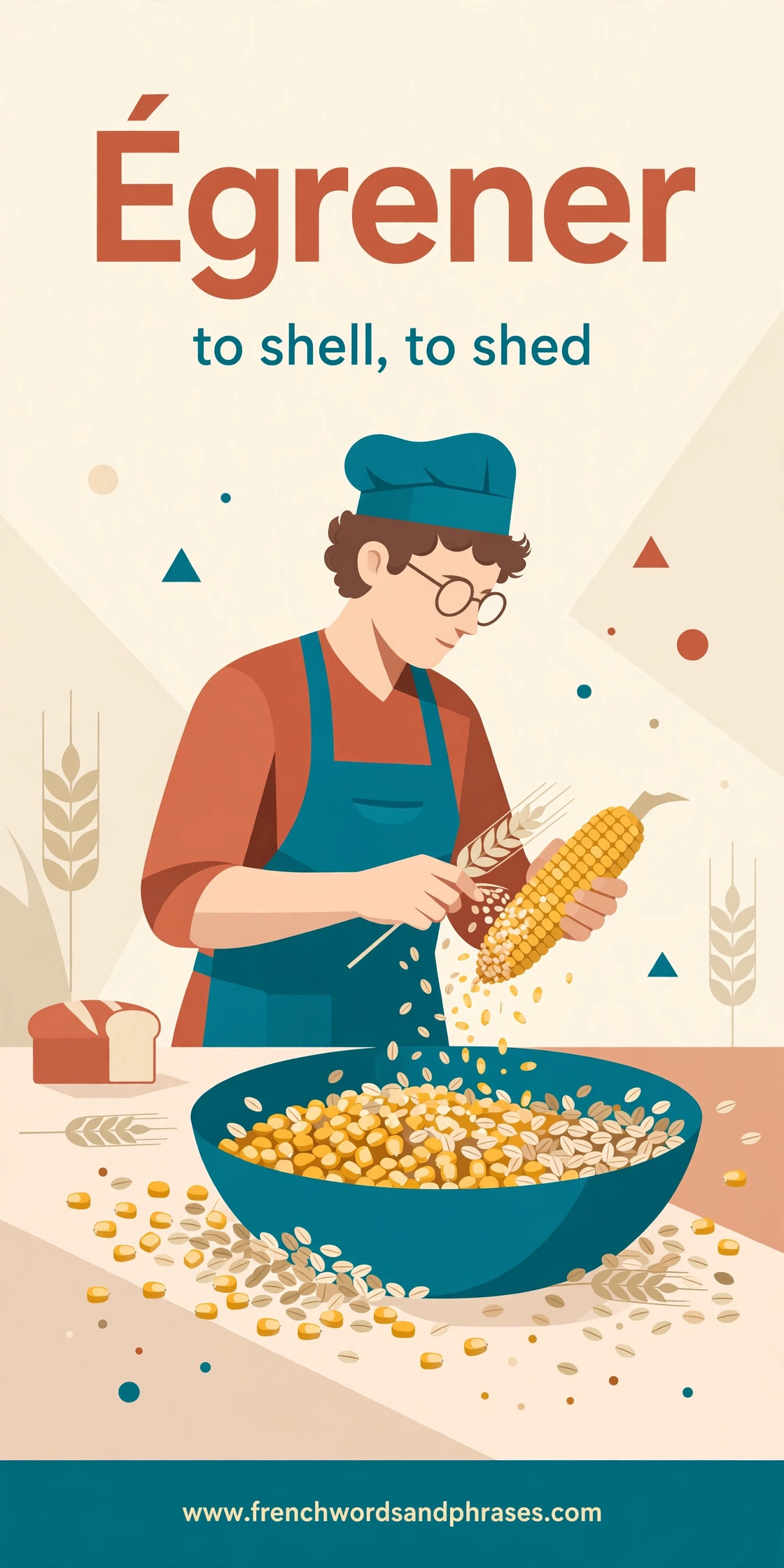
Égrener means to shell, to shed — to let grains come away one by one, from an ear of wheat, from a rosary’s beads, or from the slow hours of a day.
A ripe ear of wheat shedding its grains into a palm, an old woman telling her rosary bead by bead at a window, a clock letting the hours drop one by one over an empty afternoon — égrener is the verb of things counted out singly: grains, beads, minutes, each one separate, each one gone.
In this guide, you’ll learn how to conjugate égrener in all the major French tenses and moods. Explore complete conjugation tables, French examples, English translations, and practice quizzes.
Understanding the French Verb Égrener
Égrener is a regular French verb belonging to the first group of verbs, those ending in-er.
It means to shell, to shed. It moves between three worlds: the field, where ripe ears shed their grain at a touch; the chapel and the window seat, where un chapelet — a rosary — is égrené bead by bead; and time itself, since French lets hours and days be égrenés like grains, dropping singly into the past.
Verb classification: First group (-er)
Auxiliary verb: Avoir
Past participle: égrené
Present participle: égrenant
English equivalents: To shell, to shed grain one by one; égrener un épi — to shell an ear of grain; égrener un chapelet — to tell one’s beads; égrener les heures — to let the hours slip by one by one; le grain — the grain.
One important detail: égrener carries the grave-accent patch. Wherever the next syllable is mute, the é of the stem opens to è: j’égrène, tu égrènes, il égrène, ils égrènent, and through the future and conditional: j’égrènerai, il égrènerait. Where the ending is sounded, é survives: nous égrenons, vous égrenez, j’égrenais, en égrenant, and in the infinitive and participle, égrener, égrené. Do not confuse it with its twin égrainer (with ai), the kitchen verb for shelling peas and corn: égrener sheds grains one by one — and sheds beads and hours too.
Experience the Word
Égrener is the verb of one-by-one — nothing falls in a heap; everything is counted as it goes.
Imagine a farmhouse window in late summer. The grandmother sits with her rosary, and her thumbs move with the patience of sixty years: a bead, a prayer, a bead, a prayer. Elle égrène son chapelet — and outside, in the field beyond the glass, the ripe wheat does exactly the same with its grains, one by one, into the wind.
Beads and grains obey the same rhythm. She has told them — égrenés, one by one, to the very end.
How to Conjugate Égrener: Complete French Conjugation Guide
Let’s explore every major conjugation of égrener, beginning with the indicative mood.
How to Conjugate Égrener in the Indicative Mood
The indicative mood is used to express facts, observations, actions, and events.
How to Conjugate Égrener in the Present Tense (Présent)
Used for actions happening now, habitual actions, and general truths.
| Subject | Conjugation |
|---|---|
| je | égrène |
| tu | égrènes |
| il / elle | égrène |
| nous | égrenons |
| vous | égrenez |
| ils / elles | égrènent |
Example
Le vent égrène les épis trop mûrs.
The wind sheds the grain from the overripe ears.
Quick Quiz 1
Complete the sentence:
Nous ______ l’épi au-dessus du sac.
Reveal the answer
égrenons
Nous égrenons l’épi au-dessus du sac.
We shell the ear over the sack.
How to Conjugate Égrener in the Passé Composé
Used for completed actions in the past. Égrener takes the auxiliary verb avoir.
| Subject | Conjugation |
|---|---|
| j’ | ai égrené |
| tu | as égrené |
| il / elle | a égrené |
| nous | avons égrené |
| vous | avez égrené |
| ils / elles | ont égrené |
Example
Elle a égrené son chapelet en attendant.
She told her beads while waiting.
How to Conjugate Égrener in the Imparfait (Imperfect Tense)
Used for habitual past actions, descriptions, and ongoing situations in the past.
| Subject | Conjugation |
|---|---|
| je | égrenais |
| tu | égrenais |
| il / elle | égrenait |
| nous | égrenions |
| vous | égreniez |
| ils / elles | égrenaient |
Example
L’épi égrenait ses grains au moindre souffle.
The ear shed its grains at the slightest breeze.
Quick Quiz 2
Choose the correct form:
She told her beads.
Elle ______ son chapelet. (a égrené / est égrenée)
Reveal the answer
a égrené
Elle a égrené son chapelet.
Égrener takes avoir.
How to Conjugate Égrener in the Plus-que-parfait
Used to describe an action that had already been completed before another past event.
| Subject | Conjugation |
|---|---|
| j’ | avais égrené |
| tu | avais égrené |
| il / elle | avait égrené |
| nous | avions égrené |
| vous | aviez égrené |
| ils / elles | avaient égrené |
Example
Il avait égrené les heures sans s’en apercevoir.
He had let the hours slip by without noticing.
How to Conjugate Égrener in the Passé Simple
Primarily used in formal writing, literature, and historical narratives. It is rarely used in everyday conversation.
| Subject | Conjugation |
|---|---|
| je | égrenai |
| tu | égrenas |
| il / elle | égrena |
| nous | égrenâmes |
| vous | égrenâtes |
| ils / elles | égrenèrent |
Example
La vieille femme égrena son chapelet jusqu’au bout.
The old woman told her beads to the very end.
How to Conjugate Égrener in the Passé Antérieur
A literary tense used to express an action completed immediately before another past action, generally in the passé simple.
| Subject | Conjugation |
|---|---|
| j’ | eus égrené |
| tu | eus égrené |
| il / elle | eut égrené |
| nous | eûmes égrené |
| vous | eûtes égrené |
| ils / elles | eurent égrené |
Example
Quand le vent eut égrené l’épi, il ne resta que la tige.
When the wind had stripped the ear, only the stalk remained.
How to Conjugate Égrener in the Future Tense (Futur Simple)
Used to describe actions that will take place in the future.
| Subject | Conjugation |
|---|---|
| je | égrènerai |
| tu | égrèneras |
| il / elle | égrènera |
| nous | égrènerons |
| vous | égrènerez |
| ils / elles | égrèneront |
Example
Demain, le vent égrènera les épis oubliés.
Tomorrow, the wind will shed the grain from the forgotten ears.
How to Conjugate Égrener in the Futur Antérieur (Future Perfect)
Used for an action that will have been completed before a particular point in the future.
| Subject | Conjugation |
|---|---|
| j’ | aurai égrené |
| tu | auras égrené |
| il / elle | aura égrené |
| nous | aurons égrené |
| vous | aurez égrené |
| ils / elles | auront égrené |
Example
À la fin de la messe, elle aura égrené trois chapelets.
By the end of mass, she will have told three rosaries.
How to Conjugate Égrener in the Near Future (Futur Proche)
Used to describe something that is going to happen soon. Formed with aller + infinitive.
| Subject | Conjugation |
|---|---|
| je | vais égrener |
| tu | vas égrener |
| il / elle | va égrener |
| nous | allons égrener |
| vous | allez égrener |
| ils / elles | vont égrener |
Example
Regarde, l’épi va égrener tous ses grains.
Look, the ear is going to shed all its grains.
How to Conjugate Égrener in the Conditional Mood
The conditional mood expresses what would happen under certain circumstances. It is also frequently used to make polite requests or express wishes.
How to Conjugate Égrener in the Present Conditional
| Subject | Conjugation |
|---|---|
| je | égrènerais |
| tu | égrènerais |
| il / elle | égrènerait |
| nous | égrènerions |
| vous | égrèneriez |
| ils / elles | égrèneraient |
Example
Sans le vent, l’épi égrènerait moins vite.
Without the wind, the ear would shed its grain less quickly.
How to Conjugate Égrener in the Past Conditional
| Subject | Conjugation |
|---|---|
| j’ | aurais égrené |
| tu | aurais égrené |
| il / elle | aurait égrené |
| nous | aurions égrené |
| vous | auriez égrené |
| ils / elles | auraient égrené |
Example
Elle aurait égrené son chapelet si l’attente avait duré.
She would have told her beads if the wait had lasted.
Égrener in the Literary Past Conditional Form
This less common literary form uses the imperfect subjunctive of avoir.
| Subject | Conjugation |
|---|---|
| j’ | eusse égrené |
| tu | eusses égrené |
| il / elle | eût égrené |
| nous | eussions égrené |
| vous | eussiez égrené |
| ils / elles | eussent égrené |
Example
Le temps eût égrené les heures sans nous attendre.
Time would have let the hours slip by without waiting for us.
How to Conjugate Égrener in the Subjunctive Mood
The subjunctive is used to express wishes, emotions, doubts, necessity, and uncertainty. It frequently follows expressions such as il faut que (it is necessary that) or bien que (although).
How to Conjugate Égrener in the Present Subjunctive
| Subject | Conjugation |
|---|---|
| que je | égrène |
| que tu | égrènes |
| qu’il / qu’elle | égrène |
| que nous | égrenions |
| que vous | égreniez |
| qu’ils / qu’elles | égrènent |
Example
Il faut que tu égrènes cet épi au-dessus du sac.
You must shell this ear over the sack.
Quick Quiz 3
Complete the sentence using the subjunctive:
Il faut que tu ______ cet épi.
Reveal the answer
égrènes
Il faut que tu égrènes cet épi.
You must shell this ear.
How to Conjugate Égrener in the Imperfect Subjunctive
A literary tense, rarely encountered in modern spoken French.
| Subject | Conjugation |
|---|---|
| que je | égrenasse |
| que tu | égrenasses |
| qu’il / qu’elle | égrenât |
| que nous | égrenassions |
| que vous | égrenassiez |
| qu’ils / qu’elles | égrenassent |
Example
Elle priait lentement, comme si elle égrenât les minutes.
She prayed slowly, as if she were letting the minutes drop one by one.
How to Conjugate Égrener in the Pluperfect Subjunctive
A literary construction used to express an action completed before another past action.
| Subject | Conjugation |
|---|---|
| que j’ | eusse égrené |
| que tu | eusses égrené |
| qu’il / qu’elle | eût égrené |
| que nous | eussions égrené |
| que vous | eussiez égrené |
| qu’ils / qu’elles | eussent égrené |
Example
On disait qu’elle eût égrené des centaines de chapelets.
People said she had told hundreds of rosaries.
How to Conjugate Égrener in the Past Subjunctive
| Subject | Conjugation |
|---|---|
| que j’ | aie égrené |
| que tu | aies égrené |
| qu’il / qu’elle | ait égrené |
| que nous | ayons égrené |
| que vous | ayez égrené |
| qu’ils / qu’elles | aient égrené |
Example
Je suis étonné que le vent ait égrené tant d’épis.
I am surprised the wind stripped so many ears.
How to Conjugate Égrener in the Imperative
The imperative is used to give commands, instructions, invitations, or suggestions. Subject pronouns are omitted.
How to Conjugate Égrener in the Present Imperative
| Person | Conjugation |
|---|---|
| (tu) | égrène |
| (nous) | égrenons |
| (vous) | égrenez |
Example
Égrène l’épi doucement, sans perdre un grain.
Shell the ear gently, without losing a single grain.
Quick Quiz 4
How would you say Shell this ear gently (tu form)?
Reveal the answer
Égrène cet épi doucement !
French Participles of Égrener
Participles are verb forms that can be used in compound tenses and other grammatical constructions.
Present Participle of Égrener
égrenant
En égrenant son chapelet, elle récitait les prières.
While telling her beads, she recited the prayers.
Past Participle of Égrener
égrené
Égrené par le vent, l’épi se tenait nu dans le champ.
Stripped by the wind, the ear stood bare in the field.
Égrener in Everyday French: Real-Life Examples
Now that you know the conjugations, let’s see how égrener appears in everyday French.
Example 1 — Present
Le vent égrène les épis.
The wind sheds the grain from the ears.
Example 2 — Passé composé
Elle a égrené son chapelet.
She told her beads.
Example 3 — Imparfait
L’épi égrenait ses grains au soleil.
The ear shed its grains in the sun.
Example 4 — Future
Le vent égrènera les épis oubliés.
The wind will shed the forgotten ears.
Example 5 — Conditional
L’épi égrènerait moins vite sans le vent.
The ear would shed less quickly without the wind.
Example 6 — Imperative
Égrène cet épi au-dessus du sac !
Shell this ear over the sack!
Beyond Translation: The Meaning of Égrener
English to tell one’s beads is the exact cousin of égrener un chapelet — in both languages the rosary is counted out like grain, one unit at a time.
That counting is the soul of the verb.
Whatever égrener touches — wheat, prayers, hours, names on a list read aloud — it divides into single drops and lets them fall in order. It is the slowest verb of loss, and the most peaceful one.
How to Remember the French Verb Égrener
Remember it this way: Égrener is about the rosary and the wheat ear, counted out one by one.
- Grave patch: j’égrène with è before a mute syllable, but nous égrenons with é — and j’égrènerai in the future.
- Three cargoes: grains from an ear, beads of a rosary, hours of a day — all one by one.
- Regular endings otherwise, auxiliary avoir: elle a égrené son chapelet, past participle égrené.
The key idea is the rosary and the wheat ear, counted out one by one.
Test Your Knowledge of Égrener
Let’s see how much you’ve learned. Try answering these questions before revealing the answers.
Question 1
Why does je égrène have a grave accent but nous égrenons an acute one?
Reveal the answer
The grave-accent patch — é becomes è before a mute syllable (je égrène), and stays é where the ending is sounded (nous égrenons).
Question 2
How do you say She told her beads in French?
Reveal the answer
Elle a égrené son chapelet.
Question 3
Translate: The wind sheds the grain from the ears.
Reveal the answer
Le vent égrène les épis.
Question 4
What is the past participle of égrener?
Reveal the answer
Égrené.
Question 5
Complete the sentence:
Il faut que tu ______ cet épi au-dessus du sac.
Reveal the answer
égrènes
Il faut que tu égrènes cet épi au-dessus du sac.
You must shell this ear over the sack.
Your Final Challenge
Can You Use It?
How would you say this in French?
She tells her beads at the window, and the hours fall one by one like grains.
Reveal the answer
Elle égrène son chapelet à la fenêtre, et les heures tombent une à une comme des grains.
She tells her beads at the window, and the hours fall one by one like grains.
A little French. A little curiosity. A richer everyday life.
LEARN FRENCH ONE WORD AT A TIME