A French Word to Live By
How to Conjugate Se égratigner in French
/se.ɡʁa.ti.ɲe/
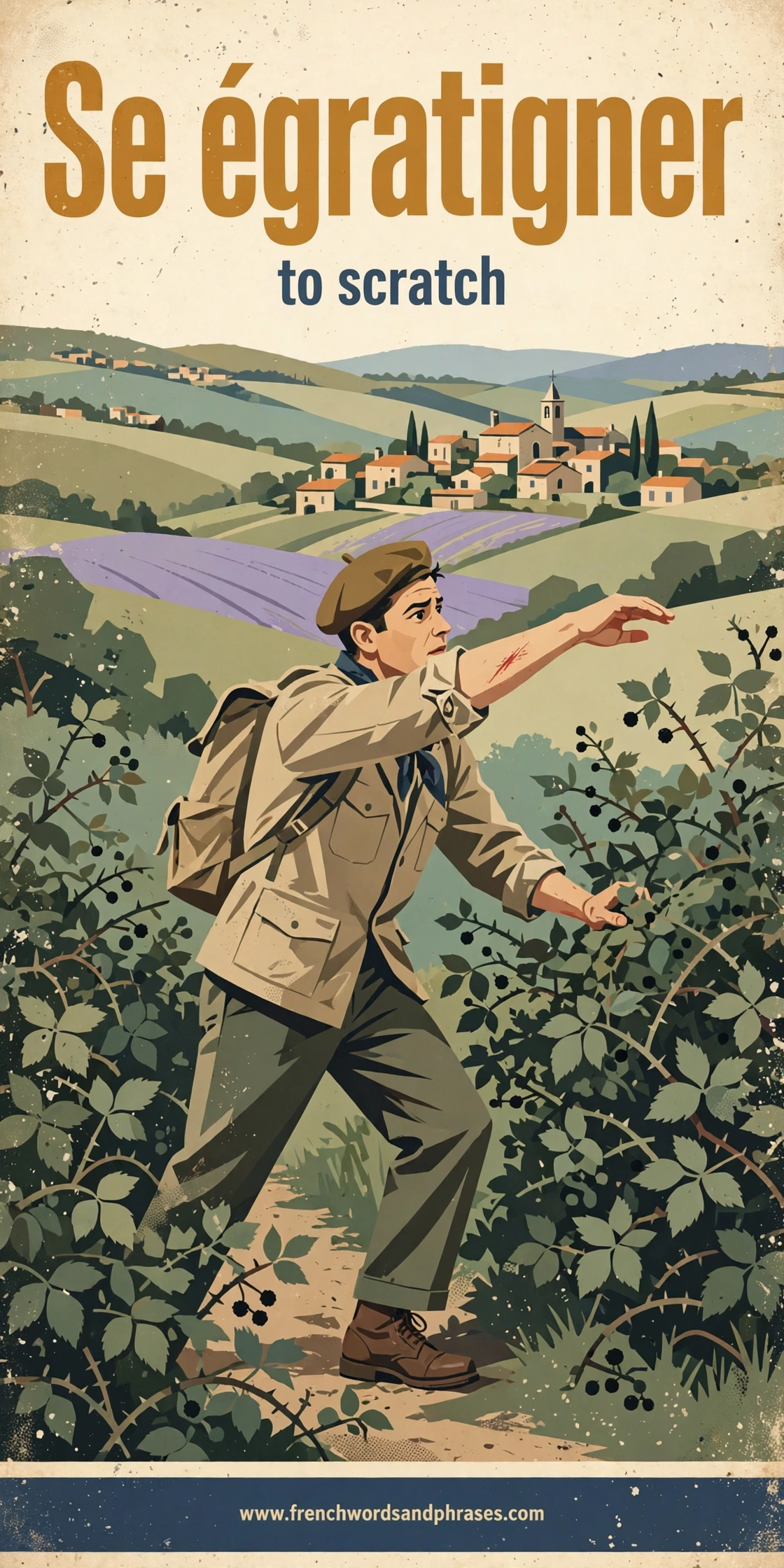
Se égratigner means to scratch oneself — to catch your own skin on a thorn, a nail or a branch and come away with a graze.
A knee grazed on gravel, arms striped by brambles, a cat owner marked by his own cat — se égratigner is the reflexive of small accidents: you are both the scratcher and the scratched, and the evidence is written in thin red lines on your own skin.
In this guide, you’ll learn how to conjugate se égratigner in all the major French tenses and moods. Explore complete conjugation tables, French examples, English translations, and practice quizzes.
Understanding the French Verb Se égratigner
Se égratigner is a regular French verb belonging to the first group of verbs, those ending in-er.
It means to scratch. It is the verb of gardeners, hikers, children and cat owners — anyone whose skin meets thorns, wire, gravel or claws. The body part is almost always named: le genou, les bras, les jambes, le visage, and the culprit follows with sur, à or contre: se égratigner sur un fil de fer, aux ronces, contre la clôture.
Verb classification: First group (-er), reflexive
Auxiliary verb: Être
Past participle: égratigné
Present participle: égratignant
English equivalents: To scratch oneself, to graze oneself; se égratigner sur une ronce — to scratch oneself on a bramble; se égratigner le genou — to graze one’s knee; se égratigner les bras — to scratch one’s arms; une égratignure — a scratch, a graze.
One important detail: se égratigner carries one of the finest agreement traps in French. When you name the body part, it becomes the direct object and the participle does not agree with the subject: elle s’est égratigné le genou, elle s’est égratigné le bras — égratigné stays unchanged, and the body part takes the definite article, never a possessive. But with no body part named, the participle agrees as usual: elle s’est égratignée aux ronces. Both patterns are everyday French, and telling them apart is a mark of real mastery.
Experience the Word
Se égratigner is the verb of the body’s small print — the scratches you only discover in the shower, each one the receipt of a moment outdoors.
Imagine a little girl coming back from the blackberry hedge, basket full, legs a map of thin red lines. Elle s’est égratignée partout, and she displays every scratch like a medal: celui-ci, c’était la grande ronce; celui-là, le rosier du voisin. Her mother sighs, fetches the antiseptic, and pretends not to smile.
Nothing is broken, nothing even bleeds. She has scratched herself — égratignée, lightly, in the pursuit of blackberries.
How to Conjugate Se égratigner: Complete French Conjugation Guide
Let’s explore every major conjugation of se égratigner, beginning with the indicative mood.
How to Conjugate Se égratigner in the Indicative Mood
The indicative mood is used to express facts, observations, actions, and events.
How to Conjugate Se égratigner in the Present Tense (Présent)
Used for actions happening now, habitual actions, and general truths.
| Subject | Conjugation |
|---|---|
| je | m’égratigne |
| tu | t’égratignes |
| il / elle | s’égratigne |
| nous | nous égratignons |
| vous | vous égratignez |
| ils / elles | s’égratignent |
Example
Les enfants s’égratignent les jambes dans les broussailles.
The children scratch their legs in the undergrowth.
Quick Quiz 1
Complete the sentence:
Les enfants ______ les jambes dans les ronces.
Reveal the answer
s’égratignent
Les enfants s’égratignent les jambes dans les ronces.
The children scratch their legs on the brambles.
How to Conjugate Se égratigner in the Passé Composé
Used for completed actions in the past. Se égratigner takes the auxiliary verb être.
| Subject | Conjugation |
|---|---|
| je | me suis égratigné / me suis égratignée |
| tu | t’es égratigné / t’es égratignée |
| il / elle | s’est égratigné / s’est égratignée |
| nous | nous sommes égratignés / nous sommes égratignées |
| vous | vous êtes égratignés / vous êtes égratignées / vous êtes égratigné / vous êtes égratignée |
| ils / elles | se sont égratignés / se sont égratignées |
Example
Elle s’est égratigné le genou en tombant du vélo.
She grazed her knee falling off her bike.
How to Conjugate Se égratigner in the Imparfait (Imperfect Tense)
Used for habitual past actions, descriptions, and ongoing situations in the past.
| Subject | Conjugation |
|---|---|
| je | m’égratignais |
| tu | t’égratignais |
| il / elle | s’égratignait |
| nous | nous égratignions |
| vous | vous égratigniez |
| ils / elles | s’égratignaient |
Example
Il s’égratignait toujours les bras dans le jardin de sa grand-mère.
He always used to scratch his arms in his grandmother’s garden.
Quick Quiz 2
Choose the correct form:
She grazed her knee.
Elle ______ le genou. (s’est égratigné / s’est égratignée)
Reveal the answer
s’est égratigné
Elle s’est égratigné le genou.
The named body part is the direct object, so the participle does not agree.
How to Conjugate Se égratigner in the Plus-que-parfait
Used to describe an action that had already been completed before another past event.
| Subject | Conjugation |
|---|---|
| je | m’étais égratigné / m’étais égratignée |
| tu | t’étais égratigné / t’étais égratignée |
| il / elle | s’était égratigné / s’était égratignée |
| nous | nous étions égratignés / nous étions égratignées |
| vous | vous étiez égratignés / vous étiez égratignées / vous étiez égratigné / vous étiez égratignée |
| ils / elles | s’étaient égratignés / s’étaient égratignées |
Example
Elle s’était égratignée aux ronces avant même le premier kilomètre.
She had scratched herself on the brambles before even the first kilometre.
How to Conjugate Se égratigner in the Passé Simple
Primarily used in formal writing, literature, and historical narratives. It is rarely used in everyday conversation.
| Subject | Conjugation |
|---|---|
| je | m’égratignai |
| tu | t’égratignas |
| il / elle | s’égratigna |
| nous | nous égratignâmes |
| vous | vous égratignâtes |
| ils / elles | s’égratignèrent |
Example
Le chat s’égratigna le museau contre la clôture.
The cat scratched its nose on the fence.
How to Conjugate Se égratigner in the Passé Antérieur
A literary tense used to express an action completed immediately before another past action, generally in the passé simple.
| Subject | Conjugation |
|---|---|
| je | me fus égratigné / me fus égratignée |
| tu | te fus égratigné / te fus égratignée |
| il / elle | se fut égratigné / se fut égratignée |
| nous | nous fûmes égratignés / nous fûmes égratignées |
| vous | vous fûtes égratignés / vous fûtes égratignées / vous fûtes égratigné / vous fûtes égratignée |
| ils / elles | se furent égratignés / se furent égratignées |
Example
Dès qu’elle se fut égratigné le bras, elle mit un pansement.
As soon as she had scratched her arm, she put a plaster on it.
How to Conjugate Se égratigner in the Future Tense (Futur Simple)
Used to describe actions that will take place in the future.
| Subject | Conjugation |
|---|---|
| je | m’égratignerai |
| tu | t’égratigneras |
| il / elle | s’égratignera |
| nous | nous égratignerons |
| vous | vous égratignerez |
| ils / elles | s’égratigneront |
Example
Tu t’égratigneras les jambes si tu traverses ce champ.
You will scratch your legs if you cross that field.
How to Conjugate Se égratigner in the Futur Antérieur (Future Perfect)
Used for an action that will have been completed before a particular point in the future.
| Subject | Conjugation |
|---|---|
| je | me serai égratigné / me serai égratignée |
| tu | te seras égratigné / te seras égratignée |
| il / elle | se sera égratigné / se sera égratignée |
| nous | nous serons égratignés / nous serons égratignées |
| vous | vous serez égratignés / vous serez égratignées / vous serez égratigné / vous serez égratignée |
| ils / elles | se seront égratignés / se seront égratignées |
Example
À la fin de la promenade, les enfants se seront égratigné les bras et les jambes.
By the end of the walk, the children will have scratched their arms and legs.
How to Conjugate Se égratigner in the Near Future (Futur Proche)
Used to describe something that is going to happen soon. Formed with aller + infinitive.
| Subject | Conjugation |
|---|---|
| je | vais m’égratigner |
| tu | vas t’égratigner |
| il / elle | va s’égratigner |
| nous | allons nous égratigner |
| vous | allez vous égratigner |
| ils / elles | vont s’égratigner |
Example
Mets un pantalon, tu vas t’égratigner les jambes !
Put trousers on, you are going to scratch your legs!
How to Conjugate Se égratigner in the Conditional Mood
The conditional mood expresses what would happen under certain circumstances. It is also frequently used to make polite requests or express wishes.
How to Conjugate Se égratigner in the Present Conditional
| Subject | Conjugation |
|---|---|
| je | m’égratignerais |
| tu | t’égratignerais |
| il / elle | s’égratignerait |
| nous | nous égratignerions |
| vous | vous égratigneriez |
| ils / elles | s’égratigneraient |
Example
Sans ces ronces, personne ne s’égratignerait ici.
Without these brambles, nobody would get scratched here.
How to Conjugate Se égratigner in the Past Conditional
| Subject | Conjugation |
|---|---|
| je | me serais égratigné / me serais égratignée |
| tu | te serais égratigné / te serais égratignée |
| il / elle | se serait égratigné / se serait égratignée |
| nous | nous serions égratignés / nous serions égratignées |
| vous | vous seriez égratignés / vous seriez égratignées / vous seriez égratigné / vous seriez égratignée |
| ils / elles | se seraient égratignés / se seraient égratignées |
Example
Elle se serait égratigné le visage sans son chapeau.
She would have scratched her face without her hat.
Se égratigner in the Literary Past Conditional Form
This less common literary form uses the imperfect subjunctive of être.
| Subject | Conjugation |
|---|---|
| je | me fusse égratigné / me fusse égratignée |
| tu | te fusses égratigné / te fusses égratignée |
| il / elle | se fût égratigné / se fût égratignée |
| nous | nous fussions égratignés / nous fussions égratignées |
| vous | vous fussiez égratignés / vous fussiez égratignées / vous fussiez égratigné / vous fussiez égratignée |
| ils / elles | se fussent égratignés / se fussent égratignées |
Example
Il se fût égratigné les mains sans ses gants de cuir.
He would have scratched his hands without his leather gloves.
How to Conjugate Se égratigner in the Subjunctive Mood
The subjunctive is used to express wishes, emotions, doubts, necessity, and uncertainty. It frequently follows expressions such as il faut que (it is necessary that) or bien que (although).
How to Conjugate Se égratigner in the Present Subjunctive
| Subject | Conjugation |
|---|---|
| que je | m’égratigne |
| que tu | t’égratignes |
| qu’il / qu’elle | s’égratigne |
| que nous | nous égratignions |
| que vous | vous égratigniez |
| qu’ils / qu’elles | s’égratignent |
Example
Il est possible que tu t’égratignes sur ce fil de fer.
You might scratch yourself on that wire.
Quick Quiz 3
Complete the sentence using the subjunctive:
Il est possible que tu ______ sur ce fil.
Reveal the answer
t’égratignes
Il est possible que tu t’égratignes sur ce fil.
You might scratch yourself on that wire.
How to Conjugate Se égratigner in the Imperfect Subjunctive
A literary tense, rarely encountered in modern spoken French.
| Subject | Conjugation |
|---|---|
| que je | m’égratignasse |
| que tu | t’égratignasses |
| qu’il / qu’elle | s’égratignât |
| que nous | nous égratignassions |
| que vous | vous égratignassiez |
| qu’ils / qu’elles | s’égratignassent |
Example
Elle avançait lentement, de peur que l’enfant ne s’égratignât aux épines.
She moved slowly, for fear the child might scratch himself on the thorns.
How to Conjugate Se égratigner in the Pluperfect Subjunctive
A literary construction used to express an action completed before another past action.
| Subject | Conjugation |
|---|---|
| que je | me fusse égratigné / me fusse égratignée |
| tu | te fusses égratigné / te fusses égratignée |
| qu’il / qu’elle | se fût égratigné / se fût égratignée |
| que nous | nous fussions égratignés / nous fussions égratignées |
| que vous | vous fussiez égratignés / vous fussiez égratignées / vous fussiez égratigné / vous fussiez égratignée |
| qu’ils / qu’elles | se fussent égratignés / se fussent égratignées |
Example
On voyait qu’il se fût égratigné les bras dans les ronces.
You could see he had scratched his arms in the brambles.
How to Conjugate Se égratigner in the Past Subjunctive
| Subject | Conjugation |
|---|---|
| que je | me sois égratigné / me sois égratignée |
| que tu | te sois égratigné / te sois égratignée |
| qu’il / qu’elle | se soit égratigné / se soit égratignée |
| que nous | nous soyons égratignés / nous soyons égratignées |
| que vous | vous soyez égratignés / vous soyez égratignées / vous soyez égratigné / vous soyez égratignée |
| qu’ils / qu’elles | se soient égratignés / se soient égratignées |
Example
Je suis étonné qu’elle se soit égratigné le genou pour si peu.
I am amazed she grazed her knee over so little.
How to Conjugate Se égratigner in the Imperative
The imperative is used to give commands, instructions, invitations, or suggestions. Subject pronouns are omitted.
How to Conjugate Se égratigner in the Present Imperative
| Person | Conjugation |
|---|---|
| (tu) | égratigne-toi |
| (nous) | égratignons-nous |
| (vous) | égratignez-vous |
Example
Ne t’égratigne pas sur ces ronces !
Do not scratch yourself on those brambles!
Quick Quiz 4
How would you say Do not scratch yourself on the brambles (tu form)?
Reveal the answer
Ne t’égratigne pas sur les ronces !
French Participles of Se égratigner
Participles are verb forms that can be used in compound tenses and other grammatical constructions.
Present Participle of Se égratigner
égratignant
En s’égratignant aux broussailles, il a déchiré sa chemise.
Scratching himself on the undergrowth, he tore his shirt.
Past Participle of Se égratigner
égratigné
Égratignée aux jambes, la fillette a montré ses pansements avec fierté.
Scratched on her legs, the little girl showed off her plasters with pride.
Se égratigner in Everyday French: Real-Life Examples
Now that you know the conjugations, let’s see how se égratigner appears in everyday French.
Example 1 — Present
Les enfants s’égratignent les jambes dans les ronces.
The children scratch their legs on the brambles.
Example 2 — Passé composé
Elle s’est égratigné le genou.
She grazed her knee.
Example 3 — Imparfait
Il s’égratignait toujours les bras au jardin.
He always used to scratch his arms in the garden.
Example 4 — Future
Tu t’égratigneras si tu restes en short.
You will get scratched if you stay in shorts.
Example 5 — Conditional
On s’égratignerait moins avec des pantalons longs.
We would get scratched less with long trousers.
Example 6 — Imperative
Ne vous égratignez pas sur la clôture !
Do not scratch yourselves on the fence!
Beyond Translation: The Meaning of Se égratigner
Where the plain verb aims outward — the cat scratches the child — se égratigner turns the accident back on its owner, and French finds the result faintly comic: nobody is ever seriously hurt by an égratignure.
It is the injury of honourable outdoor pursuits.
Blackberries, roses, dry-stone walls and bicycles all leave the same thin signature, and the scratched gardener wears it the way the girl at the hedge does — as proof the afternoon was spent somewhere real.
How to Remember the French Verb Se égratigner
Remember it this way: Se égratigner is about the grazed knee, and the participle that refuses to agree with it.
- Name the body part and the participle freezes: elle s’est égratigné le genou — no agreement, and le, never son, before the body part.
- No body part named, and the participle agrees: elle s’est égratignée aux ronces.
- Reflexive, so être: je me suis égratigné les bras, nous nous sommes égratigné les mains.
The key idea is the grazed knee, and the participle that refuses to agree with it.
Test Your Knowledge of Se égratigner
Let’s see how much you’ve learned. Try answering these questions before revealing the answers.
Question 1
Why does the participle not agree in Elle s’est égratigné le genou?
Reveal the answer
Because le genou is the direct object — with a named body part after it, the participle stays unchanged: égratigné. Without one, it agrees: elle s’est égratignée.
Question 2
How do you say She grazed her knee in French?
Reveal the answer
Elle s’est égratigné le genou.
Question 3
Translate: The children scratch their legs on the brambles.
Reveal the answer
Les enfants s’égratignent les jambes dans les ronces.
Question 4
What is the past participle of se égratigner?
Reveal the answer
Égratigné — unchanged before a named body part (elle s’est égratigné le bras), agreeing otherwise (elle s’est égratignée).
Question 5
Complete the sentence:
Il est possible que tu ______ sur ce fil de fer.
Reveal the answer
t’égratignes
Il est possible que tu t’égratignes sur ce fil de fer.
You might scratch yourself on that wire.
Your Final Challenge
Can You Use It?
How would you say this in French?
She grazed her knee, but she brought back a full basket of blackberries.
Reveal the answer
Elle s’est égratigné le genou, mais elle a rapporté un plein panier de mûres.
She grazed her knee, but she brought back a full basket of blackberries.
A little French. A little curiosity. A richer everyday life.
LEARN FRENCH ONE WORD AT A TIME