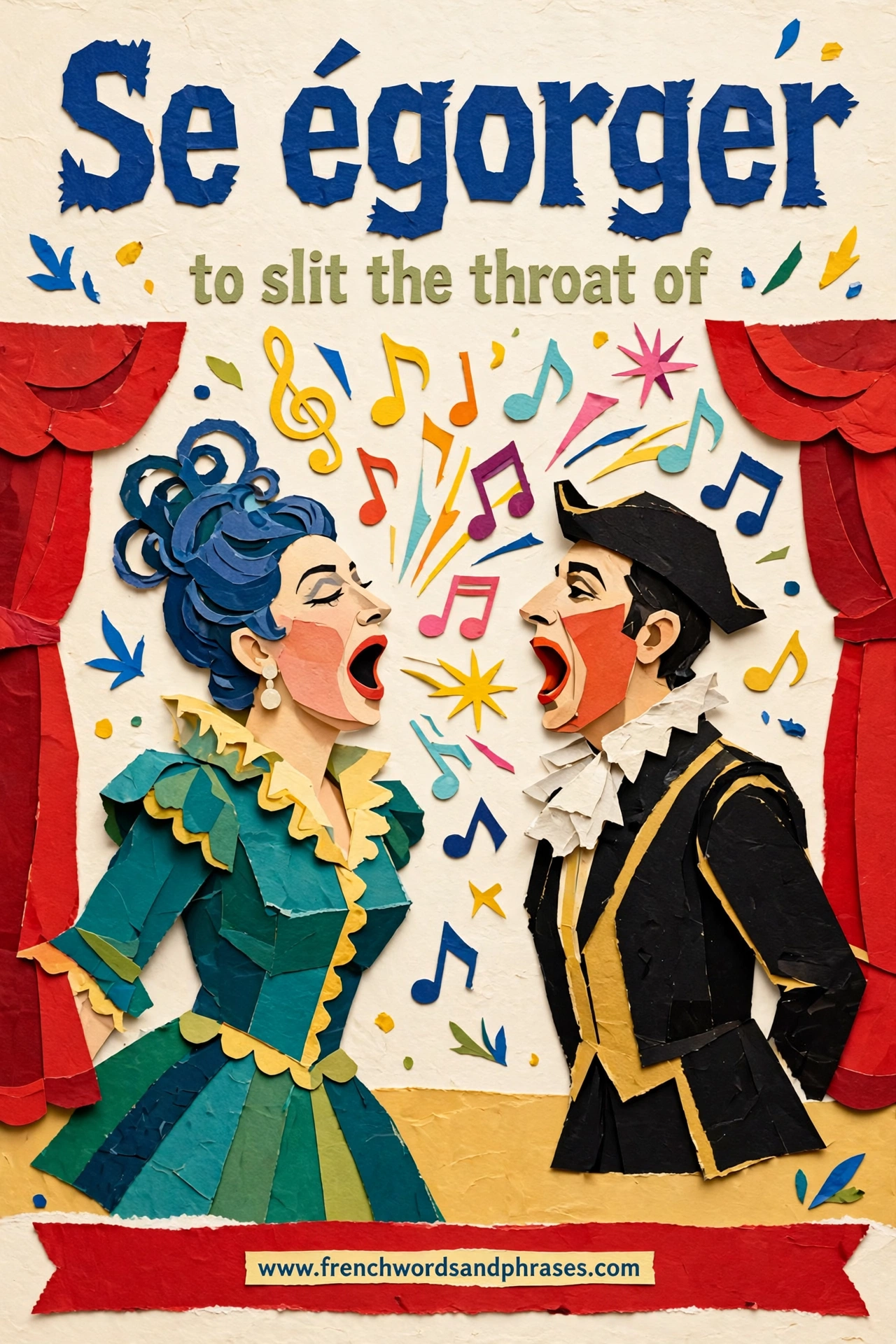
A French Word to Live By
How to Conjugate Égorger in French
/e.ɡɔʁ.ʒe/
Égorger means to slit the throat of — the stark, technical verb for slaughtering an animal by cutting its throat, and a grim word of chronicles and tragedies.
The butcher’s yard at dawn, the farm pig in November, the sacrificial lamb on a stone altar — égorger is the plain, unflinching verb for slaughter by the throat: a working word of farms and abattoirs, and a dark word of history books.
In this guide, you’ll learn how to conjugate égorger in all the major French tenses and moods. Explore complete conjugation tables, French examples, English translations, and practice quizzes.
Understanding the French Verb Égorger
Égorger is a regular French verb belonging to the first group of verbs, those ending in-er.
It means to slit the throat of. It is the ordinary working verb of traditional slaughter — pigs, sheep, poultry on farms and in abattoirs, where the act is regulated and quick — and beyond the farmyard it belongs to chronicles, tragedies and crime reports, where it keeps its full, grim literal force.
Verb classification: First group (-er)
Auxiliary verb: Avoir
Past participle: égorgé
Present participle: égorgeant
English equivalents: To slit the throat of, to slaughter by cutting the throat; égorger un cochon — to slaughter a pig; égorger un mouton — to slaughter a sheep; égorger les volailles — to slaughter the poultry; un égorgeur — a cut-throat, a ruthless killer.
One important detail: égorger is a -ger verb, so a protective e slips in after the g wherever the ending begins with a or o, to keep the g soft: nous égorgeons, en égorgeant, j’égorgeais — but j’égorge, nous égorgions, égorgé need no e because the next letter already softens the g. The word itself is gorge (throat) with a knife implied: it is the standard term for slaughtering farm animals by the throat, and in its dark figurative life, un égorgeur is a cut-throat — a man of ruthless violence.
Experience the Word
Égorger is the verb French does not soften — it names the act exactly, and lets the reader feel it.
Imagine a farm in the mountains a hundred years ago, on the first cold morning of November. The year’s pig, fattened since spring, is led into the yard while the neighbours gather to help. The work is quick, practised and almost silent: on égorge le cochon, and by evening the whole winter’s provisions — hams, sausages, pâtés — are under way.
It was not cruelty and it was not hidden. The pig was slaughtered — égorgé — openly, skilfully, and nothing was wasted.
How to Conjugate Égorger: Complete French Conjugation Guide
Let’s explore every major conjugation of égorger, beginning with the indicative mood.
How to Conjugate Égorger in the Indicative Mood
The indicative mood is used to express facts, observations, actions, and events.
How to Conjugate Égorger in the Present Tense (Présent)
Used for actions happening now, habitual actions, and general truths.
| Subject | Conjugation |
|---|---|
| je | égorge |
| tu | égorges |
| il / elle | égorge |
| nous | égorgeons |
| vous | égorgez |
| ils / elles | égorgent |
Example
À l’abattoir, on égorge les bêtes selon des règles strictes.
At the slaughterhouse, the animals are slaughtered according to strict rules.
Quick Quiz 1
Complete the sentence:
Nous ______ les volailles avant l’aube.
Reveal the answer
égorgeons
Nous égorgeons les volailles avant l’aube.
We slaughter the poultry before dawn.
How to Conjugate Égorger in the Passé Composé
Used for completed actions in the past. Égorger takes the auxiliary verb avoir.
| Subject | Conjugation |
|---|---|
| j’ | ai égorgé |
| tu | as égorgé |
| il / elle | a égorgé |
| nous | avons égorgé |
| vous | avez égorgé |
| ils / elles | ont égorgé |
Example
Le fermier a égorgé le cochon pour la fête du village.
The farmer slaughtered the pig for the village feast.
How to Conjugate Égorger in the Imparfait (Imperfect Tense)
Used for habitual past actions, descriptions, and ongoing situations in the past.
| Subject | Conjugation |
|---|---|
| je | égorgeais |
| tu | égorgeais |
| il / elle | égorgeait |
| nous | égorgions |
| vous | égorgiez |
| ils / elles | égorgeaient |
Example
Autrefois, on égorgeait un mouton pour chaque grande fête.
In the old days, a sheep would be slaughtered for every great feast.
Quick Quiz 2
Choose the correct form:
The farmer slaughtered the pig.
Le fermier ______ le cochon. (a égorgé / est égorgé)
Reveal the answer
a égorgé
Le fermier a égorgé le cochon.
Égorger takes avoir.
How to Conjugate Égorger in the Plus-que-parfait
Used to describe an action that had already been completed before another past event.
| Subject | Conjugation |
|---|---|
| j’ | avais égorgé |
| tu | avais égorgé |
| il / elle | avait égorgé |
| nous | avions égorgé |
| vous | aviez égorgé |
| ils / elles | avaient égorgé |
Example
Ils avaient égorgé les volailles avant l’aube.
They had slaughtered the poultry before dawn.
How to Conjugate Égorger in the Passé Simple
Primarily used in formal writing, literature, and historical narratives. It is rarely used in everyday conversation.
| Subject | Conjugation |
|---|---|
| je | égorgeai |
| tu | égorgeas |
| il / elle | égorgea |
| nous | égorgeâmes |
| vous | égorgeâtes |
| ils / elles | égorgeèrent |
Example
Le sacrificateur égorgea l’agneau sur l’autel de pierre.
The sacrificer cut the lamb’s throat on the stone altar.
How to Conjugate Égorger in the Passé Antérieur
A literary tense used to express an action completed immediately before another past action, generally in the passé simple.
| Subject | Conjugation |
|---|---|
| j’ | eus égorgé |
| tu | eus égorgé |
| il / elle | eut égorgé |
| nous | eûmes égorgé |
| vous | eûtes égorgé |
| ils / elles | eurent égorgé |
Example
Quand le boucher eut égorgé la bête, on la suspendit au croc.
When the butcher had slaughtered the animal, they hung it on the hook.
How to Conjugate Égorger in the Future Tense (Futur Simple)
Used to describe actions that will take place in the future.
| Subject | Conjugation |
|---|---|
| je | égorgerai |
| tu | égorgeras |
| il / elle | égorgera |
| nous | égorgerons |
| vous | égorgerez |
| ils / elles | égorgeront |
Example
Demain, l’équipe égorgera les canards dès l’aube.
Tomorrow, the team will slaughter the ducks at dawn.
How to Conjugate Égorger in the Futur Antérieur (Future Perfect)
Used for an action that will have been completed before a particular point in the future.
| Subject | Conjugation |
|---|---|
| j’ | aurai égorgé |
| tu | auras égorgé |
| il / elle | aura égorgé |
| nous | aurons égorgé |
| vous | aurez égorgé |
| ils / elles | auront égorgé |
Example
À midi, ils auront égorgé toutes les bêtes destinées au marché.
By noon, they will have slaughtered all the animals destined for the market.
How to Conjugate Égorger in the Near Future (Futur Proche)
Used to describe something that is going to happen soon. Formed with aller + infinitive.
| Subject | Conjugation |
|---|---|
| je | vais égorger |
| tu | vas égorger |
| il / elle | va égorger |
| nous | allons égorger |
| vous | allez égorger |
| ils / elles | vont égorger |
Example
Le boucher va égorger l’agneau dans la cour.
The butcher is going to slaughter the lamb in the yard.
How to Conjugate Égorger in the Conditional Mood
The conditional mood expresses what would happen under certain circumstances. It is also frequently used to make polite requests or express wishes.
How to Conjugate Égorger in the Present Conditional
| Subject | Conjugation |
|---|---|
| je | égorgerais |
| tu | égorgerais |
| il / elle | égorgerait |
| nous | égorgerions |
| vous | égorgeriez |
| ils / elles | égorgeraient |
Example
Sans machines, on égorgerait encore les bêtes à la main.
Without machines, animals would still be slaughtered by hand.
How to Conjugate Égorger in the Past Conditional
| Subject | Conjugation |
|---|---|
| j’ | aurais égorgé |
| tu | aurais égorgé |
| il / elle | aurait égorgé |
| nous | aurions égorgé |
| vous | auriez égorgé |
| ils / elles | auraient égorgé |
Example
Le fermier aurait égorgé le vieux coq sans l’intervention des enfants.
The farmer would have slaughtered the old rooster without the children’s intervention.
Égorger in the Literary Past Conditional Form
This less common literary form uses the imperfect subjunctive of avoir.
| Subject | Conjugation |
|---|---|
| j’ | eusse égorgé |
| tu | eusses égorgé |
| il / elle | eût égorgé |
| nous | eussions égorgé |
| vous | eussiez égorgé |
| ils / elles | eussent égorgé |
Example
Le prêtre eût égorgé le taureau selon le rite ancien.
The priest would have sacrificed the bull according to the ancient rite.
How to Conjugate Égorger in the Subjunctive Mood
The subjunctive is used to express wishes, emotions, doubts, necessity, and uncertainty. It frequently follows expressions such as il faut que (it is necessary that) or bien que (although).
How to Conjugate Égorger in the Present Subjunctive
| Subject | Conjugation |
|---|---|
| que je | égorge |
| que tu | égorges |
| qu’il / qu’elle | égorge |
| que nous | égorgions |
| que vous | égorgiez |
| qu’ils / qu’elles | égorgent |
Example
La loi exige qu’on égorge les bêtes sans souffrance inutile.
The law requires that animals be slaughtered without needless suffering.
Quick Quiz 3
Complete the sentence using the subjunctive:
La loi exige que vous ______ les bêtes proprement.
Reveal the answer
égorgiez
La loi exige que vous égorgiez les bêtes proprement.
The law requires that you slaughter the animals cleanly.
How to Conjugate Égorger in the Imperfect Subjunctive
A literary tense, rarely encountered in modern spoken French.
| Subject | Conjugation |
|---|---|
| que je | égorgasse |
| que tu | égorgasses |
| qu’il / qu’elle | égorgât |
| que nous | égorgassions |
| que vous | égorgassiez |
| qu’ils / qu’elles | égorgassent |
Example
Le rite voulait que le prêtre égorgeât l’agneau au lever du soleil.
The rite required the priest to cut the lamb’s throat at sunrise.
How to Conjugate Égorger in the Pluperfect Subjunctive
A literary construction used to express an action completed before another past action.
| Subject | Conjugation |
|---|---|
| que j’ | eusse égorgé |
| que tu | eusses égorgé |
| qu’il / qu’elle | eût égorgé |
| que nous | eussions égorgé |
| que vous | eussiez égorgé |
| qu’ils / qu’elles | eussent égorgé |
Example
Les chroniques racontaient que le bourreau eût égorgé le prisonnier à l’aube.
The chronicles said the executioner had cut the prisoner’s throat at dawn.
How to Conjugate Égorger in the Past Subjunctive
| Subject | Conjugation |
|---|---|
| que j’ | aie égorgé |
| que tu | aies égorgé |
| qu’il / qu’elle | ait égorgé |
| que nous | ayons égorgé |
| que vous | ayez égorgé |
| qu’ils / qu’elles | aient égorgé |
Example
Il est rare, de nos jours, qu’un fermier ait égorgé lui-même ses bêtes.
Nowadays it is rare for a farmer to have slaughtered his own animals himself.
How to Conjugate Égorger in the Imperative
The imperative is used to give commands, instructions, invitations, or suggestions. Subject pronouns are omitted.
How to Conjugate Égorger in the Present Imperative
| Person | Conjugation |
|---|---|
| (tu) | égorge |
| (nous) | égorgeons |
| (vous) | égorgez |
Example
Égorgez les bêtes proprement et sans délai !
Slaughter the animals cleanly and without delay!
Quick Quiz 4
How would you say Slaughter the lamb (tu form)?
Reveal the answer
Égorge l’agneau !
French Participles of Égorger
Participles are verb forms that can be used in compound tenses and other grammatical constructions.
Present Participle of Égorger
égorgeant
En égorgeant le cochon en novembre, on préparait les provisions de l’hiver.
By slaughtering the pig in November, they prepared the winter’s provisions.
Past Participle of Égorger
égorgé
Égorgée à l’aube, la bête fut dépecée avant midi.
Slaughtered at dawn, the animal was butchered before noon.
Égorger in Everyday French: Real-Life Examples
Now that you know the conjugations, let’s see how égorger appears in everyday French.
Example 1 — Present
On égorge les bêtes selon des règles strictes.
The animals are slaughtered according to strict rules.
Example 2 — Passé composé
Le fermier a égorgé le cochon.
The farmer slaughtered the pig.
Example 3 — Imparfait
On égorgeait un mouton pour chaque fête.
A sheep would be slaughtered for every feast.
Example 4 — Future
L’équipe égorgera les canards dès l’aube.
The team will slaughter the ducks at dawn.
Example 5 — Conditional
On égorgerait encore les bêtes à la main.
Animals would still be slaughtered by hand.
Example 6 — Imperative
Égorgeons les volailles avant la chaleur !
Let us slaughter the poultry before the heat!
Beyond Translation: The Meaning of Égorger
English cut-throat survives as an adjective for ruthless competition — French égorger is that image still alive as a working verb.
It is built on gorge, the throat.
On the farm it is simply the technical term, neither cruel nor kind — the November pig, the feast-day sheep. Off the farm, in chronicles and tragedies, it keeps all its horror: to say a man was égorgé is the grimmest sentence French can pass on his death.
How to Remember the French Verb Égorger
Remember it this way: Égorger is about gorge, the throat — the November pig and the chronicle’s darkest verb.
- -ger spelling: nous égorgeons and en égorgeant keep an e after the g to hold it soft; j’égorge and égorgé need none.
- Gorge is the throat — égorger is the throat-cutting verb of the farmyard and the chronicle.
- Regular endings otherwise: je égorge, ils égorgent, past participle égorgé; a cut-throat villain is un égorgeur.
The key idea is gorge, the throat — the November pig and the chronicle’s darkest verb.
Test Your Knowledge of Égorger
Let’s see how much you’ve learned. Try answering these questions before revealing the answers.
Question 1
Why does nous égorgeons have an extra e, but nous égorgions does not?
Reveal the answer
The -ger rule — e is kept after g before a or o to hold the soft sound (égorgeons, égorgeant); before i the g is already soft (égorgions).
Question 2
How do you say The farmer slaughtered the pig in French?
Reveal the answer
Le fermier a égorgé le cochon.
Question 3
Translate: A sheep would be slaughtered for every feast.
Reveal the answer
On égorgeait un mouton pour chaque fête.
Question 4
What is the past participle of égorger?
Reveal the answer
Égorgé.
Question 5
Complete the sentence:
La loi exige qu’on ______ les bêtes sans souffrance inutile.
Reveal the answer
égorge
La loi exige qu’on égorge les bêtes sans souffrance inutile.
The law requires that animals be slaughtered without needless suffering.
Your Final Challenge
Can You Use It?
How would you say this in French?
In November, the village pig would be slaughtered, and the whole hamlet came to lend a hand.
Reveal the answer
En novembre, on égorgeait le cochon du village, et tout le hameau venait donner un coup de main.
In November, the village pig would be slaughtered, and the whole hamlet came to lend a hand.
A little French. A little curiosity. A richer everyday life.
LEARN FRENCH ONE WORD AT A TIME