A French Word to Live By
How to Conjugate Se égorger in French
/se.ɡɔʁ.ʒe/
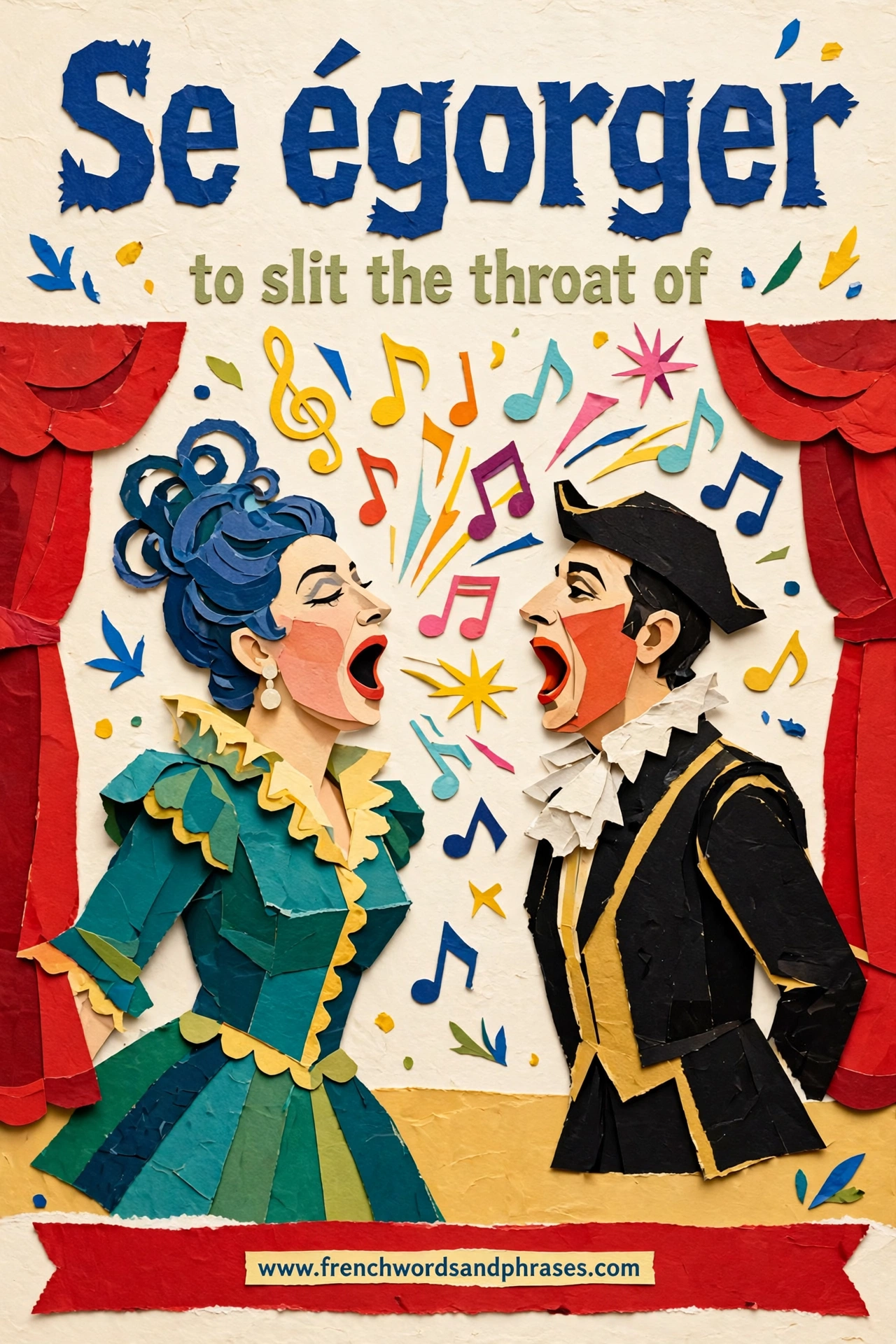
Se égorger means to slit the throat of — used of enemies who cut each other’s throats, and, with a grim smile, of people tearing each other apart over almost nothing.
Two brothers at war over a throne, two families feuding over a strip of land, two drivers in a car park ready to come to blows over a parking space — s’égorger is the verb of mutual throat-cutting, literal in the chronicles and gloriously exaggerated in everyday quarrels.
In this guide, you’ll learn how to conjugate se égorger in all the major French tenses and moods. Explore complete conjugation tables, French examples, English translations, and practice quizzes.
Understanding the French Verb Se égorger
Se égorger is a regular French verb belonging to the first group of verbs, those ending in-er.
It means to slit the throat of. It is commonly used of feuds, civil wars and rival factions destroying one another, and far more often today, with deliberate exaggeration, of bitter family quarrels, lawsuits and office wars — anywhere two sides seem determined to ruin each other over something small.
Verb classification: First group (-er), reflexive
Auxiliary verb: Être
Past participle: égorgé
Present participle: égorgeant
English equivalents: To cut each other’s throats, to slaughter one another, (figurative) to tear each other apart; les deux clans s’égorgent — the two clans are at each other’s throats; s’égorger pour un héritage — to tear each other apart over an inheritance; ils vont s’égorger — they are going to kill each other.
One important detail: s’égorger is almost always reciprocal — the reflexive pronoun points both ways at once: ils s’égorgent means they are cutting each other’s throats, the way ils se battent means they fight each other. It takes être in every compound tense, with the participle agreeing: les deux armées se sont égorgées. The -ger spelling rule still applies: nous nous égorgeons, with the protective e after the g. In modern mouths the word is usually figurative and hyperbolic — heirs, neighbours and football fans s’égorgent over inheritances, fences and referees, and nobody reaches for a knife.
Experience the Word
Se égorger is the verb of the feud — two sides so locked together in hatred that each is busy destroying the other, and itself.
Imagine two families in a mountain village, divided for three generations by a strip of land no wider than a road. The grandfathers fought over it, the fathers sued over it, and the sons now pass it without speaking. Ils se sont égorgés pour ce bout de terre — in court, at weddings, at funerals — until nobody alive remembers which family the land was supposed to feed.
No throats were cut, in the end. They tore each other apart — égorgés — over a field neither of them ploughs.
How to Conjugate Se égorger: Complete French Conjugation Guide
Let’s explore every major conjugation of se égorger, beginning with the indicative mood.
How to Conjugate Se égorger in the Indicative Mood
The indicative mood is used to express facts, observations, actions, and events.
How to Conjugate Se égorger in the Present Tense (Présent)
Used for actions happening now, habitual actions, and general truths.
| Subject | Conjugation |
|---|---|
| je | m’égorge |
| tu | t’égorges |
| il / elle | s’égorge |
| nous | nous égorgeons |
| vous | vous égorgez |
| ils / elles | s’égorgent |
Example
Dans cette tragédie, les deux frères s’égorgent pour un trône.
In this tragedy, the two brothers cut each other’s throats over a throne.
Quick Quiz 1
Complete the sentence:
Pour un héritage, nous nous ______ depuis des années.
Reveal the answer
égorgeons
Pour un héritage, nous nous égorgeons depuis des années.
Over an inheritance, we have been at each other’s throats for years.
How to Conjugate Se égorger in the Passé Composé
Used for completed actions in the past. Se égorger takes the auxiliary verb être.
| Subject | Conjugation |
|---|---|
| je | me suis égorgé / me suis égorgée |
| tu | t’es égorgé / t’es égorgée |
| il / elle | s’est égorgé / s’est égorgée |
| nous | nous sommes égorgés / nous sommes égorgées |
| vous | vous êtes égorgés / vous êtes égorgées / vous êtes égorgé / vous êtes égorgée |
| ils / elles | se sont égorgés / se sont égorgées |
Example
Les deux clans se sont égorgés pendant des générations.
The two clans cut each other’s throats for generations.
How to Conjugate Se égorger in the Imparfait (Imperfect Tense)
Used for habitual past actions, descriptions, and ongoing situations in the past.
| Subject | Conjugation |
|---|---|
| je | m’égorgeais |
| tu | t’égorgeais |
| il / elle | s’égorgeait |
| nous | nous égorgions |
| vous | vous égorgiez |
| ils / elles | s’égorgeaient |
Example
Pour un héritage, les cousins s’égorgeaient en procès sans fin.
Over an inheritance, the cousins were at each other’s throats in endless lawsuits.
Quick Quiz 2
Choose the correct form:
The two armies slaughtered each other.
Les deux armées ______. (se sont égorgées / ont égorgé)
Reveal the answer
se sont égorgées
Les deux armées se sont égorgées.
S’égorger is reflexive and takes être, and the participle agrees: égorgées.
How to Conjugate Se égorger in the Plus-que-parfait
Used to describe an action that had already been completed before another past event.
| Subject | Conjugation |
|---|---|
| je | m’étais égorgé / m’étais égorgée |
| tu | t’étais égorgé / t’étais égorgée |
| il / elle | s’était égorgé / s’était égorgée |
| nous | nous étions égorgés / nous étions égorgées |
| vous | vous étiez égorgés / vous étiez égorgées / vous étiez égorgé / vous étiez égorgée |
| ils / elles | s’étaient égorgés / s’étaient égorgées |
Example
Les deux familles s’étaient égorgées avant la réconciliation.
The two families had been at each other’s throats before the reconciliation.
How to Conjugate Se égorger in the Passé Simple
Primarily used in formal writing, literature, and historical narratives. It is rarely used in everyday conversation.
| Subject | Conjugation |
|---|---|
| je | m’égorgeai |
| tu | t’égorgeas |
| il / elle | s’égorgea |
| nous | nous égorgeâmes |
| vous | vous égorgeâtes |
| ils / elles | s’égorgeèrent |
Example
Dans la cour du château, les rivaux s’égorgèrent au lever du jour.
In the castle courtyard, the rivals cut each other’s throats at daybreak.
How to Conjugate Se égorger in the Passé Antérieur
A literary tense used to express an action completed immediately before another past action, generally in the passé simple.
| Subject | Conjugation |
|---|---|
| je | me fus égorgé / me fus égorgée |
| tu | te fus égorgé / te fus égorgée |
| il / elle | se fut égorgé / se fut égorgée |
| nous | nous fûmes égorgés / nous fûmes égorgées |
| vous | vous fûtes égorgés / vous fûtes égorgées / vous fûtes égorgé / vous fûtes égorgée |
| ils / elles | se furent égorgés / se furent égorgées |
Example
Quand les deux armées se furent égorgées, il ne resta que le silence.
When the two armies had slaughtered each other, only silence remained.
How to Conjugate Se égorger in the Future Tense (Futur Simple)
Used to describe actions that will take place in the future.
| Subject | Conjugation |
|---|---|
| je | m’égorgerai |
| tu | t’égorgeras |
| il / elle | s’égorgera |
| nous | nous égorgerons |
| vous | vous égorgerez |
| ils / elles | s’égorgeront |
Example
Si personne ne les sépare, ils s’égorgeront pour cette terre.
If nobody separates them, they will cut each other’s throats over this land.
How to Conjugate Se égorger in the Futur Antérieur (Future Perfect)
Used for an action that will have been completed before a particular point in the future.
| Subject | Conjugation |
|---|---|
| je | me serai égorgé / me serai égorgée |
| tu | te seras égorgé / te seras égorgée |
| il / elle | se sera égorgé / se sera égorgée |
| nous | nous serons égorgés / nous serons égorgées |
| vous | vous serez égorgés / vous serez égorgées / vous serez égorgé / vous serez égorgée |
| ils / elles | se seront égorgés / se seront égorgées |
Example
À ce rythme, les deux factions se seront égorgées avant l’hiver.
At this rate, the two factions will have torn each other apart before winter.
How to Conjugate Se égorger in the Near Future (Futur Proche)
Used to describe something that is going to happen soon. Formed with aller + infinitive.
| Subject | Conjugation |
|---|---|
| je | vais m’égorger |
| tu | vas t’égorger |
| il / elle | va s’égorger |
| nous | allons nous égorger |
| vous | allez vous égorger |
| ils / elles | vont s’égorger |
Example
Arrêtez-les, ils vont s’égorger !
Stop them, they are going to tear each other apart!
How to Conjugate Se égorger in the Conditional Mood
The conditional mood expresses what would happen under certain circumstances. It is also frequently used to make polite requests or express wishes.
How to Conjugate Se égorger in the Present Conditional
| Subject | Conjugation |
|---|---|
| je | m’égorgerais |
| tu | t’égorgerais |
| il / elle | s’égorgerait |
| nous | nous égorgerions |
| vous | vous égorgeriez |
| ils / elles | s’égorgeraient |
Example
Sans l’arbitre, les deux équipes s’égorgeraient à chaque match.
Without the referee, the two teams would be at each other’s throats at every match.
How to Conjugate Se égorger in the Past Conditional
| Subject | Conjugation |
|---|---|
| je | me serais égorgé / me serais égorgée |
| tu | te serais égorgé / te serais égorgée |
| il / elle | se serait égorgé / se serait égorgée |
| nous | nous serions égorgés / nous serions égorgées |
| vous | vous seriez égorgés / vous seriez égorgées / vous seriez égorgé / vous seriez égorgée |
| ils / elles | se seraient égorgés / se seraient égorgées |
Example
Ils se seraient égorgés pour ce trésor si la carte n’avait pas disparu.
They would have cut each other’s throats over that treasure if the map had not disappeared.
Se égorger in the Literary Past Conditional Form
This less common literary form uses the imperfect subjunctive of être.
| Subject | Conjugation |
|---|---|
| je | me fusse égorgé / me fusse égorgée |
| tu | te fusses égorgé / te fusses égorgée |
| il / elle | se fût égorgé / se fût égorgée |
| nous | nous fussions égorgés / nous fussions égorgées |
| vous | vous fussiez égorgés / vous fussiez égorgées / vous fussiez égorgé / vous fussiez égorgée |
| ils / elles | se fussent égorgés / se fussent égorgées |
Example
Les deux princes se fussent égorgés sans l’arrivée de l’armée royale.
The two princes would have slaughtered each other without the royal army’s arrival.
How to Conjugate Se égorger in the Subjunctive Mood
The subjunctive is used to express wishes, emotions, doubts, necessity, and uncertainty. It frequently follows expressions such as il faut que (it is necessary that) or bien que (although).
How to Conjugate Se égorger in the Present Subjunctive
| Subject | Conjugation |
|---|---|
| que je | m’égorge |
| que tu | t’égorges |
| qu’il / qu’elle | s’égorge |
| que nous | nous égorgions |
| que vous | vous égorgiez |
| qu’ils / qu’elles | s’égorgent |
Example
Je ne veux pas que les enfants s’égorgent pour un jouet.
I do not want the children tearing each other apart over a toy.
Quick Quiz 3
Complete the sentence using the subjunctive:
Je ne veux pas que vous ______ pour si peu.
Reveal the answer
vous égorgiez
Je ne veux pas que vous vous égorgiez pour si peu.
I do not want you tearing each other apart over so little.
How to Conjugate Se égorger in the Imperfect Subjunctive
A literary tense, rarely encountered in modern spoken French.
| Subject | Conjugation |
|---|---|
| que je | m’égorgasse |
| que tu | t’égorgasses |
| qu’il / qu’elle | s’égorgât |
| que nous | nous égorgassions |
| que vous | vous égorgassiez |
| qu’ils / qu’elles | s’égorgassent |
Example
Le roi craignait que ses fils s’égorgeassent pour la couronne.
The king feared his sons might cut each other’s throats over the crown.
How to Conjugate Se égorger in the Pluperfect Subjunctive
A literary construction used to express an action completed before another past action.
| Subject | Conjugation |
|---|---|
| que je | me fusse égorgé / me fusse égorgée |
| que tu | te fusses égorgé / te fusses égorgée |
| qu’il / qu’elle | se fût égorgé / se fût égorgée |
| que nous | nous fussions égorgés / nous fussions égorgées |
| que vous | vous fussiez égorgés / vous fussiez égorgées / vous fussiez égorgé / vous fussiez égorgée |
| qu’ils / qu’elles | se fussent égorgés / se fussent égorgées |
Example
Les chroniques disaient que les barons se fussent égorgés pour un château.
The chronicles said the barons had slaughtered each other over a castle.
How to Conjugate Se égorger in the Past Subjunctive
| Subject | Conjugation |
|---|---|
| que je | me sois égorgé / me sois égorgée |
| que tu | te sois égorgé / te sois égorgée |
| qu’il / qu’elle | se soit égorgé / se soit égorgée |
| que nous | nous soyons égorgés / nous soyons égorgées |
| que vous | vous soyez égorgés / vous soyez égorgées / vous soyez égorgé / vous soyez égorgée |
| qu’ils / qu’elles | se soient égorgés / se soient égorgées |
Example
C’est triste que ces frères se soient égorgés pour si peu.
It is sad that these brothers tore each other apart over so little.
How to Conjugate Se égorger in the Imperative
The imperative is used to give commands, instructions, invitations, or suggestions. Subject pronouns are omitted.
How to Conjugate Se égorger in the Present Imperative
| Person | Conjugation |
|---|---|
| (tu) | égorge-toi |
| (nous) | égorgeons-nous |
| (vous) | égorgez-vous |
Example
Ne vous égorgez pas pour une place de parking !
Do not tear each other apart over a parking space!
Quick Quiz 4
How would you say Do not tear each other apart (tu form)?
Reveal the answer
Ne t’égorge pas avec ton frère !
French Participles of Se égorger
Participles are verb forms that can be used in compound tenses and other grammatical constructions.
Present Participle of Se égorger
égorgeant
En s’égorgeant pour le pouvoir, ils ont fini par perdre le royaume.
By slaughtering each other over power, they ended up losing the kingdom.
Past Participle of Se égorger
égorgé
Égorgés l’un par l’autre, les deux rivaux gisaient dans la cour.
Each with his throat cut by the other, the two rivals lay in the courtyard.
Se égorger in Everyday French: Real-Life Examples
Now that you know the conjugations, let’s see how se égorger appears in everyday French.
Example 1 — Present
Les deux clans s’égorgent depuis des générations.
The two clans have been at each other’s throats for generations.
Example 2 — Passé composé
Ils se sont égorgés pour un héritage.
They tore each other apart over an inheritance.
Example 3 — Imparfait
Les cousins s’égorgeaient en procès sans fin.
The cousins were at each other’s throats in endless lawsuits.
Example 4 — Future
Ils s’égorgeront pour cette terre.
They will cut each other’s throats over this land.
Example 5 — Conditional
Sans l’arbitre, les deux équipes s’égorgeraient.
Without the referee, the two teams would be at each other’s throats.
Example 6 — Imperative
Ne vous égorgez pas pour une place de parking !
Do not tear each other apart over a parking space!
Beyond Translation: The Meaning of Se égorger
English to be at each other’s throats is the living twin of s’égorger — the same image, kept as an idiom.
French keeps the verb itself.
Because égorger still works on every farm, its reflexive can swing from the chronicle’s battlefield to the family lunch table without changing a letter: ils s’égorgent pour l’héritage needs no knife at all, just an inheritance, two brothers, and time.
How to Remember the French Verb Se égorger
Remember it this way: Se égorger is about two brothers, one throne — each busy destroying the other.
- Almost always reciprocal: ils s’égorgent = they cut each other’s throats — the pronoun points both ways.
- Être and agreement, as with every reflexive: les deux armées se sont égorgées.
- -ger spelling survives the reflexive: nous nous égorgeons, with the protective e; today it is usually hyperbole — feuds, lawsuits, inheritances.
The key idea is two brothers, one throne — each busy destroying the other.
Test Your Knowledge of Se égorger
Let’s see how much you’ve learned. Try answering these questions before revealing the answers.
Question 1
In ils s’égorgent pour un héritage, what does the reflexive pronoun mean?
Reveal the answer
Each other — s’égorger is reciprocal: they are tearing each other apart over an inheritance.
Question 2
How do you say They tore each other apart over an inheritance in French?
Reveal the answer
Ils se sont égorgés pour un héritage.
Question 3
Translate: The two clans have been at each other’s throats for generations.
Reveal the answer
Les deux clans s’égorgent depuis des générations.
Question 4
What is the past participle of s’égorger?
Reveal the answer
Égorgé — agreeing: égorgée, égorgés, égorgées.
Question 5
Complete the sentence:
Je ne veux pas que les enfants ______ pour un jouet.
Reveal the answer
s’égorgent
Je ne veux pas que les enfants s’égorgent pour un jouet.
I do not want the children tearing each other apart over a toy.
Your Final Challenge
Can You Use It?
How would you say this in French?
They tore each other apart for thirty years over a field that nobody ploughs any more.
Reveal the answer
Ils se sont égorgés pendant trente ans pour un champ que plus personne ne laboure.
They tore each other apart for thirty years over a field that nobody ploughs any more.
A little French. A little curiosity. A richer everyday life.
LEARN FRENCH ONE WORD AT A TIME