A French Word to Live By
How to Conjugate Se égarer in French
/se.ɡa.ʁe/
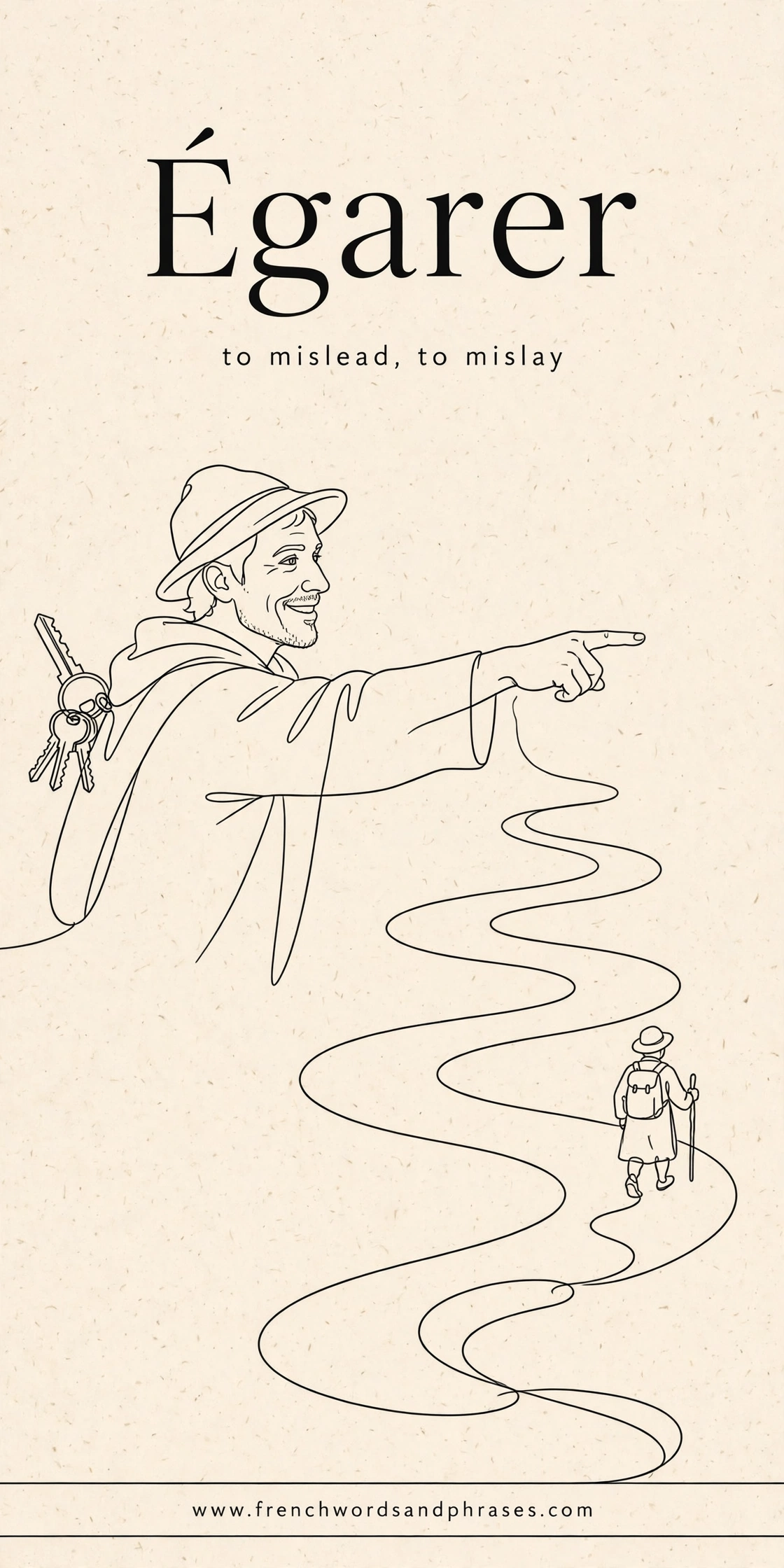
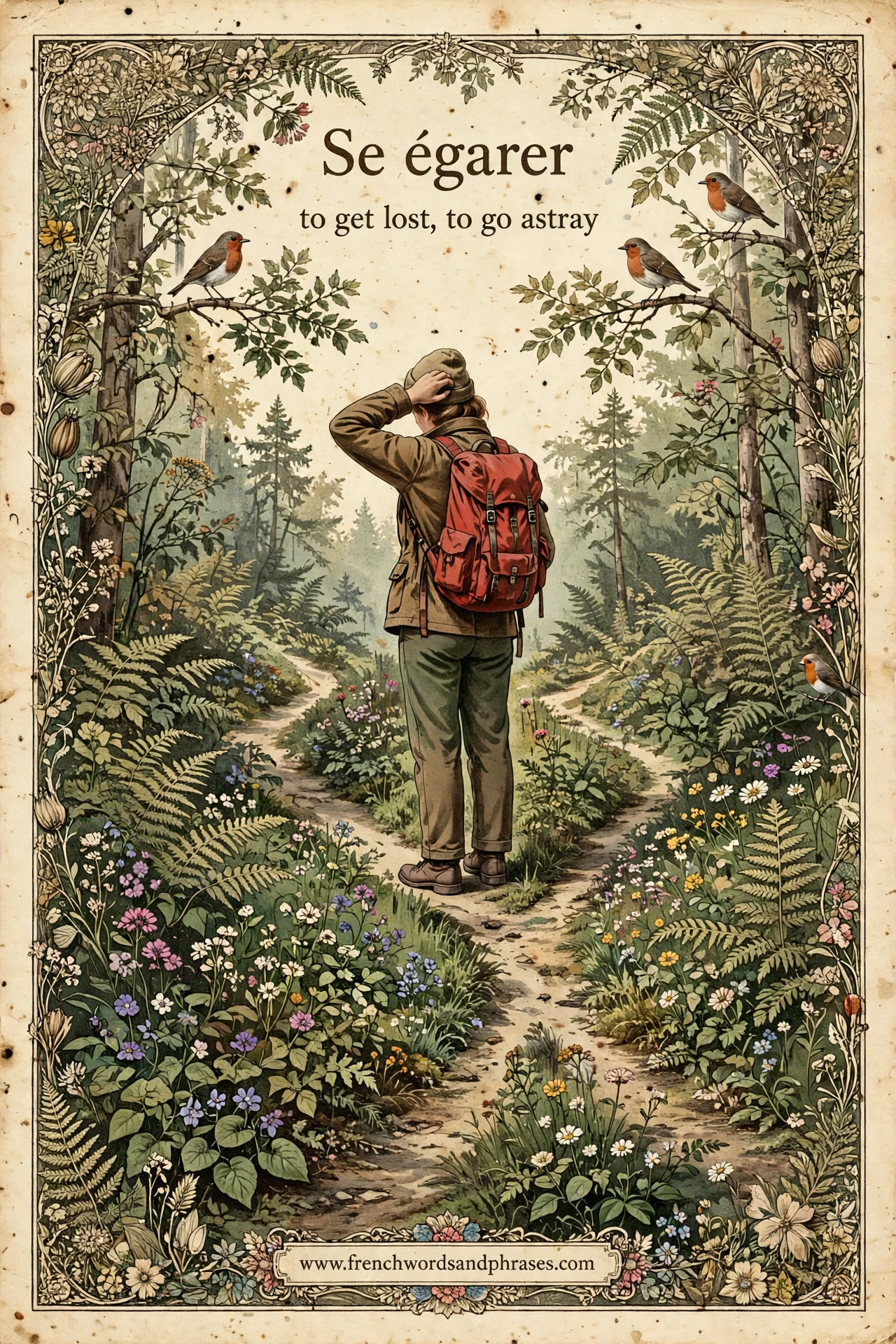
Se égarer means to get lost, to go astray — to leave the right path without noticing, and find yourself somewhere you never meant to be.
A walker who misses the marked turning in the forest, a flock drifting away from the pasture, a letter that never arrives — s’égarer is the verb of quietly losing the way, of wandering off the path while thinking you were still on it.
In this guide, you’ll learn how to conjugate se égarer in all the major French tenses and moods. Explore complete conjugation tables, French examples, English translations, and practice quizzes.
Understanding the French Verb Se égarer
Se égarer is a regular French verb belonging to the first group of verbs, those ending in-er.
It means to get lost, to go astray. It is commonly used of walkers, tourists and drivers losing their way, of sheep and herds straying from the pasture — the lost sheep, la brebis égarée, is its emblem — and figuratively of arguments, conversations and minds wandering off the point.
Verb classification: First group (-er), reflexive
Auxiliary verb: Être
Past participle: égaré
Present participle: égarant
English equivalents: To get lost, to lose one’s way, to go astray, to stray; s’égarer dans la forêt — to get lost in the forest; s’égarer en route — to lose one’s way on the road; une brebis égarée — a lost sheep; s’égarer dans ses pensées — to lose oneself in one’s thoughts.
One important detail: s’égarer is égarer turned back on the subject — the plain verb misleads others or mislays things, but the moment you are the one who is lost, French makes it reflexive, with être in every compound tense and agreement on the participle: elle s’est égarée, ils se sont égarés. It covers both the map sense (getting lost on a road) and the moral sense (going astray, straying from the right path) — and, gently, the daydream sense: s’égarer dans ses pensées, to lose yourself in your thoughts. The negative imperative keeps the pronoun before the verb: ne t’égare pas !
Experience the Word
Se égarer is the verb of the missed turning — you never decide to get lost; you simply notice, too late, that the path has gone.
Imagine a pilgrim on a mountain path in the late afternoon. The mist comes down between one marker and the next; he walks on, certain, for an hour — then the path ends at a cliff edge above the wrong valley. Il s’est égaré, not by wandering, but by trusting. Somewhere below, a village bell rings the hour, and he turns towards the sound like a compass.
He did not choose the wrong road. He lost the right one — égaré — and the bell gave it back.
How to Conjugate Se égarer: Complete French Conjugation Guide
Let’s explore every major conjugation of se égarer, beginning with the indicative mood.
How to Conjugate Se égarer in the Indicative Mood
The indicative mood is used to express facts, observations, actions, and events.
How to Conjugate Se égarer in the Present Tense (Présent)
Used for actions happening now, habitual actions, and general truths.
| Subject | Conjugation |
|---|---|
| je | m’égare |
| tu | t’égares |
| il / elle | s’égare |
| nous | nous égarons |
| vous | vous égarez |
| ils / elles | s’égarent |
Example
Les touristes s’égarent facilement dans la vieille ville.
Tourists easily get lost in the old town.
Quick Quiz 1
Complete the sentence:
Nous nous ______ dans la forêt.
Reveal the answer
égarons
Nous nous égarons dans la forêt.
We are getting lost in the forest.
How to Conjugate Se égarer in the Passé Composé
Used for completed actions in the past. Se égarer takes the auxiliary verb être.
| Subject | Conjugation |
|---|---|
| je | me suis égaré / me suis égarée |
| tu | t’es égaré / t’es égarée |
| il / elle | s’est égaré / s’est égarée |
| nous | nous sommes égarés / nous sommes égarées |
| vous | vous êtes égarés / vous êtes égarées / vous êtes égaré / vous êtes égarée |
| ils / elles | se sont égarés / se sont égarées |
Example
Nous nous sommes égarés dans la forêt au crépuscule.
We got lost in the forest at dusk.
How to Conjugate Se égarer in the Imparfait (Imperfect Tense)
Used for habitual past actions, descriptions, and ongoing situations in the past.
| Subject | Conjugation |
|---|---|
| je | m’égarais |
| tu | t’égarais |
| il / elle | s’égarait |
| nous | nous égarions |
| vous | vous égariez |
| ils / elles | s’égaraient |
Example
Enfant, il s’égarait sans cesse dans les couloirs de l’école.
As a child, he was always getting lost in the school corridors.
Quick Quiz 2
Choose the correct form:
We got lost at dusk.
Nous ______ au crépuscule. (nous sommes égarés / avons égaré)
Reveal the answer
nous sommes égarés
Nous nous sommes égarés au crépuscule.
S’égarer is reflexive and takes être.
How to Conjugate Se égarer in the Plus-que-parfait
Used to describe an action that had already been completed before another past event.
| Subject | Conjugation |
|---|---|
| je | m’étais égaré / m’étais égarée |
| tu | t’étais égaré / t’étais égarée |
| il / elle | s’était égaré / s’était égarée |
| nous | nous étions égarés / nous étions égarées |
| vous | vous étiez égarés / vous étiez égarées / vous étiez égaré / vous étiez égarée |
| ils / elles | s’étaient égarés / s’étaient égarées |
Example
Le troupeau s’était égaré loin des pâturages.
The flock had strayed far from the pastures.
How to Conjugate Se égarer in the Passé Simple
Primarily used in formal writing, literature, and historical narratives. It is rarely used in everyday conversation.
| Subject | Conjugation |
|---|---|
| je | m’égarai |
| tu | t’égaras |
| il / elle | s’égara |
| nous | nous égarâmes |
| vous | vous égarâtes |
| ils / elles | s’égarèrent |
Example
Le pèlerin s’égara dans les montagnes et marcha toute la nuit.
The pilgrim lost his way in the mountains and walked all night.
How to Conjugate Se égarer in the Passé Antérieur
A literary tense used to express an action completed immediately before another past action, generally in the passé simple.
| Subject | Conjugation |
|---|---|
| je | me fus égaré / me fus égarée |
| tu | te fus égaré / te fus égarée |
| il / elle | se fut égaré / se fut égarée |
| nous | nous fûmes égarés / nous fûmes égarées |
| vous | vous fûtes égarés / vous fûtes égarées / vous fûtes égaré / vous fûtes égarée |
| ils / elles | se furent égarés / se furent égarées |
Example
Dès qu’ils se furent égarés, les enfants appelèrent au secours.
As soon as they had got lost, the children called for help.
How to Conjugate Se égarer in the Future Tense (Futur Simple)
Used to describe actions that will take place in the future.
| Subject | Conjugation |
|---|---|
| je | m’égarerai |
| tu | t’égareras |
| il / elle | s’égarera |
| nous | nous égarerons |
| vous | vous égarerez |
| ils / elles | s’égareront |
Example
Sans boussole, vous vous égarerez dans ce désert.
Without a compass, you will get lost in this desert.
How to Conjugate Se égarer in the Futur Antérieur (Future Perfect)
Used for an action that will have been completed before a particular point in the future.
| Subject | Conjugation |
|---|---|
| je | me serai égaré / me serai égarée |
| tu | te seras égaré / te seras égarée |
| il / elle | se sera égaré / se sera égarée |
| nous | nous serons égarés / nous serons égarées |
| vous | vous serez égarés / vous serez égarées / vous serez égaré / vous serez égarée |
| ils / elles | se seront égarés / se seront égarées |
Example
À la tombée de la nuit, ils se seront égarés loin du sentier.
By nightfall, they will have strayed far from the path.
How to Conjugate Se égarer in the Near Future (Futur Proche)
Used to describe something that is going to happen soon. Formed with aller + infinitive.
| Subject | Conjugation |
|---|---|
| je | vais m’égarer |
| tu | vas t’égarer |
| il / elle | va s’égarer |
| nous | allons nous égarer |
| vous | allez vous égarer |
| ils / elles | vont s’égarer |
Example
Reste près de moi, tu vas t’égarer dans cette foule.
Stay close to me, you are going to get lost in this crowd.
How to Conjugate Se égarer in the Conditional Mood
The conditional mood expresses what would happen under certain circumstances. It is also frequently used to make polite requests or express wishes.
How to Conjugate Se égarer in the Present Conditional
| Subject | Conjugation |
|---|---|
| je | m’égarerais |
| tu | t’égarerais |
| il / elle | s’égarerait |
| nous | nous égarerions |
| vous | vous égareriez |
| ils / elles | s’égareraient |
Example
Même avec une carte, on s’égarerait dans ce labyrinthe.
Even with a map, one would get lost in this labyrinth.
How to Conjugate Se égarer in the Past Conditional
| Subject | Conjugation |
|---|---|
| je | me serais égaré / me serais égarée |
| tu | te serais égaré / te serais égarée |
| il / elle | se serait égaré / se serait égarée |
| nous | nous serions égarés / nous serions égarées |
| vous | vous seriez égarés / vous seriez égarées / vous seriez égaré / vous seriez égarée |
| ils / elles | se seraient égarés / se seraient égarées |
Example
Elle ne se serait pas égarée avec un téléphone chargé.
She would not have got lost with a charged phone.
Se égarer in the Literary Past Conditional Form
This less common literary form uses the imperfect subjunctive of être.
| Subject | Conjugation |
|---|---|
| je | me fusse égaré / me fusse égarée |
| tu | te fusses égaré / te fusses égarée |
| il / elle | se fût égaré / se fût égarée |
| nous | nous fussions égarés / nous fussions égarées |
| vous | vous fussiez égarés / vous fussiez égarées / vous fussiez égaré / vous fussiez égarée |
| ils / elles | se fussent égarés / se fussent égarées |
Example
Le voyageur se fût égaré dans la brume sans la cloche du village.
The traveller would have lost his way in the mist without the village bell.
How to Conjugate Se égarer in the Subjunctive Mood
The subjunctive is used to express wishes, emotions, doubts, necessity, and uncertainty. It frequently follows expressions such as il faut que (it is necessary that) or bien que (although).
How to Conjugate Se égarer in the Present Subjunctive
| Subject | Conjugation |
|---|---|
| que je | m’égare |
| que tu | t’égares |
| qu’il / qu’elle | s’égare |
| que nous | nous égarions |
| que vous | vous égariez |
| qu’ils / qu’elles | s’égarent |
Example
Je crains que les enfants s’égarent au marché.
I fear the children may get lost at the market.
Quick Quiz 3
Complete the sentence using the subjunctive:
Je crains que vous ______ dans ce désert.
Reveal the answer
vous égariez
Je crains que vous vous égariez dans ce désert.
I fear you may get lost in this desert.
How to Conjugate Se égarer in the Imperfect Subjunctive
A literary tense, rarely encountered in modern spoken French.
| Subject | Conjugation |
|---|---|
| que je | m’égarasse |
| que tu | t’égarasses |
| qu’il / qu’elle | s’égarât |
| que nous | nous égarassions |
| que vous | vous égarassiez |
| qu’ils / qu’elles | s’égarassent |
Example
Le berger redoutait que ses brebis s’égarassent dans la montagne.
The shepherd dreaded his sheep straying in the mountain.
How to Conjugate Se égarer in the Pluperfect Subjunctive
A literary construction used to express an action completed before another past action.
| Subject | Conjugation |
|---|---|
| que je | me fusse égaré / me fusse égarée |
| tu | te fusses égaré / te fusses égarée |
| qu’il / qu’elle | se fût égaré / se fût égarée |
| que nous | nous fussions égarés / nous fussions égarées |
| que vous | vous fussiez égarés / vous fussiez égarées / vous fussiez égaré / vous fussiez égarée |
| qu’ils / qu’elles | se fussent égarés / se fussent égarées |
Example
On disait que le convoi se fût égaré dès le premier jour.
People said the convoy had lost its way from the very first day.
How to Conjugate Se égarer in the Past Subjunctive
| Subject | Conjugation |
|---|---|
| que je | me sois égaré / me sois égarée |
| tu | te sois égaré / te sois égarée |
| qu’il / qu’elle | se soit égaré / se soit égarée |
| que nous | nous soyons égarés / nous soyons égarées |
| que vous | vous soyez égarés / vous soyez égarées / vous soyez égaré / vous soyez égarée |
| qu’ils / qu’elles | se soient égarés / se soient égarées |
Example
Je suis soulagé qu’ils ne se soient pas égarés.
I am relieved they did not get lost.
How to Conjugate Se égarer in the Imperative
The imperative is used to give commands, instructions, invitations, or suggestions. Subject pronouns are omitted.
How to Conjugate Se égarer in the Present Imperative
| Person | Conjugation |
|---|---|
| (tu) | égare-toi |
| (nous) | égarons-nous |
| (vous) | égarez-vous |
Example
Ne t’égare pas dans les ruelles après minuit !
Do not get lost in the little lanes after midnight!
Quick Quiz 4
How would you say Do not get lost (tu form)?
Reveal the answer
Ne t’égare pas !
French Participles of Se égarer
Participles are verb forms that can be used in compound tenses and other grammatical constructions.
Present Participle of Se égarer
égarant
En s’égarant dans la médina, ils ont découvert un palais caché.
By getting lost in the medina, they discovered a hidden palace.
Past Participle of Se égarer
égaré
Égarée dans la foule, la petite fille cherchait sa mère.
Lost in the crowd, the little girl was looking for her mother.
Se égarer in Everyday French: Real-Life Examples
Now that you know the conjugations, let’s see how se égarer appears in everyday French.
Example 1 — Present
Les touristes s’égarent dans la vieille ville.
Tourists get lost in the old town.
Example 2 — Passé composé
Nous nous sommes égarés dans la forêt.
We got lost in the forest.
Example 3 — Imparfait
Le troupeau s’égarait loin des pâturages.
The flock would stray far from the pastures.
Example 4 — Future
Sans boussole, vous vous égarerez.
Without a compass, you will get lost.
Example 5 — Conditional
On s’égarerait même avec une carte.
One would get lost even with a map.
Example 6 — Imperative
Ne t’égare pas dans les ruelles !
Do not get lost in the little lanes!
Beyond Translation: The Meaning of Se égarer
English astray — as in gone astray and led astray — is the exact twin of s’égarer, and the two languages share its emblem: the lost sheep.
La brebis égarée is never just a sheep.
From the parable onwards, the strayed sheep is everyone who has left the path — which is why French can say, with a smile, s’égarer dans ses pensées: even a daydream is a small, harmless going-astray.
How to Remember the French Verb Se égarer
Remember it this way: Se égarer is about the pilgrim in the mist, walking an hour in the wrong valley.
- Égarer loses other people or things; s’égarer is when you are the one who is lost — reflexive, être, participle agrees.
- Its emblem is la brebis égarée, the lost sheep: think straying, not just street maps.
- Regular -er underneath: nous nous égarons, vous vous égarez, past participle égaré; negative imperative: ne t’égare pas.
The key idea is the pilgrim in the mist, walking an hour in the wrong valley.
Test Your Knowledge of Se égarer
Let’s see how much you’ve learned. Try answering these questions before revealing the answers.
Question 1
Which auxiliary does s’égarer use, and why?
Reveal the answer
Être — it is a reflexive verb: nous nous sommes égarés dans la forêt.
Question 2
How do you say We got lost in the forest in French?
Reveal the answer
Nous nous sommes égarés dans la forêt.
Question 3
Translate: Tourists easily get lost in the old town.
Reveal the answer
Les touristes s’égarent facilement dans la vieille ville.
Question 4
What is the past participle of s’égarer?
Reveal the answer
Égaré — agreeing: égarée, égarés, égarées.
Question 5
Complete the sentence:
Je crains que les enfants ______ au marché.
Reveal the answer
s’égarent
Je crains que les enfants s’égarent au marché.
I fear the children may get lost at the market.
Your Final Challenge
Can You Use It?
How would you say this in French?
They got lost in the medina, and that is how they found the most beautiful garden in the city.
Reveal the answer
Ils se sont égarés dans la médina, et c’est ainsi qu’ils ont trouvé le plus beau jardin de la ville.
They got lost in the medina, and that is how they found the most beautiful garden in the city.
A little French. A little curiosity. A richer everyday life.
LEARN FRENCH ONE WORD AT A TIME