A French Word to Live By
How to Conjugate Égarer in French
/e.ɡa.ʁe/
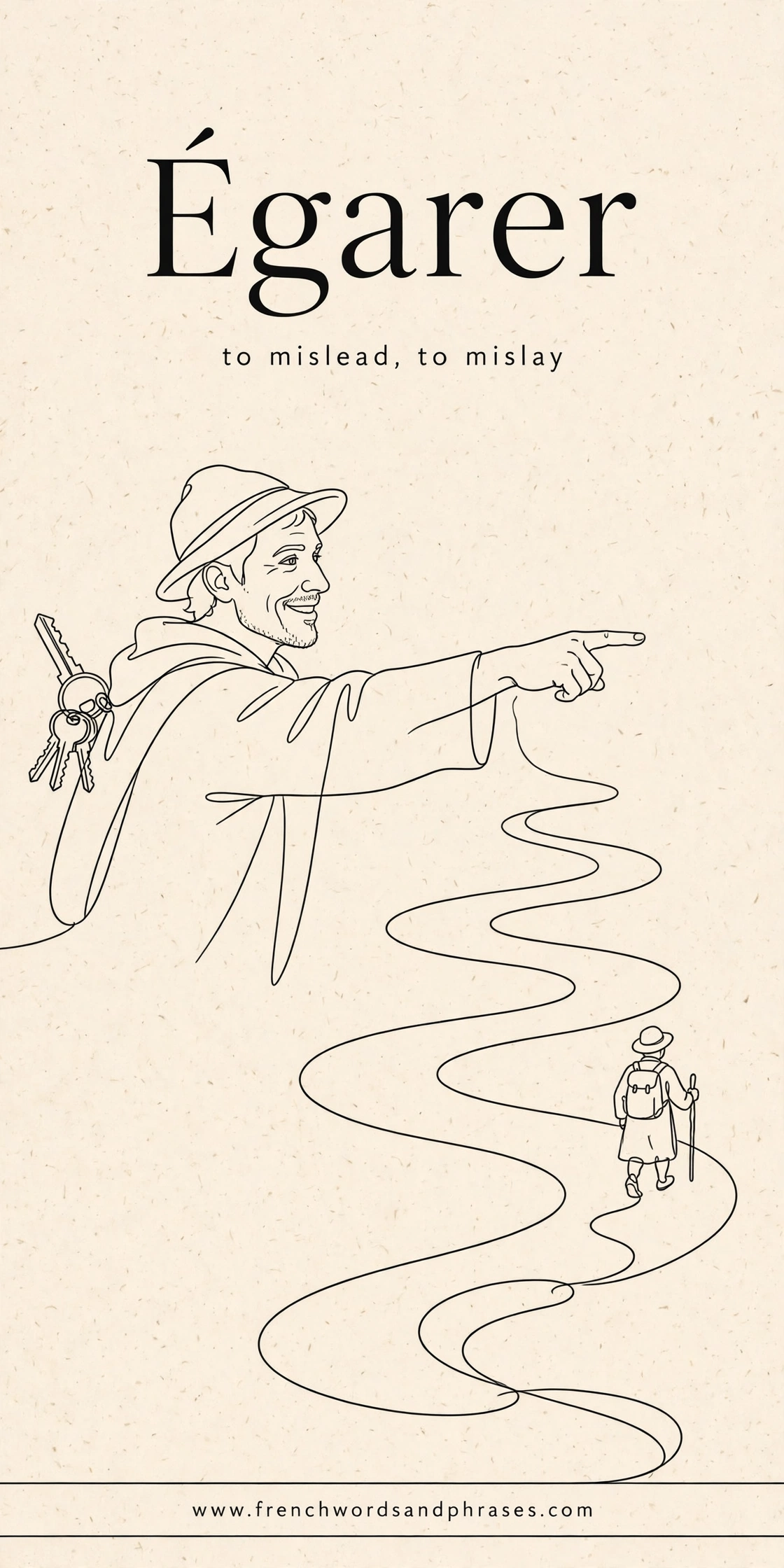
Égarer means to mislead, to mislay — to send someone down the wrong path, or to put something down so thoroughly lost that it might as well have walked away.
A signpost turned by the wind, sending walkers into the wrong valley; a passport that vanishes somewhere between the hotel and the airport — égarer is the verb of leading astray and losing things well, the double talent of bad maps and absent minds.
In this guide, you’ll learn how to conjugate égarer in all the major French tenses and moods. Explore complete conjugation tables, French examples, English translations, and practice quizzes.
Understanding the French Verb Égarer
Égarer is a regular French verb belonging to the first group of verbs, those ending in-er.
It means to mislead, to mislay. It is commonly used for keys, glasses, passports and documents that vanish into drawers and coat pockets, and for anything — a false trail, a confusing map, a lying guide — that sends people the wrong way; the reflexive s’égarer, to get lost, is its inseparable other half.
Verb classification: First group (-er)
Auxiliary verb: Avoir
Past participle: égaré
Present participle: égarant
English equivalents: To mislead, to lead astray, to mislay, to lose; égarer ses clés — to mislay one’s keys; égarer les voyageurs — to mislead the travellers; un panneau qui égare — a sign that sends you the wrong way; égarer un document — to mislay a document.
One important detail: égarer does two kinds of losing. With people (or their minds) as its object, it misleads: ce panneau égare les automobilistes — the sign sends drivers astray. With things as its object, it is the elegant word for mislaying: j’ai égaré mon passeport is politer than j’ai perdu, because égarer admits the thing is probably somewhere — you have simply put it beyond finding. The verb itself is a perfectly regular -er: j’égare, nous égarons, ils égarent.
Experience the Word
Égarer is the verb of the wrong turning and the missing key — it loses people and things with equal ease.
Imagine a traveller at a country crossroads in the fog. The signpost has turned in the wind during the night, and its arm now points cheerfully towards the wrong valley. The sign has égaré him completely — and somewhere at home, in a coat he never wears, his spare glasses lie égarées in the pocket, waiting for exactly this day.
The sign did it on purpose, almost; the glasses, by accident. Both were led astray — égarés — one by a sign, the others by a pocket.
How to Conjugate Égarer: Complete French Conjugation Guide
Let’s explore every major conjugation of égarer, beginning with the indicative mood.
How to Conjugate Égarer in the Indicative Mood
The indicative mood is used to express facts, observations, actions, and events.
How to Conjugate Égarer in the Present Tense (Présent)
Used for actions happening now, habitual actions, and general truths.
| Subject | Conjugation |
|---|---|
| je | égare |
| tu | égares |
| il / elle | égare |
| nous | égarons |
| vous | égarez |
| ils / elles | égarent |
Example
Il égare toujours ses clés en rentrant.
He always mislays his keys when he comes home.
Quick Quiz 1
Complete the sentence:
Nous ______ souvent nos gants en hiver.
Reveal the answer
égarons
Nous égarons souvent nos gants en hiver.
We often mislay our gloves in winter.
How to Conjugate Égarer in the Passé Composé
Used for completed actions in the past. Égarer takes the auxiliary verb avoir.
| Subject | Conjugation |
|---|---|
| j’ | ai égaré |
| tu | as égaré |
| il / elle | a égaré |
| nous | avons égaré |
| vous | avez égaré |
| ils / elles | ont égaré |
Example
J’ai égaré mon passeport pendant le voyage.
I mislaid my passport during the trip.
How to Conjugate Égarer in the Imparfait (Imperfect Tense)
Used for habitual past actions, descriptions, and ongoing situations in the past.
| Subject | Conjugation |
|---|---|
| je | égarais |
| tu | égarais |
| il / elle | égarait |
| nous | égarions |
| vous | égariez |
| ils / elles | égaraient |
Example
Ce panneau égarait les voyageurs à chaque carrefour.
That sign used to mislead travellers at every crossroads.
Quick Quiz 2
Choose the correct form:
I mislaid my passport.
J’______ mon passeport. (ai égaré / suis égaré)
Reveal the answer
ai égaré
J’ai égaré mon passeport.
Égarer takes avoir.
How to Conjugate Égarer in the Plus-que-parfait
Used to describe an action that had already been completed before another past event.
| Subject | Conjugation |
|---|---|
| j’ | avais égaré |
| tu | avais égaré |
| il / elle | avait égaré |
| nous | avions égaré |
| vous | aviez égaré |
| ils / elles | avaient égaré |
Example
Elle avait égaré la lettre avant même de la lire.
She had mislaid the letter before even reading it.
How to Conjugate Égarer in the Passé Simple
Primarily used in formal writing, literature, and historical narratives. It is rarely used in everyday conversation.
| Subject | Conjugation |
|---|---|
| je | égarai |
| tu | égaras |
| il / elle | égara |
| nous | égarâmes |
| vous | égarâtes |
| ils / elles | égarèrent |
Example
Le brouillard égara les randonneurs pendant une heure.
The fog led the hikers astray for an hour.
How to Conjugate Égarer in the Passé Antérieur
A literary tense used to express an action completed immediately before another past action, generally in the passé simple.
| Subject | Conjugation |
|---|---|
| j’ | eus égaré |
| tu | eus égaré |
| il / elle | eut égaré |
| nous | eûmes égaré |
| vous | eûtes égaré |
| ils / elles | eurent égaré |
Example
Quand il eut égaré ses lunettes, il renonça à lire le journal.
When he had mislaid his glasses, he gave up reading the newspaper.
How to Conjugate Égarer in the Future Tense (Futur Simple)
Used to describe actions that will take place in the future.
| Subject | Conjugation |
|---|---|
| je | égarerai |
| tu | égareras |
| il / elle | égarera |
| nous | égarerons |
| vous | égarerez |
| ils / elles | égareront |
Example
Ne laisse pas traîner ce document, tu l’égareras encore.
Do not leave that document lying around, you will mislay it again.
How to Conjugate Égarer in the Futur Antérieur (Future Perfect)
Used for an action that will have been completed before a particular point in the future.
| Subject | Conjugation |
|---|---|
| j’ | aurai égaré |
| tu | auras égaré |
| il / elle | aura égaré |
| nous | aurons égaré |
| vous | aurez égaré |
| ils / elles | auront égaré |
Example
D’ici demain, il aura encore égaré ses gants quelque part.
By tomorrow, he will have mislaid his gloves somewhere again.
How to Conjugate Égarer in the Near Future (Futur Proche)
Used to describe something that is going to happen soon. Formed with aller + infinitive.
| Subject | Conjugation |
|---|---|
| je | vais égarer |
| tu | vas égarer |
| il / elle | va égarer |
| nous | allons égarer |
| vous | allez égarer |
| ils / elles | vont égarer |
Example
Attention, ce vieux plan va égarer les visiteurs.
Careful, that old map is going to mislead the visitors.
How to Conjugate Égarer in the Conditional Mood
The conditional mood expresses what would happen under certain circumstances. It is also frequently used to make polite requests or express wishes.
How to Conjugate Égarer in the Present Conditional
| Subject | Conjugation |
|---|---|
| je | égarerais |
| tu | égarerais |
| il / elle | égarerait |
| nous | égarerions |
| vous | égareriez |
| ils / elles | égareraient |
Example
Un guide si confus égarerait n’importe quel groupe.
Such a confusing guide would mislead any group.
How to Conjugate Égarer in the Past Conditional
| Subject | Conjugation |
|---|---|
| j’ | aurais égaré |
| tu | aurais égaré |
| il / elle | aurait égaré |
| nous | aurions égaré |
| vous | auriez égaré |
| ils / elles | auraient égaré |
Example
Elle n’aurait pas égaré la clé si elle l’avait rangée.
She would not have mislaid the key if she had put it away.
Égarer in the Literary Past Conditional Form
This less common literary form uses the imperfect subjunctive of avoir.
| Subject | Conjugation |
|---|---|
| j’ | eusse égaré |
| tu | eusses égaré |
| il / elle | eût égaré |
| nous | eussions égaré |
| vous | eussiez égaré |
| ils / elles | eussent égaré |
Example
Ce sentier eût égaré les pèlerins sans les croix de pierre.
That path would have led the pilgrims astray without the stone crosses.
How to Conjugate Égarer in the Subjunctive Mood
The subjunctive is used to express wishes, emotions, doubts, necessity, and uncertainty. It frequently follows expressions such as il faut que (it is necessary that) or bien que (although).
How to Conjugate Égarer in the Present Subjunctive
| Subject | Conjugation |
|---|---|
| que je | égare |
| que tu | égares |
| qu’il / qu’elle | égare |
| que nous | égarions |
| que vous | égariez |
| qu’ils / qu’elles | égarent |
Example
Je ne crois pas qu’il égare ses affaires exprès.
I do not think he mislays his things on purpose.
Quick Quiz 3
Complete the sentence using the subjunctive:
On craignait que la fausse piste ______ les secours.
Reveal the answer
égarât
On craignait que la fausse piste égarât les secours.
People feared the false trail might mislead the rescue teams.
How to Conjugate Égarer in the Imperfect Subjunctive
A literary tense, rarely encountered in modern spoken French.
| Subject | Conjugation |
|---|---|
| que je | égarasse |
| que tu | égarasses |
| qu’il / qu’elle | égarât |
| que nous | égarassions |
| que vous | égarassiez |
| qu’ils / qu’elles | égarassent |
Example
On craignait que la fausse piste égarât les secours.
People feared the false trail might mislead the rescue teams.
How to Conjugate Égarer in the Pluperfect Subjunctive
A literary construction used to express an action completed before another past action.
| Subject | Conjugation |
|---|---|
| que j’ | eusse égaré |
| que tu | eusses égaré |
| qu’il / qu’elle | eût égaré |
| que nous | eussions égaré |
| que vous | eussiez égaré |
| qu’ils / qu’elles | eussent égaré |
Example
On racontait que ce guide eût égaré plus d’un voyageur.
People said that guide had misled more than one traveller.
How to Conjugate Égarer in the Past Subjunctive
| Subject | Conjugation |
|---|---|
| que j’ | aie égaré |
| que tu | aies égaré |
| qu’il / qu’elle | ait égaré |
| que nous | ayons égaré |
| que vous | ayez égaré |
| qu’ils / qu’elles | aient égaré |
Example
C’est dommage qu’elle ait égaré le manuscrit.
It is a pity she mislaid the manuscript.
How to Conjugate Égarer in the Imperative
The imperative is used to give commands, instructions, invitations, or suggestions. Subject pronouns are omitted.
How to Conjugate Égarer in the Present Imperative
| Person | Conjugation |
|---|---|
| (tu) | égare |
| (nous) | égarons |
| (vous) | égarez |
Example
N’égarez pas les touristes avec vos vieilles cartes !
Do not mislead the tourists with your old maps!
Quick Quiz 4
How would you say Do not mislay your glasses (tu form)?
Reveal the answer
N’égare pas tes lunettes !
French Participles of Égarer
Participles are verb forms that can be used in compound tenses and other grammatical constructions.
Present Participle of Égarer
égarant
En égarant ses clés chaque semaine, il a fini par acheter un porte-clés qui sonne.
By mislaying his keys every week, he ended up buying a key-ring that beeps.
Past Participle of Égarer
égaré
Égarée dans un tiroir, la lettre attendait depuis dix ans.
Mislaid in a drawer, the letter had been waiting for ten years.
Égarer in Everyday French: Real-Life Examples
Now that you know the conjugations, let’s see how égarer appears in everyday French.
Example 1 — Present
Il égare toujours ses clés.
He always mislays his keys.
Example 2 — Passé composé
J’ai égaré mon passeport.
I mislaid my passport.
Example 3 — Imparfait
Ce panneau égarait les voyageurs.
That sign used to mislead travellers.
Example 4 — Future
Tu égareras encore ce document.
You will mislay that document again.
Example 5 — Conditional
Un guide si confus égarerait n’importe qui.
Such a confusing guide would mislead anyone.
Example 6 — Imperative
N’égare pas tes lunettes cette fois !
Do not mislay your glasses this time!
Beyond Translation: The Meaning of Égarer
English mislay covers the lost keys, but French égarer adds the darker twin — to mislead, to lead a mind astray.
It is the verb of losing with a guide.
Something is always doing the leading: a turned signpost, a false trail, a smooth talker. The theologians used it for souls, the shepherds for sheep — la brebis égarée, the lost sheep, is one of the oldest images in French, and it comes from this verb.
How to Remember the French Verb Égarer
Remember it this way: Égarer is about the turned signpost for people, the vanished keys for things.
- Two objects, two senses: égarer quelqu’un — to mislead them; égarer quelque chose — to mislay it.
- Égarer is the polite perdre: the thing is not destroyed, just put beyond finding — probably in a drawer.
- Regular -er: j’égare, nous égarons, past participle égaré; and the lost sheep is la brebis égarée.
The key idea is the turned signpost for people, the vanished keys for things.
Test Your Knowledge of Égarer
Let’s see how much you’ve learned. Try answering these questions before revealing the answers.
Question 1
What are the two senses of égarer, depending on its object?
Reveal the answer
With people, to mislead; with things, to mislay — égarer les voyageurs, égarer ses clés.
Question 2
How do you say I mislaid my passport in French?
Reveal the answer
J’ai égaré mon passeport.
Question 3
Translate: That sign used to mislead travellers.
Reveal the answer
Ce panneau égarait les voyageurs.
Question 4
What is the past participle of égarer?
Reveal the answer
Égaré.
Question 5
Complete the sentence:
Je ne crois pas qu’il ______ ses affaires exprès.
Reveal the answer
égare
Je ne crois pas qu’il égare ses affaires exprès.
I do not think he mislays his things on purpose.
Your Final Challenge
Can You Use It?
How would you say this in French?
He mislaid his keys, his passport and two travellers, all before breakfast.
Reveal the answer
Il a égaré ses clés, son passeport et deux voyageurs, le tout avant le petit déjeuner.
He mislaid his keys, his passport and two travellers, all before breakfast.
A little French. A little curiosity. A richer everyday life.
LEARN FRENCH ONE WORD AT A TIME