A French Word to Live By
How to Conjugate Se égaliser in French
/se.ɡa.li.ze/
Se égaliser means to become level — to settle, by itself, into an even state, as water finds its level and chances even out.
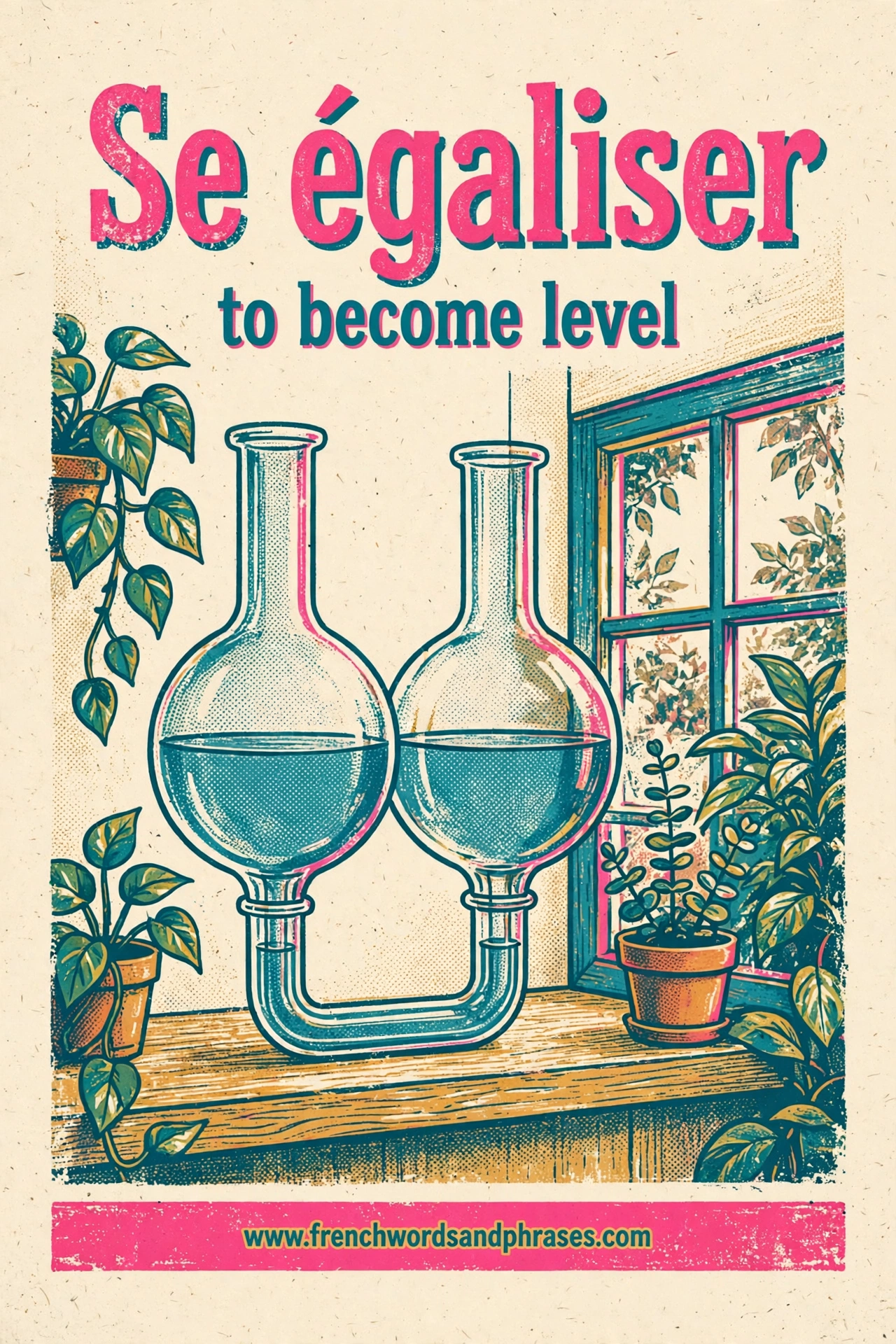
Two tanks joined by a pipe, their levels slowly meeting in the middle; two candidates whose support creeps together week by week — s’égaliser is the verb of things levelling themselves, with no hand and no rake, just time and physics.
In this guide, you’ll learn how to conjugate se égaliser in all the major French tenses and moods. Explore complete conjugation tables, French examples, English translations, and practice quizzes.
Understanding the French Verb Se égaliser
Se égaliser is a regular French verb belonging to the first group of verbs, those ending in-er.
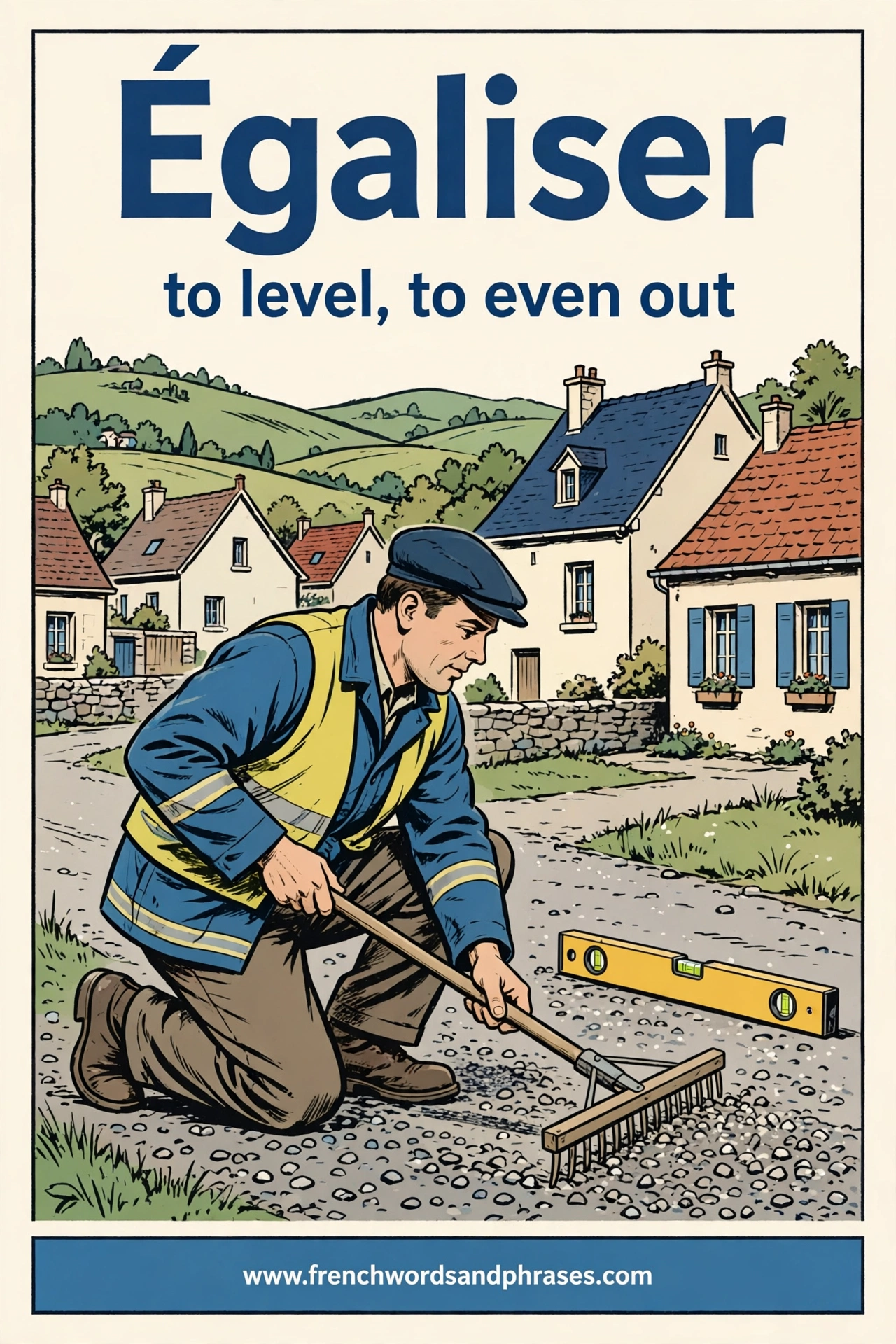
It means to become level. It is commonly used of communicating vessels and water levels in physics, of temperatures and pressures settling, and figuratively of markets, prices and rivals’ chances evening out over time — the patient, automatic counterpart of the gardener’s égaliser.
Verb classification: First group (-er), reflexive
Auxiliary verb: Être
Past participle: égalisé
Present participle: égalisant
English equivalents: To become level, to level out, to even out; les niveaux s’égalisent — the levels even out; les prix s’égalisent — prices level off evenly; les chances s’égalisent — the chances become even.
One important detail: s’égaliser is what happens when nobody is holding the rake — where égaliser is something a person does to a surface or a score, s’égaliser is what water, prices, temperatures and chances do by themselves, given time. Being reflexive, it takes être in every compound tense and the participle agrees: les niveaux se sont égalisés, les chances se sont égalisées. Its natural partners are slow adverbs — peu à peu, lentement, avec le temps — because self-levelling is never instant.
Experience the Word
Se égaliser is the verb of patience — leave two uneven things connected, and slowly, silently, they come level on their own.
Imagine two old stone basins in a farmyard, joined by a rusty pipe. One is brimming from the morning’s rain, the other nearly empty. Nobody touches them; by evening the water has crept, millimetre by millimetre, until both stand exactly half full — les niveaux se sont égalisés, and the farmyard has done the work itself.
No rake, no trowel, no hand. They became level — égalisés — by the simple law of water.
How to Conjugate Se égaliser: Complete French Conjugation Guide
Let’s explore every major conjugation of se égaliser, beginning with the indicative mood.
How to Conjugate Se égaliser in the Indicative Mood
The indicative mood is used to express facts, observations, actions, and events.
How to Conjugate Se égaliser in the Present Tense (Présent)
Used for actions happening now, habitual actions, and general truths.
| Subject | Conjugation |
|---|---|
| je | m’égalise |
| tu | t’égalises |
| il / elle | s’égalise |
| nous | nous égalisons |
| vous | vous égalisez |
| ils / elles | s’égalisent |
Example
Les deux réservoirs s’égalisent lentement par le tuyau.
The two tanks are slowly levelling out through the pipe.
Quick Quiz 1
Complete the sentence:
Les prix ______ peu à peu sur le marché.
Reveal the answer
s’égalisent
Les prix s’égalisent peu à peu sur le marché.
Prices are gradually evening out on the market.
How to Conjugate Se égaliser in the Passé Composé
Used for completed actions in the past. Se égaliser takes the auxiliary verb être.
| Subject | Conjugation |
|---|---|
| je | me suis égalisé / me suis égalisée |
| tu | t’es égalisé / t’es égalisée |
| il / elle | s’est égalisé / s’est égalisée |
| nous | nous sommes égalisés / nous sommes égalisées |
| vous | vous êtes égalisés / vous êtes égalisées / vous êtes égalisé / vous êtes égalisée |
| ils / elles | se sont égalisés / se sont égalisées |
Example
Les températures se sont égalisées entre le jour et la nuit.
The temperatures evened out between day and night.
How to Conjugate Se égaliser in the Imparfait (Imperfect Tense)
Used for habitual past actions, descriptions, and ongoing situations in the past.
| Subject | Conjugation |
|---|---|
| je | m’égalisais |
| tu | t’égalisais |
| il / elle | s’égalisait |
| nous | nous égalisions |
| vous | vous égalisiez |
| ils / elles | s’égalisaient |
Example
Après la crue, le niveau des étangs s’égalisait peu à peu.
After the flood, the level of the ponds was gradually evening out.
Quick Quiz 2
Choose the correct form:
The temperatures evened out.
Les températures ______. (se sont égalisées / ont égalisé)
Reveal the answer
se sont égalisées
Les températures se sont égalisées.
S’égaliser is reflexive, takes être, and the participle agrees: égalisées.
How to Conjugate Se égaliser in the Plus-que-parfait
Used to describe an action that had already been completed before another past event.
| Subject | Conjugation |
|---|---|
| je | m’étais égalisé / m’étais égalisée |
| tu | t’étais égalisé / t’étais égalisée |
| il / elle | s’était égalisé / s’était égalisée |
| nous | nous étions égalisés / nous étions égalisées |
| vous | vous étiez égalisés / vous étiez égalisées / vous étiez égalisé / vous étiez égalisée |
| ils / elles | s’étaient égalisés / s’étaient égalisées |
Example
Les chances des deux candidats s’étaient égalisées avant le débat.
The two candidates’ chances had evened out before the debate.
How to Conjugate Se égaliser in the Passé Simple
Primarily used in formal writing, literature, and historical narratives. It is rarely used in everyday conversation.
| Subject | Conjugation |
|---|---|
| je | m’égalisai |
| tu | t’égalisas |
| il / elle | s’égalisa |
| nous | nous égalisâmes |
| vous | vous égalisâtes |
| ils / elles | s’égalisèrent |
Example
En quelques jours, les deux colonnes de mercure s’égalisèrent.
Within a few days, the two columns of mercury levelled out.
How to Conjugate Se égaliser in the Passé Antérieur
A literary tense used to express an action completed immediately before another past action, generally in the passé simple.
| Subject | Conjugation |
|---|---|
| je | me fus égalisé / me fus égalisée |
| tu | te fus égalisé / te fus égalisée |
| il / elle | se fut égalisé / se fut égalisée |
| nous | nous fûmes égalisés / nous fûmes égalisées |
| vous | vous fûtes égalisés / vous fûtes égalisées / vous fûtes égalisé / vous fûtes égalisée |
| ils / elles | se furent égalisés / se furent égalisées |
Example
Quand les eaux se furent égalisées, on rouvrit l’écluse.
When the waters had levelled out, they reopened the lock.
How to Conjugate Se égaliser in the Future Tense (Futur Simple)
Used to describe actions that will take place in the future.
| Subject | Conjugation |
|---|---|
| je | m’égaliserai |
| tu | t’égaliseras |
| il / elle | s’égalisera |
| nous | nous égaliserons |
| vous | vous égaliserez |
| ils / elles | s’égaliseront |
Example
Avec le temps, les prix s’égaliseront dans tout le pays.
With time, prices will even out across the whole country.
How to Conjugate Se égaliser in the Futur Antérieur (Future Perfect)
Used for an action that will have been completed before a particular point in the future.
| Subject | Conjugation |
|---|---|
| je | me serai égalisé / me serai égalisée |
| tu | te seras égalisé / te seras égalisée |
| il / elle | se sera égalisé / se sera égalisée |
| nous | nous serons égalisés / nous serons égalisées |
| vous | vous serez égalisés / vous serez égalisées / vous serez égalisé / vous serez égalisée |
| ils / elles | se seront égalisés / se seront égalisées |
Example
À la fin du mois, les deux comptes se seront égalisés.
By the end of the month, the two accounts will have balanced out.
How to Conjugate Se égaliser in the Near Future (Futur Proche)
Used to describe something that is going to happen soon. Formed with aller + infinitive.
| Subject | Conjugation |
|---|---|
| je | vais m’égaliser |
| tu | vas t’égaliser |
| il / elle | va s’égaliser |
| nous | allons nous égaliser |
| vous | allez vous égaliser |
| ils / elles | vont s’égaliser |
Example
Regarde le niveau : il va s’égaliser avec l’autre bassin.
Watch the level: it is going to even out with the other basin.
How to Conjugate Se égaliser in the Conditional Mood
The conditional mood expresses what would happen under certain circumstances. It is also frequently used to make polite requests or express wishes.
How to Conjugate Se égaliser in the Present Conditional
| Subject | Conjugation |
|---|---|
| je | m’égaliserais |
| tu | t’égaliserais |
| il / elle | s’égaliserait |
| nous | nous égaliserions |
| vous | vous égaliseriez |
| ils / elles | s’égaliseraient |
Example
Sans la digue, les deux lacs s’égaliseraient en une nuit.
Without the dyke, the two lakes would level out in one night.
How to Conjugate Se égaliser in the Past Conditional
| Subject | Conjugation |
|---|---|
| je | me serais égalisé / me serais égalisée |
| tu | te serais égalisé / te serais égalisée |
| il / elle | se serait égalisé / se serait égalisée |
| nous | nous serions égalisés / nous serions égalisées |
| vous | vous seriez égalisés / vous seriez égalisées / vous seriez égalisé / vous seriez égalisée |
| ils / elles | se seraient égalisés / se seraient égalisées |
Example
Les forces se seraient égalisées sans ce renfort inattendu.
The forces would have evened out without that unexpected reinforcement.
Se égaliser in the Literary Past Conditional Form
This less common literary form uses the imperfect subjunctive of être.
| Subject | Conjugation |
|---|---|
| je | me fusse égalisé / me fusse égalisée |
| tu | te fusses égalisé / te fusses égalisée |
| il / elle | se fût égalisé / se fût égalisée |
| nous | nous fussions égalisés / nous fussions égalisées |
| vous | vous fussiez égalisés / vous fussiez égalisées / vous fussiez égalisé / vous fussiez égalisée |
| ils / elles | se fussent égalisés / se fussent égalisées |
Example
Les deux armées se fussent égalisées sans la trahison du général.
The two armies would have been evenly matched without the general’s treason.
How to Conjugate Se égaliser in the Subjunctive Mood
The subjunctive is used to express wishes, emotions, doubts, necessity, and uncertainty. It frequently follows expressions such as il faut que (it is necessary that) or bien que (although).
How to Conjugate Se égaliser in the Present Subjunctive
| Subject | Conjugation |
|---|---|
| que je | m’égalise |
| que tu | t’égalises |
| qu’il / qu’elle | s’égalise |
| que nous | nous égalisions |
| que vous | vous égalisiez |
| qu’ils / qu’elles | s’égalisent |
Example
Il est normal que les niveaux s’égalisent entre les deux vases.
It is normal for the levels to even out between the two vessels.
Quick Quiz 3
Complete the sentence using the subjunctive:
Il est normal que les niveaux ______ entre les deux vases.
Reveal the answer
s’égalisent
Il est normal que les niveaux s’égalisent entre les deux vases.
It is normal for the levels to even out between the two vessels.
How to Conjugate Se égaliser in the Imperfect Subjunctive
A literary tense, rarely encountered in modern spoken French.
| Subject | Conjugation |
|---|---|
| que je | m’égalisasse |
| que tu | t’égalisasses |
| qu’il / qu’elle | s’égalisât |
| que nous | nous égalisassions |
| que vous | vous égalisassiez |
| qu’ils / qu’elles | s’égalisassent |
Example
On attendait que les prix s’égalisassent sur tout le marché.
People were waiting for prices to even out across the whole market.
How to Conjugate Se égaliser in the Pluperfect Subjunctive
A literary construction used to express an action completed before another past action.
| Subject | Conjugation |
|---|---|
| que je | me fusse égalisé / me fusse égalisée |
| tu | te fusses égalisé / te fusses égalisée |
| qu’il / qu’elle | se fût égalisé / se fût égalisée |
| que nous | nous fussions égalisés / nous fussions égalisées |
| que vous | vous fussiez égalisés / vous fussiez égalisées / vous fussiez égalisé / vous fussiez égalisée |
| qu’ils / qu’elles | se fussent égalisés / se fussent égalisées |
Example
On constatait que les chances se fussent égalisées avant le scrutin.
It was observed that the chances had evened out before the vote.
How to Conjugate Se égaliser in the Past Subjunctive
| Subject | Conjugation |
|---|---|
| que je | me sois égalisé / me sois égalisée |
| tu | te sois égalisé / te sois égalisée |
| qu’il / qu’elle | se soit égalisé / se soit égalisée |
| que nous | nous soyons égalisés / nous soyons égalisées |
| que vous | vous soyez égalisés / vous soyez égalisées / vous soyez égalisé / vous soyez égalisée |
| qu’ils / qu’elles | se soient égalisés / se soient égalisées |
Example
Je suis surpris que les scores se soient égalisés si vite.
I am surprised the scores levelled out so quickly.
How to Conjugate Se égaliser in the Imperative
The imperative is used to give commands, instructions, invitations, or suggestions. Subject pronouns are omitted.
How to Conjugate Se égaliser in the Present Imperative
| Person | Conjugation |
|---|---|
| (tu) | égalise-toi |
| (nous) | égalisons-nous |
| (vous) | égalisez-vous |
Example
Égalise-toi avec ton frère avant la photo !
Get level with your brother before the photo!
Quick Quiz 4
How would you say Get level with your brother (tu form)?
Reveal the answer
Égalise-toi avec ton frère !
French Participles of Se égaliser
Participles are verb forms that can be used in compound tenses and other grammatical constructions.
Present Participle of Se égaliser
égalisant
En s’égalisant, les deux bassins forment une seule nappe calme.
By levelling out, the two basins form a single calm sheet of water.
Past Participle of Se égaliser
égalisé
Égalisés par la marée, les deux chenaux n’en font plus qu’un.
Levelled by the tide, the two channels are now only one.
Se égaliser in Everyday French: Real-Life Examples
Now that you know the conjugations, let’s see how se égaliser appears in everyday French.
Example 1 — Present
Les deux réservoirs s’égalisent lentement.
The two tanks are slowly levelling out.
Example 2 — Passé composé
Les températures se sont égalisées.
The temperatures evened out.
Example 3 — Imparfait
Le niveau des étangs s’égalisait peu à peu.
The level of the ponds was gradually evening out.
Example 4 — Future
Les prix s’égaliseront avec le temps.
Prices will even out with time.
Example 5 — Conditional
Les deux lacs s’égaliseraient sans la digue.
The two lakes would level out without the dyke.
Example 6 — Imperative
Égalise-toi avec ton frère avant la photo !
Get level with your brother before the photo!
Beyond Translation: The Meaning of Se égaliser
English says water finds its own level — French s’égaliser is that proverb turned into a verb.
It is the physics of fairness.
Join two vessels and the water shares itself equally between them; join two markets and, slowly, prices do the same. French uses one reflexive verb for the whole quiet process: things left connected become level — tout s’égalise avec le temps.
How to Remember the French Verb Se égaliser
Remember it this way: Se égaliser is about two basins joined by a pipe — the water levelling itself by evening.
- S’égaliser is what levels do by themselves; égaliser is what a person does with a rake, a trowel or a goal.
- Être and agreement, as with every reflexive: les chances se sont égalisées.
- Regular -er underneath: nous nous égalisons, vous vous égalisez, past participle égalisé — and slow adverbs are its friends: peu à peu, lentement.
The key idea is two basins joined by a pipe — the water levelling itself by evening.
Test Your Knowledge of Se égaliser
Let’s see how much you’ve learned. Try answering these questions before revealing the answers.
Question 1
Which auxiliary does s’égaliser use, and why?
Reveal the answer
Être — it is a reflexive verb: les niveaux se sont égalisés.
Question 2
How do you say The temperatures evened out in French?
Reveal the answer
Les températures se sont égalisées.
Question 3
Translate: With time, prices will even out.
Reveal the answer
Avec le temps, les prix s’égaliseront.
Question 4
What is the past participle of s’égaliser?
Reveal the answer
Égalisé — agreeing: égalisée, égalisés, égalisées.
Question 5
Complete the sentence:
Il est normal que les niveaux ______ entre les deux vases.
Reveal the answer
s’égalisent
Il est normal que les niveaux s’égalisent entre les deux vases.
It is normal for the levels to even out between the two vessels.
Your Final Challenge
Can You Use It?
How would you say this in French?
Leave the two basins alone: with time, levels always even out.
Reveal the answer
Laissez les deux bassins tranquilles : avec le temps, les niveaux s’égalisent toujours.
Leave the two basins alone: with time, levels always even out.
A little French. A little curiosity. A richer everyday life.
LEARN FRENCH ONE WORD AT A TIME