A French Word to Live By
Translate Articulation to English
/aʁ.ti.ky.la.sjɔ̃/
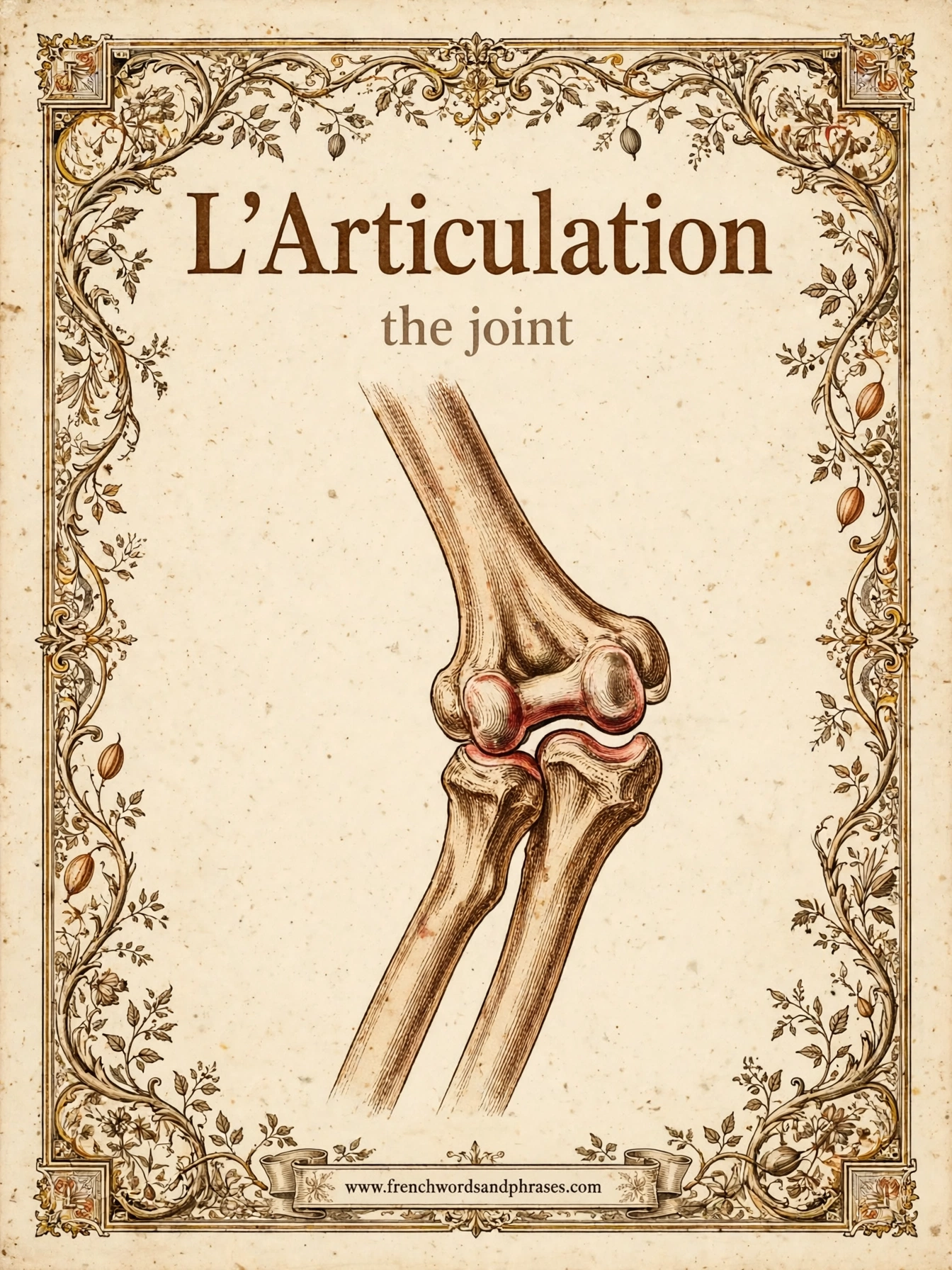
L’articulation means the joint.
The dancer bends, turns, leaps — and lands without a sound. Somewhere at every bend of her body, a small, perfectly oiled hinge did its silent work: l’articulation.
In this guide, you’ll learn what articulation means in English, how to use it with its articles, how to form its plural, and how it appears in everyday French. Explore French examples, English translations, and practice quizzes.
Understanding the French Noun Articulation
Articulation is a feminine French noun. It begins with a vowel, so the article shrinks: l’articulation, une articulation. The plural is regular, les articulations — the knees, shoulders, elbows and fingers that let the whole body fold and unfold.
It means the joint — the place where two os (bones) meet and move: l’articulation du genou (the knee joint), de l’épaule, du coude. The word carries a second life in speech: l’articulation is also clear enunciation, the way sounds are joined — fitting, since an articulation is, in body and in language alike, a joining that moves.
Gender: Feminine
Definite article: l’ — l’articulation (the joint)
Indefinite article: une — une articulation (a joint)
Plural: les articulations
Where they are: le genou, l’épaule, le coude, les doigts — every meeting of two bones
Second sense: Clear enunciation in speech — sounds joined cleanly
English equivalents: The joint.
One delight of this word: the same l’articulation that bends your knee also shapes your speech. A singing teacher who says « Travaille ton articulation ! » means enunciate clearly — join your sounds as smoothly as your bones are joined. Two senses, one idea: a good join, well made.
Experience the Word
L’articulation is the body’s diplomacy — the place where two hard bones agree to move together without grinding, cushioned, oiled and held by quiet ligaments.
Imagine an old door hinge, oiled to silence, swinging a hundred times a day for eighty years. Your genou has done exactly that, a million times over.
You have not just bent a knee. You have used a masterpiece of engineering — l’articulation, le joint parfait.
How to Use Articulation in French: Complete Guide
Let’s explore how articulation works in French, beginning with its articles — remember the vowel start, which turns la into l’.
Articulation with the Definite Article (L’, Les)
Articulation begins with a vowel, so la shrinks to l’ — l’articulation, the joint in question.
| Form | French |
|---|---|
| Singular | l’articulation |
| Plural | les articulations |
Example
L’articulation du genou permet de plier la jambe.
The knee joint lets you bend your leg.
Articulation with the Indefinite Article (Une, Des)
Used for a joint in general — une articulation raide, a stiff joint, is the classic complaint of cold mornings.
| Form | French |
|---|---|
| Singular | une articulation |
| Plural | des articulations |
Example
Une articulation raide rend la marche difficile.
A stiff joint makes walking difficult.
Articulation with Quantities (Chaque, Toutes les…)
Joints are counted one by one — each knee, each finger — so French counts and points rather than measuring.
| Quantity | French |
|---|---|
| a stiff joint | une articulation raide |
| every joint | chaque articulation |
| all the joints | toutes les articulations |
| the knee joint | l’articulation du genou |
| sore joints | des articulations douloureuses |
Example
Toutes les articulations travaillent quand on danse.
All the joints work when you dance.
Quick Quiz 1
Complete the sentence:
______ du coude permet de plier le bras.
Reveal the answer
L’articulation
L’articulation du coude permet de plier le bras.
The elbow joint lets you bend your arm — l’, because articulation begins with a vowel.
The Plural of Articulation
Articulation adds an -s in the plural — les articulations, dozens of hinges in one body.
| Number | French |
|---|---|
| Singular | l’articulation |
| Plural | les articulations |
Example
Les articulations des doigts sont petites mais précises.
The finger joints are small but precise.
Articulation with Possessive Adjectives (Mon, Ton, Son…)
A vowel start means the possessives stay smooth: mon articulation, ton articulation — even though the noun is feminine.
| Owner | French |
|---|---|
| my | mon articulation |
| your (tu) | ton articulation |
| his / her | son articulation |
| our | notre articulation |
| your (vous) | votre articulation |
| their | leur articulation |
Example
Mon articulation de la hanche me fait mal le matin.
My hip joint hurts in the morning.
Quick Quiz 2
Complete the sentence:
______ articulations craquent quand elle se lève. (Her)
Reveal the answer
Ses
Ses articulations craquent quand elle se lève.
Her joints crack when she stands up — ses, because articulations is plural.
Articulation with Demonstrative Adjectives (Cette, Ces)
Used to point: cette articulation — this joint, the one on the scan or under the doctor’s thumb.
| Form | French |
|---|---|
| Singular | cette articulation |
| Plural | ces articulations |
Example
Cette articulation est encore enflée après l’entorse.
This joint is still swollen after the sprain.
Articulation with Adjectives
Adjectives agree with articulation, feminine: raide, douloureuse, souple.
| Adjective | With Articulation |
|---|---|
| raide (stiff) | une articulation raide |
| douloureux (sore) | une articulation douloureuse |
| souple (flexible) | une articulation souple |
| fragile (fragile) | une articulation fragile |
| gonflé (swollen) | une articulation gonflée |
Example
Une articulation souple est un trésor pour un danseur.
A flexible joint is a treasure for a dancer.
Quick Quiz 3
A singing teacher says « Travaille ton articulation ! » What does she mean?
Reveal the answer
Enunciate clearly — articulation is also the clean joining of sounds in speech.
Une bonne articulation rend la voix claire.
Good articulation makes the voice clear.
Everyday Expressions with Articulation
Cracking, stiffening and protecting — the articulation phrases of daily life.
| Expression | In English |
|---|---|
| faire craquer ses articulations | to crack one’s joints |
| des articulations raides | stiff joints |
| l’articulation du genou | the knee joint |
| protéger ses articulations | to protect one’s joints |
| avoir mal aux articulations | to have aching joints |
Example
Il fait craquer ses articulations avant de jouer du piano.
He cracks his joints before playing the piano.
Words from the Same Family as Articulation
Joining, bending and speaking clearly — the words that travel with articulation.
| French | In English |
|---|---|
| articuler | to articulate, to enunciate |
| articulaire | of the joints (articular) |
| articulé | articulated, jointed |
| le cartilage | the cartilage |
| le genou | the knee |
| le ligament | the ligament |
Example
Le cartilage protège l’articulation du genou.
Cartilage protects the knee joint.
Quick Quiz 4
What does faire craquer ses articulations mean?
Reveal the answer
To crack one’s joints — knuckles, neck and all.
Elle fait craquer ses articulations après le travail.
She cracks her joints after work.
Articulation in Everyday French: Real-Life Examples
Now that you know the word, let’s see how articulation appears in everyday French.
Example 1 — Cold morning
Mes articulations sont raides quand il fait froid.
My joints are stiff when it is cold.
Example 2 — At the doctor’s
L’articulation de son épaule est douloureuse depuis la chute.
Her shoulder joint has been sore since the fall.
Example 3 — A dancer
Ses articulations souples lui permettent des mouvements gracieux.
Her flexible joints allow her graceful movements.
Example 4 — Cracking knuckles
Il fait toujours craquer ses articulations avant d’écrire.
He always cracks his joints before writing.
Example 5 — Protecting joints
La natation protège les articulations des coureurs.
Swimming protects runners’ joints.
Example 6 — Singing lesson
Le professeur demande aux élèves de travailler leur articulation.
The teacher asks the pupils to work on their enunciation.
Beyond Translation: The Meaning of Articulation
Articulation is one of French’s most elegant double agents. In the body it joins bone to bone; in speech it joins sound to sound — and the language sees no contradiction, because both are the same craft: making separate pieces move as one. Anatomists and singing teachers share the word the way dancers and debaters share a stage, each trusting the join to hold.
To say articulation is to praise a connection — the hinge that lets the whole thing move.
It evokes cracking knuckles and crystal-clear diction, stiff winter knees and a dancer’s impossible grace.
How to Remember the French Noun Articulation
Remember it this way: Articulation is the joint — feminine, vowel first, so l’articulation; and it doubles as the word for clear speech.
- You hear the vowel — l’articulation, mon articulation, never « la articulation ».
- You place the hinges — l’articulation du genou, de l’épaule, du coude.
- You keep both lives — a joint in the body, clear enunciation in speech.
The key idea is l’articulation — the joint, and clear enunciation too.
Test Your Knowledge of Articulation
Let’s see how much you’ve learned. Try answering these questions before revealing the answers.
Question 1
Is articulation masculine or feminine?
Reveal the answer
Feminine — l’articulation, une articulation.
Question 2
How do you say the knee joint?
Reveal the answer
L’articulation du genou.
Question 3
Translate: My joints are stiff this morning.
Reveal the answer
Mes articulations sont raides ce matin.
Question 4
What is the second sense of articulation?
Reveal the answer
Clear enunciation — the clean joining of sounds in speech.
Question 5
Complete the sentence:
______ articulation du coude est gonflée.
Reveal the answer
L’
L’articulation du coude est gonflée.
The elbow joint is swollen.
Your Final Challenge
Can You Use It?
How would you say this in French?
“Swimming protects the joints and strengthens the muscles.”
Reveal the answer
La natation protège les articulations et renforce les muscles.
Swimming protects the joints and strengthens the muscles.
A little French. A little curiosity. A richer everyday life.
LEARN FRENCH ONE WORD AT A TIME