A French Word to Live By
Translate Orteil to English
/ɔʁ.tɛj/
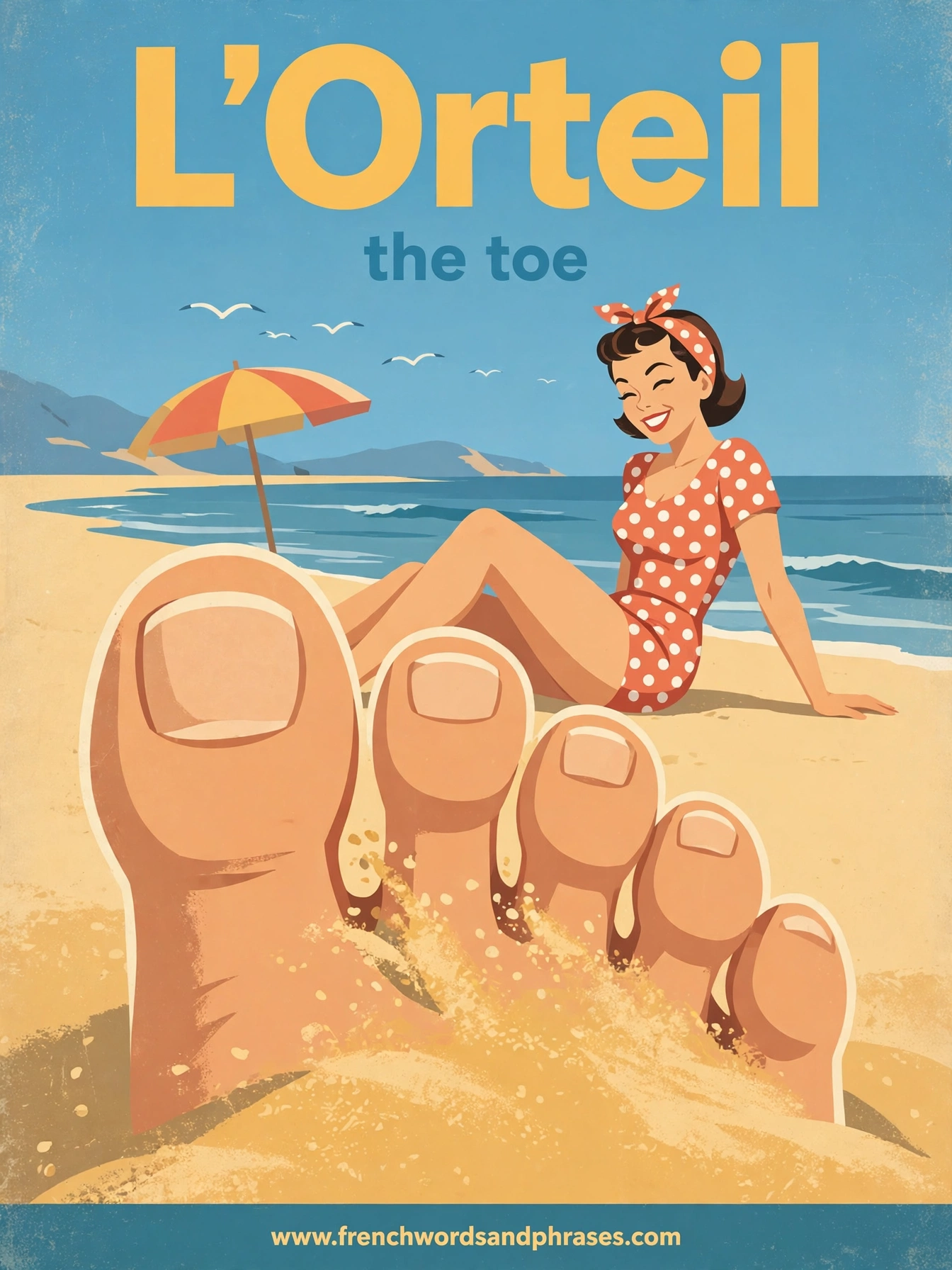
L’orteil means the toe.
Two in the morning, a glass of water, a dark hallway — and the corner of the dresser finds the smallest target in the house. The cry that follows is for one small soldier: l’orteil.
In this guide, you’ll learn what orteil means in English, how to use it with its articles, how to form its plural, and how it appears in everyday French. Explore French examples, English translations, and practice quizzes.
Understanding the French Noun Orteil
Orteil is a masculine French noun. Because it begins with a vowel, the article shrinks: l’orteil, un orteil. The plural is regular, les orteils — ten of them, five on each foot, with the biggest given his own title: le gros orteil, the big toe.
It means the toe — one of the five small digits at the end of the foot. French keeps toes and fingers firmly apart: fingers are les doigts, toes are les orteils, and only in relaxed speech do you hear les doigts de pied. You stub them (se cogner l’orteil), wiggle them in the sand, and paint their nails in summer.
Gender: Masculine
Definite article: l’ — l’orteil (the toe)
Indefinite article: un — un orteil (a toe)
Plural: les orteils
The big toe: le gros orteil
Fingers are not toes: les doigts are on the hand; les orteils are on the foot
English equivalents: The toe; the big toe (le gros orteil).
One important usage detail: English lets « digit » thinking blur fingers and toes, but French never does. A piano player uses ses doigts; a ballet dancer rises sur la pointe des pieds — and if you say doigt for a toe, a French listener pictures a hand. Reach for orteil below the ankle, every time.
Experience the Word
L’orteil is the body’s smallest casualty and its loudest reporter. The gros orteil balances you; the petit orteil, the little one, seems to exist mainly to find furniture in the dark.
Imagine the first warm day of the year: sandals come out, and ten orteils blink at the light like holidaymakers arriving at the beach.
You have not just wiggled a toe. You have checked in with the far end of yourself — le petit bout du pied.
How to Use Orteil in French: Complete Guide
Let’s explore how orteil works in French, beginning with its articles — remember the vowel start, which turns le into l’.
Orteil with the Definite Article (L’, Les)
Orteil begins with a vowel, so le shrinks to l’ — l’orteil, the toe in question.
| Form | French |
|---|---|
| Singular | l’orteil |
| Plural | les orteils |
Example
L’orteil qu’il s’est cogné est encore gonflé.
The toe he stubbed is still swollen.
Orteil with the Indefinite Article (Un, Des)
Used for a toe in general — un orteil cassé, a broken toe, is a classic summer injury.
| Form | French |
|---|---|
| Singular | un orteil |
| Plural | des orteils |
Example
Il s’est cassé un orteil en jouant au football.
He broke a toe playing football.
Orteil with Quantities (Dix, Chaque…)
Toes come in a fixed set — ten in total — so French counts them, five by five.
| Quantity | French |
|---|---|
| ten toes | les dix orteils |
| one toe | un orteil |
| each toe | chaque orteil |
| the big toe | le gros orteil |
| a broken toe | un orteil cassé |
Example
Elle compte les dix orteils du bébé avec bonheur.
She happily counts the baby’s ten toes.
Quick Quiz 1
Complete the sentence:
Il s’est cogné ______ contre le pied de la table.
Reveal the answer
l’orteil
Il s’est cogné l’orteil contre le pied de la table.
He stubbed his toe on the table leg — l’, because orteil begins with a vowel.
The Plural of Orteil
Orteil adds an -s in the plural — les orteils, all ten of them.
| Number | French |
|---|---|
| Singular | l’orteil |
| Plural | les orteils |
Example
Les orteils du bébé sont minuscules.
The baby’s toes are tiny.
Orteil with Possessive Adjectives (Mon, Ton, Son…)
A vowel start means even the possessives stay simple: mon orteil, ton orteil, son orteil.
| Owner | French |
|---|---|
| my | mon orteil |
| your (tu) | ton orteil |
| his / her | son orteil |
| our | notre orteil |
| your (vous) | votre orteil |
| their | leur orteil |
Example
Mon orteil me fait encore mal ce matin.
My toe still hurts this morning.
Quick Quiz 2
Complete the sentence:
______ gros orteil est couvert de sable. (Her)
Reveal the answer
Son
Son gros orteil est couvert de sable.
Her big toe is covered in sand — son, because orteil is masculine.
Orteil with Demonstrative Adjectives (Cet, Ces)
Used to point — and because of the vowel, the masculine form is cet: cet orteil.
| Form | French |
|---|---|
| Singular | cet orteil |
| Plural | ces orteils |
Example
Cet orteil est plus long que les autres.
This toe is longer than the others.
Orteil with Adjectives
Adjectives agree with orteil, masculine: gros, petit, cassé.
| Adjective | With Orteil |
|---|---|
| gros (big) | le gros orteil |
| petit (little) | le petit orteil |
| cassé (broken) | un orteil cassé |
| long (long) | un orteil long |
| douloureux (painful) | un orteil douloureux |
Example
Son petit orteil est tout rouge après la randonnée.
His little toe is all red after the hike.
Quick Quiz 3
How do you say the big toe in French?
Reveal the answer
Le gros orteil
Le gros orteil aide à garder l’équilibre.
The big toe helps you keep your balance.
Everyday Expressions with Orteil
Stubbed toes and holidays — the orteil phrases of daily life.
| Expression | In English |
|---|---|
| se cogner l’orteil | to stub one’s toe |
| le gros orteil | the big toe |
| les orteils en éventail | with one’s toes splayed — totally relaxed |
| remuer les orteils | to wiggle one’s toes |
| montrer ses orteils | to show one’s toes (sandals weather) |
Example
En vacances, il passe ses journées les orteils en éventail.
On holiday, he spends his days completely relaxed, toes in the air.
Words from the Same Family as Orteil
The end of the foot — the words that travel with orteil.
| French | In English |
|---|---|
| le pied | the foot |
| le doigt | the finger |
| l’ongle | the nail |
| le talon | the heel |
| la cheville | the ankle |
| la plante du pied | the sole of the foot |
Example
L’ongle du gros orteil est cassé.
The nail of his big toe is broken.
Quick Quiz 4
What are les orteils en éventail a picture of?
Reveal the answer
Total relaxation — toes spread like a fan, éventail, doing nothing at all.
À la plage, les enfants jouent les orteils en éventail.
At the beach, the children play without a care in the world.
Orteil in Everyday French: Real-Life Examples
Now that you know the word, let’s see how orteil appears in everyday French.
Example 1 — In the dark
Il s’est cogné l’orteil contre la commode cette nuit.
He stubbed his toe on the dresser last night.
Example 2 — At the beach
Elle remue les orteils dans le sable chaud.
She wiggles her toes in the warm sand.
Example 3 — A small injury
Un orteil cassé l’empêche de courir cette semaine.
A broken toe is stopping him from running this week.
Example 4 — Baby toes
Le bébé attrape ses orteils avec ses petites mains.
The baby grabs his toes with his little hands.
Example 5 — Sandals
Avec ces sandales, on voit tous ses orteils.
In these sandals, you can see all her toes.
Example 6 — The big toe
Le gros orteil la fait souffrir quand elle danse.
Her big toe hurts when she dances.
Beyond Translation: The Meaning of Orteil
French gave the toe a word of its own, unrelated to the finger — a small act of anatomical honesty that English, with its borrowed « toe », never quite matched in everyday speech. And the language rewards the orteil with one of its sunniest images: les orteils en éventail, toes spread like an open fan, is the classic picture of a French holiday — doing nothing, beautifully.
To say orteil is to name the body’s outposts — small, sensitive, and first to know everything.
It evokes stubbed corners and sandy beaches, painted nails and baby feet — the far end of the body, where every step begins.
How to Remember the French Noun Orteil
Remember it this way: Orteil is the toe — masculine, vowel first, so l’orteil; and the big one is le gros orteil.
- You split the foot from the hand — les doigts up top, les orteils down below.
- You hear the vowel — l’orteil, cet orteil, never « le orteil ».
- You crown the biggest — le gros orteil, the balance keeper.
The key idea is l’orteil — the toe; le gros orteil — the big toe.
Test Your Knowledge of Orteil
Let’s see how much you’ve learned. Try answering these questions before revealing the answers.
Question 1
Is orteil masculine or feminine?
Reveal the answer
Masculine — l’orteil, un orteil.
Question 2
How do you say the big toe?
Reveal the answer
Le gros orteil.
Question 3
Translate: He stubbed his toe.
Reveal the answer
Il s’est cogné l’orteil.
Question 4
What is the difference between un doigt and un orteil?
Reveal the answer
Un doigt is a finger; un orteil is a toe — French keeps hands and feet apart.
Question 5
Complete the sentence:
Elle s’est cassé ______ orteil.
Reveal the answer
un
Elle s’est cassé un orteil.
She broke a toe.
Your Final Challenge
Can You Use It?
How would you say this in French?
“He stubbed his toe on the corner of the bed.”
Reveal the answer
Il s’est cogné l’orteil contre le coin du lit.
He stubbed his toe on the corner of the bed.
A little French. A little curiosity. A richer everyday life.
LEARN FRENCH ONE WORD AT A TIME