A French Word to Live By
Translate Dos to English
/do/
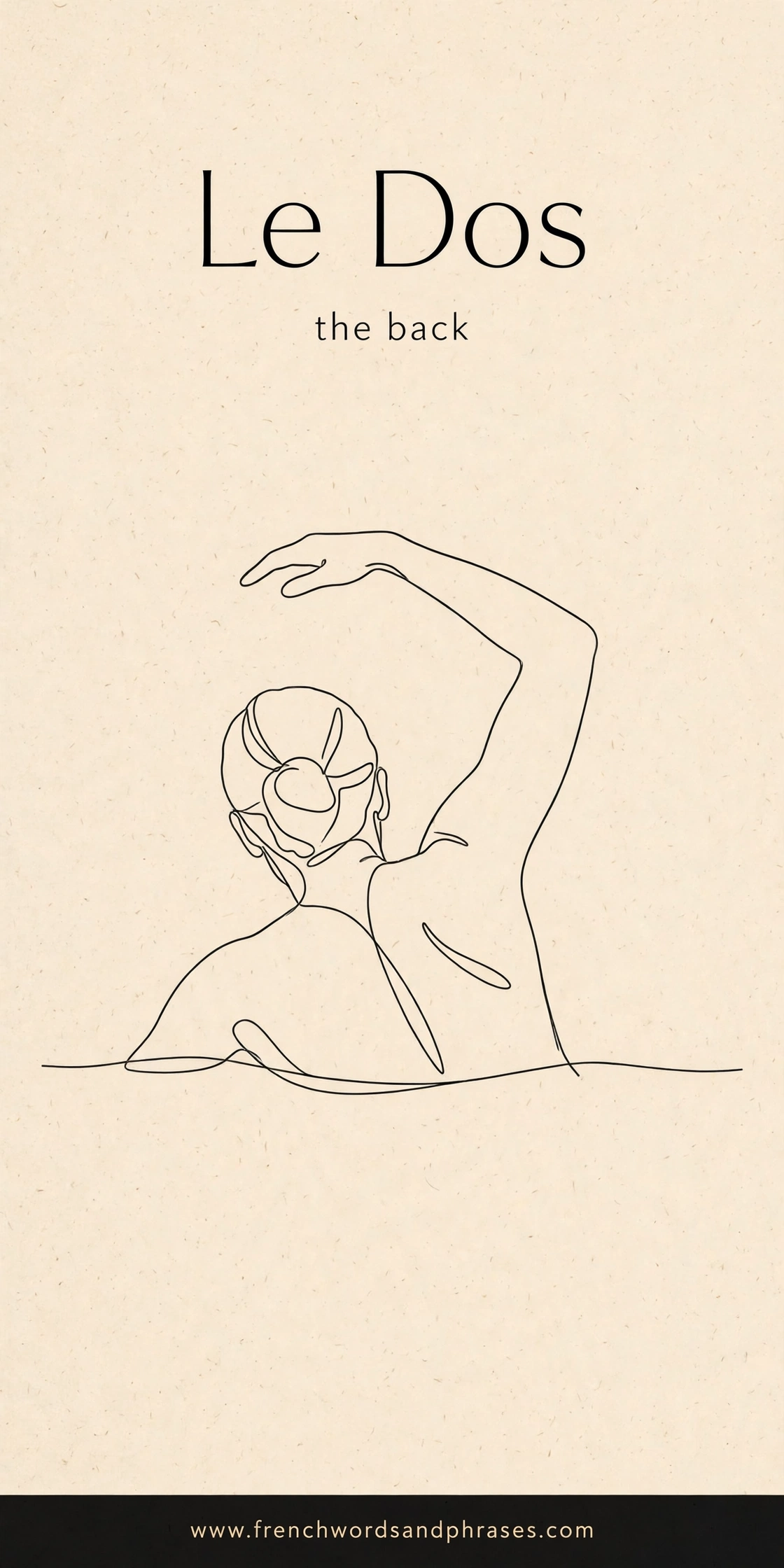
Le dos means the back.
All morning the gardener has worked bent over the rose beds, and now he straightens up slowly, one hand pressed into the small of his back — son dos — with a long sigh.
In this guide, you’ll learn what dos means in English, how to use it with its articles, how to form its plural, and how it appears in everyday French. Explore French examples, English translations, and practice quizzes.
Understanding the French Noun Dos
Dos is a masculine French noun, learned with its article: le dos, un dos. The final -s is silent and never changes: singular and plural are spelled exactly the same — le dos, les dos.
It means the back — the whole rear of the torso, from the neck to the waist, the part you cannot see without a mirror. French uses the same word for the back of anything: le dos de la main (the back of the hand), le dos de la chaise (the back of the chair), le dos du livre (the back of the book, its spine side).
Gender: Masculine
Definite article: le — le dos (the back)
Indefinite article: un — un dos (a back)
Plural: les dos — spelled exactly like the singular
Sound note: The final -s is silent — dos sounds like « do »
English equivalents: The back — of the body, of the hand, of a chair, of a book.
One important usage detail: dos is one of the great expression-words of French. En avoir plein le dos means to be fed up to the back teeth, and a speed bump is picturesquely called un dos d’âne — a donkey’s back.
Experience the Word
Dos is the body’s load-bearing wall. It carries the shopping, the children, the rucksack and the worries — and it is always the first to complain.
Imagine the porter at the market, bent double under a crate, or the swimmer whose dos crawls smoothly through the pool — le dos crawlé, backstroke.
You have not just turned around. You have shown your back — le dos, the side the world sees when you walk away.
How to Use Dos in French: Complete Guide
Let’s explore how dos works in French, beginning with its articles — and meet the word that never changes its spelling.
Dos with the Definite Article (Le, Les)
Used for a specific back — the one that aches after the gardening.
| Form | French |
|---|---|
| Masculine singular | le dos |
| Plural | les dos |
Example
Le dos du jardinier est courbaturé après ce travail.
The gardener’s back is stiff after that work.
Dos with the Indefinite Article (Un, Des)
Used for a back in general — un dos, a back like any other.
| Form | French |
|---|---|
| Masculine singular | un dos |
| Plural | des dos |
Example
Il faut un dos solide pour porter ces caisses.
You need a strong back to carry these crates.
Dos with Quantities and Measures
Backs are rarely counted — but loads on backs are: the quantities of carrying.
| Quantity | French |
|---|---|
| one back | un dos |
| a load on the back | une charge sur le dos |
| a full rucksack on the back | un sac plein sur le dos |
| the width of a back | la largeur d’un dos |
| back to back | dos à dos |
Example
Les enfants partent à l’école, le sac sur le dos.
The children leave for school, bags on their backs.
Quick Quiz 1
Complete the sentence:
J’ai mal au ______. (back)
Reveal the answer
dos
J’ai mal au dos.
My back hurts — au dos, because dos is masculine.
The Plural of Dos
Dos never changes: le dos, les dos — only the article tells you how many.
| Number | French |
|---|---|
| Singular | le dos |
| Plural | les dos |
Example
Les dos des nageurs brillent au soleil.
The swimmers’ backs shine in the sun.
Dos with Possessive Adjectives (Mon, Ton, Son…)
Possessives agree with the noun: dos is masculine, so it takes mon, ton, son.
| Owner | French |
|---|---|
| my | mon dos |
| your (tu) | ton dos |
| his / her | son dos |
| our | notre dos |
| your (vous) | votre dos |
| their | leur dos |
Example
Elle porte son bébé sur son dos toute la journée.
She carries her baby on her back all day.
Quick Quiz 2
Complete the sentence:
______ dos est fatigué après ce long voyage en voiture. (Their)
Reveal the answer
Leur
Leur dos est fatigué après ce long voyage en voiture.
Their backs are tired after that long car journey — leur dos, dos stays unchanged.
Dos with Demonstrative Adjectives (Ce, Ces)
Used to point: ce dos, ces dos — the noun looks the same, the adjective changes.
| Form | French |
|---|---|
| Masculine singular | ce dos |
| Plural | ces dos |
Example
Ce dos de chaise est magnifiquement sculpté.
This chair back is beautifully carved.
Dos with Adjectives
Adjectives agree with dos — and they carry the plural when dos itself cannot change.
| Adjective | With Dos |
|---|---|
| large (broad) | un dos large |
| musclé (muscular) | un dos musclé |
| douloureux (painful) | un dos douloureux |
| droit (straight) | un dos droit |
| voûté (stooped) | un dos voûté |
Example
Le vieil homme a le dos voûté par les années de travail.
The old man has a back stooped by years of work.
Quick Quiz 3
True or false: the plural of dos is « des doses »?
Reveal the answer
False
Le dos, les dos — dos never changes its spelling.
False — dos is invariable: le dos, les dos. (Une dose is a different word: a dose.)
Everyday Expressions with Dos
Fed up, carrying and turning away — the dos phrases of daily life.
| Expression | In English |
|---|---|
| avoir mal au dos | to have backache |
| en avoir plein le dos | to be fed up (informal) |
| tourner le dos à quelqu’un | to turn one’s back on someone |
| le dos d’âne | a speed bump (a donkey’s back) |
| faire le gros dos | to arch one’s back (like a cat); to keep a low profile |
| le dos crawlé | backstroke |
Example
Après trois heures de réunion, j’en ai plein le dos !
After three hours of meetings, I’m fed up!
Words from the Same Family as Dos
Files, folders and leaning — the words that travel with dos.
| French | In English |
|---|---|
| le dossier | the file, the folder; the backrest |
| adosser | to lean (something) against |
| dorsal | dorsal, relating to the back |
| dos à dos | back to back |
| le sac à dos | the rucksack, the backpack |
Example
Le dossier de la chaise est trop droit pour moi.
The backrest of the chair is too straight for me.
Quick Quiz 4
What is un dos d’âne on a French road?
Reveal the answer
A speed bump — named for its shape, a donkey’s rounded back.
Ralentis, il y a un dos d’âne devant l’école.
Slow down, there’s a speed bump in front of the school.
Dos in Everyday French: Real-Life Examples
Now that you know the word, let’s see how dos appears in everyday French.
Example 1 — After gardening
Il se redresse lentement : son dos est fatigué.
He straightens up slowly: his back is tired.
Example 2 — At the pool
Elle nage le dos crawlé dans la grande ligne.
She swims backstroke in the fast lane.
Example 3 — Carrying
Les enfants portent leur sac à dos jusqu’à l’école.
The children carry their rucksacks to school.
Example 4 — Fed up
Des dossiers, toujours des dossiers… j’en ai plein le dos !
Files, always files… I’m fed up!
Example 5 — On the road
La voiture ralentit devant le dos d’âne.
The car slows down before the speed bump.
Example 6 — A farewell
Elle lui tourne le dos et part sans un mot.
She turns her back on him and leaves without a word.
Beyond Translation: The Meaning of Dos
Dos comes from the Latin dorsum, and French has loaded the word with life: you carry burdens sur le dos, you are fed up plein le dos, and diplomats who cannot agree sit dos à dos, back to back. The word even colonised the office — le dossier, the file, is named for the label once pasted on its back, and a chair’s backrest is a dossier too.
To say dos is to name everything you carry — and everything you leave behind you.
It evokes the porter’s bent figure, the swimmer’s smooth backstroke, and the sigh of the gardener straightening up at last.
How to Remember the French Noun Dos
Remember it this way: Dos is the back — masculine, and one of French’s stay-the-same words: le dos, les dos, spelled identically.
- You carry — everything heavy goes sur le dos.
- You are fed up — j’en ai plein le dos, up to the back with it.
- You slow down — un dos d’âne, a donkey’s back, is a speed bump.
The key idea is le dos, les dos — the word that never changes.
Test Your Knowledge of Dos
Let’s see how much you’ve learned. Try answering these questions before revealing the answers.
Question 1
Is dos masculine or feminine?
Reveal the answer
Masculine — le dos, un dos.
Question 2
How do you write « the backs » in French?
Reveal the answer
Les dos — dos is invariable; only the article changes.
Question 3
Translate: My back hurts.
Reveal the answer
J’ai mal au dos.
Question 4
What is le dos crawlé?
Reveal the answer
Backstroke — the swimming stroke done on your back.
Question 5
Complete the sentence:
Elle porte son sac sur ______ dos.
Reveal the answer
son
Elle porte son sac sur son dos.
She carries her bag on her back — son, because dos is masculine.
Your Final Challenge
Can You Use It?
How would you say this in French?
“The gardener straightens up and rubs his back.”
Reveal the answer
Le jardinier se redresse et se frotte le dos.
The gardener straightens up and rubs his back.
A little French. A little curiosity. A richer everyday life.
LEARN FRENCH ONE WORD AT A TIME