A French Word to Live By
Translate Beaucoup to English
/bo.ku/
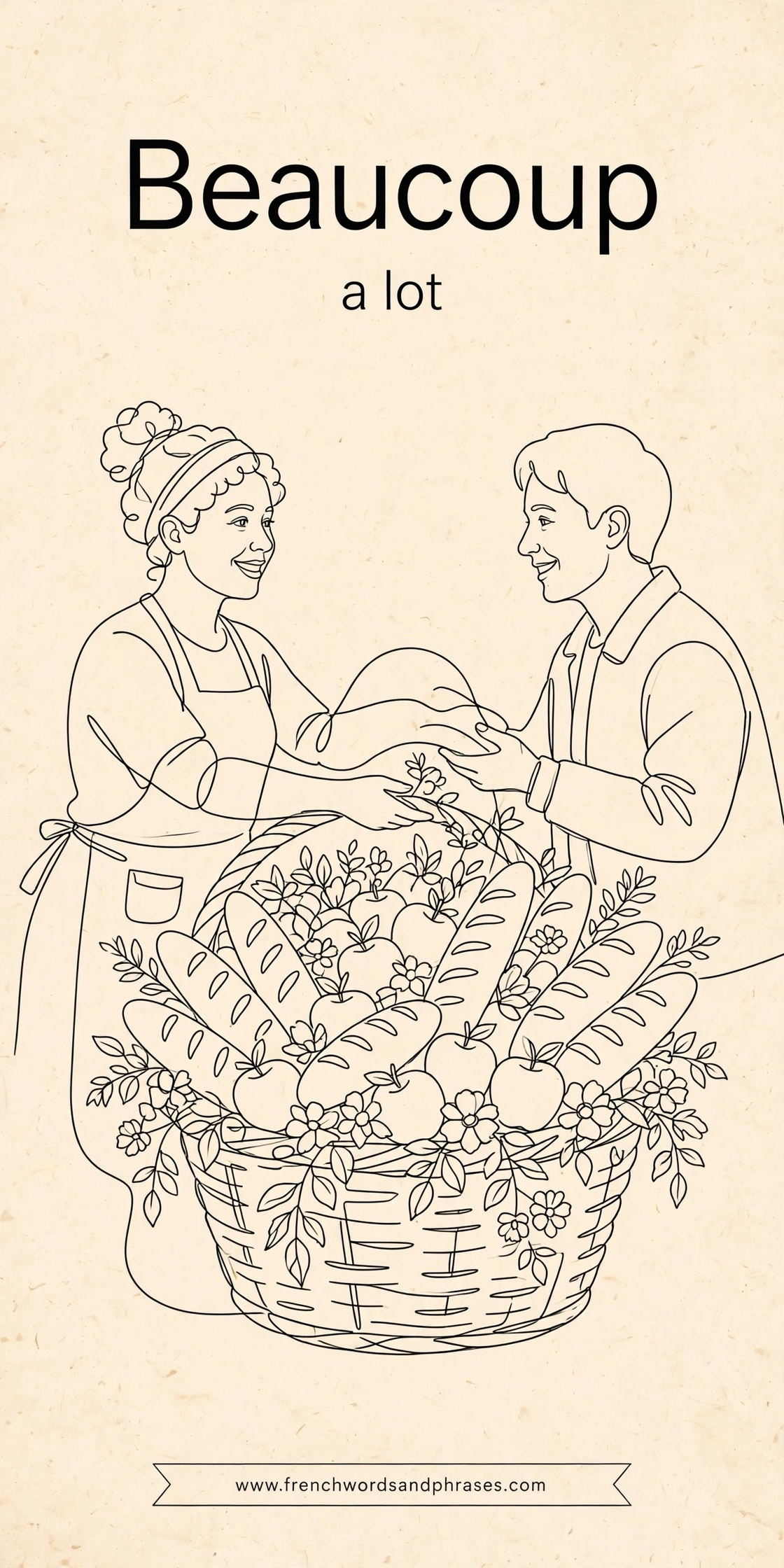
Beaucoup means a lot.
The harvest table sags gently under its load: baskets of plums, jars of honey, loaves still warm, and neighbours arriving with more. « Il y a beaucoup à manger », laughs the farmer — there is a lot to eat, and plenty of people to eat it.
In this guide, you’ll learn what beaucoup means in English, why it takes de before a noun, why it — and not très — strengthens verbs, and how it works in thank yous and comparisons. Explore French examples, English translations, and practice quizzes.
Understanding the French Adverb Beaucoup
Beaucoup is a French adverb of quantity. It measures abundance: a lot of a thing, a lot of an action. It never changes form, and its partner before nouns is always de.
It means a lot, much, many. Beaucoup de livres — a lot of books. Il travaille beaucoup — he works a lot. Beaucoup is the generous word of the quantity family: where assez stops at enough, beaucoup overflows, cheerfully and without complaint — that is trop’s job.
Type: Adverb of quantity — abundance
Answers the question: How much? How many? — a large amount
Changes form: Never — beaucoup is invariable
English equivalents: A lot; much; many; very much (after a verb).
One important usage detail: before a noun, beaucoup always takes de, and the noun loses its article — beaucoup de monde, a lot of people, never « beaucoup des gens ». After a verb, beaucoup stands alone: je lis beaucoup, I read a lot.
Experience the Word
Beaucoup is the adverb of the full table and the long evening — of harvests, of crowds at the fête, of stories that take all night to tell.
Imagine the village square on the fourteenth of July: beaucoup de monde, beaucoup de musique, beaucoup de lumières dans le ciel, and nobody in any hurry to go home.
You have not just counted a large number. You have evoked abundance itself.
How to Use Beaucoup in French: Complete Guide
Let’s explore how beaucoup works in French, beginning with the whole word on one card.
Beaucoup at a Glance
Before the details, here is the whole word on one card.
The Whole Word on One Card
Meaning, type, position and form — beaucoup in four lines.
| Point | Beaucoup |
|---|---|
| Meaning | a lot; much; many |
| Type | adverb of quantity — abundance |
| Usual position | after the verb, or before de + noun |
| Form | invariable — never changes |
Il y a beaucoup de monde au marché.
There are a lot of people at the market.
Beaucoup De: A Lot of a Thing
Before a noun, beaucoup always brings de, and the noun stands bare — no le, no les, no des in front of it.
| French | In English |
|---|---|
| beaucoup de livres | a lot of books |
| beaucoup d’eau | a lot of water |
| beaucoup de monde | a lot of people |
| beaucoup de bruit | a lot of noise |
| beaucoup de travail | a lot of work |
Example
Elle a beaucoup d’amis dans cette ville.
She has a lot of friends in this town.
Quick Quiz 1
True or false: a lot of people is « beaucoup des gens ».
Reveal the answer
False
Beaucoup de monde, beaucoup de gens — de only, and no article.
Il y a beaucoup de monde ici. — There are a lot of people here.
Beaucoup After the Verb: Doing Something a Lot
After a verb, beaucoup measures the action itself — and this is the job English gives to very much, which très can never do.
| French | In English |
|---|---|
| travailler beaucoup | to work a lot |
| lire beaucoup | to read a lot |
| aimer beaucoup | to like a lot, to love |
| rire beaucoup | to laugh a lot |
| voyager beaucoup | to travel a lot |
Example
Mes grands-parents voyagent beaucoup.
My grandparents travel a lot.
Merci Beaucoup and the Polite Beaucoup
Beaucoup lives inside the warmest phrases of French politeness — beginning with the most useful thank-you in the language.
| Expression | In English |
|---|---|
| merci beaucoup | thank you very much |
| beaucoup de succès | every success (a wish) |
| avec beaucoup de plaisir | with great pleasure |
| beaucoup de courage ! | take heart! (a wish of strength) |
Example
Merci beaucoup pour votre aide.
Thank you very much for your help.
Quick Quiz 2
Complete the sentence:
Elle lit ______ le soir. (a lot)
Reveal the answer
beaucoup
Elle lit beaucoup le soir.
She reads a lot in the evening.
Beaucoup in Comparisons: Much More, Much Less
Before plus and moins, beaucoup widens the gap: not just more, but much more — a whole staircase of difference.
| French | In English |
|---|---|
| beaucoup plus grand | much taller, much bigger |
| beaucoup moins cher | much cheaper |
| beaucoup mieux | much better |
| beaucoup plus de temps | much more time |
| de beaucoup | by far — il est le plus fort, et de beaucoup |
Example
Ce train est beaucoup plus rapide.
This train is much faster.
Beaucoup or Très? The Great Division of Labour
French splits the work of English very between two words. Beaucoup takes the verbs and the nouns; très takes the adjectives and adverbs.
| Situation | Correct French |
|---|---|
| Before an adjective | très — très content, very happy |
| After a verb | beaucoup — je dors beaucoup, I sleep a lot |
| Before a noun | beaucoup de — beaucoup de livres |
| In a thank-you | beaucoup — merci beaucoup |
Example
Il travaille beaucoup et il est très content de son travail.
He works a lot and he is very happy with his work.
Quick Quiz 3
Which word completes it: « merci ______ » — très or beaucoup?
Reveal the answer
Beaucoup
Merci beaucoup !
Thank you very much! Très can never follow a verb like this.
The Quantity Family: From Peu to Trop
Beaucoup sits high on the quantity ladder. Learn the whole ladder and you can measure anything in French.
| French | In English |
|---|---|
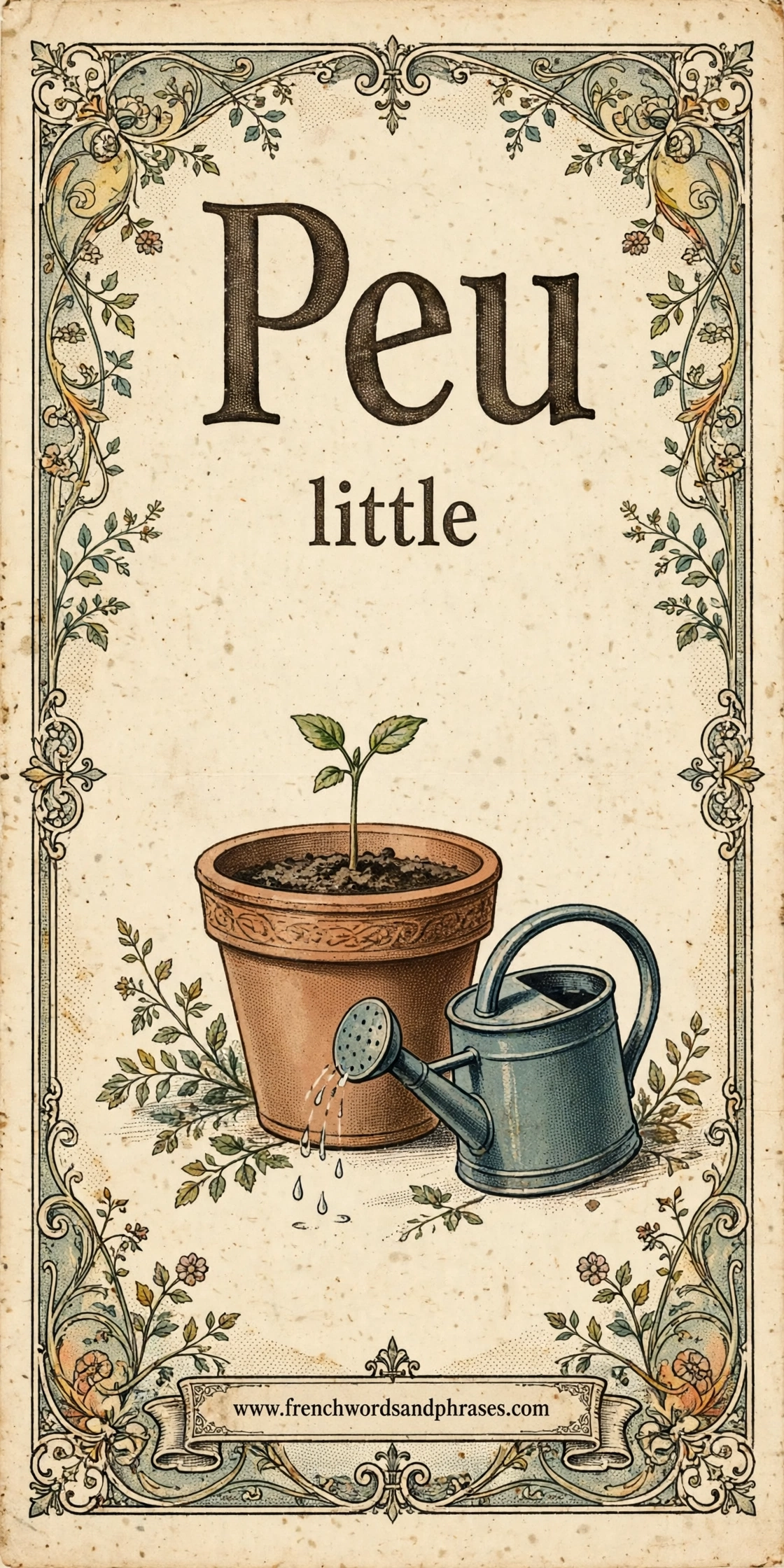
| peu de | little, few |
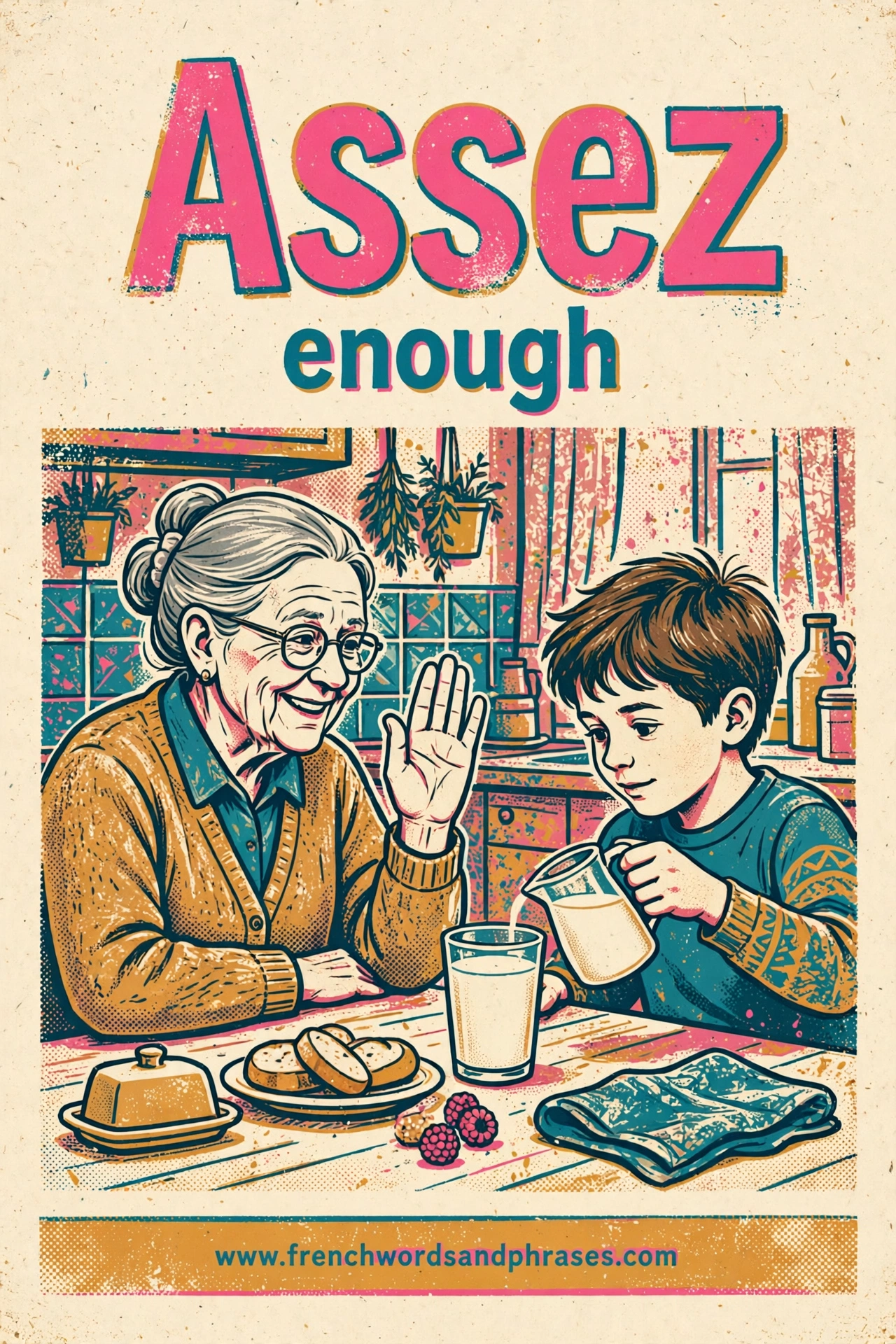
| assez de | enough |
| beaucoup de | a lot of |
| énormément de | an enormous amount of (even more) |
| trop de | too much, too many |
Example
Il y a assez de pain, mais beaucoup de fromage.
There is enough bread, but a lot of cheese.
Watch Out: Beaucoup and the Vanishing Article
The traps with beaucoup are all about what disappears: the article after de, and the de itself after a verb.
| Mistake | Correct French |
|---|---|
| « beaucoup des livres » (article kept) | beaucoup de livres |
| « je lis beaucoup de » (de left dangling) | je lis beaucoup |
| « merci très » (très after a verb) | merci beaucoup |
| « beaucoup personnes » (de forgotten) | beaucoup de personnes |
Example
Beaucoup de personnes visitent ce musée.
A lot of people visit this museum.
Quick Quiz 4
Translate: There are a lot of people at the market.
Reveal the answer
Il y a beaucoup de monde au marché.
Beaucoup de monde is the everyday French way of saying a lot of people.
Beaucoup in Everyday French: Real-Life Examples
Now that you know the word, let’s see how beaucoup appears in everyday French.
Example 1 — At the market
Il y a beaucoup de monde ce matin.
There are a lot of people this morning.
Example 2 — At work
Je travaille beaucoup cette semaine.
I am working a lot this week.
Example 3 — Politeness
Merci beaucoup pour le dîner, c’était délicieux.
Thank you very much for dinner, it was delicious.
Example 4 — At home
Les enfants lisent beaucoup avant de dormir.
The children read a lot before sleeping.
Example 5 — Travel
Ce train coûte beaucoup moins cher le mardi.
This train costs much less on Tuesdays.
Example 6 — Weather
Il a beaucoup plu cette nuit.
It rained a lot last night.
Beyond Translation: The Meaning of Beaucoup
Its name is a small poem: beaucoup is beau coup, a fine blow, a handsome stroke — abundance named as something beautiful.
To say beaucoup is to measure generously.
It is the word of the loaded table, the crowded square and the heartfelt thank-you. Where trop complains of excess, beaucoup celebrates plenty — the same mountain, seen from the sunny side.
How to Remember the French Adverb Beaucoup
Remember it this way: Beaucoup means a lot — it follows verbs, and before a noun it always brings de and takes the article away.
- You thank with it — merci beaucoup, thank you very much.
- You measure things — beaucoup de monde, beaucoup de livres, no article after de.
- You measure actions — je travaille beaucoup, the job très can never do.
The key idea is a lot — beaucoup + verb, beaucoup de + bare noun; merci beaucoup, never merci très.
Test Your Knowledge of Beaucoup
Let’s see how much you’ve learned. Try answering these questions before revealing the answers.
Question 1
What does beaucoup mean?
Reveal the answer
A lot — much, many, a large amount.
Question 2
How do you say a lot of books in French?
Reveal the answer
Beaucoup de livres — de, and no article.
Question 3
Translate: He works a lot.
Reveal the answer
Il travaille beaucoup.
Question 4
Why is « merci très » wrong?
Reveal the answer
Très cannot follow a verb. Thank you very much is merci beaucoup.
Question 5
Complete the sentence:
Il y a ______ de monde au marché. (a lot)
Reveal the answer
beaucoup
Il y a beaucoup de monde au marché.
There are a lot of people at the market.
Your Final Challenge
Can You Use It?
How would you say this in French?
“Thank you very much — there are a lot of people here today.”
Reveal the answer
Merci beaucoup — il y a beaucoup de monde ici aujourd’hui.
Thank you very much — there are a lot of people here today.
A little French. A little curiosity. A richer everyday life.
LEARN FRENCH ONE WORD AT A TIME