A French Word to Live By
Translate Assez to English
/a.se/
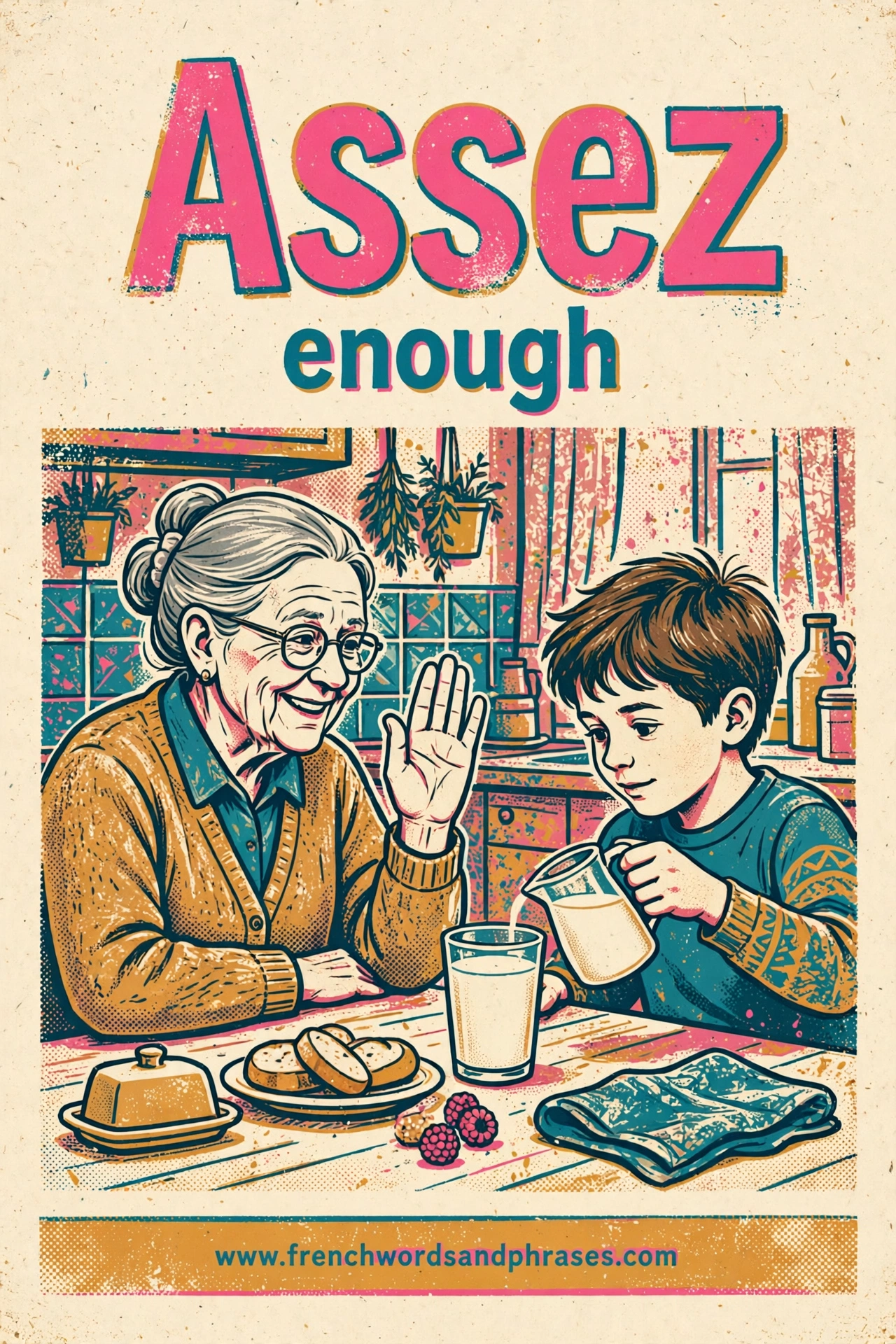
Assez means enough.
The baker slides one more croissant into the paper bag and looks up, eyebrows raised, the question in his eyes. « C’est assez », you say — that is enough, that will do nicely, no more and no less.
In this guide, you’ll learn what assez means in English, how it builds enough with adjectives and nouns, how it softens into quite, and how the French say they have had enough. Explore French examples, English translations, and practice quizzes.
Understanding the French Adverb Assez
Assez is a French adverb of quantity and degree. It measures sufficiency: enough of a quality, enough of a thing — and, standing before an adjective, it can soften into quite or rather.
It means enough. Assez grand — big enough. Assez d’argent — enough money. Assez is the word of the satisfied measure: the point where need is met and more would be waste. In a softer light it also means quite, fairly: assez bien, quite well.
Type: Adverb of quantity and degree — sufficiency
Answers the question: How much? — as much as is needed
Changes form: Never — assez is invariable
English equivalents: Enough; quite, fairly (before an adjective).
One important usage detail: before a noun, assez always takes de, and the noun loses its article — assez de pain, enough bread, never « assez du pain ». And when assez follows an adjective, the pair often points forward to pour: assez grand pour entrer, big enough to get in.
Experience the Word
Assez is the adverb of contentment. It draws a line at exactly the right place: enough bread for the table, enough time for the walk, enough money for the journey — and no anxiety beyond.
Imagine the village fête being set up at dawn: tables in a row, chairs counted twice, and the mayor nodding over the square — « Il y a assez de place pour tout le monde. »
You have not just counted something. You have declared the measure full.
How to Use Assez in French: Complete Guide
Let’s explore how assez works in French, beginning with the whole word on one card.
Assez at a Glance
Before the details, here is the whole word on one card.
The Whole Word on One Card
Meaning, type, position and form — assez in four lines.
| Point | Assez |
|---|---|
| Meaning | enough; quite, fairly |
| Type | adverb of quantity and degree |
| Usual position | before an adjective, or before de + noun |
| Form | invariable — never changes |
Nous avons assez de temps.
We have enough time.
Where Assez Goes in the Sentence
Assez has two homes: before an adjective, where it grades a quality, and before de plus a noun, where it measures a thing.
| Situation | Pattern |
|---|---|
| Before an adjective | assez + adjective — assez grand, assez riche |
| Before a noun | assez de + noun — assez d’eau, assez de livres |
| After a verb (a quantity of action) | travailler assez — to work enough |
| Standing alone (an answer) | C’est assez. — That is enough. |
Example
Il a assez travaillé pour aujourd’hui.
He has worked enough for today.
Quick Quiz 1
True or false: enough money is « assez d’argent », with de and no article.
Reveal the answer
True
Assez de + noun, and the article disappears.
Elle a assez d’argent pour le voyage. — She has enough money for the trip.
Assez De: Enough of a Thing
With de, assez measures the concrete world — food, money, time, room — and the noun stands bare, with no article.
| French | In English |
|---|---|
| assez de pain | enough bread |
| assez d’argent | enough money |
| assez de temps | enough time |
| assez de place | enough room |
| pas assez de sel | not enough salt |
Example
Il y a assez de pain pour tout le monde.
There is enough bread for everyone.
Assez + Adjective + Pour: Big Enough To…
One of the most useful patterns in French: assez, an adjective, then pour and a verb — the recipe for everything from doors to driving licences.
| Pattern | Example |
|---|---|
| Old enough to… | Elle est assez grande pour conduire. |
| Strong enough to… | Il est assez fort pour porter la valise. |
| Near enough to… | Nous sommes assez près pour marcher. |
| The negative | Il n’est pas assez rapide pour gagner. |
Example
Tu es assez grand pour prendre le train seul.
You are old enough to take the train alone.
Complete the sentence:
Nous avons ______ de pain pour le dîner. (enough)
Reveal the answer
assez
Nous avons assez de pain pour le dîner.
We have enough bread for dinner.
Assez the Softener: Quite, Fairly, Rather
Before an adjective, assez often steps down from enough to quite — a mild, slightly reserved degree, very common in French judgements.
| French | In English |
|---|---|
| assez bien | quite well |
| assez intéressant | quite interesting |
| assez souvent | quite often |
| assez content | quite pleased |
| assez loin | quite far |
Example
Le film était assez intéressant.
The film was quite interesting.
En Avoir Assez: To Have Had Enough
When assez joins en avoir, the meaning sharpens: en avoir assez means to be fed up, to have had more than enough — of rain, of noise, of waiting.
| Expression | In English |
|---|---|
| J’en ai assez. | I have had enough. / I am fed up. |
| en avoir assez du bruit | to be fed up with the noise |
| en avoir assez d’attendre | to be fed up with waiting |
| Ça suffit ! | That is enough! (a close cousin, sharper) |
Example
J’en ai assez de ce bruit, fermons la fenêtre.
I have had enough of this noise, let’s close the window.
Quick Quiz 3
What does « j’en ai assez » mean?
Reveal the answer
I have had enough — I am fed up
J’en ai assez d’attendre.
I am fed up with waiting.
Assez and Its Neighbours on the Scale
Assez holds the middle of the quantity scale: more than peu, less than beaucoup, and far below trop.
| French | In English |
|---|---|
| peu de | little, few — not much |
| assez de | enough — the need is met |
| beaucoup de | a lot of — plenty |
| trop de | too much, too many — past the limit |
| pas assez de | not enough — the need is missed |
Example
Il y a peu de lait, mais assez pour le café.
There is little milk, but enough for the coffee.
Watch Out: Assez Comes Before, English Enough Comes After
The classic word-order trap: English puts enough after the adjective (big enough), but French assez always leads the adjective it grades.
| Mistake | Correct French |
|---|---|
| « grand assez » (English order) | assez grand — big enough |
| « assez du pain » (article kept) | assez de pain — enough bread |
| « assez argent » (de forgotten) | assez d’argent — enough money |
| « très assez » (two degree words stacked) | assez — assez stands alone |
Example
Elle est assez grande pour ce travail.
She is big enough for this job.
Translate: He is old enough to drive.
Reveal the answer
Il est assez grand pour conduire.
Assez before the adjective, and pour opens the door to the verb.
Assez in Everyday French: Real-Life Examples
Now that you know the word, let’s see how assez appears in everyday French.
Example 1 — At the bakery
C’est assez, merci — deux croissants seulement.
That is enough, thank you — just two croissants.
Example 2 — At home
Nous avons assez de chaises pour les invités.
We have enough chairs for the guests.
Example 3 — At work
Elle parle assez bien le français maintenant.
She speaks French quite well now.
Example 4 — Travel
Il est assez tôt pour prendre le premier train.
It is early enough to catch the first train.
Example 5 — Weather
Il fait assez froid pour mettre un pull.
It is cold enough to wear a jumper.
Example 6 — Feelings
J’en ai assez de cette pluie !
I have had enough of this rain!
Beyond Translation: The Meaning of Assez
English enough trails behind its adjective like a servant — big enough, old enough, good enough. French assez walks in front, deciding the measure before the quality is even named.
To say assez is to be satisfied with the measure of things.
It is a deeply French contentment: assez de pain, assez de temps, assez de place pour tout le monde — and, when patience ends, the same small word says so: j’en ai assez.
How to Remember the French Adverb Assez
Remember it this way: Assez means enough — it stands before the adjective, and before a noun it always brings de with it.
- You measure a thing — assez de pain, assez d’argent, assez de temps.
- You grade a quality — assez grand pour conduire, old enough to drive.
- You end your patience — j’en ai assez, I have had enough.
The key idea is enough — assez + adjective, assez de + bare noun; en avoir assez = to be fed up.
Test Your Knowledge of Assez
Let’s see how much you’ve learned. Try answering these questions before revealing the answers.
Question 1
What does assez mean?
Reveal the answer
Enough — and, before an adjective, quite or fairly.
Question 2
How do you say enough time in French?
Reveal the answer
Assez de temps — assez de, and no article on the noun.
Question 3
Translate: She is tall enough.
Reveal the answer
Elle est assez grande.
Question 4
What does « j’en ai assez » mean?
Reveal the answer
I have had enough — I am fed up.
Question 5
Complete the sentence:
Il y a ______ de place pour tout le monde. (enough)
Reveal the answer
assez
Il y a assez de place pour tout le monde.
There is enough room for everyone.
Your Final Challenge
Can You Use It?
How would you say this in French?
“We have enough bread for everyone.”
Reveal the answer
Nous avons assez de pain pour tout le monde.
We have enough bread for everyone.
A little French. A little curiosity. A richer everyday life.
LEARN FRENCH ONE WORD AT A TIME