A French Word to Live By
Translate Certes to English
/sɛʁt/
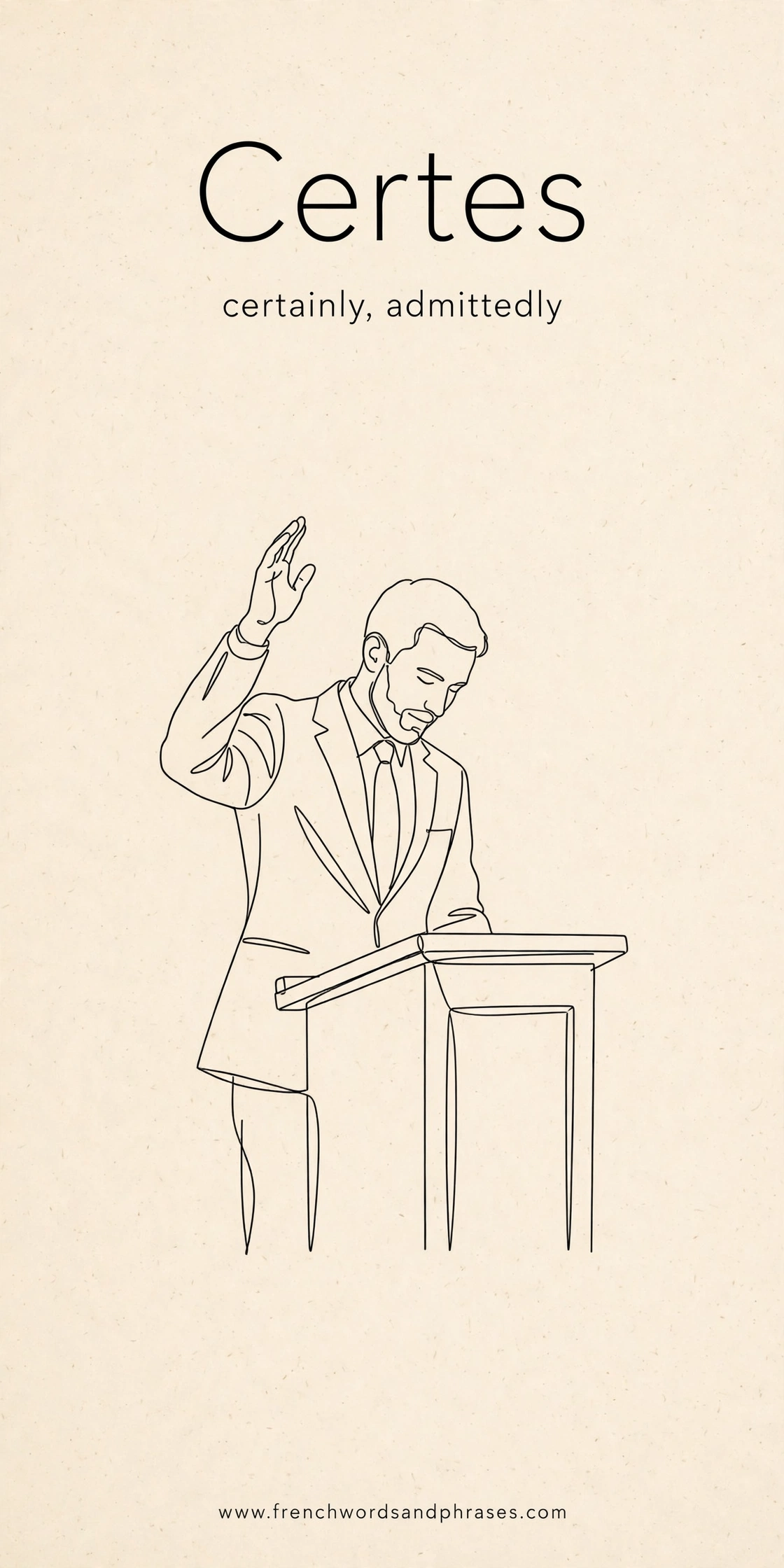
Certes means certainly, admittedly — the gracious word that grants a point before answering it.
The village hall is full and the mayor is on his feet. A farmer has just complained, loudly, about the new parking charges. The mayor nods, slowly and publicly. « Certes, » he says, « the charges are unpopular… » — and the whole room leans in, because everyone in France knows what comes next: the mais.
Let’s explore how certes works in French, beginning with the whole word on one card.
Understanding the French Phrase Certes
Certes is a French adverb of concession, descended from the Latin certe, surely. It stands at the head of a clause and does one elegant job: it grants the truth of what has just been said — completely, without quibbling — before the speaker turns, almost always with mais, to the answer. Certes… mais… is one of the classic paired shapes of French argument.
It means certainly, admittedly, granted. English reaches for the same move with « granted… but » or « admittedly… but »: you hand your opponent the point, cleanly and in public, and only then do you reply. The concession is not a trick — certes really does agree. That is exactly why the reply that follows carries weight: it comes from someone who has listened.
Type: Adverb of concession — grants a point, then pivots
Answers the need: Agreeing gracefully before you disagree
Register: Polished — essays, debates, careful speech; rare in casual chat
Strength: Full concession — it gives the point completely, which is what makes the mais land
One important usage detail: certes almost never travels alone. It opens the door and mais walks through it — Certes, il a raison, mais… Drop the mais and the sentence hangs in the air, waiting for its second half. In everyday speech, French speakers more often reach for c’est vrai que… mais or d’accord, mais…; certes is the dressed-up, deliberate version, chosen when the concession itself should sound considered.
Experience the Word
Certes is the salute before the fencing bout — a small ceremony of respect performed in one word.
Imagine a radio debate. The journalist attacks: the reform has cost a fortune and delivered nothing. The minister does not flinch. « Certes, les débuts ont été difficiles, dit-elle, mais regardez les chiffres d’aujourd’hui. » Certes, the beginnings were hard, she says, but look at today’s figures. In one word she has disarmed the attack — she agreed with it — and bought herself the right to be heard.
That is the word’s whole art: certes concedes in order to convince. It costs the speaker nothing but honesty, and it changes the temperature of the room.
How to Use Certes in French: Complete Guide
Let’s explore how certes works in French, beginning with the whole word on one card.
Certes at a Glance
The Whole Word on One Card
Real meaning, classic shape, register and secret — certes in five lines.
| Point | Certes |
|---|---|
| What it really means | certainly, admittedly — yes, that much is true |
| Word for word | « certainly » — from the Latin certe, surely |
| Its classic shape | certes… mais… — grant the point, then pivot |
| Register | polished — essays, speeches, careful argument |
| Its secret | the concession is genuine — that is why the answer persuades |
Example
Certes, tu as raison sur les prix, mais la qualité compte aussi.
Granted, you are right about the prices, but quality counts too.
Word by Word: Building the Concession
One small word and its inseparable partner — take them one by one.
| Word | Literal meaning | Its job in the phrase |
|---|---|---|
| certes | certainly | the concession itself — placed first, like a bow |
| la virgule | the comma | the pause after certes — the breath in which the point is granted |
| mais | but, however | the pivot — the reply the concession has earned |
| la suite | what follows | your real argument, now heard with respect |
Example
Certes, il pleut, mais nous partirons quand même.
Admittedly, it is raining, but we shall set off all the same.
Quick Quiz 1
What does certes almost always set up?
Reveal the answer
A mais — certes grants the point, and mais delivers the reply.
Certes, c’est cher, mais cela durera des années.
Granted, it is expensive, but it will last for years.
When You Say It: The Granting Moments
Certes appears at moments like these — wherever a point deserves to be granted before it is answered.
| Moment | What certes does there |
|---|---|
| In a debate | disarms the attack by agreeing with its true part |
| Answering a critic | shows you listened before you replied |
| In an essay | opens the balanced paragraph — the classic school shape |
| Conceding a price | admits the cost before defending the value |
| Admitting a fault | owns the mistake before explaining it |
Example
Certes, j’ai oublié ton anniversaire, mais regarde ce que je t’ai apporté.
Admittedly, I forgot your birthday, but look what I have brought you.
Make It Yours: The Concession in Every Shape
Certes mostly opens the sentence — but it can slip inside it too.
| Form | French | In English |
|---|---|---|
| The full pattern | Certes, …, mais… | Granted, …, but… |
| Inside the clause | C’est certes vrai, mais… | That is certainly true, but… |
| After the verb | Il a certes gagné, mais de peu. | He certainly won, but only just. |
| The refusal | Certes non ! | Certainly not! |
| Doubling the grant | Certes, certes, mais écoute-moi. | Yes, yes, granted, but listen to me. |
Example
C’est certes un beau projet, mais qui va le payer ?
It is certainly a fine project, but who is going to pay for it?
Quick Quiz 2
Which of these is the everyday, spoken twin of certes… mais…?
Reveal the answer
C’est vrai que… mais — the same grant-and-pivot move in ordinary clothes.
C’est vrai qu’il est tard, mais on peut encore appeler.
True, it is late, but we can still call.
Everyday Expressions: Building on the Concession
Certes slots into these everyday frames — each one ready to use as it stands.
| Frame | What it does |
|---|---|
| Certes, mais il reste que… | grants, then insists on what remains true |
| Certes, et pourtant… | grants, then pivots with « and yet » |
| C’est certes un risque, mais… | places certes inside, right before the risky word |
| Certes non, jamais de la vie. | the flat refusal — certainly not, never |
| Certes, admettons, mais… | grants twice over before replying — very deliberate |
Example
Certes, mais il reste que nous n’avons pas le choix.
Granted, but the fact remains that we have no choice.
Close Cousins: The Other Ways to Grant a Point
French keeps a whole shelf of conceding words — certes is the polished one; its cousins dress down or change the angle.
| Cousin | How it differs |
|---|---|
| bien sûr | of course — cheerful agreement, no pivot required |
| c’est vrai que… mais | the everyday twin — same move, spoken register |
| d’accord, mais | agreed, but — the quick, informal grant |
| bien entendu | needless to say — presents the point as obvious |
| sans doute | probably — a weaker, doubtful cousin; it concedes with a shrug |
Example
Bien sûr, tu peux venir, mais préviens-moi avant.
Of course you can come, but let me know beforehand.
Quick Quiz 3
True or false: certes usually closes a discussion.
Reveal the answer
False — certes opens your reply. It grants the other side’s point so that your mais can begin.
Certes, le train est rapide, mais la voiture est plus libre.
Granted, the train is fast, but the car gives more freedom.
Certes and Its Neighbours
The conceding shelf in one view — from the full grant to the pivot words themselves.
| Word | Its flavour |
|---|---|
| certes | certainly — the polished full concession |
| bien sûr | of course — warm, obvious agreement |
| évidemment | obviously — the point needs no arguing |
| en effet | indeed — confirms what was just said |
| pourtant | yet, however — a pivot without the grant |
| néanmoins | nevertheless — the formal pivot |
Example
Certes, elle chante bien ; pourtant, je préfère l’autre chanteuse.
Granted, she sings well; and yet I prefer the other singer.
Watch Out: The Traps Around Certes
The traps: a missing mais, a register slip, and a refusal hiding inside the word.
| Trap | Why it matters |
|---|---|
| Dropping the mais | certes alone leaves the sentence suspended — the listener waits for the turn |
| Using it in casual chat | with friends it can sound stiff or ironic — c’est vrai que fits better |
| Reading certes non as agreement | it is the opposite — a firm « certainly not » |
| Translating word by word | English « certainly » mid-sentence loses the ceremony — « granted » or « admittedly » keeps it |
Example
— Tu viens demain ? — Certes non, je travaille !
« Are you coming tomorrow? » « Certainly not, I am working! »
Quick Quiz 4
What does Certes non ! mean?
Reveal the answer
Certainly not! — the one place certes stands alone, as a refusal.
Certes non, je ne prêterai pas la voiture à ton frère.
Certainly not, I will not lend the car to your brother.
Certes in Everyday French: Real-Life Examples
Now that you know the word, let’s see how certes appears in everyday French.
Example 1 — At the market
Certes, vos tomates sont belles, mais à ce prix-là, je vais réfléchir.
Granted, your tomatoes are lovely, but at that price, I shall think it over.
Example 2 — In a meeting
Certes, le projet coûte cher, mais il rapportera dès la première année.
Admittedly, the project is expensive, but it will pay for itself from the first year.
Example 3 — Answering a friend
Certes, j’aurais dû appeler, mais le téléphone était déchargé.
Granted, I should have called, but the phone was flat.
Example 4 — In an essay
Certes, la voiture offre la liberté, mais elle pollue nos villes.
Admittedly, the car offers freedom, but it pollutes our towns.
Example 5 — About the weather
Certes, il fait froid, mais quel beau soleil !
True, it is cold, but what beautiful sunshine!
Example 6 — Conceding a fault
Certes, c’est ma faute, mais laisse-moi réparer.
Granted, it is my fault, but let me put it right.
Beyond Translation: The Meaning of Certes
English argues by scoring points; French, at its most classical, argues by granting them. Certes is the purest form of that courtesy: the concession is a move of strength, not weakness, inherited from centuries of rhetoric in which the orator first states the opponent’s case better than the opponent did. When a French speaker says certes, a whole tradition is bowing — briefly — before it draws.
How to Remember the French Phrase Certes
Remember it this way: Certes is about the fencer’s salute — the blade raised in respect before the bout begins.
- You picture the salute — certes bows to the true point before the reply begins.
- You wait for the partner — certes almost always calls mais onto the stage.
- You keep the everyday twin in your pocket — c’est vrai que… mais for friends, certes for the podium.
The key idea is certes means certainly, admittedly — grant the point gracefully, then pivot with mais.
Test Your Knowledge of Certes
Let’s see how much you’ve learned. Try answering these questions before revealing the answers.
Question 1
What does certes mean?
Reveal the answer
Certainly, admittedly — it grants that what was just said is true.
Question 2
Which word almost always follows a certes concession?
Reveal the answer
Mais — certes… mais… is the classic pair: grant, then pivot.
Question 3
What is the spoken, everyday equivalent of certes… mais…?
Reveal the answer
C’est vrai que… mais — the same move in ordinary register.
Question 4
What does « Certes non ! » mean?
Reveal the answer
Certainly not! — a firm refusal, the one standalone use of certes.
Question 5
In which register does certes belong?
Reveal the answer
Polished, careful French — essays, speeches and debates rather than casual chat.
Your Final Challenge
Can You Use It?
How would you say this in French?
“Granted, the train is faster, but I still prefer the road.”
Reveal the answer
Certes, le train est plus rapide, mais je préfère quand même la route.
Granted, the train is faster, but I still prefer the road.
A little French. A little curiosity. A richer everyday life.
LEARN FRENCH ONE WORD AT A TIME