A French Word to Live By
Translate Avoir envie de tout abandonner to English
/a.vwaʁ ɑ̃.vi də tu.t‿a.bɑ̃.dɔ.ne/
Avoir envie de tout abandonner means to feel like giving everything up — to want to abandon it all.
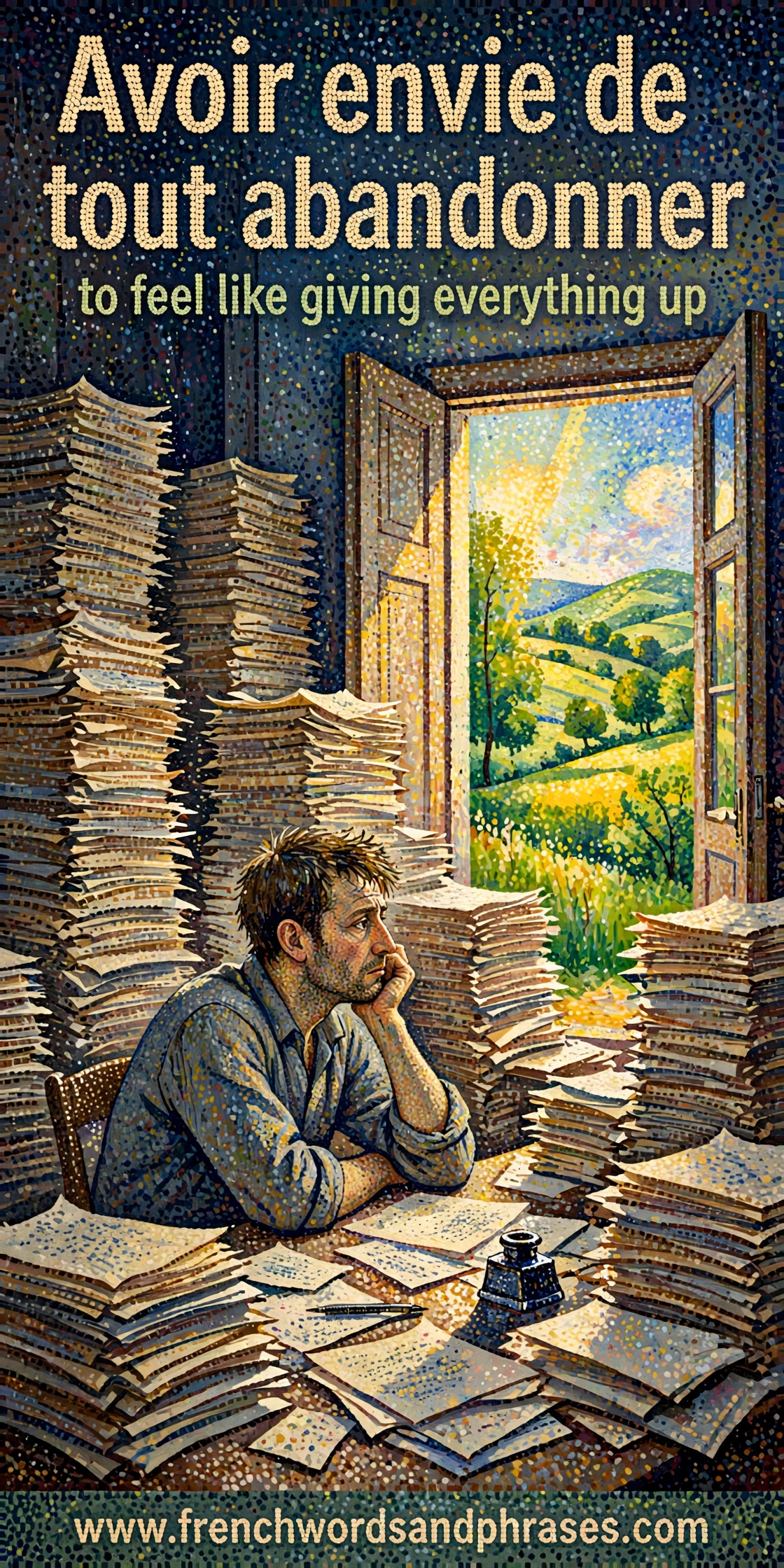
Rain on the tent at three in the morning, wet socks, a stove that will not light and a map that has dissolved into grey pulp. Your friend sits down on a rock, looks at the mountain doing its best impression of a wall, and announces: « J’ai envie de tout abandonner. » By nine, the sun is out and she is climbing. The sentence was weather, not a decision.
Let’s explore how avoir envie de tout abandonner works in French, beginning with the whole phrase on one card.
Understanding the French Phrase Avoir envie de tout abandonner
Avoir envie de tout abandonner is a French expression built from avoir envie de (to feel like, to want) and tout abandonner (to give everything up — abandonner is to abandon, to quit). It names the dramatic moment when the whole enterprise suddenly feels like too much.
It means to feel like giving everything up — the urge, at a hard moment, to drop the project, the course, the climb, the whole thing, and walk away. Nobody is signing a resignation: envie is a feeling, and tout abandonner is its most theatrical form. French speakers say it at desks, on mountains and over broken cars — usually an hour before carrying on.
Type: Expression — discouragement (avoir envie de + tout + infinitive)
Answers the need: Confessing the urge to quit everything, at the worst moment
Register: Neutral to informal — everyday speech, diaries, friends at midnight
Strength: Dramatic but temporary — a storm of feeling, rarely a real decision
One important usage detail: envie de is followed by the infinitive, and tout slips in before it — envie de tout abandonner, envie de tout laisser tomber. The phrase describes the feeling, not the act: for actually quitting, French says tout abandonner or tout plaquer without envie. And note the reassurance built into the grammar — an envie passes, which is why friends answer: ça va passer, repose-toi.
Experience the Word
Avoir envie de tout abandonner is the valley of every long effort — the phrase exists because the valley is universal.
Imagine the student in month four of a thesis, surrounded by index cards, reading the same paragraph for the ninth time. The sentence arrives like weather: j’ai envie de tout abandonner. She makes tea. She sleeps. In the morning the paragraph is just a paragraph again. The phrase did its work — it let the feeling speak, so the feeling did not have to act.
French is wise about this sentence. It gives discouragement a full, dramatic voice — because a feeling spoken aloud loses half its power.
How to Use Avoir envie de tout abandonner in French: Complete Guide
Let’s explore how avoir envie de tout abandonner works in French, beginning with the whole phrase on one card.
Avoir envie de tout abandonner at a Glance
The Whole Phrase on One Card
Real meaning, literal picture, English twin and register — avoir envie de tout abandonner in five lines.
| Point | Avoir envie de tout abandonner |
|---|---|
| What it really means | to feel like giving everything up — the urge to quit it all |
| Word for word | to have the desire to abandon everything — envie is a want, a craving |
| English equivalent | to feel like giving up / to want to throw it all in |
| Register | neutral to informal — confession, not official resignation |
| Use it for | studies, projects, climbs, repairs — the worst hour of any long effort |
Example
À minuit, devant ce rapport, j’ai envie de tout abandonner.
At midnight, in front of this report, I feel like giving everything up.
Word by Word: Building the Urge
Four small pieces — take them one by one and the storm gathers.
| Word | Literal meaning | Its job in the phrase |
|---|---|---|
| avoir envie de | to feel like, to want | the feeling-frame — an urge, not a decision |
| tout | everything | the dramatic total: not one task, the whole enterprise |
| abandonner | to abandon, to give up | a regular -er verb — to leave something unfinished and walk away |
Example
Elle a envie de tout abandonner, puis elle se fait un thé.
She feels like giving everything up, then she makes herself a tea.
Quick Quiz 1
Does avoir envie de tout abandonner mean you have quit, or that you feel like quitting?
Reveal the answer
You feel like it — envie is a desire, a passing urge. Actually quitting is tout abandonner, without the envie.
J’ai envie de tout abandonner, mais demain je continuerai.
I feel like giving everything up, but tomorrow I’ll carry on.
When You Say It: The Worst-Hour Moments
Avoir envie de tout abandonner fires at moments like these — wherever a long effort reaches its valley.
| Situation | Example |
|---|---|
| Studying | après trois échecs, il a envie de tout abandonner — after three failures, he feels like giving everything up |
| A project | le chantier prend du retard, elle a envie de tout abandonner — the work is behind, she feels like giving it all up |
| Sport | au trentième kilomètre, on a envie de tout abandonner — at kilometre thirty, you feel like giving everything up |
| A repair | la machine casse encore, j’ai envie de tout abandonner — the machine breaks again, I feel like giving up entirely |
| Confession to a friend | parfois, j’ai envie de tout abandonner — sometimes, I feel like giving everything up |
Example
Il a envie de tout abandonner, mais son équipe l’attend demain.
He feels like giving everything up, but his team is expecting him tomorrow.
Make It Yours: The Urge for Every Person
Avoir envie conjugates through avoir — and tout can soften or sharpen the drama.
| Form | French | In English |
|---|---|---|
| I feel like giving up | j’ai envie de tout abandonner | I feel like giving everything up |
| She felt like it | elle avait envie de tout abandonner | she felt like giving everything up |
| Sometimes | parfois, j’ai envie de tout abandonner | sometimes, I feel like giving everything up |
| The twin | avoir envie de tout laisser tomber | to feel like dropping everything |
| Actually quitting | tout abandonner / tout plaquer | to give everything up — doing it, not feeling it |
| The reply | ça va passer, repose-toi | it will pass, get some rest |
Example
Parfois j’ai envie de tout laisser tomber, puis je dors et ça va mieux.
Sometimes I feel like dropping everything, then I sleep and it feels better.
Quick Quiz 2
Which twin means exactly the same — tout laisser tomber or tout ramasser?
Reveal the answer
Tout laisser tomber — to let everything drop. Ramasser is the opposite: to pick things up.
À ce stade du projet, elle a envie de tout laisser tomber.
At this stage of the project, she feels like dropping everything.
Everyday Expressions: Building on the Urge
Avoir envie de tout abandonner slots into these everyday frames — each one ready to use as it stands.
| Frame | In English |
|---|---|
| avoir envie de tout abandonner | to feel like giving everything up |
| avoir envie de tout laisser tomber | to feel like dropping everything |
| être sur le point de tout abandonner | to be on the verge of giving everything up |
| tenir bon | to hold on, to hang in there |
| reprendre courage | to take heart again |
Example
Il était sur le point de tout abandonner quand l’aide est arrivée.
He was on the verge of giving everything up when help arrived.
Close Cousins: The Other Ways to Waver
French has a whole shelf of wavering phrases — avoir envie de tout abandonner is the dramatic urge; its cousins are fed up, tired or actually packing.
| Expression | The difference |
|---|---|
| avoir envie de tout abandonner | to feel like giving everything up — the dramatic urge, usually temporary |
| en avoir marre | to be fed up — the everyday grumble that feeds the urge |
| en avoir assez | to have had enough — the measure is full |
| baisser les bras | to give up, to drop one’s arms — the gesture of surrender |
| tout plaquer | to chuck everything in — actually doing it, informal and final |
Example
Elle en a marre, elle baisse les bras, mais elle ne plaque pas tout.
She is fed up, she is giving up for today, but she is not chucking it all in.
Quick Quiz 3
Your friend has actually resigned and left the country. Envie de tout abandonner or tout plaquer?
Reveal the answer
Tout plaquer — the deed is done. Envie de tout abandonner is only the feeling, and feelings pass.
Il a tout plaqué pour ouvrir un café au bord de la mer.
He chucked everything in to open a café by the sea.
Avoir envie de tout abandonner and Its Neighbours
The discouragement shelf around the phrase — from the first sigh to the second wind.
| French | In English |
|---|---|
| abandonner | to abandon, to give up |
| en avoir marre | to be fed up |
| le découragement | discouragement |
| tenir bon | to hold on |
| le courage | courage |
| reprendre | to resume, to take up again |
Example
Après le découragement du soir, le courage du matin.
After the evening’s discouragement, the morning’s courage.
Watch Out: The Traps Around Avoir envie de tout abandonner
The traps: a feeling mistaken for a fact, an abandon that is not leaving a person, and drama that needs its hour.
| Trap | The truth |
|---|---|
| feeling, not fact | the phrase reports an urge — translating it as ‘I give up’ signs a resignation the speaker never signed |
| abandonner and people | abandonner quelqu’un means to abandon a person, a serious charge; here the object is tout, the enterprise, not a soul |
| tout before the verb | tout slips between de and the infinitive: envie de TOUT abandonner — envie d’abandonner tout is understood but heavier |
| the hour matters | said at midnight it is weather; written in a resignation letter it becomes real — keep the phrase in speech and diaries |
Example
À minuit, elle a envie de tout abandonner ; à huit heures, elle reprend le dossier.
At midnight, she feels like giving everything up; at eight, she picks the file up again.
Quick Quiz 4
True or false: j’ai envie de tout abandonner is a good sentence for a resignation letter.
Reveal the answer
False — it confesses a passing feeling, the opposite of a decision. A resignation states facts; this phrase states weather.
Dans sa lettre, il écrit simplement qu’il démissionne.
In his letter, he simply writes that he is resigning.
Avoir envie de tout abandonner in Everyday French: Real-Life Examples
Now that you know the word, let’s see how avoir envie de tout abandonner appears in everyday French.
Example 1 — Studying
Après cet échec, j’ai envie de tout abandonner.
After this failure, I feel like giving everything up.
Example 2 — On the mountain
Sous la pluie, elle a envie de tout abandonner.
In the rain, she feels like giving everything up.
Example 3 — A project
Le chantier avance si lentement qu’il a envie de tout abandonner.
The work is advancing so slowly that he feels like giving everything up.
Example 4 — Confession
Parfois, le soir, j’ai envie de tout laisser tomber.
Sometimes, in the evening, I feel like dropping everything.
Example 5 — Encouragement
Tu as envie de tout abandonner ? Dors, on verra demain.
You feel like giving everything up? Sleep, we’ll see tomorrow.
Example 6 — The morning after
Hier j’avais envie de tout abandonner ; aujourd’hui je continue.
Yesterday I felt like giving everything up; today I carry on.
Beyond Translation: The Meaning of Avoir envie de tout abandonner
English gives up — two flat words, a white flag. French builds the moment a whole theatre: an envie, a craving, turned against everything you have built. The drama is the honesty. Nobody at kilometre thirty feels a mild preference for stopping.
Avoir envie de tout abandonner names the storm at full size — so that the morning can be measured against it.
And the grammar itself consoles: envie is the tense of cravings, and cravings, unlike decisions, are famous for passing by breakfast.
How to Remember the French Phrase Avoir envie de tout abandonner
Remember it this way: Avoir envie de tout abandonner is the rain on the tent at 3 a.m. — by nine, the sun is out and you are climbing.
- You picture the weather — envie is a craving, and cravings pass; the phrase is a storm report, not a resignation.
- You place tout before the verb — envie de tout abandonner: everything, dramatically, at once.
- You keep the deed apart — actually quitting is tout plaquer; this phrase only feels like it.
The key idea is avoir envie de tout abandonner means to feel like giving everything up — a storm, not a decision.
Test Your Knowledge of Avoir envie de tout abandonner
Let’s see how much you’ve learned. Try answering these questions before revealing the answers.
Question 1
What does avoir envie de tout abandonner mean?
Reveal the answer
To feel like giving everything up — the urge to quit it all, at a hard moment.
Question 2
Does the phrase mean you have actually quit?
Reveal the answer
No — envie is a feeling. Actually quitting is tout abandonner or tout plaquer, without envie.
Question 3
How do you say ‘sometimes I feel like dropping everything’?
Reveal the answer
Parfois, j’ai envie de tout laisser tomber — laisser tomber is the exact twin of abandonner here.
Question 4
Where does tout go in the phrase?
Reveal the answer
Before the infinitive — envie de tout abandonner: de, then tout, then the verb.
Question 5
Complete the sentence:
À minuit, j’ai ______ de tout abandonner. (At midnight, I feel like giving everything up.)
Reveal the answer
envie
À minuit, j’ai envie de tout abandonner.
At midnight, I feel like giving everything up.
Your Final Challenge
Can You Use It?
How would you say this in French?
“At midnight, I feel like giving everything up, but tomorrow I’ll carry on.”
Reveal the answer
À minuit, j’ai envie de tout abandonner, mais demain je continuerai.
At midnight, I feel like giving everything up, but tomorrow I’ll carry on.
A little French. A little curiosity. A richer everyday life.
LEARN FRENCH ONE WORD AT A TIME