A French Word to Live By
Translate Avoir froid aux pieds to English
/a.vwaʁ fʁwa o pje/
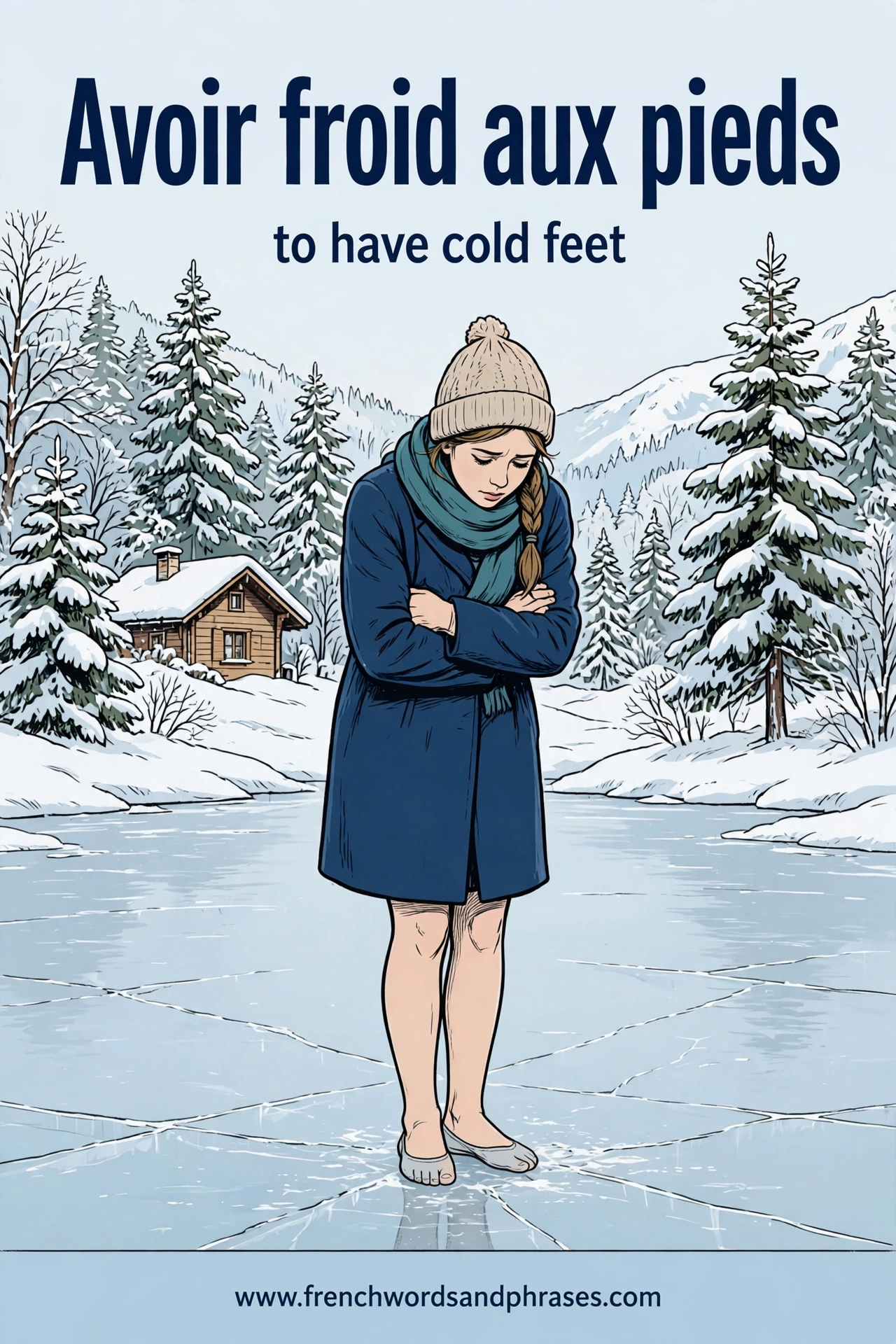
Avoir froid aux pieds means to have cold feet — cold that starts at the floor and climbs through the whole body.
A mountain refuge in January, boots off by the door, socks steaming near the stove. The walker stamps life back into his toes and announces it to the whole room: « J’ai froid aux pieds, je ne les sens plus. »
Let’s explore how avoir froid aux pieds works in French, beginning with the whole phrase on one card.
Understanding the French Phrase Avoir froid aux pieds
Avoir froid aux pieds is a French expression built from avoir (to have), froid (cold — used as a noun, le froid) and aux pieds (at the feet). It is the precision version of avoir froid: French lets you say where the cold has settled, and it very often settles in the feet.
It means to have cold feet — literally, physically cold feet, the kind that come from stone floors, thin socks and long winter walks. Nobody is getting married or backing out of anything: in French this is the body’s honest report, toes first. The famous English metaphor of cold feet before a wedding is not what the French phrase means.
Type: Everyday expression — the body and the weather (avoir + froid + aux pieds)
Answers the need: Saying your feet are cold — and that the cold is winning
Register: Neutral — everywhere, from the ski lift to the stone-floored kitchen
Strength: Honest and physical — a complaint the whole body agrees with
One important usage detail: froid here is a noun, not an adjective — avoir froid means to feel cold, while être froid describes a cold thing or a cold person. And aux is à + les fused: j’ai froid aux pieds, aux mains, aux oreilles. You feel cold at the extremities, and French names them one by one.
Experience the Word
Avoir froid aux pieds is the sentence of winter itself — said in refuges, at bus stops, and on every cold kitchen floor in the country.
Imagine the cathedral guide in February, six hours on ancient stone, whispering it to a colleague between two groups. The cold has climbed from the soles to the knees, and the whole body is negotiating a surrender. French gives that negotiation three exact words.
English made cold feet into a metaphor about courage. French kept them as feet — and left courage to other phrases.
How to Use Avoir froid aux pieds in French: Complete Guide
Let’s explore how avoir froid aux pieds works in French, beginning with the whole phrase on one card.
Avoir froid aux pieds at a Glance
The Whole Phrase on One Card
Real meaning, literal picture, English twin and register — avoir froid aux pieds in five lines.
| Point | Avoir froid aux pieds |
|---|---|
| What it really means | to have cold feet — your feet are physically cold |
| Word for word | to have cold at the feet |
| English equivalent | my feet are cold / I have cold feet |
| Register | neutral — safe everywhere |
| Use it for | winter walks, cold floors, thin shoes — real cold, in real feet |
Example
Sur ce sol en pierre, j’ai toujours froid aux pieds.
On this stone floor, my feet are always cold.
Word by Word: Building the Cold Feet
Three small pieces — take them one by one and the cold starts to climb.
| Word | Literal meaning | Its job in the phrase |
|---|---|---|
| avoir | to have | the verb that holds the cold — j’ai, tu as, il a |
| froid | cold | a noun here, le froid: the cold you feel, not the cold of a thing |
| aux pieds | at the feet | à + les fused: the place where the cold has settled |
Example
Elle a froid aux pieds malgré ses grosses chaussettes.
Her feet are cold despite her thick socks.
Quick Quiz 1
‘My feet are cold’: je suis froid aux pieds or j’ai froid aux pieds?
Reveal the answer
J’ai froid aux pieds — feelings of cold are had in French, not been. Être froid would describe a cold object, or a cold-hearted person.
J’ai froid aux pieds, je vais changer de chaussettes.
My feet are cold, I’m going to change my socks.
When You Say It: The Cold-Feet Moments
Avoir froid aux pieds fires at moments like these — wherever the floor, the snow or the wind reaches your toes.
| Situation | Example |
|---|---|
| Winter walking | après deux heures de marche, j’ai froid aux pieds — after two hours of walking, my feet are cold |
| Old houses | dans cette maison, on a froid aux pieds — in this house, your feet get cold |
| Skiing | il a froid aux pieds dans ses bottes — his feet are cold in his boots |
| Children in snow | les enfants ont froid aux pieds et aux mains — the children’s feet and hands are cold |
| Asking for slippers | tu as des chaussons ? j’ai froid aux pieds — do you have slippers? my feet are cold |
Example
Viens près du feu si tu as froid aux pieds.
Come near the fire if your feet are cold.
Make It Yours: The Cold for Every Body Part
Avoir conjugates, and the cold settles wherever it likes — the frame follows it.
| Form | French | In English |
|---|---|---|
| My feet are cold | j’ai froid aux pieds | my feet are cold |
| My hands are cold | j’ai froid aux mains | my hands are cold |
| His ears are cold | il a froid aux oreilles | his ears are cold |
| Cold all over | nous avons froid | we are cold |
| The question | tu as froid aux pieds ? | are your feet cold? |
| Colder still | j’ai très froid aux pieds | my feet are very cold |
Example
Le bébé a froid aux mains, mets-lui ses gants.
The baby’s hands are cold, put his gloves on.
Quick Quiz 2
Which is the fused form: j’ai froid à les pieds or j’ai froid aux pieds?
Reveal the answer
Aux pieds — à + les always fuses into aux, for feet, hands and teeth alike.
En hiver, j’ai froid aux pieds et aux mains.
In winter, my feet and hands get cold.
Everyday Expressions: Building on the Cold
Avoir froid aux pieds slots into these everyday frames — each one ready to use as it stands.
| Frame | In English |
|---|---|
| avoir froid aux pieds | to have cold feet — literally |
| avoir froid aux mains | to have cold hands |
| avoir les pieds gelés | to have frozen feet — the stage after cold |
| se réchauffer les pieds | to warm your feet up |
| avoir froid partout | to be cold all over |
Example
Après la neige, les enfants avaient les pieds gelés.
After the snow, the children’s feet were frozen.
Close Cousins: The Other Ways to Be Cold
French has a whole shelf of cold phrases — avoir froid aux pieds is the localised one; its cousins cover the whole body or the whole room.
| Expression | The difference |
|---|---|
| avoir froid aux pieds | to have cold feet — the cold is localised, in the feet |
| avoir froid | to be cold — the general feeling, no address given |
| avoir les pieds gelés | to have frozen feet — colder, the numb stage |
| grelotter | to shiver — the body’s visible answer to cold |
| il fait froid | it is cold — the weather’s version, no person involved |
Example
Il fait froid dehors, et dedans j’ai froid aux pieds.
It is cold outside, and indoors my feet are cold.
Quick Quiz 3
The weather report says the day is cold. J’ai froid or il fait froid?
Reveal the answer
Il fait froid — the weather does the cold. J’ai froid is what a person feels.
Il fait froid, mets ton manteau.
It is cold, put your coat on.
Avoir froid aux pieds and Its Neighbours
The winter shelf around the phrase — the cold, the clothing and the fire.
| French | In English |
|---|---|
| les chaussettes | socks |
| les chaussons | slippers |
| la neige | snow |
| le feu | the fire |
| une bouillotte | a hot-water bottle |
| se réchauffer | to warm up |
Example
Une bouillotte et de grosses chaussettes : fini, le froid aux pieds.
A hot-water bottle and thick socks: no more cold feet.
Watch Out: The Traps Around Avoir froid aux pieds
The traps: an English metaphor that does not cross the Channel, and a verb choice that changes you into furniture.
| Trap | The truth |
|---|---|
| the wedding metaphor | English ‘cold feet’ before a wedding is nerves; the French phrase is physical — for wedding nerves, say avoir le trac or hésiter |
| être froid | je suis froid would call you a cold person (or a corpse); feelings of cold take avoir |
| froid is a noun here | in avoir froid, froid does not agree: elle a froid, never elle a froide |
| aux, never à les | à + les fuses: aux pieds, aux mains, aux dents |
Example
Elle a froid aux pieds, mais pas le trac : elle se marie demain, heureuse.
Her feet are cold, but she has no nerves: she is getting married tomorrow, happily.
Quick Quiz 4
True or false: avoir froid aux pieds is what French says about a groom who panics before the wedding.
Reveal the answer
False — it is literal: cold feet, cold toes. The panicking groom a le trac.
Il n’a pas le trac, il a froid aux pieds, c’est tout.
He has no nerves, his feet are cold, that is all.
Avoir froid aux pieds in Everyday French: Real-Life Examples
Now that you know the word, let’s see how avoir froid aux pieds appears in everyday French.
Example 1 — In the refuge
Après la descente, tout le monde avait froid aux pieds.
After the descent, everyone’s feet were cold.
Example 2 — The old house
Dans cette cuisine en pierre, j’ai froid aux pieds dès octobre.
In this stone kitchen, my feet are cold from October on.
Example 3 — A child’s complaint
Maman, j’ai froid aux pieds, je veux rentrer.
Mum, my feet are cold, I want to go home.
Example 4 — Thick socks
Mets tes grosses chaussettes si tu as froid aux pieds.
Put your thick socks on if your feet are cold.
Example 5 — At the bus stop
Elle dansait sur place parce qu’elle avait froid aux pieds.
She was dancing on the spot because her feet were cold.
Example 6 — By the fire
Assis près du feu, il n’a plus froid aux pieds.
Sitting by the fire, his feet are no longer cold.
Beyond Translation: The Meaning of Avoir froid aux pieds
Languages reveal themselves in what they refuse to metaphorise. English took cold feet and made them a failure of courage; French looked at the same feet and saw — feet, cold, in winter, wanting a fire.
To avoir froid aux pieds is to report the body plainly, extremity by extremity, and to ask for warmth, not judgement.
There is a whole climate philosophy in the phrase: first the socks, then the philosophy.
How to Remember the French Phrase Avoir froid aux pieds
Remember it this way: Avoir froid aux pieds is winter reported from the toes up — the cold is had, located, and answered with socks.
- You feel cold with avoir — j’ai froid; être froid describes cold things and cold hearts.
- You fuse the address — aux pieds, aux mains: à + les never stays separate.
- You keep it literal — wedding nerves are le trac; this phrase wants a fire and thick socks.
The key idea is avoir froid aux pieds means to have cold feet — literally, toes first.
Test Your Knowledge of Avoir froid aux pieds
Let’s see how much you’ve learned. Try answering these questions before revealing the answers.
Question 1
What does j’ai froid aux pieds mean?
Reveal the answer
My feet are cold — literally, physically cold feet.
Question 2
How do you say ‘her hands are cold’?
Reveal the answer
Elle a froid aux mains — avoir, froid, and aux + the body part.
Question 3
What is the difference between avoir froid and être froid?
Reveal the answer
Avoir froid is to feel cold; être froid describes a cold thing or an unfeeling person — feelings take avoir.
Question 4
What does avoir les pieds gelés add to the picture?
Reveal the answer
Frozen, numb feet — gelés is the stage beyond cold: the feet you can no longer feel.
Question 5
Complete the sentence:
En hiver, les enfants ont froid ______ pieds et aux mains. (In winter, the children’s feet and hands are cold.)
Reveal the answer
aux
En hiver, les enfants ont froid aux pieds et aux mains.
In winter, the children’s feet and hands are cold.
Your Final Challenge
Can You Use It?
How would you say this in French?
“Come in, your feet must be cold.”
Reveal the answer
Entre, tu dois avoir froid aux pieds.
Come in, your feet must be cold.
A little French. A little curiosity. A richer everyday life.
LEARN FRENCH ONE WORD AT A TIME