A French Word to Live By
Translate Avoir du temps to English
/a.vwaʁ dy tɑ̃/
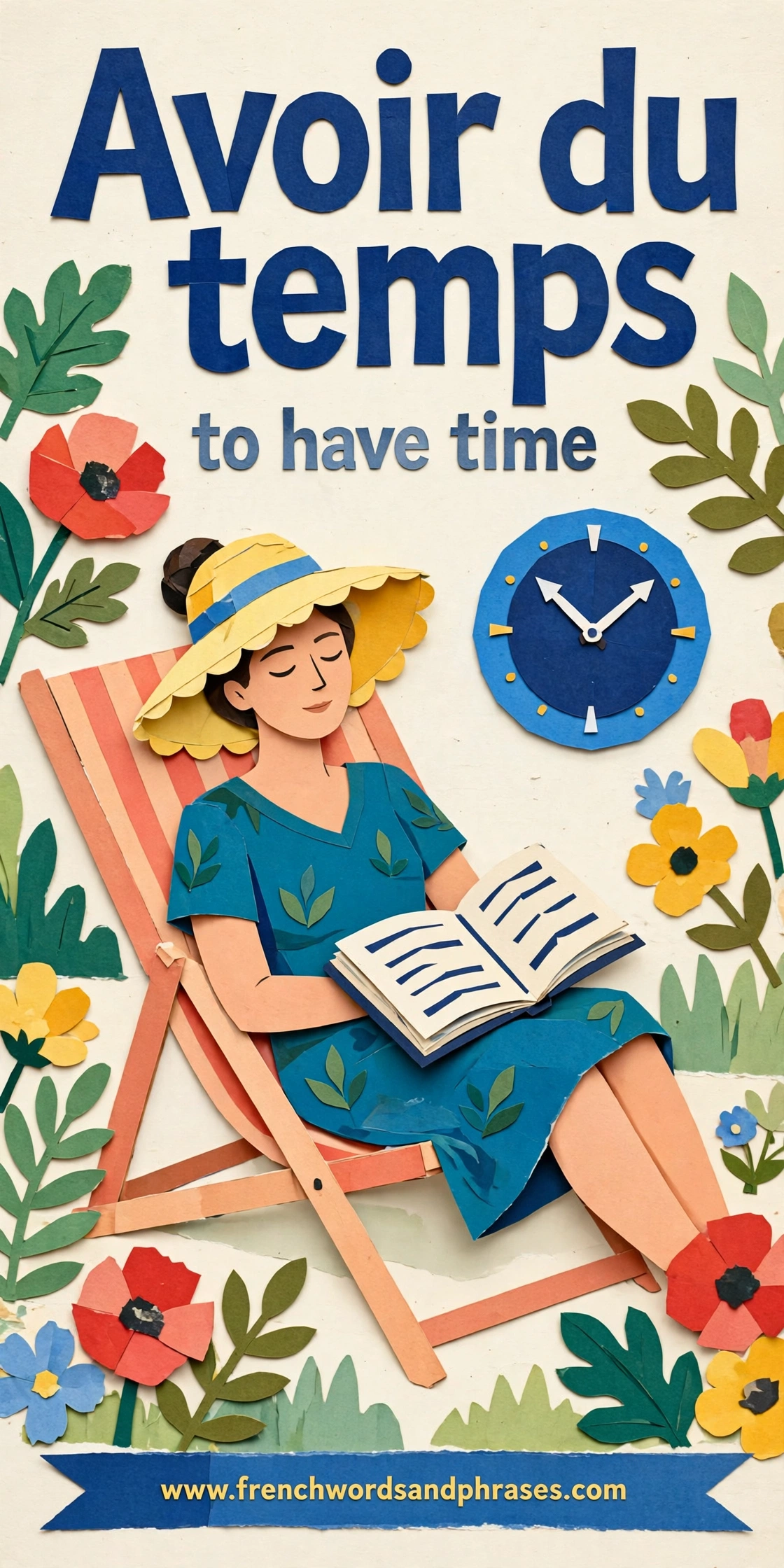
Avoir du temps means to have time — to have hours or minutes free, not already spoken for.
A café terrace, four in the afternoon, nowhere to be until seven. Your friend closes her notebook, stretches, and says the sentence that makes the whole afternoon feel like a gift: « J’ai du temps, pour une fois. »
Let’s explore how avoir du temps works in French, beginning with the whole phrase on one card.
Understanding the French Phrase Avoir du temps
Avoir du temps is a French expression built from avoir (to have), du (some — the partitive article) and le temps (time, a masculine noun). The du is the heart of it: you never have all of time, you have some of it — a portion of the day that belongs to you.
It means to have time — free time, available time, time that is yours to spend. Nobody owns the clock: French simply says that a slice of the day sits in your hands. With a place or a person attached it grows warmer: avoir du temps pour soi, time for yourself; avoir du temps à perdre, time to waste.
Type: Everyday expression — time (avoir + du + temps)
Answers the need: Saying you are free, unhurried, or available
Register: Neutral — everywhere, in speech and writing
Strength: Calm — it states a fact about your day, not a boast
One important usage detail: the partitive du survives in the negative only by shrinking to de — je n’ai pas de temps, I have no time. The same shrinking happens after adverbs: peu de temps, trop de temps, beaucoup de temps. But plain avoir du temps keeps its du, and the clock keeps its portion.
Experience the Word
Avoir du temps is the rarest sentence of modern life — and French phrases it as a possession, something you can hold, give and share.
Imagine a grandfather with a whole Sunday and a grandson with a fishing rod. He does not check a phone; he simply has the day, the way his own grandfather had it. The phrase is old and unhurried, and saying it slows the room down a little.
English asks whether you have time, as if time were money in a pocket. French agrees — and then spends it more slowly.
How to Use Avoir du temps in French: Complete Guide
Let’s explore how avoir du temps works in French, beginning with the whole phrase on one card.
Avoir du temps at a Glance
The Whole Phrase on One Card
Real meaning, literal picture, English twin and register — avoir du temps in five lines.
| Point | Avoir du temps |
|---|---|
| What it really means | to have time — free, available time in your day |
| Word for word | to have some time — du is the partitive, a portion of time |
| English equivalent | to have time / to have some time on your hands |
| Register | neutral — safe everywhere |
| Use it for | saying you are free, offering help, planning without hurry |
Example
J’ai du temps cet après-midi, je peux t’aider.
I have time this afternoon, I can help you.
Word by Word: Building the Free Hour
Three small pieces — take them one by one and the day opens up.
| Word | Literal meaning | Its job in the phrase |
|---|---|---|
| avoir | to have | the verb that holds the hours — j’ai, tu as, il a |
| du | some, of the | the partitive article: a portion of time, never all of it |
| temps | time | a masculine noun — le temps, also the word for weather |
Example
Tu as du temps demain matin ?
Do you have time tomorrow morning?
Quick Quiz 1
Why du temps and not le temps?
Reveal the answer
Because you have a portion of it — du is the partitive: some time, a slice of the day. Le temps would be time itself, the whole river.
Le temps passe, mais aujourd’hui j’ai du temps.
Time passes, but today I have time.
When You Say It: The Unhurried Moments
Avoir du temps fires at moments like these — wherever a gap opens in the day and you mean to use it well.
| Situation | Example |
|---|---|
| Offering help | j’ai du temps, je t’aide — I have time, I’ll help you |
| Weekend plans | ce week-end, nous avons du temps — this weekend, we have time |
| For yourself | avoir du temps pour soi — to have time for yourself |
| Retirement | à la retraite, on a du temps — in retirement, you have time |
| No hurry | prends ton temps, j’ai du temps — take your time, I have time |
Example
Enfin les vacances : nous avons du temps pour lire.
Holidays at last: we have time to read.
Make It Yours: Time for Every Person
Avoir conjugates — and the negative shrinks du to de.
| Form | French | In English |
|---|---|---|
| I have time | j’ai du temps | I have time |
| You have time | tu as du temps | you have time |
| She has time | elle a du temps | she has time |
| We have time | nous avons du temps | we have time |
| No time | je n’ai pas de temps | I have no time |
| The question | vous avez du temps ? | do you have time? |
Example
Elle a du temps le jeudi, pas le lundi.
She has time on Thursdays, not Mondays.
Quick Quiz 2
‘I have no time’: je n’ai pas du temps or je n’ai pas de temps?
Reveal the answer
Je n’ai pas de temps — after pas, the partitive du shrinks to de.
Désolé, je n’ai pas de temps aujourd’hui.
Sorry, I have no time today.
Everyday Expressions: Building on the Free Hour
Avoir du temps slots into these everyday frames — each one ready to use as it stands.
| Frame | In English |
|---|---|
| avoir du temps pour soi | to have time for yourself |
| avoir du temps à perdre | to have time to waste — often a warning: je n’ai pas de temps à perdre |
| avoir le temps de faire quelque chose | to have the time to do something — with le, the specific time needed |
| avoir tout son temps | to have all the time in the world |
| manquer de temps | to be short of time — the worried opposite |
Example
Je n’ai pas de temps à perdre, allons-y.
I have no time to waste, let’s go.
Close Cousins: The Other Ways to Have a Day
French has a whole shelf of time phrases — avoir du temps is the calm one; its cousins hurry, kill or take the hours.
| Expression | The difference |
|---|---|
| avoir du temps | to have time — a portion of the day is yours |
| avoir le temps de | to have the time to do something — the definite le points at the specific task |
| prendre le temps de | to take the time to — a deliberate choice, slower and kinder |
| passer le temps | to pass the time — filling the hours, sometimes out of boredom |
| tuer le temps | to kill time — the bored version, waiting for something better |
Example
Prenez le temps de déjeuner, vous avez du temps.
Take the time to have lunch, you have time.
Quick Quiz 3
Which cousin is the bored one — passer le temps or tuer le temps?
Reveal the answer
Tuer le temps — to kill time is what you do when the hours are an enemy. Passer le temps is gentler.
Dans la salle d’attente, il tue le temps avec un magazine.
In the waiting room, he kills time with a magazine.
Avoir du temps and Its Neighbours
The clock shelf around the phrase — the hours, the hurry and the rest.
| French | In English |
|---|---|
| une heure | an hour |
| être pressé | to be in a hurry |
| être libre | to be free, available |
| les vacances | the holidays |
| se reposer | to rest |
| un emploi du temps | a timetable, a schedule |
Example
Son emploi du temps est plein, mais le dimanche il a du temps.
His schedule is full, but on Sundays he has time.
Watch Out: The Traps Around Avoir du temps
The traps: a partitive that vanishes, a definite article that changes the sense, and a noun that is also the weather.
| Trap | The truth |
|---|---|
| the vanishing du | after pas, peu, trop, beaucoup, du becomes de: peu de temps, pas de temps |
| du vs le | avoir du temps = to have some time free; avoir le temps de = to have the time needed for a specific thing |
| temps is also weather | quel temps fait-il ? asks about the sky, not the clock — context decides |
| not a calque of English | never j’ai un temps — French portions time with du, like bread and water |
Example
Il fait beau temps, et j’ai du temps : journée parfaite.
The weather is fine, and I have time: a perfect day.
Quick Quiz 4
True or false: quel temps fait-il ? asks what time it is.
Reveal the answer
False — it asks about the weather. For the clock, ask il est quelle heure ?
Quel temps fait-il chez vous en hiver ?
What is the weather like at yours in winter?
Avoir du temps in Everyday French: Real-Life Examples
Now that you know the word, let’s see how avoir du temps appears in everyday French.
Example 1 — On the terrace
Assieds-toi, j’ai du temps, raconte-moi tout.
Sit down, I have time, tell me everything.
Example 2 — Offering help
Tu as du temps pour m’aider à déménager ?
Do you have time to help me move?
Example 3 — The weekend
Ce week-end, nous avons enfin du temps pour nous.
This weekend, we finally have time for ourselves.
Example 4 — No time
Je suis désolé, je n’ai pas de temps cette semaine.
I am sorry, I have no time this week.
Example 5 — Retirement
Depuis sa retraite, il a du temps pour son jardin.
Since retiring, he has time for his garden.
Example 6 — A little time
Elle a peu de temps, mais elle viendra.
She has little time, but she will come.
Beyond Translation: The Meaning of Avoir du temps
English and French agree that time is something you have — but French measures it out with the partitive, the same grammar it uses for bread, water and wine: du temps, a portion, a helping.
To avoir du temps is to be served a slice of the day and to sit down to it properly.
Nobody at the table asks for the whole loaf. A slice, eaten slowly, is the entire philosophy.
How to Remember the French Phrase Avoir du temps
Remember it this way: Avoir du temps is the day served by the slice — du is the partitive, and you never ask for the whole loaf of time.
- You portion it with du — du temps, like du pain: some, not all.
- You shrink it after negatives — pas de temps, peu de temps, trop de temps.
- You split the twins — avoir du temps is free time; avoir le temps de is the time a task needs.
The key idea is avoir du temps means to have time — a portion of the day that is yours.
Test Your Knowledge of Avoir du temps
Let’s see how much you’ve learned. Try answering these questions before revealing the answers.
Question 1
What does j’ai du temps mean?
Reveal the answer
I have time — a portion of my day is free.
Question 2
Why du and not le in avoir du temps?
Reveal the answer
Du is the partitive — you have some time, a slice of it, never time itself.
Question 3
How do you say ‘I have no time’?
Reveal the answer
Je n’ai pas de temps — after pas, du shrinks to de.
Question 4
What is the difference between avoir du temps and avoir le temps de faire quelque chose?
Reveal the answer
Du temps is free time in general; le temps de is the specific time a task requires — j’ai le temps de finir, I have time to finish.
Question 5
Complete the sentence:
Le dimanche, nous ______ du temps pour la famille. (On Sundays, we have time for the family.)
Reveal the answer
avons
Le dimanche, nous avons du temps pour la famille.
On Sundays, we have time for the family.
Your Final Challenge
Can You Use It?
How would you say this in French?
“This afternoon, I have time to help you.”
Reveal the answer
Cet après-midi, j’ai du temps pour t’aider.
This afternoon, I have time to help you.
A little French. A little curiosity. A richer everyday life.
LEARN FRENCH ONE WORD AT A TIME