A French Word to Live By
How to Conjugate Réveiller in French
/ʁe.vɛ.je/
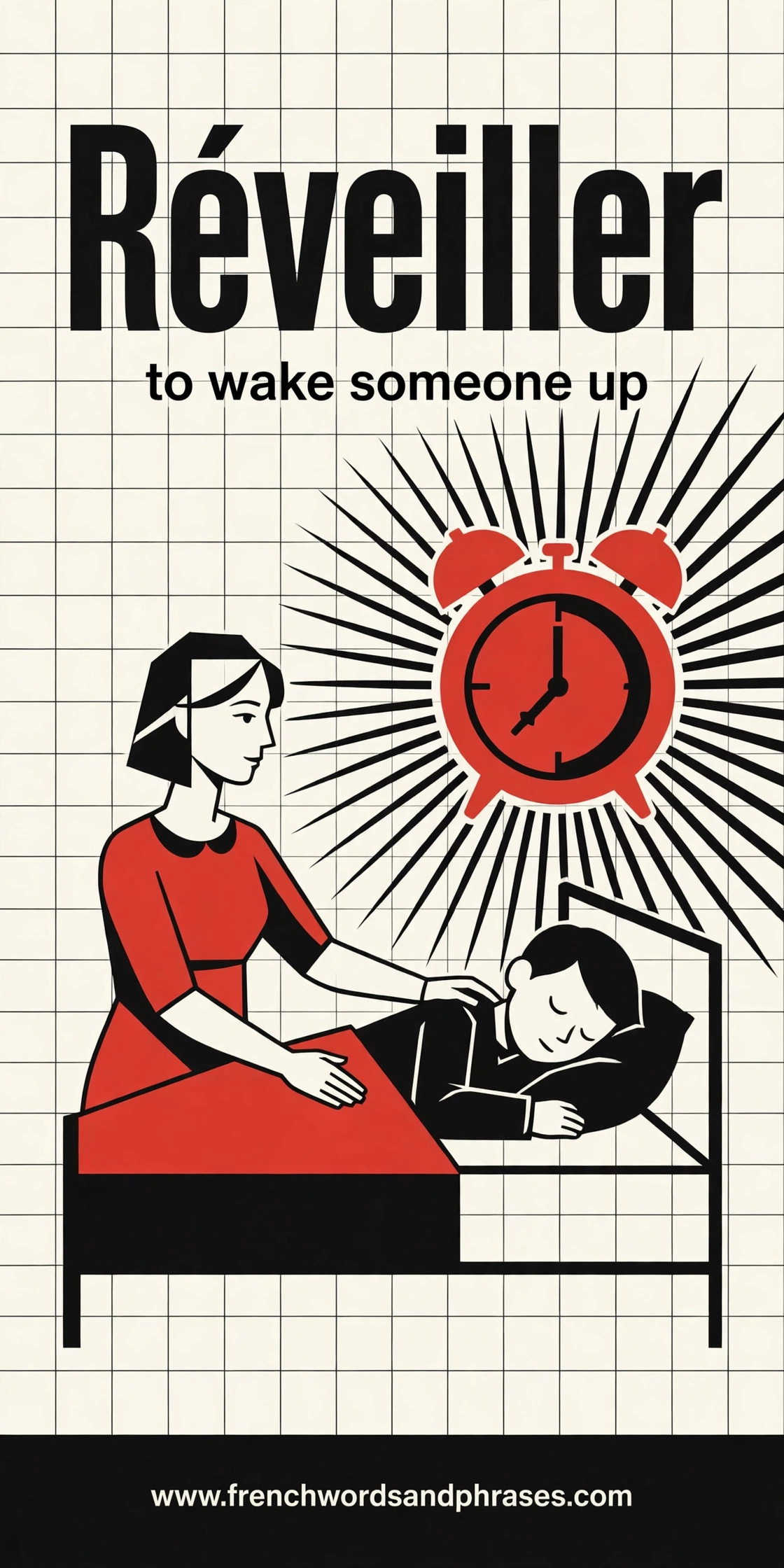
Réveiller means to wake someone up — to pull a sleeper back into the day, with an alarm clock, a noise, a smell of coffee, or a hand on the shoulder.
A cockerel shattering the farmyard silence at five, a mother calling up the stairs for the third time, an alarm clock dragging a student out of a warm bed in January — réveiller is the verb of waking others: sleep ends because someone, or something, has réveillé the sleeper.
In this guide, you’ll learn how to conjugate réveiller in all the major French tenses and moods. Explore complete conjugation tables, French examples, English translations, and practice quizzes.
Understanding the French Verb Réveiller
Réveiller is a regular French verb belonging to the first group of verbs, those ending in-er.
It means to wake someone up. Réveiller reaches beyond bedrooms: an old song réveille des souvenirs (awakens memories), a walk réveille l’appétit (whets the appetite), and pain or anger can se réveiller after years asleep. Its noun, le réveil, is both the alarm clock on the table and the great awakening of a people or a conscience.
Verb classification: First group (-er)
Auxiliary verb: Avoir
Past participle: réveillé
Present participle: réveillant
English equivalents: To wake (someone) up, to awaken; réveiller un enfant — to wake a child; réveiller quelqu’un en douceur — to wake someone gently; réveiller des souvenirs — to awaken memories; réveiller l’appétit — to whet the appetite; un réveil — an alarm clock, an awakening.
One important detail: réveiller always wakes someone else — it is transitive, and the sleeper is its object: je réveille les enfants, le bruit m’a réveillé. For your own waking, French turns the verb reflexive: je me réveille à sept heures. The pair never swaps: you cannot say je réveille at seven o’clock and mean yourself. The -ill- is pronounced like a y: réveiller sounds like ré-vè-yé, and the forms are perfectly regular.
Experience the Word
Réveiller is the verb of sleep interrupted from outside — every réveil has an author: a bird, a bell, a mother, a smell of coffee.
Imagine a farmhouse kitchen at dawn in haymaking season. The grandfather has been up since four; now he climbs the stairs with a cup of coffee in each hand, sets one down beside his sleeping grandson, and says nothing at all. The smell does the work — il réveille l’enfant sans un mot, and two minutes later the boy is at the table, hair everywhere, reaching for the bread.
No alarm, no shout, just coffee and daylight. He has woken him — il l’a réveillé — the gentlest way there is.
How to Conjugate Réveiller: Complete French Conjugation Guide
Let’s explore every major conjugation of réveiller, beginning with the indicative mood.
How to Conjugate Réveiller in the Indicative Mood
The indicative mood is used to express facts, observations, actions, and events.
How to Conjugate Réveiller in the Present Tense (Présent)
Used for actions happening now, habitual actions, and general truths.
| Subject | Conjugation |
|---|---|
| je | réveille |
| tu | réveilles |
| il / elle | réveille |
| nous | réveillons |
| vous | réveillez |
| ils / elles | réveillent |
Example
Le coq réveille tout le village à cinq heures.
The cockerel wakes the whole village at five o’clock.
Quick Quiz 1
Complete the sentence:
Nous ______ les enfants à sept heures.
Reveal the answer
réveillons
Nous réveillons les enfants à sept heures.
We wake the children at seven o’clock.
How to Conjugate Réveiller in the Passé Composé
Used for completed actions in the past. Réveiller takes the auxiliary verb avoir.
| Subject | Conjugation |
|---|---|
| j’ | ai réveillé |
| tu | as réveillé |
| il / elle | a réveillé |
| nous | avons réveillé |
| vous | avez réveillé |
| ils / elles | ont réveillé |
Example
Je l’ai réveillé en douceur à sept heures.
I woke him gently at seven o’clock.
How to Conjugate Réveiller in the Imparfait (Imperfect Tense)
Used for habitual past actions, descriptions, and ongoing situations in the past.
| Subject | Conjugation |
|---|---|
| je | réveillais |
| tu | réveillais |
| il / elle | réveillait |
| nous | réveillions |
| vous | réveilliez |
| ils / elles | réveillaient |
Example
Autrefois, le tambour réveillait les soldats à l’aube.
In the old days, the drum used to wake the soldiers at dawn.
Quick Quiz 2
Choose the correct form:
The noise woke the baby.
Le bruit ______ le bébé. (a réveillé / est réveillé)
Reveal the answer
a réveillé
Le bruit a réveillé le bébé.
Réveiller takes avoir.
How to Conjugate Réveiller in the Plus-que-parfait
Used to describe an action that had already been completed before another past event.
| Subject | Conjugation |
|---|---|
| j’ | avais réveillé |
| tu | avais réveillé |
| il / elle | avait réveillé |
| nous | avions réveillé |
| vous | aviez réveillé |
| ils / elles | avaient réveillé |
Example
Elle avait réveillé les enfants avant l’arrivée des invités.
She had woken the children before the guests arrived.
How to Conjugate Réveiller in the Passé Simple
Primarily used in formal writing, literature, and historical narratives. It is rarely used in everyday conversation.
| Subject | Conjugation |
|---|---|
| je | réveillai |
| tu | réveillas |
| il / elle | réveilla |
| nous | réveillâmes |
| vous | réveillâtes |
| ils / elles | réveillèrent |
Example
Un grand bruit réveilla toute la maison.
A loud noise woke the whole house.
How to Conjugate Réveiller in the Passé Antérieur
A literary tense used to express an action completed immediately before another past action, generally in the passé simple.
| Subject | Conjugation |
|---|---|
| j’ | eus réveillé |
| tu | eus réveillé |
| il / elle | eut réveillé |
| nous | eûmes réveillé |
| vous | eûtes réveillé |
| ils / elles | eurent réveillé |
Example
Dès qu’il eut réveillé son frère, ils partirent pêcher.
As soon as he had woken his brother, they set off to fish.
How to Conjugate Réveiller in the Future Tense (Futur Simple)
Used to describe actions that will take place in the future.
| Subject | Conjugation |
|---|---|
| je | réveillerai |
| tu | réveilleras |
| il / elle | réveillera |
| nous | réveillerons |
| vous | réveillerez |
| ils / elles | réveilleront |
Example
Demain, je te réveillerai à six heures précises.
Tomorrow, I will wake you at six o’clock sharp.
How to Conjugate Réveiller in the Futur Antérieur (Future Perfect)
Used for an action that will have been completed before a particular point in the future.
| Subject | Conjugation |
|---|---|
| j’ | aurai réveillé |
| tu | auras réveillé |
| il / elle | aura réveillé |
| nous | aurons réveillé |
| vous | aurez réveillé |
| ils / elles | auront réveillé |
Example
À l’aube, le chant des oiseaux aura réveillé les campeurs.
By dawn, the birdsong will have woken the campers.
How to Conjugate Réveiller in the Near Future (Futur Proche)
Used to describe something that is going to happen soon. Formed with aller + infinitive.
| Subject | Conjugation |
|---|---|
| je | vais réveiller |
| tu | vas réveiller |
| il / elle | va réveiller |
| nous | allons réveiller |
| vous | allez réveiller |
| ils / elles | vont réveiller |
Example
Ne fais pas de bruit, tu vas réveiller le bébé !
Do not make a noise, you are going to wake the baby!
How to Conjugate Réveiller in the Conditional Mood
The conditional mood expresses what would happen under certain circumstances. It is also frequently used to make polite requests or express wishes.
How to Conjugate Réveiller in the Present Conditional
| Subject | Conjugation |
|---|---|
| je | réveillerais |
| tu | réveillerais |
| il / elle | réveillerait |
| nous | réveillerions |
| vous | réveilleriez |
| ils / elles | réveilleraient |
Example
Je ne te réveillerais jamais pour si peu.
I would never wake you for so little.
How to Conjugate Réveiller in the Past Conditional
| Subject | Conjugation |
|---|---|
| j’ | aurais réveillé |
| tu | aurais réveillé |
| il / elle | aurait réveillé |
| nous | aurions réveillé |
| vous | auriez réveillé |
| ils / elles | auraient réveillé |
Example
Elle aurait réveillé tout l’immeuble avec sa musique.
She would have woken the whole building with her music.
Réveiller in the Literary Past Conditional Form
This less common literary form uses the imperfect subjunctive of avoir.
| Subject | Conjugation |
|---|---|
| j’ | eusse réveillé |
| tu | eusses réveillé |
| il / elle | eût réveillé |
| nous | eussions réveillé |
| vous | eussiez réveillé |
| ils / elles | eussent réveillé |
Example
Le canon eût réveillé les morts, cette nuit-là.
The cannon would have woken the dead, that night.
How to Conjugate Réveiller in the Subjunctive Mood
The subjunctive is used to express wishes, emotions, doubts, necessity, and uncertainty. It frequently follows expressions such as il faut que (it is necessary that) or bien que (although).
How to Conjugate Réveiller in the Present Subjunctive
| Subject | Conjugation |
|---|---|
| que je | réveille |
| que tu | réveilles |
| qu’il / qu’elle | réveille |
| que nous | réveillions |
| que vous | réveilliez |
| qu’ils / qu’elles | réveillent |
Example
Il faut que je réveille les enfants à l’heure.
I must wake the children on time.
Quick Quiz 3
Complete the sentence using the subjunctive:
Elle parle bas pour que rien ne ______ le bébé.
Reveal the answer
réveille
Elle parle bas pour que rien ne réveille le bébé.
She speaks quietly so that nothing wakes the baby.
How to Conjugate Réveiller in the Imperfect Subjunctive
A literary tense, rarely encountered in modern spoken French.
| Subject | Conjugation |
|---|---|
| que je | réveillasse |
| que tu | réveillasses |
| qu’il / qu’elle | réveillât |
| que nous | réveillassions |
| que vous | réveillassiez |
| qu’ils / qu’elles | réveillassent |
Example
Elle parlait bas pour que rien ne réveillât le bébé.
She spoke quietly so that nothing would wake the baby.
How to Conjugate Réveiller in the Pluperfect Subjunctive
A literary construction used to express an action completed before another past action.
| Subject | Conjugation |
|---|---|
| que j’ | eusse réveillé |
| que tu | eusses réveillé |
| qu’il / qu’elle | eût réveillé |
| que nous | eussions réveillé |
| que vous | eussiez réveillé |
| qu’ils / qu’elles | eussent réveillé |
Example
On craignait que le tonnerre n’eût réveillé les enfants.
People feared the thunder had woken the children.
How to Conjugate Réveiller in the Past Subjunctive
| Subject | Conjugation |
|---|---|
| que j’ | aie réveillé |
| que tu | aies réveillé |
| qu’il / qu’elle | ait réveillé |
| que nous | ayons réveillé |
| que vous | ayez réveillé |
| qu’ils / qu’elles | aient réveillé |
Example
Je suis désolé que ce bruit vous ait réveillés.
I am sorry this noise woke you.
How to Conjugate Réveiller in the Imperative
The imperative is used to give commands, instructions, invitations, or suggestions. Subject pronouns are omitted.
How to Conjugate Réveiller in the Present Imperative
| Person | Conjugation |
|---|---|
| (tu) | réveille |
| (nous) | réveillons |
| (vous) | réveillez |
Example
Réveille ton frère, le petit-déjeuner est prêt !
Wake your brother up, breakfast is ready!
Quick Quiz 4
How would you say Wake your brother up (tu form)?
Reveal the answer
Réveille ton frère !
French Participles of Réveiller
Participles are verb forms that can be used in compound tenses and other grammatical constructions.
Present Participle of Réveiller
réveillant
En réveillant les enfants tôt, elle a gagné une heure de calme.
By waking the children early, she gained an hour of calm.
Past Participle of Réveiller
réveillé
Réveillés en pleine nuit, les enfants ont cru à un rêve.
Woken in the middle of the night, the children thought it was a dream.
Réveiller in Everyday French: Real-Life Examples
Now that you know the conjugations, let’s see how réveiller appears in everyday French.
Example 1 — Present
Le coq réveille tout le village.
The cockerel wakes the whole village.
Example 2 — Passé composé
Je l’ai réveillé à sept heures.
I woke him at seven o’clock.
Example 3 — Imparfait
Le tambour réveillait les soldats à l’aube.
The drum used to wake the soldiers at dawn.
Example 4 — Future
Je te réveillerai à six heures.
I will wake you at six o’clock.
Example 5 — Conditional
Je ne te réveillerais jamais pour si peu.
I would never wake you for so little.
Example 6 — Imperative
Réveille ton frère !
Wake your brother up!
Beyond Translation: The Meaning of Réveiller
Réveiller is éveiller (to awaken) with the prefix re-, again — sleep’s opposite, done to someone once more each morning; behind it stands Latin vigilare, to keep watch, the root of English vigil and surveillance.
The watcher wakes the sleeper.
That is the verb’s whole story: someone was awake — the cockerel, the mother, the grandfather with the coffee — and their wakefulness, passed on, becomes yours.
How to Remember the French Verb Réveiller
Remember it this way: Réveiller is about the grandfather on the stairs at dawn, waking his grandson with the smell of coffee.
- Réveiller wakes SOMEONE ELSE: je réveille les enfants. For yourself, the reflexive: je me réveille.
- Le réveil is the alarm clock — and also any great awakening.
- Regular -er with the -ill- pronounced like a y: je réveille, nous réveillons, past participle réveillé.
The key idea is the grandfather on the stairs at dawn, waking his grandson with the smell of coffee.
Test Your Knowledge of Réveiller
Let’s see how much you’ve learned. Try answering these questions before revealing the answers.
Question 1
How do you say I wake up at seven, and why can réveiller not be used alone there?
Reveal the answer
Je me réveille à sept heures — réveiller alone wakes someone else; waking yourself takes the reflexive se réveiller.
Question 2
How do you say The cockerel wakes the whole village in French?
Reveal the answer
Le coq réveille tout le village.
Question 3
Translate: I woke him gently at seven o’clock.
Reveal the answer
Je l’ai réveillé en douceur à sept heures.
Question 4
What is the past participle of réveiller?
Reveal the answer
Réveillé.
Question 5
Complete the sentence:
Il faut que je ______ les enfants à l’heure.
Reveal the answer
réveille
Il faut que je réveille les enfants à l’heure.
I must wake the children on time.
Your Final Challenge
Can You Use It?
How would you say this in French?
The cockerel wakes the village, the sun wakes the fields, and the day begins for everyone.
Reveal the answer
Le coq réveille le village, le soleil réveille les champs, et la journée commence pour tous.
The cockerel wakes the village, the sun wakes the fields, and the day begins for everyone.
A little French. A little curiosity. A richer everyday life.
LEARN FRENCH ONE WORD AT A TIME