A French Word to Live By
Translate Édifice to English
/e.di.fis/
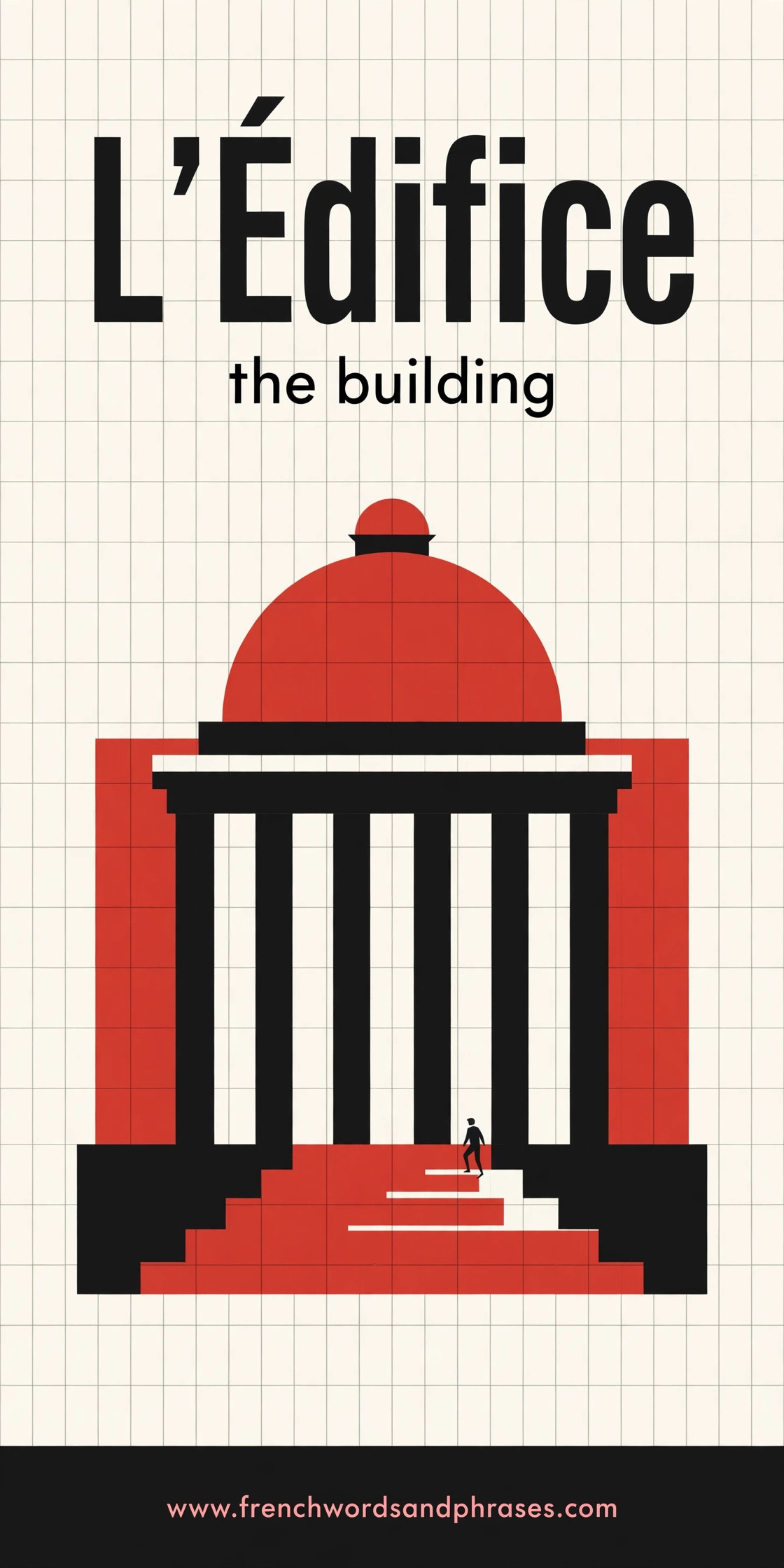
L’édifice means the building.
The guide stops the group at the corner and points up: « Regardez cet édifice — trois siècles d’histoire dans une seule façade. » Grand, solemn, built to last — l’édifice is no ordinary building.
In this guide, you’ll learn what édifice means in English, how to use it with its articles, how to form its plural, and how it appears in everyday French. Explore French examples, English translations, and practice quizzes.
Understanding the French Noun Édifice
Édifice is a masculine French noun. Because it begins with a vowel, the article shrinks: l’édifice, un édifice. It is a grander word than un bâtiment — an édifice is a large, imposing building, often public: a cathedral, a palace, a ministry. The plural is les édifices.
It means a building — but a monumental one. You use édifice for the great constructions of a city: un édifice religieux (a church or cathedral), un édifice public, les édifices historiques of Paris. French also uses it figuratively, for any great constructed system: un édifice de mensonges, an edifice of lies, which can s’effondrer — collapse — like a real one.
Gender: Masculine — l’édifice, un édifice
Article: l’ — the word begins with a vowel, so le becomes l’
Plural: les édifices
Register: Grand and formal — grander than un bâtiment (a building)
Figurative sense: any vast constructed system: un édifice de mensonges
English equivalents: The building, the edifice.
One useful usage detail: for an ordinary house or block of flats, French says un bâtiment or un immeuble — save édifice for buildings with presence and history. Calling a garden shed un édifice would raise a smile; calling a cathedral un bâtiment would sound flat. The word itself is a small act of respect.
Experience the Word
Édifice is architecture with its chin up. It is the building that was meant to outlive its builders — stone laid on stone by people who knew they would never see the roof finished.
Imagine the cathedral builders: a grandfather cuts the first stones, his grandson sets the last — the édifice rises above both their lives, indifferent and magnificent.
You have not just seen a building. You have stood before l’édifice — three centuries looking back at you.
How to Use Édifice in French: Complete Guide
Let’s explore how édifice works in French, beginning with its articles — and watch le shrink to l’ before the opening vowel.
Édifice with the Definite Article (L’, Les)
Édifice begins with a vowel, so le becomes l’ — l’édifice, the building everyone knows.
| Form | French |
|---|---|
| Masculine singular | l’édifice |
| Plural | les édifices |
Example
L’édifice domine la place depuis le Moyen Âge.
The building has dominated the square since the Middle Ages.
Édifice with the Indefinite Article (Un, Des)
Used for a grand building in general — un édifice, des édifices.
| Form | French |
|---|---|
| Masculine singular | un édifice |
| Plural | des édifices |
Example
Un édifice du dix-septième siècle se dresse au bout de la rue.
A seventeenth-century edifice stands at the end of the street.
Édifice with Quantities (Un ensemble d’…)
Édifices are countable monuments, so French counts and groups them rather than taking « some » of them.
| Quantity | French |
|---|---|
| some edifices | des édifices |
| a group of edifices | un ensemble d’édifices |
| many edifices | beaucoup d’édifices |
| a single edifice | un seul édifice |
| all the edifices | tous les édifices |
Example
Un ensemble d’édifices anciens entoure la cathédrale.
A group of old edifices surrounds the cathedral.
Quick Quiz 1
Complete the sentence:
______ édifice a été construit en 1680. (This)
Reveal the answer
Cet
Cet édifice a été construit en 1680.
This edifice was built in 1680 — cet, not ce, before a vowel.
The Plural of Édifice
Édifice adds an -s in the plural — les édifices, the monuments of a city.
| Number | French |
|---|---|
| Singular | l’édifice |
| Plural | les édifices |
Example
Les édifices historiques de la ville attirent des milliers de visiteurs.
The town’s historic buildings attract thousands of visitors.
Édifice with Possessive Adjectives (Mon, Ton, Son…)
Possessives agree with the noun — édifice is masculine, so it takes mon, ton, son (which also flow smoothly into the vowel).
| Owner | French |
|---|---|
| my | mon édifice |
| your (tu) | ton édifice |
| his / her | son édifice |
| our | notre édifice |
| your (vous) | votre édifice |
| their | leur édifice |
Example
Chaque époque a laissé son édifice à la ville.
Every age has left its edifice to the city.
Quick Quiz 2
Complete the sentence:
______ édifices publics sont ouverts aux visites ce week-end. (Our)
Reveal the answer
Nos
Nos édifices publics sont ouverts aux visites ce week-end.
Our public buildings are open for visits this weekend.
Édifice with Demonstrative Adjectives (Cet, Ces)
Used to point: cet édifice — cet, the special form for masculine nouns beginning with a vowel.
| Form | French |
|---|---|
| Masculine singular | cet édifice |
| Plural | ces édifices |
Example
Cet édifice religieux date du douzième siècle.
This religious edifice dates from the twelfth century.
Édifice with Adjectives
Adjectives agree with édifice — masculine, and mostly placed after the noun.
| Adjective | With Édifice |
|---|---|
| ancien (old) | un édifice ancien |
| imposant (imposing) | un édifice imposant |
| public (public) | un édifice public |
| religieux (religious) | un édifice religieux |
| magnifique (magnificent) | un édifice magnifique |
Example
Un édifice imposant se dresse au centre de la place.
An imposing edifice stands in the centre of the square.
Quick Quiz 3
Complete the sentence:
C’est un édifice très ______. (imposing)
Reveal the answer
imposant
C’est un édifice très imposant.
It is a very imposing edifice — masculine, so imposant, not imposante.
Everyday Expressions with Édifice
Cathedrals, collapses and contributions — the édifice phrases of daily life.
| Expression | In English |
|---|---|
| un édifice public | a public building |
| un édifice religieux | a religious building, a church |
| l’édifice s’effondre | the edifice collapses (also figuratively) |
| un édifice de mensonges | an edifice of lies |
| apporter sa pierre à l’édifice | to play your part, to contribute |
| un édifice classé | a listed building |
Example
Chacun apporte sa pierre à l’édifice, à sa manière.
Everyone contributes to the edifice, in their own way.
Words from the Same Family as Édifice
Building, builders and building up — the words that travel with édifice.
| French | In English |
|---|---|
| édifier | to build, to erect; to edify |
| le bâtiment | the building (everyday word) |
| l’immeuble | the block of flats, the building |
| la façade | the façade, the front |
| construire | to build, to construct |
| s’effondrer | to collapse |
Example
On a édifié cet édifice pour célébrer la victoire.
This edifice was erected to celebrate the victory.
Quick Quiz 4
What does « apporter sa pierre à l’édifice » mean?
Reveal the answer
To play your part, to make your contribution — to bring your stone to the great building everyone is raising together.
Pour ce projet, chacun apporte sa pierre à l’édifice.
For this project, everyone is doing their bit.
Édifice in Everyday French: Real-Life Examples
Now that you know the word, let’s see how édifice appears in everyday French.
Example 1 — Sightseeing
Cet édifice est le plus ancien de la ville.
This building is the oldest in the town.
Example 2 — A guided tour
L’édifice que vous voyez date du Moyen Âge.
The edifice you can see dates from the Middle Ages.
Example 3 — In the news
Un vieil édifice s’est effondré dans le centre-ville.
An old building collapsed in the town centre.
Example 4 — Working together
Merci à tous ceux qui ont apporté leur pierre à l’édifice.
Thank you to everyone who played their part.
Example 5 — Architecture
Les édifices de Paris racontent mille ans d’histoire.
The buildings of Paris tell a thousand years of history.
Example 6 — A white lie grows
Son petit mensonge est devenu un véritable édifice.
His little lie became a veritable edifice.
Beyond Translation: The Meaning of Édifice
Édifice comes from the Latin aedificium, a building — and its verb, édifier, kept a second meaning in French: to edify, to build someone up morally. The two senses still lean on each other: a great édifice is meant to lift the people who look at it. That is why the figurative uses cut so deep — an édifice de mensonges is a lie built like a cathedral, and when it s’effondre, it falls like one too.
To say édifice is to give a building its full dignity.
It evokes cathedrals and ministries, scaffolding and centuries — and the quiet idea that everything worth having, from a city to a reputation, is built stone by stone.
How to Remember the French Noun Édifice
Remember it this way: Édifice is masculine and begins with a vowel — l’édifice — and it is the grand word for a building, not the everyday one.
- You point at the cathedral — cet édifice, this edifice.
- You do your bit — apporter sa pierre à l’édifice.
- You mean an ordinary block — un bâtiment, not un édifice.
The key idea is l’édifice — the building with dignity.
Test Your Knowledge of Édifice
Let’s see how much you’ve learned. Try answering these questions before revealing the answers.
Question 1
Is édifice masculine or feminine?
Reveal the answer
Masculine — l’édifice, un édifice (l’ because it begins with a vowel).
Question 2
What is the everyday word for a building?
Reveal the answer
Un bâtiment — édifice is the grand, formal word, for monuments and great public buildings.
Question 3
Translate: This edifice is very imposing.
Reveal the answer
Cet édifice est très imposant.
Question 4
What does l’édifice s’effondre mean, figuratively?
Reveal the answer
The whole construction collapses — a system of lies, an empire, a plan, falling apart like a building.
Question 5
Complete the sentence:
______ édifices entourent la place. (These)
Reveal the answer
Ces
Ces édifices entourent la place.
These edifices surround the square.
Your Final Challenge
Can You Use It?
How would you say this in French?
“Everyone brings their stone to the edifice.”
Reveal the answer
Chacun apporte sa pierre à l’édifice.
Everyone brings their stone to the edifice.
A little French. A little curiosity. A richer everyday life.
LEARN FRENCH ONE WORD AT A TIME