A French Word to Live By
Translate Verre to English
/vɛʁ/
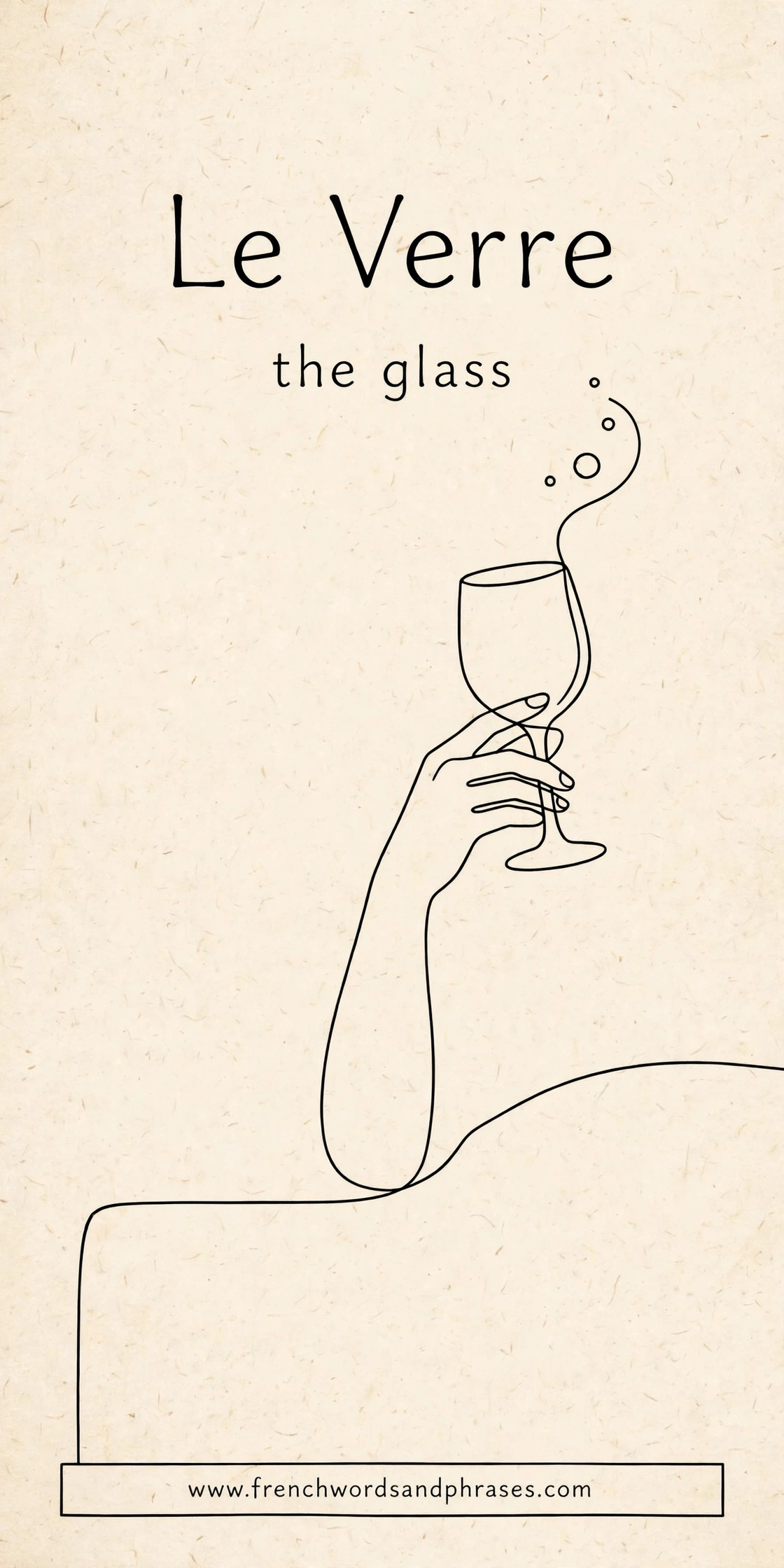
Le verre means the glass.
The waiter sets down a tray that catches the light — water sparkling, wine glowing ruby, every glass singing faintly as it lands: « Voici vos verres ! » Fragile, transparent and everywhere — le verre.
In this guide, you’ll learn what verre means in English, how to use it with its articles, how to form its plural, and how it appears in everyday French. Explore French examples, English translations, and practice quizzes.
Understanding the French Noun Verre
Verre is a masculine French noun, learned with its article: le verre, un verre. It covers three things at once: the material glass, the drinking glass, and the lens in your spectacles. Its plural is les verres — and beware, it sounds exactly like vert (green), vers (towards) and un ver (a worm).
It means glass in all its everyday forms. As a material: une bouteille en verre, a glass bottle. As an object: un verre d’eau, a glass of water — the glass and its contents in one phrase. And on your nose: des verres correcteurs are corrective lenses, and des verres de contact are contact lenses.
Gender: Masculine — le verre, un verre
Plural: les verres
Three senses: the material, the drinking glass, the lens
Sounds like: vert (green), vers (towards), un ver (a worm) — context decides
A glass of…: un verre d’eau, un verre de vin — the contents come with it
English equivalents: The glass; a glass (of water, of wine); a lens.
One golden usage detail: to invite someone for a drink, French says boire un verre — literally to drink a glass. « On va boire un verre ? » is the classic friendly invitation, and nobody expects you to drink the glass itself. The same trick gives you lever son verre, to raise your glass in a toast.
Experience the Word
Verre is the most social material in the house. It is the clink of a toast, the sparkle of the table, the window between you and the world — transparent, fragile, and trusted with everything from water to celebration.
Imagine the toast at a family dinner: every glass raised, catching the candlelight, forty voices saying « Santé ! » — for one second the whole room is made of light and verre.
You have not just held a glass. You have raised le verre — and drunk to someone’s health.
How to Use Verre in French: Complete Guide
Let’s explore how verre works in French, beginning with its articles — one masculine noun for the material, the drink and the lens.
Verre with the Definite Article (Le, Les)
Le verre for the material or a particular glass; les verres for glasses — or for lenses.
| Form | French |
|---|---|
| Masculine singular | le verre |
| Plural | les verres |
Example
Le verre est fragile, pose-le doucement sur la table.
Glass is fragile; put it down gently on the table.
Verre with the Indefinite Article (Un, Des)
Un verre is a glass — and with de after it, the drink inside it too.
| Form | French |
|---|---|
| Masculine singular | un verre |
| Plural | des verres |
Example
Je te sers un verre de jus d’orange ?
Shall I pour you a glass of orange juice?
Verre with the Partitive (Du verre)
As a material, verre takes the partitive: du verre, some glass — molten, recycled, broken.
| Quantity | French |
|---|---|
| some glass (material) | du verre |
| a piece of glass | un morceau de verre |
| broken glass | du verre brisé |
| a lot of glass | beaucoup de verre |
| a glass of wine | un verre de vin |
Example
Il y a du verre brisé sur le trottoir, attention aux chiens.
There is broken glass on the pavement; mind the dogs.
Quick Quiz 1
Complete the sentence:
Elle a renversé ______ verre d’eau sur la nappe. (her)
Reveal the answer
son
Elle a renversé son verre d’eau sur la nappe.
She knocked over her glass of water on the tablecloth — son, because verre is masculine.
The Plural of Verre
Verre adds an -s in the plural — les verres, glasses on the table or lenses in your glasses.
| Number | French |
|---|---|
| Singular | le verre |
| Plural | les verres |
Example
Les verres de ses lunettes sont tout embués.
The lenses of her glasses are all steamed up.
Verre with Possessive Adjectives (Mon, Ton, Son…)
Possessives agree with the noun — verre is masculine, so it takes mon, ton, son.
| Owner | French |
|---|---|
| my | mon verre |
| your (tu) | ton verre |
| his / her | son verre |
| our | notre verre |
| your (vous) | votre verre |
| their | leur verre |
Example
Lève ton verre, on trinque à la santé de Marie !
Raise your glass; we’re toasting Marie’s health!
Quick Quiz 2
Complete the sentence:
______ verres sont sur le plateau, prêts pour les invités. (Our)
Reveal the answer
Nos
Nos verres sont sur le plateau, prêts pour les invités.
Our glasses are on the tray, ready for the guests.
Verre with Demonstrative Adjectives (Ce, Ces)
Used to point: ce verre, this glass — the one in your hand.
| Form | French |
|---|---|
| Masculine singular | ce verre |
| Plural | ces verres |
Example
Ce verre est ébréché, prends-en un autre.
This glass is chipped; take another one.
Verre with Adjectives
Adjectives agree with verre — masculine, and mostly placed after the noun.
| Adjective | With Verre |
|---|---|
| plein (full) | un verre plein |
| vide (empty) | un verre vide |
| brisé (broken) | un verre brisé |
| grand (large) | un grand verre |
| en cristal (crystal) | un verre en cristal |
Example
Un verre vide à côté d’une assiette pleine : le repas commence.
An empty glass beside a full plate: the meal is beginning.
Quick Quiz 3
Complete the sentence:
Ce verre est ______, je vais le remplir. (empty)
Reveal the answer
vide
Ce verre est vide, je vais le remplir.
This glass is empty; I’ll fill it.
Everyday Expressions with Verre
Toasts, teacups and contact lenses — the verre phrases of daily life.
| Expression | In English |
|---|---|
| boire un verre | to have a drink |
| lever son verre | to raise your glass (in a toast) |
| un verre d’eau | a glass of water |
| une tempête dans un verre d’eau | a storm in a teacup |
| des verres de contact | contact lenses |
| le verre à moitié plein | the glass half full |
Example
On va boire un verre après le travail ?
Shall we go for a drink after work?
Words from the Same Family as Verre
Windows, glassworks and stained glass — the words that travel with verre.
| French | In English |
|---|---|
| la vitre | the windowpane |
| le vitrail | the stained-glass window |
| la verrerie | glassware; the glassworks |
| le vitrier | the glazier |
| un sous-verre | a framed picture (under glass) |
| la bouteille en verre | the glass bottle |
Example
Le vitrail de la cathédrale projette des couleurs sur le sol.
The cathedral’s stained-glass window casts colours on the floor.
Quick Quiz 4
What is « une tempête dans un verre d’eau »?
Reveal the answer
A storm in a teacup — a big fuss in a very small glass.
Tout ce bruit pour une réunion déplacée : une tempête dans un verre d’eau !
All this fuss over a moved meeting: a storm in a teacup!
Verre in Everyday French: Real-Life Examples
Now that you know the word, let’s see how verre appears in everyday French.
Example 1 — An invitation
Tu viens boire un verre à la maison ce soir ?
Are you coming for a drink at our place tonight?
Example 2 — At the table
Passe-moi un verre propre, s’il te plaît.
Pass me a clean glass, please.
Example 3 — A toast
Levons nos verres à la santé des mariés !
Let’s raise our glasses to the newlyweds’ health!
Example 4 — At the optician’s
Je dois changer les verres de mes lunettes.
I need to change the lenses in my glasses.
Example 5 — An accident
Attention, il y a un verre brisé par terre.
Careful, there’s a broken glass on the floor.
Example 6 — Half full
Lui, il voit toujours le verre à moitié plein.
He always sees the glass half full.
Beyond Translation: The Meaning of Verre
Verre is one of French’s great sound-alikes: verre, vert, vers and ver — glass, green, towards and worm — four words, one sound, endless classroom jokes. But the glass itself is serious French history: the verreries of the forests, the stained glass of Chartres, the Hall of Mirrors at Versailles. And in everyday speech the little glass holds a whole philosophy: le verre à moitié plein ou à moitié vide — your character, read in three centimetres of water.
To say verre is to raise a toast to fragile, shining things.
It evokes clinking glasses and cathedral windows, contact lenses and champagne — the material France turned into light.
How to Remember the French Noun Verre
Remember it this way: Verre is masculine — the material, the drinking glass and the lens, all in one word: le verre.
- You go for a drink — boire un verre with friends.
- You make a toast — lever son verre, raise your glass.
- You overreact — une tempête dans un verre d’eau.
The key idea is le verre — material, drink and lens in one.
Test Your Knowledge of Verre
Let’s see how much you’ve learned. Try answering these questions before revealing the answers.
Question 1
Is verre masculine or feminine?
Reveal the answer
Masculine — le verre, un verre.
Question 2
How do you invite a friend for a drink?
Reveal the answer
On va boire un verre ? — literally, shall we drink a glass?
Question 3
Translate: She is drinking a glass of water.
Reveal the answer
Elle boit un verre d’eau.
Question 4
What are des verres de contact?
Reveal the answer
Contact lenses — verre is also the word for a lens.
Question 5
Complete the sentence:
______ verre est plein de vin rouge. (My)
Reveal the answer
Mon
Mon verre est plein de vin rouge.
My glass is full of red wine.
Your Final Challenge
Can You Use It?
How would you say this in French?
“Let’s go for a drink after work.”
Reveal the answer
Allons boire un verre après le travail.
Let’s go for a drink after work.
A little French. A little curiosity. A richer everyday life.
LEARN FRENCH ONE WORD AT A TIME