A French Word to Live By
Translate Pâte to English
/pɑt/
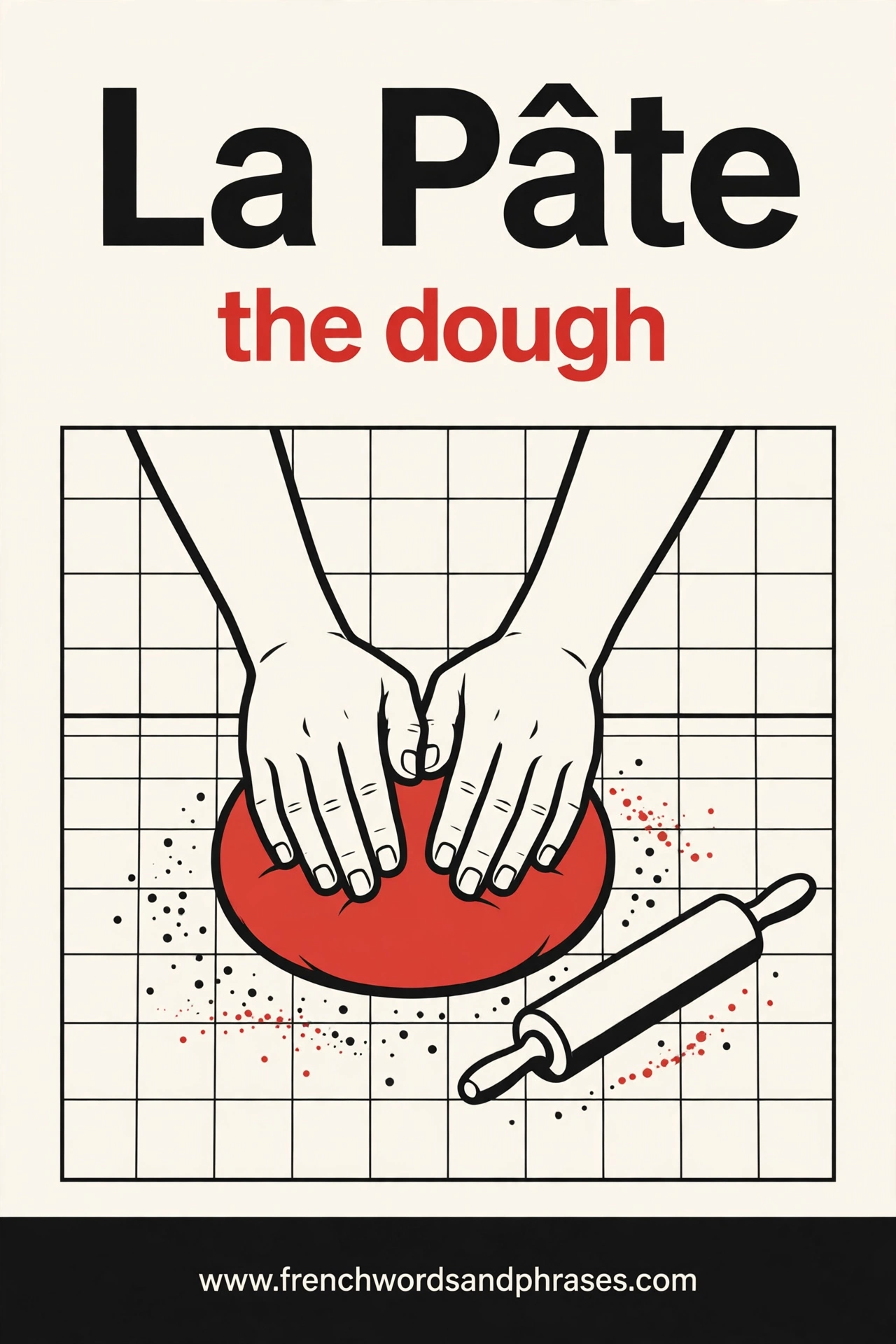
La pâte means the dough.
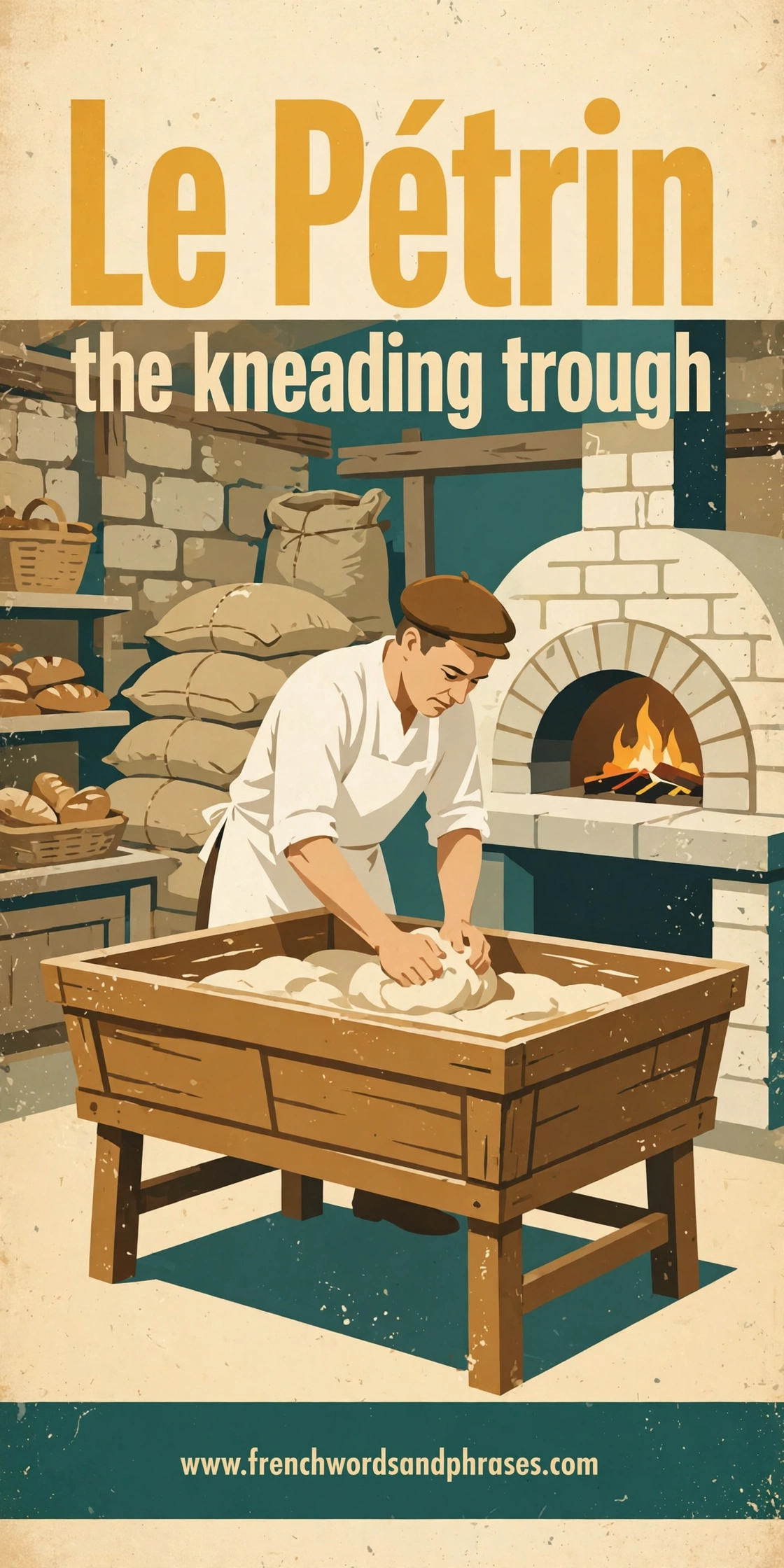
Flour on the worktop, flour on her apron, flour on the tip of her nose: the baker’s hands fold, press and turn a soft white mass that sighs under her palms — la pâte, on its way to becoming bread.
In this guide, you’ll learn what pâte means in English, how to use it with its articles, how to form its plural, and how it appears in everyday French. Explore French examples, English translations, and practice quizzes.
Understanding the French Noun Pâte
Pâte is a feminine French noun. It is learned together with its article: la pâte, une pâte. It is the great soft substance of the French kitchen — flour and water worked together — and like all substances it loves the partitive: de la pâte. In the plural it changes jobs completely: les pâtes is pasta.
It means the dough — and much more. La pâte à pain is bread dough, la pâte feuilletée puff pastry, la pâte brisée shortcrust pastry, la pâte à crêpes pancake batter. Beyond the kitchen, la pâte à modeler is modelling clay for children, and a good, kind person is praised as une bonne pâte — a good dough, soft-hearted through and through.
Gender: Feminine — la pâte, une pâte
Plural: les pâtes — which means pasta, and types of pastry
The pastry shelf: la pâte feuilletée (puff), la pâte brisée (shortcrust), la pâte sablée (sweet crumbly pastry)
Outside the kitchen: la pâte à modeler — modelling clay, play dough
A character compliment: une bonne pâte — a good sort, a kind, easy-going person
English equivalents: The dough; pastry; batter; paste.
One important usage detail: keep la pâte and le pâté apart — the little hat and the final -é change everything. La pâte is the raw dough you roll; le pâté is the finished, cooked terrine you spread. And remember the helping-hand idiom built on this word: mettre la main à la pâte, to put your hand to the dough, means to pitch in and do your share of the work.
Experience the Word
Pâte is more than an ingredient. It is the beginning of almost everything good in a French kitchen — bread, tarts, crêpes, croissants — all of them were pâte first, soft and promising under someone’s hands.
Imagine the child’s rainy afternoon: snakes and snails of pâte à modeler in red, blue and green, a whole zoo drying on the radiator.
You have not just mixed flour and water. You have made la pâte — the soft start of a hundred delicious things.
How to Use Pâte in French: Complete Guide
Let’s explore how pâte works in French, beginning with its articles — then we will roll it, fold it and put our hand to it.
Pâte with the Definite Article (La, Les)
Used for the dough everyone knows — la pâte, the one rising in the bowl.
| Form | French |
|---|---|
| Feminine singular | la pâte |
| Plural | les pâtes |
Example
La pâte lève doucement sous un torchon propre.
The dough is rising gently under a clean cloth.
Pâte with the Indefinite Article (Une, Des)
Used for a dough or pastry in general — une pâte, des pâtes.
| Form | French |
|---|---|
| Feminine singular | une pâte |
| Plural | des pâtes |
Example
Pour cette tarte, il faut une pâte fine et croustillante.
For this tart, you need a thin, crisp pastry.
Pâte with the Partitive and Kinds (De la, À…)
Dough is a substance: French takes some with de la, and names each kind with à or a pastry adjective.
| Expression | French |
|---|---|
| some dough | de la pâte |
| bread dough | la pâte à pain |
| puff pastry | la pâte feuilletée |
| shortcrust pastry | la pâte brisée |
| modelling clay | la pâte à modeler |
Example
Elle étale de la pâte sur le plan de travail fariné.
She rolls out some dough on the floured worktop.
Quick Quiz 1
Complete the sentence:
Il met ______ pâte dans un saladier et la laisse reposer. (some)
Reveal the answer
de la
Il met de la pâte dans un saladier et la laisse reposer.
He puts some dough in a bowl and leaves it to rest — de la, the partitive, for a substance.
The Plural of Pâte
Pâte adds an -s in the plural — and les pâtes leads a double life: types of pastry, and pasta itself.
| Number | French |
|---|---|
| Singular | la pâte |
| Plural | les pâtes |
Example
Les pâtes fraîches cuisent en trois minutes dans l’eau bouillante.
Fresh pasta cooks in three minutes in boiling water.
Pâte with Possessive Adjectives (Ma, Ta, Sa…)
Possessives agree with the noun: pâte is feminine, so it takes ma, ta, sa.
| Owner | French |
|---|---|
| my | ma pâte |
| your (tu) | ta pâte |
| his / her | sa pâte |
| our | notre pâte |
| your (vous) | votre pâte |
| their | leur pâte |
Example
Ma pâte à crêpes est prête, on peut commencer à les cuire.
My pancake batter is ready, we can start cooking them.
Quick Quiz 2
Complete the sentence:
______ pâte feuilletée est faite maison, c’est rare. (Her)
Reveal the answer
Sa
Sa pâte feuilletée est faite maison, c’est rare.
Her puff pastry is home-made, that’s rare.
Pâte with Demonstrative Adjectives (Cette, Ces)
Used to point: cette pâte, this dough here.
| Form | French |
|---|---|
| Feminine singular | cette pâte |
| Plural | ces pâtes |
Example
Cette pâte est trop collante, ajoute un peu de farine.
This dough is too sticky, add a little flour.
Pâte with Adjectives
Adjectives agree with pâte, feminine: molle, fine, croustillante.
| Adjective | With Pâte |
|---|---|
| molle (soft) | une pâte molle |
| fine (thin) | une pâte fine |
| croustillante (crisp) | une pâte croustillante |
| fraîche (fresh) | une pâte fraîche |
| épaisse (thick) | une pâte épaisse |
Example
Une pâte fine et croustillante fait toute la différence dans une tarte.
A thin, crisp pastry makes all the difference in a tart.
Quick Quiz 3
Complete the sentence:
La pâte doit rester très ______. (soft)
Reveal the answer
molle
La pâte doit rester très molle.
The dough must stay very soft — molle, with the feminine ending.
Everyday Expressions with Pâte
Helping hands and kind hearts — the pâte phrases of daily life.
| Expression | In English |
|---|---|
| mettre la main à la pâte | to pitch in, to lend a hand (literally: to put your hand to the dough) |
| une bonne pâte | a good sort, a kind easy-going person |
| la pâte à modeler | modelling clay, play dough |
| les pâtes fraîches | fresh pasta |
| étaler la pâte | to roll out the dough |
Example
Tout le monde met la main à la pâte pour préparer la fête.
Everyone is pitching in to prepare the party.
Words from the Same Family as Pâte
Flour, ovens and rolling pins — the words that travel with pâte.
| French | In English |
|---|---|
| la farine | the flour |
| pétrir | to knead |
| le rouleau à pâtisserie | the rolling pin |
| le pâté | the pâté, the terrine (careful: not the dough!) |
| la pâtisserie | pastry-making; the cake shop |
| le four | the oven |
Example
Elle pétrit la pâte pendant dix minutes avant de la laisser lever.
She kneads the dough for ten minutes before leaving it to rise.
Quick Quiz 4
What does mettre la main à la pâte mean?
Reveal the answer
To pitch in, to lend a hand — to do your share of the work, like a baker at the dough.
Allez, tout le monde met la main à la pâte !
Come on, everyone pitch in!
Pâte in Everyday French: Real-Life Examples
Now that you know the word, let’s see how pâte appears in everyday French.
Example 1 — In the bakery
Le boulanger pétrit la pâte dès quatre heures du matin.
The baker kneads the dough from four in the morning.
Example 2 — Making a tart
Elle étale la pâte brisée dans le moule beurré.
She rolls out the shortcrust pastry into the buttered tin.
Example 3 — Pasta night
Ce soir, on mange des pâtes fraîches à la tomate.
Tonight, we’re having fresh pasta with tomato.
Example 4 — Helping out
Viens mettre la main à la pâte, on a besoin de toi.
Come and pitch in, we need you.
Example 5 — A kind person
C’est une bonne pâte, il ne dit jamais non.
He’s a good sort, he never says no.
Example 6 — Playtime
Les enfants font des animaux en pâte à modeler.
The children are making animals out of modelling clay.
Beyond Translation: The Meaning of Pâte
La pâte is the humble beginning of French glory: before the croissant’s hundred layers, before the baguette’s crackle, there was flour, water and hands. The language knows it — to call someone une bonne pâte is to say they are made of the right soft stuff, and to demand effort from a group is to order every hand into the dough. Even childhood is shaped in it, in bright sticks of pâte à modeler.
To say pâte is to name the soft start of bread, kindness and play.
It evokes the flour-dusted worktop at dawn, the tart tin and the rolling pin, and the moment the whole family is called to put their hands in and help.
How to Remember the French Noun Pâte
Remember it this way: Pâte is the dough — feminine, la pâte; in the plural, les pâtes, it becomes pasta, and it is not le pâté.
- You knead it — la pâte à pain, dès le matin.
- You eat its plural — les pâtes, fraîches de préférence.
- You lend it your hand — mettre la main à la pâte.
The key idea is la pâte — dough, pastry and pasta; never le pâté.
Test Your Knowledge of Pâte
Let’s see how much you’ve learned. Try answering these questions before revealing the answers.
Question 1
Is pâte masculine or feminine?
Reveal the answer
Feminine — la pâte, une pâte.
Question 2
What are les pâtes?
Reveal the answer
Pasta — in the plural, pâte changes jobs: les pâtes fraîches, fresh pasta.
Question 3
Translate: She rolls out the dough.
Reveal the answer
Elle étale la pâte.
Question 4
What is the difference between la pâte and le pâté?
Reveal the answer
La pâte is the raw dough you roll and bake; le pâté is the cooked terrine you spread. The hat and the -é change everything.
Question 5
Complete the sentence:
______ pâte est trop collante. (This)
Reveal the answer
Cette
Cette pâte est trop collante.
This dough is too sticky.
Your Final Challenge
Can You Use It?
How would you say this in French?
“The baker kneads the dough early in the morning.”
Reveal the answer
Le boulanger pétrit la pâte tôt le matin.
The baker kneads the dough early in the morning.
A little French. A little curiosity. A richer everyday life.
LEARN FRENCH ONE WORD AT A TIME