A French Word to Live By
Translate Pommade to English
/pɔ.mad/
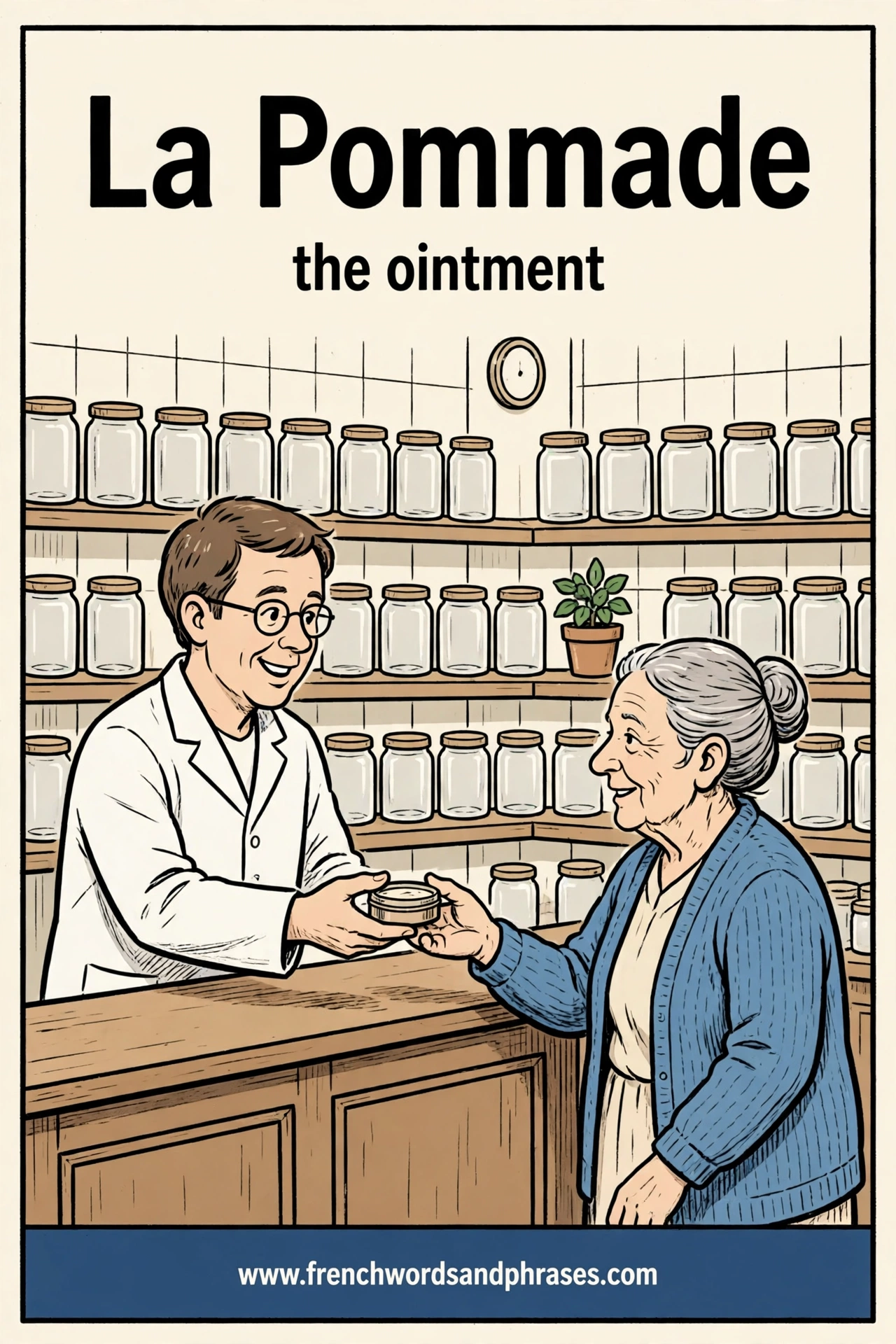
La pommade means the ointment.
The child comes in from the garden holding a scraped knee and trying not to cry. Grandmother opens the bathroom cabinet, takes down a little tube and says the sentence that fixes everything: « On va mettre de la pommade. »
In this guide, you’ll learn what pommade means in English, how to use it with its articles, how to form its plural, and how it appears in everyday French. Explore French examples, English translations, and practice quizzes.
Understanding the French Noun Pommade
Pommade is a feminine French noun. It is learned together with its article: la pommade, une pommade. A pommade is a substance, a cream you spread, so French most often meets it with the partitive: de la pommade, some ointment, a little ointment.
It means the ointment — the smooth, greasy cream you rub on skin to soothe, heal or protect: une pommade pour les brûlures (ointment for burns), une pommade cicatrisante (healing ointment), mettre de la pommade sur une piqûre (to put ointment on a sting). It lives in the pharmacy and the bathroom cabinet, in tubes and little pots, somewhere between medicine and comfort.
Gender: Feminine — la pommade, une pommade
Plural: les pommades
How it is measured: By the tube and the dab: un tube de pommade, une noisette de pommade (a pea-sized blob)
The usual article: de la pommade — the partitive, because it is a substance you spread
Old relative: l’onguent — the old-fashioned word for a healing ointment, now mostly literary
English equivalents: The ointment; a salve, a cream.
One important usage detail: pommade has a second, slippery career in French speech — passer de la pommade à quelqu’un, to spread ointment on someone, means to butter them up with flattery, and a flatterer is un passe-pommade. The image is perfect: compliments applied thickly, to make everything glide.
Experience the Word
Pommade is more than a cream. It is the smell of the bathroom cabinet of childhood — a little medicinal, a little sweet — and the cool touch that meant « it will stop hurting soon ».
Imagine the scene at the pharmacy counter: the white coat, the small tube produced like a magic trick, the instructions murmured — « matin et soir, en couche fine » — morning and evening, in a thin layer.
You have not just applied a cream. You have been soothed — apaisé, the pommade way.
How to Use Pommade in French: Complete Guide
Let’s explore how pommade works in French, beginning with its articles — and notice how a substance lives by the partitive: de la pommade.
Pommade with the Definite Article (La, Les)
Used for the ointment everyone knows — la pommade, the one in the cabinet.
| Form | French |
|---|---|
| Feminine singular | la pommade |
| Plural | les pommades |
Example
La pommade est dans l’armoire de la salle de bain.
The ointment is in the bathroom cabinet.
Pommade with the Indefinite Article (Une, Des)
Used for an ointment in general — une pommade, a type of ointment.
| Form | French |
|---|---|
| Feminine singular | une pommade |
| Plural | des pommades |
Example
Le pharmacien me conseille une pommade pour les piqûres d’insectes.
The pharmacist recommends an ointment for insect bites.
Pommade with the Partitive and Quantities (De la…)
Ointment is a substance: French takes some of it with de la, and measures it by the tube.
| Expression | French |
|---|---|
| some ointment | de la pommade |
| a tube of ointment | un tube de pommade |
| a pea-sized dab of ointment | une noisette de pommade |
| a thin layer of ointment | une couche fine de pommade |
| a healing ointment | une pommade cicatrisante |
Example
Mets de la pommade sur ton genou, ça ne piquera plus.
Put some ointment on your knee, it won’t sting any more.
Quick Quiz 1
Complete the sentence:
Elle met ______ pommade sur la brûlure. (some)
Reveal the answer
de la
Elle met de la pommade sur la brûlure.
She is putting some ointment on the burn — de la, the partitive, for a substance.
The Plural of Pommade
Pommade adds an -s in the plural — les pommades, the different kinds in the pharmacy drawer.
| Number | French |
|---|---|
| Singular | la pommade |
| Plural | les pommades |
Example
La pharmacie vend des pommades pour tous les petits bobos.
The pharmacy sells ointments for every little scrape and bump.
Pommade with Possessive Adjectives (Ma, Ta, Sa…)
Possessives agree with the noun: pommade is feminine, so it takes ma, ta, sa.
| Owner | French |
|---|---|
| my | ma pommade |
| your (tu) | ta pommade |
| his / her | sa pommade |
| our | notre pommade |
| your (vous) | votre pommade |
| their | leur pommade |
Example
Ma pommade pour les mains sent bon la lavande.
My hand ointment smells nicely of lavender.
Quick Quiz 2
Complete the sentence:
______ pommade est presque finie, il faut en racheter. (My)
Reveal the answer
Ma
Ma pommade est presque finie, il faut en racheter.
My ointment is nearly finished, I need to buy more.
Pommade with Demonstrative Adjectives (Cette, Ces)
Used to point: cette pommade, this ointment here.
| Form | French |
|---|---|
| Feminine singular | cette pommade |
| Plural | ces pommades |
Example
Cette pommade apaise les piqûres en quelques minutes.
This ointment soothes bites in a few minutes.
Pommade with Adjectives
Adjectives agree with pommade, feminine: cicatrisante, douce, grasse.
| Adjective | With Pommade |
|---|---|
| cicatrisante (healing) | une pommade cicatrisante |
| douce (gentle) | une pommade douce |
| grasse (greasy) | une pommade grasse |
| naturelle (natural) | une pommade naturelle |
| ancienne (old) | une pommade ancienne |
Example
Une pommade cicatrisante aide la petite plaie à se refermer.
A healing ointment helps the little wound to close.
Quick Quiz 3
Complete the sentence:
C’est une pommade très ______. (gentle)
Reveal the answer
douce
C’est une pommade très douce.
It is a very gentle ointment — douce, with the feminine ending.
Everyday Expressions with Pommade
Scraped knees and smooth talkers — the pommade phrases of daily life.
| Expression | In English |
|---|---|
| mettre de la pommade | to put on some ointment |
| passer de la pommade à quelqu’un | to butter someone up (literally: to spread ointment on someone) |
| un tube de pommade | a tube of ointment |
| une pommade pour les brûlures | an ointment for burns |
| en couche fine | in a thin layer |
Example
Il passe de la pommade au directeur avant de demander ses vacances.
He is buttering up the boss before asking for his holiday.
Words from the Same Family as Pommade
Creams, pharmacies and soothing — the words that travel with pommade.
| French | In English |
|---|---|
| la crème | the cream |
| l’onguent | the ointment (old-fashioned word) |
| la pharmacie | the pharmacy |
| apaiser | to soothe |
| la plaie | the wound |
| le pansement | the dressing, the plaster |
Example
Après la pommade, elle met un pansement sur le genou de l’enfant.
After the ointment, she puts a dressing on the child’s knee.
Quick Quiz 4
What does passer de la pommade à quelqu’un mean?
Reveal the answer
To butter someone up — to flatter them thickly so everything glides your way.
Il passe toujours de la pommade à la cheffe avant les réunions.
He always butters up the boss before meetings.
Pommade in Everyday French: Real-Life Examples
Now that you know the word, let’s see how pommade appears in everyday French.
Example 1 — A scraped knee
Maman met de la pommade sur le genou de son fils.
Mum puts some ointment on her son’s knee.
Example 2 — At the pharmacy
Je voudrais une pommade pour cette piqûre, s’il vous plaît.
I’d like an ointment for this bite, please.
Example 3 — Following instructions
Appliquez la pommade matin et soir, en couche fine.
Apply the ointment morning and evening, in a thin layer.
Example 4 — A compliment trap
Il lui passe de la pommade pour obtenir une augmentation.
He is buttering her up to get a pay rise.
Example 5 — In the cabinet
La pommade est à côté des pansements, dans l’armoire.
The ointment is next to the dressings, in the cabinet.
Example 6 — Soothing
Cette pommade calme les démangeaisons presque aussitôt.
This ointment calms the itching almost at once.
Beyond Translation: The Meaning of Pommade
The pommade began in the apple orchard: its name comes from pomme, the apple, because the first beauty and healing pastes were scented and softened with apple pulp. From the lady’s dressing table it travelled to the pharmacy shelf, and from there into the language of flattery — passer de la pommade, to spread someone with compliments until they shine.
To say pommade is to name comfort in a tube — and flattery at its smoothest.
It evokes the cool dab on the scraped knee, the pharmacist’s quiet authority, and the colleague whose compliments arrive, suspiciously, just before he asks a favour.
How to Remember the French Noun Pommade
Remember it this way: Pommade is the ointment — feminine, la pommade, a substance you take by the dab: de la pommade.
- You spread it — de la pommade sur la plaie.
- You measure it — un tube de pommade, une noisette à la fois.
- You flatter with it — passer de la pommade à quelqu’un.
The key idea is la pommade — de la pommade on the knee, or on the boss.
Test Your Knowledge of Pommade
Let’s see how much you’ve learned. Try answering these questions before revealing the answers.
Question 1
Is pommade masculine or feminine?
Reveal the answer
Feminine — la pommade, une pommade.
Question 2
How do you say some ointment?
Reveal the answer
De la pommade — the partitive, because ointment is a substance you spread.
Question 3
Translate: Put some ointment on the burn.
Reveal the answer
Mets de la pommade sur la brûlure.
Question 4
Where does the word pommade come from?
Reveal the answer
From pomme, the apple — the first pastes were softened and scented with apple pulp.
Question 5
Complete the sentence:
______ pommade apaise très vite. (This)
Reveal the answer
Cette
Cette pommade apaise très vite.
This ointment soothes very quickly.
Your Final Challenge
Can You Use It?
How would you say this in French?
“She puts some ointment on her knee.”
Reveal the answer
Elle met de la pommade sur son genou.
She puts some ointment on her knee.
A little French. A little curiosity. A richer everyday life.
LEARN FRENCH ONE WORD AT A TIME