A French Word to Live By
Translate Pierre to English
/pjɛʁ/
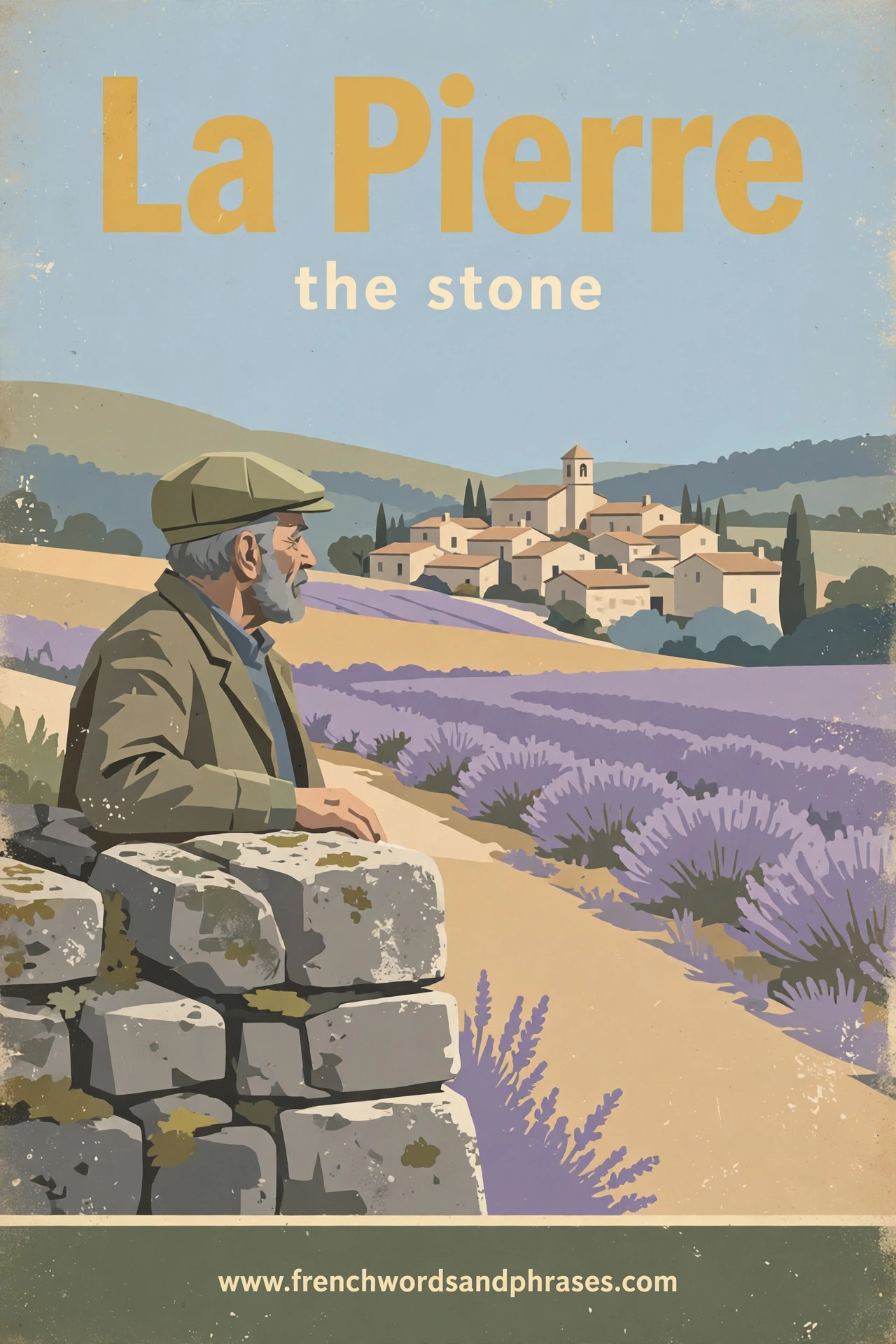
La pierre means the stone.
The mason lifts the block, turns it once in his hands, and sets it into the wall of a house that will stand for three hundred years. No mortar of words is needed: la pierre, the stone, is the oldest building material of France — and one of its hardest-working words.
In this guide, you’ll learn what pierre means in English, how to use it with its articles, how to form its plural, and how it appears in everyday French. Explore French examples, English translations, and practice quizzes.
Understanding the French Noun Pierre
Pierre is a feminine French noun, learned with its article: la pierre, une pierre. It names both a single stone you can hold and stone as a material. Do not let the capital letter fool you: Pierre with a capital is also the man’s name Peter — context tells them apart.
It means the stone — a piece of rock, from a pebble turned in a child’s pocket to the cut blocks of a cathedral. As a material, la pierre builds walls, bridges and villages: une maison en pierre, a stone house. And French thinks with it constantly: hearts are made of it, days are marked with it, and two birds, famously, are killed with a single one of it.
Gender: Feminine — la pierre, une pierre
Plural: les pierres
As a material: en pierre — une maison en pierre, a stone house
Precious: une pierre précieuse — a gemstone
The name: Pierre (capital P) is also Peter, a man’s name
English equivalents: The stone; rock (as material)
One usage detail: pierre is the beating heart of a whole family of sayings about effort and luck — you lay it (poser la première pierre, to lay the foundation stone), you contribute it (apporter sa pierre à l’édifice), you mark a great day with a white one (marquer d’une pierre blanche), and on the coldest days it splits: geler à pierre fendre.
Experience the Word
Pierre is permanence. Wood rots, iron rusts, but the pierre of a Roman bridge still carries the road, and the stones of a village church have heard eight centuries of bells.
Imagine a quarry at dawn in the Luberon: the first cuts ringing out, dust on the men’s boots, and blocks coming away clean and pale — each one a wall, a lintel, a doorstep in somebody’s future house.
You have not just named a piece of rock. You have named the material France built itself from.
How to Use Pierre in French: Complete Guide
Let’s explore how pierre works in French, beginning with its articles — la for one stone, les for the wall it joins.
Pierre with the Definite Article (La, Les)
The stone is feminine: la in the singular, les in the plural.
| Form | French |
|---|---|
| Feminine singular | la pierre |
| Plural | les pierres |
Example
La pierre est lourde et froide dans sa main.
The stone is heavy and cold in her hand.
Pierre with the Indefinite Article (Une, Des)
Used for a stone in general — une pierre, a stone; des pierres, stones.
| Form | French |
|---|---|
| Feminine singular | une pierre |
| Plural | des pierres |
Example
Il jette une pierre dans la rivière.
He throws a stone into the river.
Pierre with the Partitive and Quantities (De la, Un tas de…)
As a building material, stone takes the partitive; as objects, stones are counted in heaps and loads.
| Quantity | French |
|---|---|
| some stone (as material) | de la pierre |
| a heap of stones | un tas de pierres |
| made of stone | en pierre |
| a white stone | une pierre blanche |
Example
La vieille maison est construite en pierre du pays.
The old house is built of local stone.
Quick Quiz 1
Complete the sentence:
Il a fait d’une ______ deux coups.
Reveal the answer
pierre
Il a fait d’une pierre deux coups.
He killed two birds with one stone — faire d’une pierre deux coups, the most efficient stone in French.
The Plural of Pierre
Pierre simply adds an -s in the plural — les pierres, stones by the wall and by the cartload.
| Number | French |
|---|---|
| Singular | la pierre |
| Plural | les pierres |
Example
Les pierres du mur brillent après la pluie.
The stones of the wall shine after the rain.
Pierre with Possessive Adjectives (Ma, Ta, Sa…)
Possessives agree with the noun — pierre is feminine, so it takes ma, ta, sa.
| Owner | French |
|---|---|
| my | ma pierre |
| your (tu) | ta pierre |
| his / her | sa pierre |
| our | notre pierre |
| your (vous) | votre pierre |
| their | leur pierre |
Example
Chacun apporte sa pierre à l’édifice.
Everyone contributes their stone to the building — everyone does their bit.
Quick Quiz 2
Complete the sentence:
Cette journée restera marquée d’une pierre ______. (white)
Reveal the answer
blanche
Cette journée restera marquée d’une pierre blanche.
This day will be marked with a white stone — a red-letter day, one to remember; blanche agrees with pierre.
Pierre with Demonstrative Adjectives (Cette, Ces)
Used to point: cette pierre, this stone; ces pierres, these stones.
| Form | French |
|---|---|
| Feminine singular | cette pierre |
| Plural | ces pierres |
Example
Cette pierre date de l’époque romaine.
This stone dates from Roman times.
Pierre with Adjectives
Adjectives agree with pierre — feminine forms, and most follow the noun.
| Adjective | With Pierre |
|---|---|
| blanche (white) | une pierre blanche |
| dure (hard) | une pierre dure |
| lourde (heavy) | une pierre lourde |
| précieuse (precious) | une pierre précieuse |
| tombale (grave-) | une pierre tombale |
Example
Il a trouvé une pierre précieuse dans l’ancienne mine.
He found a precious stone in the old mine.
Quick Quiz 3
Complete the sentence:
Il a un cœur de ______. (stone — he feels nothing)
Reveal the answer
pierre
Il a un cœur de pierre.
He has a heart of stone — avoir un cœur de pierre, to be utterly unfeeling.
Everyday Expressions with Pierre
No French noun works harder in sayings — six famous expressions, one stone.
| Expression | In English |
|---|---|
| faire d’une pierre deux coups | to kill two birds with one stone |
| avoir un cœur de pierre | to have a heart of stone |
| apporter sa pierre à l’édifice | to do your bit, to play your part |
| jeter la pierre à quelqu’un | to cast the first stone, to blame someone |
| marquer quelque chose d’une pierre blanche | to mark something as a red-letter day |
| geler à pierre fendre | to be bitterly, stone-splittingly cold |
Example
En passant à la poste, je ferai d’une pierre deux coups et je posterai aussi ton colis.
By stopping at the post office, I’ll kill two birds with one stone and post your parcel too.
Words from the Same Family as Pierre
Ages, quarries and philosophers — the richest family in this set of nouns.
| French | In English |
|---|---|
| l’âge de pierre | the Stone Age |
| une pierre précieuse | a gemstone, a precious stone |
| la pierre tombale | the gravestone, the tombstone |
| la pierre de Rosette | the Rosetta Stone |
| la pierre philosophale | the philosopher’s stone |
| le tailleur de pierre | the stonemason, the stone-cutter |
| la carrière | the quarry |
| pierreux | stony (a stony path, un chemin pierreux) |
| poser la première pierre | to lay the foundation stone |
Example
Le tailleur de pierre prépare les blocs pour la restauration de l’église.
The stonemason is preparing the blocks for the restoration of the church.
Quick Quiz 4
What is la pierre de Rosette?
Reveal the answer
The Rosetta Stone — the inscribed stone that let Champollion decipher Egyptian hieroglyphs.
Grâce à la pierre de Rosette, on a pu lire les hiéroglyphes.
Thanks to the Rosetta Stone, hieroglyphs could be read again.
Pierre in Everyday French: Real-Life Examples
Now that you know the word, let’s see how pierre appears in everyday French.
Example 1 — On a walk
L’enfant ramasse une pierre plate pour faire des ricochets.
The child picks up a flat stone to skim across the water.
Example 2 — A memorable day
Le jour de leur mariage restera marqué d’une pierre blanche.
Their wedding day will remain a red-letter day.
Example 3 — Teamwork
Chacun a apporté sa pierre à l’édifice, le projet est fini.
Everyone did their bit, the project is finished.
Example 4 — Winter weather
Cette nuit, il a gelé à pierre fendre.
Last night it was bitterly, stone-splittingly cold.
Example 5 — A hard character
Ne lui demande pas pardon, il a un cœur de pierre.
Don’t ask him for mercy, he has a heart of stone.
Example 6 — Building work
Le mur est en pierre, il tiendra des siècles.
The wall is made of stone, it will last for centuries.
Beyond Translation: The Meaning of Pierre
If one word could carry the whole of French history, it might be pierre: the âge de pierre where the story starts, the Roman stones still standing, the cathedrals raised pierre par pierre by masons whose names are lost, and the pierre de Rosette, which handed back a lost civilisation’s voice. Even the language’s wisdom is set in it — hearts, days, cold and blame are all measured against this one patient material.
To say pierre is to say the thing that lasts.
It evokes quarries and cathedrals, garden walls and gravestones, a child’s pocket pebble and a philosopher’s impossible stone — permanence you can hold in one hand.
How to Remember the French Noun Pierre
Remember it this way: Pierre is the stone — feminine, la pierre — the single noun behind six of the most famous expressions in French.
- One stone, two birds — faire d’une pierre deux coups.
- A great day — marqué d’une pierre blanche, marked with a white stone.
- Your share of the work — apporter sa pierre à l’édifice.
The key idea is la pierre — one stone, six sayings.
Test Your Knowledge of Pierre
Let’s see how much you’ve learned. Try answering these questions before revealing the answers.
Question 1
Is pierre masculine or feminine?
Reveal the answer
Feminine — la pierre, une pierre. (Pierre with a capital letter is the name Peter.)
Question 2
How do you say ‘to kill two birds with one stone’?
Reveal the answer
Faire d’une pierre deux coups — to make two hits with one stone.
Question 3
Translate: Everyone does their bit.
Reveal the answer
Chacun apporte sa pierre à l’édifice.
Question 4
What is une pierre précieuse?
Reveal the answer
A precious stone, a gemstone — précieuse agrees with pierre, feminine.
Question 5
Complete the sentence:
La maison est construite en ______.
Reveal the answer
pierre
La maison est construite en pierre.
The house is built of stone.
Your Final Challenge
Can You Use It?
How would you say this in French?
“Everyone brings their stone, and the wall rises.”
Reveal the answer
Chacun apporte sa pierre, et le mur s’élève.
Everyone brings their stone, and the wall rises.
A little French. A little curiosity. A richer everyday life.
LEARN FRENCH ONE WORD AT A TIME