A French Word to Live By
Translate Bœuf to English
/bœf/
Le bœuf means the ox.
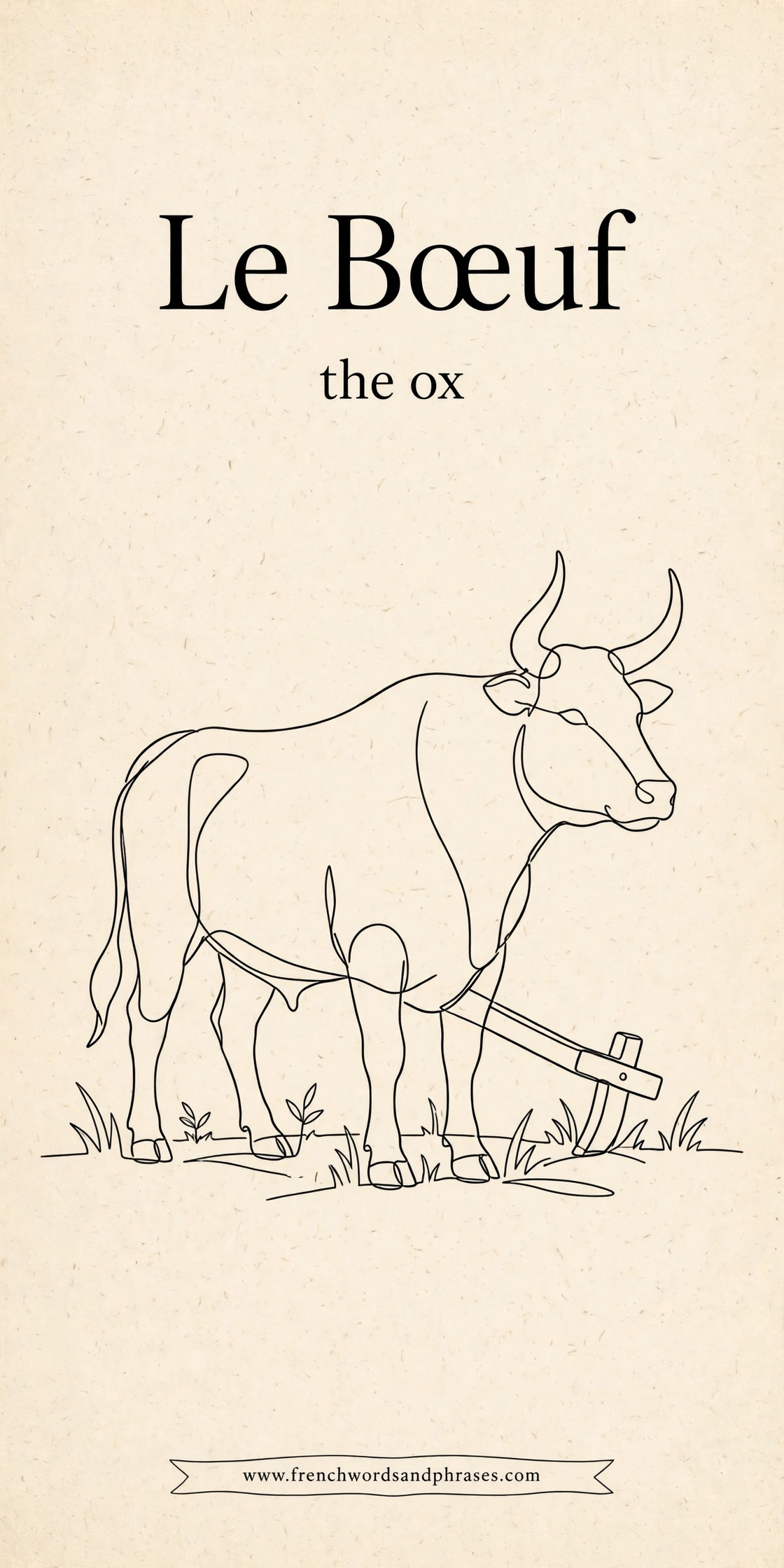
Two great horned heads bow into the yoke, the wooden plough creaks, and the furrow begins — slow, straight, unstoppable. For a thousand years, France was ploughed by le bœuf.
In this guide, you’ll learn what bœuf means in English, how to use it with its articles, how to form its plural, and how it appears in everyday French. Explore French examples, English translations, and practice quizzes.
Understanding the French Noun Bœuf
Bœuf is a masculine French noun, learned with its article: le bœuf, un bœuf. It carries two famous tricks: the letters o and e are fused into the ligature œ, and the final -f is heard in the singular but falls silent in the plural — les bœufs sounds quite different from le bœuf.
It means the ox — the strong, patient castrated bull that pulled the plough and the cart, and by extension the beef on the table: du bœuf is beef, un bœuf bourguignon is the great wine-dark stew of Burgundy. The animal symbolises steady strength — fort comme un bœuf, strong as an ox — and it stands at the heart of the famous warning mettre la charrue avant les bœufs: to put the plough before the oxen, the cart before the horse.
Gender: Masculine
Definite article: le — le bœuf (the ox)
Indefinite article: un — un bœuf (an ox)
Plural: les bœufs — spelled with -fs, but the f falls silent in the plural
The ligature: œ in bœuf fuses o and e into a single letter
English equivalents: The ox; and at the table, beef.
One important usage detail: keep the farmyard family straight — le taureau is the bull, la vache is the cow, le veau is the calf, and le bœuf is the ox, the working animal, whose name doubles as the word for beef. In the butcher’s and the restaurant, bœuf means the meat, never the living animal.
Experience the Word
Bœuf is more than a farm animal. It is the engine of the old French countryside — patient, enormous, and utterly dependable, the tractor of a thousand years.
Imagine the village festival in the old days: garlanded oxen parading through the streets, bells on their horns, the whole commune turned out to honour the animals that fed it.
You have not just met a beast of burden. You have met the strength that built rural France — lent, sûr, et fort comme un bœuf.
How to Use Bœuf in French: Complete Guide
Let’s explore how bœuf works in French, beginning with its articles — and listen out for that -f, which vanishes in the plural.
Bœuf with the Definite Article (Le, Les)
Used for a particular ox — the one in the yoke, the strongest of the farm.
| Form | French |
|---|---|
| Singular | le bœuf |
| Plural | les bœufs |
Example
Le bœuf tire la charrue sans se presser.
The ox pulls the plough without hurrying.
Bœuf with the Indefinite Article (Un, Des)
Used for an ox in general — un bœuf, and des bœufs when the whole team appears.
| Form | French |
|---|---|
| Singular | un bœuf |
| Plural | des bœufs |
Example
Un bœuf peut tirer des charges très lourdes.
An ox can pull very heavy loads.
Bœuf with the Partitive: The Beef Sense
At the table, bœuf becomes an uncountable meat and takes the partitive — du bœuf, some beef.
| Expression | French |
|---|---|
| some beef | du bœuf |
| a piece of beef | un morceau de bœuf |
| a kilo of beef | un kilo de bœuf |
| a lot of beef | beaucoup de bœuf |
| no beef | pas de bœuf |
Example
Elle achète un kilo de bœuf pour le bourguignon.
She is buying a kilo of beef for the bourguignon.
Quick Quiz 1
Complete the sentence:
Ce soir, nous mangeons ______. (beef)
Reveal the answer
du bœuf
Ce soir, nous mangeons du bœuf.
This evening we are eating beef — the partitive du, because beef is uncountable at the table.
The Plural of Bœuf
Bœufs keeps its -fs in writing, but the f falls silent when you say the plural — a spelling trap for every learner.
| Number | French |
|---|---|
| Singular | le bœuf |
| Plural | les bœufs |
Example
Les bœufs attendent patiemment devant la charrue.
The oxen are waiting patiently in front of the plough.
Bœuf with Possessive Adjectives (Mon, Ton, Son…)
Possessives agree with the noun: bœuf is masculine, so mon, ton, son in the singular.
| Owner | French |
|---|---|
| my | mon bœuf |
| your (tu) | ton bœuf |
| his / her | son bœuf |
| our | notre bœuf |
| your (vous) | votre bœuf |
| their | leur bœuf |
Example
Son bœuf est le plus fort du village.
His ox is the strongest in the village.
Quick Quiz 2
Complete the sentence:
______ bœufs tirent la charrue dans le champ. (Their)
Reveal the answer
Leurs
Leurs bœufs tirent la charrue dans le champ.
Their oxen are pulling the plough in the field — leurs, plural, for des bœufs.
Bœuf with Demonstrative Adjectives (Ce, Ces)
Used to point: ce bœuf — this ox here, the white one by the gate.
| Form | French |
|---|---|
| Singular | ce bœuf |
| Plural | ces bœufs |
Example
Ce bœuf connaît le chemin du champ par cœur.
This ox knows the way to the field by heart.
Bœuf with Adjectives
Adjectives agree with bœuf, masculine: fort, patient, énorme.
| Adjective | With Bœuf |
|---|---|
| fort (strong) | un bœuf fort |
| patient (patient) | un bœuf patient |
| énorme (enormous) | un énorme bœuf |
| vieux (old) | un vieux bœuf |
| blanc (white) | un bœuf blanc |
Example
Un énorme bœuf blanc dort à l’ombre du chêne.
An enormous white ox is sleeping in the shade of the oak.
Quick Quiz 3
Complete the sentence:
Il est fort comme un ______. (ox)
Reveal the answer
bœuf
Il est fort comme un bœuf.
He is strong as an ox — the classic comparison.
Everyday Expressions with Bœuf
Ploughs, stews and jam sessions — the bœuf phrases of daily life.
| Expression | In English |
|---|---|
| mettre la charrue avant les bœufs | to put the cart before the horse |
| fort comme un bœuf | strong as an ox |
| le bœuf bourguignon | beef bourguignon, the Burgundy stew |
| faire un bœuf | to have a jam session (musicians’ slang) |
| un effet bœuf | a stunning effect, a real wow (informal) |
| du bœuf | beef, the meat |
Example
Son arrivée sur scène a fait un effet bœuf.
Her entrance on stage made a stunning impression.
Words from the Same Family as Bœuf
Bulls, cows and drovers — the words that travel with bœuf.
| French | In English |
|---|---|
| le taureau | the bull |
| la vache | the cow |
| le veau | the calf; veal |
| bovin | bovine, cattle (adjective) |
| le bouvier | the oxherd, the drover |
| la charrue | the plough |
Example
Le bouvier guide les bœufs le long du chemin.
The drover guides the oxen along the track.
Quick Quiz 4
What does « mettre la charrue avant les bœufs » mean?
Reveal the answer
To put the cart before the horse — to do things in the wrong order.
Tu mets la charrue avant les bœufs : d’abord l’entraînement, ensuite le match !
You’re putting the cart before the horse: training first, then the match!
Bœuf in Everyday French: Real-Life Examples
Now that you know the word, let’s see how bœuf appears in everyday French.
Example 1 — Ploughing
Les bœufs tirent la charrue dans le grand champ.
The oxen are pulling the plough in the big field.
Example 2 — At the butcher’s
Je voudrais un kilo de bœuf, s’il vous plaît.
I would like a kilo of beef, please.
Example 3 — Sunday lunch
Le bœuf bourguignon mijote depuis le matin.
The beef bourguignon has been simmering since morning.
Example 4 — A compliment
Ce déménageur est fort comme un bœuf.
That removal man is strong as an ox.
Example 5 — The idiom
Ne mets pas la charrue avant les bœufs !
Don’t put the cart before the horse!
Example 6 — Music night
Les musiciens font un bœuf au café du coin.
The musicians are having a jam session at the corner café.
Beyond Translation: The Meaning of Bœuf
Before the tractor, France ran on bœufs. The ox ploughed, hauled and threshed its way through a thousand years of harvests, and the language has never forgotten the debt: strength is « fort comme un bœuf », haste is mocked in « mettre la charrue avant les bœufs », and a musician’s improvised evening is still un bœuf — named, they say, after Le Bœuf sur le toit, the Paris cabaret where jazz musicians once gathered to jam. The animal retired from the fields, but it never left the language.
To say bœuf is to name patient strength — the power that pulls all day and never hurries.
It evokes the creaking yoke and the straight furrow, the steaming bourguignon and the smoky jam session — one word from the furrow to the stage.
How to Remember the French Noun Bœuf
Remember it this way: Bœuf is the ox — masculine, written with the fused œ, and hiding an -f that you hear in the singular and lose in the plural.
- You fuse the letters — bœuf with œ, one letter made of two.
- You drop the -f — le bœuf sounds its f; les bœufs lets it go.
- You keep the order — never mettre la charrue avant les bœufs, the cart before the horse.
The key idea is le bœuf, les bœufs — the -f falls silent in the plural.
Test Your Knowledge of Bœuf
Let’s see how much you’ve learned. Try answering these questions before revealing the answers.
Question 1
Is bœuf masculine or feminine?
Reveal the answer
Masculine — le bœuf, un bœuf.
Question 2
What is the difference between un bœuf and un taureau?
Reveal the answer
Un bœuf is an ox — the working, castrated animal (and beef at the table); un taureau is a bull.
Question 3
Translate: You must not put the cart before the horse.
Reveal the answer
Il ne faut pas mettre la charrue avant les bœufs.
Question 4
How do you say some beef?
Reveal the answer
Du bœuf — at the table bœuf is uncountable and takes the partitive.
Question 5
Complete the sentence:
______ tirent la charrue. (The oxen)
Reveal the answer
Les bœufs
Les bœufs tirent la charrue.
The oxen are pulling the plough — bœufs, with the -f written but silent.
Your Final Challenge
Can You Use It?
How would you say this in French?
“You must not put the cart before the horse.”
Reveal the answer
Il ne faut pas mettre la charrue avant les bœufs.
You must not put the cart before the horse.
A little French. A little curiosity. A richer everyday life.
LEARN FRENCH ONE WORD AT A TIME