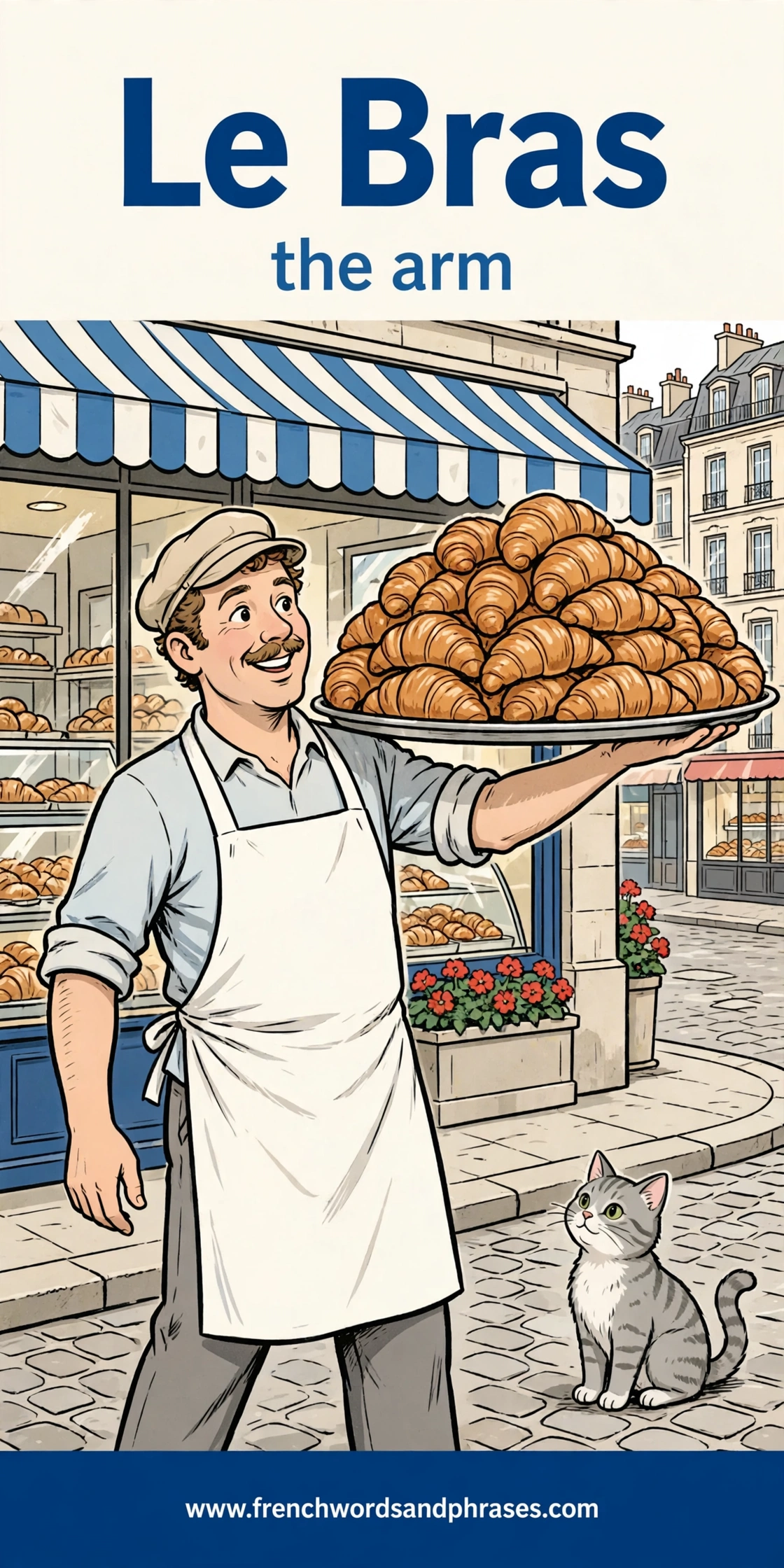
A French Word to Live By
Translate Bras to English
/bʁa/
Le bras means the arm.
The toddler lifts both arms to the sky — the universal wordless sentence for « carry me ». Before French children can speak, they already know the power of les bras.
In this guide, you’ll learn what bras means in English, how to use it with its articles, how to form its plural, and how it appears in everyday French. Explore French examples, English translations, and practice quizzes.
Understanding the French Noun Bras
Bras is a masculine French noun, learned with its article: le bras, un bras. It hides a double trick: the final -s is silent, and the plural is spelled exactly like the singular — les bras — so only the article tells you how many arms you are talking about.
It means the arm — the limb from shoulder to hand, the part of you that carries, holds, waves and embraces. French also gives bras to things: le bras d’une rivière is a branch of a river, le bras d’un fauteuil is the arm of an armchair. And the idioms are everywhere: to welcome someone à bras ouverts is to welcome them with open arms, while baisser les bras is to give up entirely.
Gender: Masculine
Definite article: le — le bras (the arm)
Indefinite article: un — un bras (an arm)
Plural: les bras — spelled exactly like the singular; the final -s is silent
Beyond the body: le bras d’une rivière — a branch of a river; le bras d’un fauteuil — an armrest
English equivalents: The arm.
One important usage detail: bras ends in a silent -s in both numbers, so « un bras » and « des bras » sound identical — the article does all the work. And when the idiom says les bras m’en sont tombés — literally « my arms fell off » — it means I was stunned, flabbergasted, completely floored by the news.
Experience the Word
Bras is more than a limb. It is the first embrace a baby knows, the wave from the station platform, the strong right arm a whole team depends on.
Imagine the harbour at dawn: the fisherman hauling nets hand over hand, arms brown from the summer, the whole catch of the morning hanging on his strength.
You have not just lifted something. You have carried the world a little way — à bout de bras, at arm’s length and beyond.
How to Use Bras in French: Complete Guide
Let’s explore how bras works in French, beginning with its articles — and mind the silent -s that never changes.
Bras with the Definite Article (Le, Les)
Used for a particular arm — and since bras never changes its spelling, le and les carry the whole meaning.
| Form | French |
|---|---|
| Singular | le bras |
| Plural | les bras |
Example
Il s’est cassé le bras en tombant de l’échelle.
He broke his arm falling off the ladder.
Bras with the Indefinite Article (Un, Des)
Used for an arm in general — un bras, and des bras when there are several, spelled the same.
| Form | French |
|---|---|
| Singular | un bras |
| Plural | des bras |
Example
Elle tient un enfant dans chaque bras.
She is holding a child in each arm.
Bras in Quantities and Negatives
Arms come in pairs, and after quantity words French uses de — deux bras, plein de bras volontaires.
| Expression | French |
|---|---|
| two arms | deux bras |
| both arms | les deux bras |
| many willing arms | beaucoup de bras |
| an arm’s length | à bout de bras |
| no arm | pas de bras |
Example
Pour déménager le piano, il faut beaucoup de bras.
To move the piano, we need a lot of arms.
Quick Quiz 1
Complete the sentence:
Il lève ______ droit pour poser une question. (the right arm)
Reveal the answer
le bras
Il lève le bras droit pour poser une question.
He raises his right arm to ask a question.
The Plural of Bras
Bras is one of the rare nouns whose plural looks exactly like the singular — le bras, les bras — with a silent -s throughout.
| Number | French |
|---|---|
| Singular | le bras / un bras |
| Plural | les bras / des bras |
Example
Les bras du nageur sont puissants.
The swimmer’s arms are powerful.
Bras with Possessive Adjectives (Mon, Ton, Son…)
Possessives agree with the noun: bras is masculine, so mon, ton, son in the singular.
| Owner | French |
|---|---|
| my | mon bras / mes bras |
| your (tu) | ton bras / tes bras |
| his / her | son bras / ses bras |
| our | notre bras / nos bras |
| your (vous) | votre bras / vos bras |
| their | leur bras / leurs bras |
Example
Elle ouvre ses bras pour accueillir ses petits-enfants.
She opens her arms to welcome her grandchildren.
Quick Quiz 2
Complete the sentence:
______ bras sont fatigués après ce travail. (My)
Reveal the answer
Mes
Mes bras sont fatigués après ce travail.
My arms are tired after that work — mes, the plural of mon.
Bras with Demonstrative Adjectives (Ce, Ces)
Used to point: ce bras — this arm, the one in the plaster cast.
| Form | French |
|---|---|
| Singular | ce bras |
| Plural | ces bras |
Example
Ce bras me fait encore mal.
This arm still hurts.
Bras with Adjectives
Adjectives agree with bras, masculine: long, fort, cassé.
| Adjective | With Bras |
|---|---|
| long (long) | un bras long / des bras longs |
| fort (strong) | un bras fort |
| cassé (broken) | un bras cassé |
| droit (right) | le bras droit |
| gauche (left) | le bras gauche |
Example
Le joueur de tennis a un bras droit très puissant.
The tennis player has a very powerful right arm.
Quick Quiz 3
Complete the sentence:
Elle accueille ses amis à bras ______. (open)
Reveal the answer
ouverts
Elle accueille ses amis à bras ouverts.
She welcomes her friends with open arms — the famous phrase à bras ouverts.
Everyday Expressions with Bras
Open arms, folded arms and giving up — the bras phrases of daily life.
| Expression | In English |
|---|---|
| à bras ouverts | with open arms |
| les bras m’en sont tombés | I was stunned, flabbergasted |
| baisser les bras | to give up, to throw in the towel |
| croiser les bras | to fold your arms; to sit back and do nothing |
| avoir quelqu’un sur les bras | to be stuck with someone, to have them on your hands |
| le bras droit de quelqu’un | someone’s right-hand man |
Example
Quand j’ai entendu la nouvelle, les bras m’en sont tombés.
When I heard the news, I was flabbergasted.
Words from the Same Family as Bras
Forearms, armfuls and embraces — the words that travel with bras.
| French | In English |
|---|---|
| l’avant-bras | the forearm |
| la brassée | an armful |
| embrasser | to hug; to kiss |
| le coude | the elbow |
| la main | the hand |
| le bras de fer | arm wrestling; a trial of strength |
Example
Elle apporte une brassée de fleurs du jardin.
She brings in an armful of flowers from the garden.
Quick Quiz 4
What does « baisser les bras » mean?
Reveal the answer
To give up — literally, to lower your arms and stop fighting.
Il ne faut jamais baisser les bras.
You must never give up.
Bras in Everyday French: Real-Life Examples
Now that you know the word, let’s see how bras appears in everyday French.
Example 1 — A welcome
Elle les accueille à bras ouverts.
She welcomes them with open arms.
Example 2 — An accident
Il s’est cassé le bras en skiant.
He broke his arm while skiing.
Example 3 — Hard work
Nous portons les cartons à bout de bras.
We are carrying the boxes at arm’s length.
Example 4 — Stunned
Quand il a vu la facture, les bras lui en sont tombés.
When he saw the bill, he was flabbergasted.
Example 5 — Giving up
L’équipe ne baisse pas les bras malgré la défaite.
The team is not giving up despite the defeat.
Example 6 — A hug
L’enfant court dans les bras de sa mère.
The child runs into his mother’s arms.
Beyond Translation: The Meaning of Bras
The bras is the hardest-working word in the French body. It welcomes (à bras ouverts), surrenders (baisser les bras), idles (les bras croisés), burdens (avoir quelqu’un sur les bras) and expresses pure astonishment — les bras m’en tombent, my arms fall off me, I am stunned. It even leaves the body behind: rivers have bras, armchairs have bras, and a boss’s trusted deputy is his bras droit, his right arm.
To say bras is to name the limb that does the living — carrying, holding, waving, embracing.
It evokes the fisherman’s haul and the grandmother’s open arms, the plaster cast and the farewell wave — strength and tenderness in a single short word.
How to Remember the French Noun Bras
Remember it this way: Bras is the arm — masculine, with a silent -s that never changes, so le bras and les bras are spelled exactly the same.
- You hear nothing at the end — le bras, les bras, the -s is always silent.
- You welcome warmly — à bras ouverts, with open arms.
- You drop them in shock — les bras m’en sont tombés, I was flabbergasted.
The key idea is le bras, les bras — same spelling, silent -s.
Test Your Knowledge of Bras
Let’s see how much you’ve learned. Try answering these questions before revealing the answers.
Question 1
Is bras masculine or feminine?
Reveal the answer
Masculine — le bras, un bras.
Question 2
What changes between the singular and plural of bras?
Reveal the answer
Only the article — le bras becomes les bras; the word itself is spelled and sounded the same.
Question 3
Translate: She welcomes them with open arms.
Reveal the answer
Elle les accueille à bras ouverts.
Question 4
What is l’avant-bras?
Reveal the answer
The forearm — the part of the bras between the elbow and the wrist.
Question 5
Complete the sentence:
Il s’est cassé ______ en tombant. (the arm)
Reveal the answer
le bras
Il s’est cassé le bras en tombant.
He broke his arm when he fell — French uses le bras, not « son bras », for body parts here.
Your Final Challenge
Can You Use It?
How would you say this in French?
“She welcomes them with open arms.”
Reveal the answer
Elle les accueille à bras ouverts.
She welcomes them with open arms.
A little French. A little curiosity. A richer everyday life.
LEARN FRENCH ONE WORD AT A TIME