A French Word to Live By
Translate Revenons à nos moutons to English
/ʁə.və.nɔ̃ a no mu.tɔ̃/
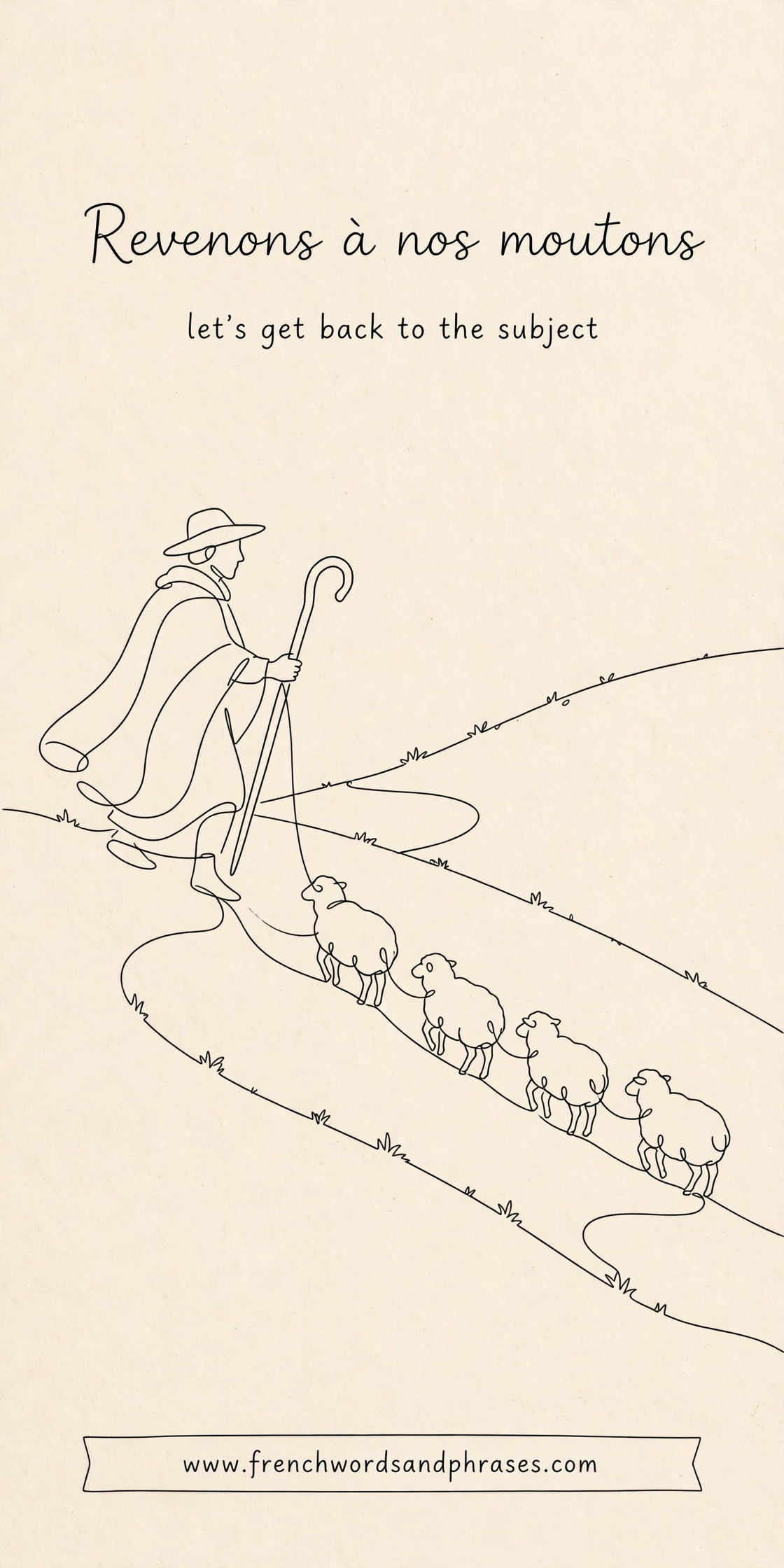
Revenons à nos moutons means let’s get back to the subject — the classic call to return to the point.
The meeting has wandered from the budget to the coffee machine, from the coffee machine to someone’s holiday, and from the holiday to football. The director taps her pen twice on the table and smiles the smile everyone knows: « Bien. Revenons à nos moutons. »
Let’s explore how revenons à nos moutons works in French, beginning with the whole phrase on one card.
Understanding the French Phrase Revenons à nos moutons
Revenons à nos moutons is a French idiomatic expression built from revenons (let us come back) and nos moutons (our sheep). It is five centuries old: it comes from the medieval farce of Maître Pathelin, where a judge, drowning in a case that kept mixing stolen cloth with stolen sheep, cried out for the sheep — the actual subject. It means: let’s get back to the point.
It means let’s get back to the subject — the classic, slightly amused call to end a digression and return to the matter in hand. Nobody is farming: the sheep are the original topic, patiently waiting in their field while the conversation wandered off after every distraction in the countryside.
Type: Idiomatic expression — conversation (imperative phrase)
Answers the need: Bringing a wandering discussion back to the point
Register: Neutral — meetings, classrooms, conversations; amused rather than angry
Strength: Gentle but final — the digression ends when it is spoken
One important usage detail: the phrase is a ready-made quotation and almost never changes its shape — revenons à nos moutons, with the nous-form revenons and the sheep firmly plural. A playful variant adds en: revenons-en à nos moutons. Tone does the rest: said with a smile it is a nudge; said with a sigh, a judge restoring order.
Experience the Word
Revenons à nos moutons is the shepherd’s whistle of French conversation — one short call, and the whole flock of ideas comes trotting back.
Imagine the judge in the old farce: a draper suing a shepherd, a lawyer who has cheated them both, cloth and sheep tangling into one glorious muddle — until the cry goes up for the sheep, the one real subject. Every meeting since has needed the same cry.
Five hundred years of French speakers have kept this phrase alive because digression never dies. Every conversation strays; the elegant ones have a way home.
How to Use Revenons à nos moutons in French: Complete Guide
Let’s explore how revenons à nos moutons works in French, beginning with the whole phrase on one card.
Revenons à nos moutons at a Glance
The Whole Phrase on One Card
Real meaning, literal picture, English twin and register — revenons à nos moutons in five lines.
| Point | Revenons à nos moutons |
|---|---|
| What it really means | let’s get back to the subject — enough digression |
| Word for word | let us return to our sheep |
| English equivalent | let’s get back to the point / back to the matter in hand |
| Register | neutral — amused, classic, safe from classroom to boardroom |
| Use it for | meetings, lessons, stories and debates that have wandered off |
Example
Nous parlions du budget : revenons à nos moutons.
We were talking about the budget: let’s get back to the subject.
Word by Word: Building the Return
Four small pieces — take them one by one and the flock starts moving home.
| Word | Literal meaning | Its job in the phrase |
|---|---|---|
| revenons | let us come back | the nous-imperative of revenir — an invitation, not an order |
| à | to | the direction of the return — back TO the subject |
| nos | our | the sheep belong to everyone in the conversation — our shared topic |
| moutons | sheep | the original subject, waiting patiently where the talk left it |
Example
Assez parlé de la météo, revenons à nos moutons.
Enough about the weather — let’s get back to the subject.
Quick Quiz 1
Why sheep? Where do the moutons come from?
Reveal the answer
From a medieval farce — in La Farce de Maître Pathelin, the judge, lost between a cloth case and a sheep case, begs to return to the sheep: the real subject.
Le juge s’écria : revenons à nos moutons !
The judge cried: let’s get back to our sheep!
When You Say It: The Digression Moments
Revenons à nos moutons fires at moments like these — the talk has strayed, and someone calls it home.
| Situation | Example |
|---|---|
| In a meeting | revenons à nos moutons, il nous reste dix minutes — let’s get back to the point, we have ten minutes left |
| In class | le professeur sourit : revenons à nos moutons — the teacher smiles: back to the subject |
| Telling a story | mais je m’égare, revenons à nos moutons — but I’m wandering, let’s get back to it |
| In a debate | revenons à nos moutons, la question était le prix — back to the subject, the question was the price |
| At the family table | bon, revenons à nos moutons : qui apporte le dessert ? — right, back to it: who’s bringing dessert? |
Example
Après cette longue parenthèse, revenons à nos moutons.
After that long digression, let’s get back to the subject.
Make It Yours: The Return for Every Talk
The phrase is a fixed quotation — the sheep stay plural and revenons stays revenons; only the frame around it changes.
| Form | French | In English |
|---|---|---|
| The classic call | revenons à nos moutons | let’s get back to the subject |
| With en | revenons-en à nos moutons | let’s get back to the matter |
| After a pause | bon, revenons à nos moutons | right, back to the point |
| Confessing the detour | je m’égare — revenons à nos moutons | I’m wandering — let’s get back to it |
| Gentle question | si nous revenions à nos moutons ? | shall we get back to the subject? |
| About a text | l’auteur revient à ses moutons | the author returns to his subject |
Example
Si nous revenions à nos moutons, la réunion finirait à l’heure.
If we got back to the subject, the meeting would end on time.
Quick Quiz 2
Are the sheep ever singular — revenons à notre mouton?
Reveal the answer
No — the quotation is fixed: nos moutons, plural, exactly as the judge said it five centuries ago.
Revenons à nos moutons, tous ensemble.
Let’s get back to the subject, all of us together.
Everyday Expressions: Building on the Sheep
Revenons à nos moutons slots into these everyday frames — each one ready to use as it stands.
| Frame | In English |
|---|---|
| revenons à nos moutons | let’s get back to the subject |
| revenons-en à nos moutons | let’s get back to the matter in hand |
| pour revenir à nos moutons | to get back to our subject |
| je m’égare | I’m wandering off the point — the confession before the return |
| où en étions-nous ? | where were we? — the softer cousin |
Example
Pour revenir à nos moutons, le train part à quelle heure ?
To get back to the point, what time does the train leave?
Close Cousins: The Other Ways Back
French has a whole shelf of return phrases — the moutons are the classic, literary one; its cousins are briefer, blunter or purely practical.
| Expression | The difference |
|---|---|
| revenons à nos moutons | let’s get back to the subject — the classic call, five centuries old |
| revenons au sujet | back to the subject — plain and neutral, the prose version |
| au fait | by the way — actually moves AWAY to a new point, the opposite direction |
| bref | anyway, in short — the brisk modern broom that sweeps digressions away |
| pour en revenir à… | to come back to… — names the subject explicitly as it returns |
Example
Bref, revenons au sujet — ou plutôt, à nos moutons.
Anyway, back to the subject — or rather, to our sheep.
Quick Quiz 3
Which cousin moves the talk AWAY to something new rather than back — au fait or bref?
Reveal the answer
Au fait — ‘by the way’ opens a new door. Bref sweeps you back towards the close.
Au fait, tu as des nouvelles de Marie ?
By the way, do you have news of Marie?
Revenons à nos moutons and Its Neighbours
The conversation shelf around the phrase — straying, returning and the sheep themselves.
| French | In English |
|---|---|
| un mouton | a sheep |
| le sujet | the subject, the topic |
| une digression | a digression |
| s’égarer | to wander off, to stray |
| revenir | to come back |
| un troupeau | a flock — the whole wandering discussion |
Example
Après la digression, tout le troupeau revient à ses moutons.
After the digression, the whole flock comes back to its sheep.
Watch Out: The Traps Around the Sheep
The traps: sheep that are never livestock, a form that never changes, and a tone that must stay amused.
| Trap | The truth |
|---|---|
| no farming involved | the moutons are the topic of discussion, never real sheep — unless you are quoting the farce itself |
| the form is fixed | revenons à nos moutons is a quotation: plural sheep, nous-form, no tinkering |
| keep it smiling | the phrase charms a room back to order; snapped angrily, it loses its five centuries of good humour |
| not for changing the subject | it RETURNS to the subject — to change topics entirely, au fait or parlons d’autre chose does the job |
Example
Elle sourit, dit « revenons à nos moutons », et la salle se recentre.
She smiles, says ‘let’s get back to the subject’, and the room refocuses.
Quick Quiz 4
True or false: revenons à nos moutons is how you announce a brand-new topic.
Reveal the answer
False — it returns to the OLD topic after a digression. New topics arrive with au fait or changeons de sujet.
Après la pause, revenons à nos moutons.
After the break, let’s get back to the subject.
Revenons à nos moutons in Everyday French: Real-Life Examples
Now that you know the word, let’s see how revenons à nos moutons appears in everyday French.
Example 1 — The meeting
Revenons à nos moutons : le budget de mars.
Let’s get back to the subject: the March budget.
Example 2 — The classroom
Le professeur tape des mains : revenons à nos moutons.
The teacher claps his hands: back to the subject.
Example 3 — The storyteller
Mais je m’égare ; revenons à nos moutons.
But I’m wandering; let’s get back to it.
Example 4 — The debate
Revenons à nos moutons, la question portait sur les prix.
Back to the subject — the question was about prices.
Example 5 — The family call
Bon, revenons à nos moutons : dimanche, chez qui ?
Right, back to it: Sunday, at whose house?
Example 6 — The interview
L’animateur sourit : revenons à nos moutons.
The host smiles: let’s get back to the subject.
Beyond Translation: The Meaning of Revenons à nos moutons
Most idioms are metaphors; this one is a quotation that outlived its play by five hundred years. The farce of Maître Pathelin was performed in the 1460s, its author forgotten, its plot half-remembered — and yet a French chairperson in a glass office tower still calls the room back with the judge’s cry.
To say revenons à nos moutons is to borrow the judge’s gavel, softened by centuries into a smile.
The sheep, meanwhile, have become immortal — the most famous flock in the French language, forever waiting to be returned to.
How to Remember the French Phrase Revenons à nos moutons
Remember it this way: Revenons à nos moutons is the judge’s cry from the medieval farce — cloth, sheep and chaos, until someone calls for the real subject.
- You picture the courtroom muddle — the judge, lost between cloth and sheep, begs for the sheep: the actual case.
- You freeze the form — revenons à nos moutons, plural sheep, exactly as quoted for five centuries.
- You keep it amused — the phrase charms a discussion home; it is a whistle, not a whip.
The key idea is revenons à nos moutons means let’s get back to the subject — the judge’s cry for his sheep, the real case.
Test Your Knowledge of Revenons à nos moutons
Let’s see how much you’ve learned. Try answering these questions before revealing the answers.
Question 1
What does revenons à nos moutons mean?
Reveal the answer
Let’s get back to the subject — the classic call to end a digression.
Question 2
Where does the phrase come from?
Reveal the answer
From La Farce de Maître Pathelin — a medieval judge, lost between a cloth case and a sheep case, cried for the sheep: the real subject.
Question 3
How do you soften it into a question?
Reveal the answer
Si nous revenions à nos moutons ? — shall we get back to the subject? The sheep stay plural either way.
Question 4
What is the difference between revenons à nos moutons and au fait?
Reveal the answer
Au fait moves AWAY — ‘by the way’, a new topic. The moutons bring you BACK to the old one.
Question 5
Complete the sentence:
Assez de digressions, revenons à nos ______. (Enough digressions, let’s get back to the subject.)
Reveal the answer
moutons
Assez de digressions, revenons à nos moutons.
Enough digressions, let’s get back to the subject.
Your Final Challenge
Can You Use It?
How would you say this in French?
“But let’s get back to the subject.”
Reveal the answer
Mais revenons à nos moutons.
But let’s get back to the subject.
A little French. A little curiosity. A richer everyday life.
LEARN FRENCH ONE WORD AT A TIME