A French Word to Live By
Translate Je n’ai pas un radis to English
/ʒə ne pa œ̃ ʁa.di/
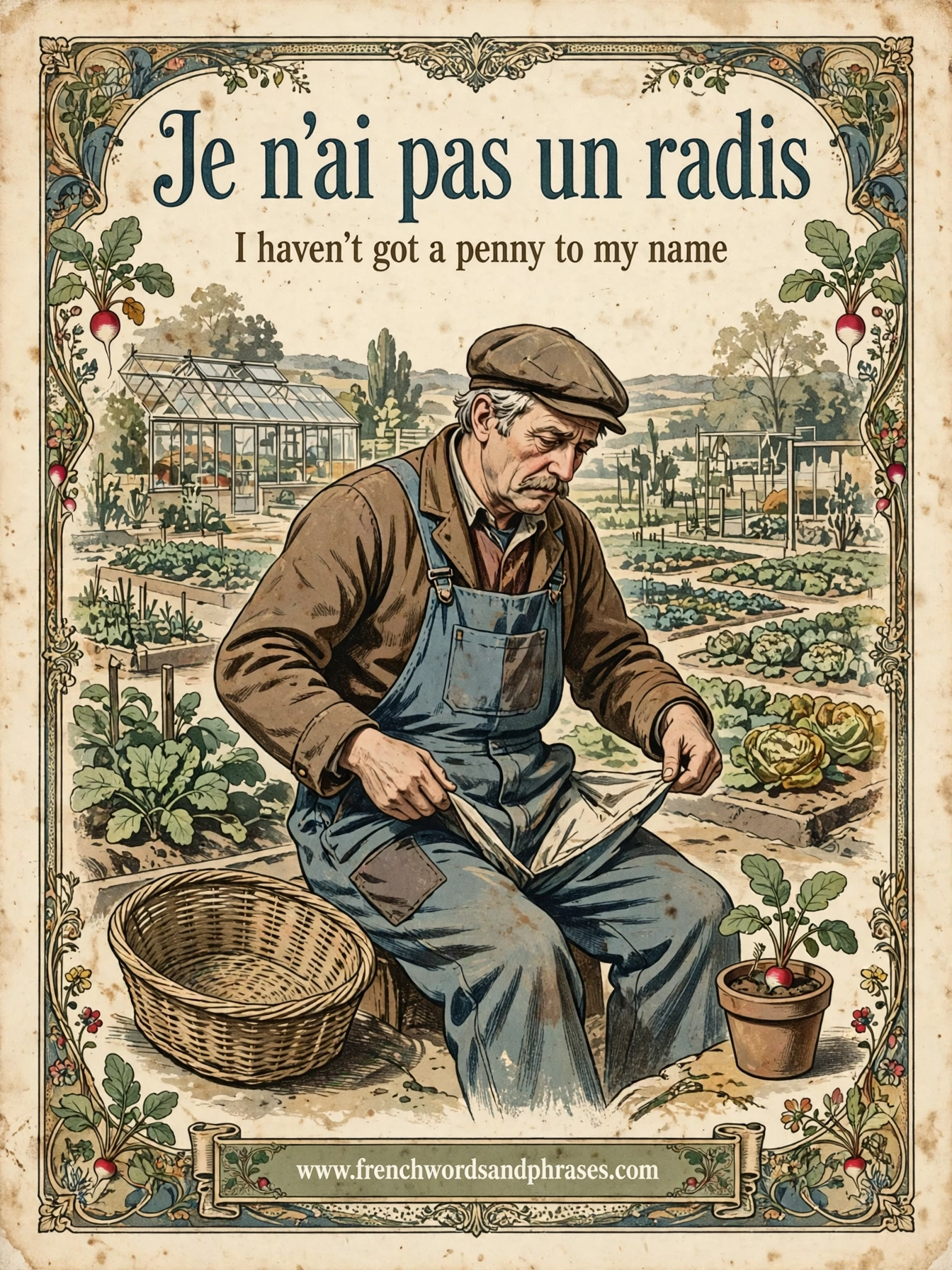
Je n’ai pas un radis means I haven’t got a penny to my name — to be completely broke.
End of the month at the student residence. The invitation is tempting — a concert, then dinner — but your flatmate turns his pockets inside out on the kitchen table: a button, a bus ticket, and absolutely nothing else. « Désolé. Je n’ai pas un radis. »
Let’s explore how je n’ai pas un radis works in French, beginning with the whole phrase on one card.
Understanding the French Phrase Je n’ai pas un radis
Je n’ai pas un radis is a French idiomatic expression built from je n’ai pas (I don’t have) and un radis (a radish). In nineteenth-century slang, un radis was a small coin — round like the vegetable, and worth about as much. To not have a single radish is to be completely broke.
It means I haven’t got a penny to my name — to have no money at all, not one small coin. Nobody is gardening: the radish is slang for the humblest money there is, so lacking even one radish means the purse is not merely light but empty to the bottom.
Type: Idiomatic expression — money (negative sentence phrase)
Answers the need: Saying you are completely broke, with a laugh
Register: Informal — humorous, everyday speech among friends
Strength: Total — not low on money, but without a single coin
One important usage detail: the phrase lives inside its negation — je n’ai pas un radis, il n’a plus un radis, sans un radis. The je can change (tu n’as pas un radis, elle n’a pas un radis), but the radish never becomes plural and never loses its pas. For a slightly different flavour, French also says ne pas avoir un rond — the rond, a round coin, is the radish’s round cousin.
Experience the Word
Je n’ai pas un radis is poverty told as a joke — the empty purse described in vegetables, so the whole table laughs instead of sighing.
Imagine the end-of-month ritual: pockets turned out, wallet opened to its echo, the bank application showing a number that rounds to nothing. French could have made it grim. Instead it reached for the smallest, crunchiest coin in the garden.
Slang loves devaluing money — pennies become buttons, beans, radishes. To je n’ai pas un radis is to be rich in exactly one thing: the phrase itself.
How to Use Je n’ai pas un radis in French: Complete Guide
Let’s explore how je n’ai pas un radis works in French, beginning with the whole phrase on one card.
Je n’ai pas un radis at a Glance
The Whole Phrase on One Card
Real meaning, literal picture, English twin and register — je n’ai pas un radis in five lines.
| Point | Je n’ai pas un radis |
|---|---|
| What it really means | I haven’t got a penny — I’m completely broke |
| Word for word | I don’t have a radish — the radish being slang for a small coin |
| English equivalent | I haven’t got a penny to my name / I’m flat broke / I’m skint |
| Register | informal and humorous — friends, students, end-of-month talk |
| Use it for | empty wallets, declined invitations, payday countdowns |
Example
Je n’ai pas un radis, le concert attendra le mois prochain.
I haven’t got a penny — the concert will have to wait until next month.
Word by Word: Building the Empty Purse
Five small pieces — take them one by one and the pockets turn inside out.
| Word | Literal meaning | Its job in the phrase |
|---|---|---|
| je | I | the speaker — but any person works: tu n’as pas, il n’a pas |
| n’ai pas | don’t have | the negation that empties the purse — the phrase lives inside it |
| un | a, one | a single one — not even ONE radish is too much to hope for |
| radis | a radish | the slang coin — round, small and worth almost nothing |
Example
Elle n’a pas un radis, mais elle garde le sourire.
She hasn’t got a penny, but she keeps smiling.
Quick Quiz 1
Why a radish? What did un radis mean in old slang?
Reveal the answer
A small coin — round like the vegetable and worth very little. Not having even one means the purse is truly empty.
À l’époque, un radis valait à peine un café.
In those days, a ‘radish’ was barely worth a coffee.
When You Say It: The Broke Moments
Je n’ai pas un radis fires at moments like these — the invitation is lovely, and the wallet is empty.
| Situation | Example |
|---|---|
| Declining an invitation | je n’ai pas un radis, je passe mon tour — I haven’t got a penny, I’ll sit this one out |
| End of the month | le 28, il n’a pas un radis — on the 28th, he’s flat broke |
| Student life | les étudiants n’ont pas un radis après le loyer — the students haven’t a penny after the rent |
| Checking a wallet | ouvre son portefeuille : pas un radis — he opens his wallet: not a penny |
| Cheerfully | pas un radis, mais le soleil brille — not a penny, but the sun is shining |
Example
Tu viens au restaurant ? — Je n’ai pas un radis, désolé.
Are you coming to the restaurant? — I haven’t got a penny, sorry.
Make It Yours: The Radish for Every Person
Avoir conjugates as normal inside the negation — the radish stays singular and the pas never leaves.
| Form | French | In English |
|---|---|---|
| I | je n’ai pas un radis | I haven’t got a penny |
| You | tu n’as pas un radis | you haven’t got a penny |
| She | elle n’a pas un radis | she hasn’t got a penny |
| We | nous n’avons pas un radis | we haven’t got a penny |
| No longer | je n’ai plus un radis | I’ve not got a penny left |
| Without one | partir sans un radis | to leave without a penny to your name |
Example
Ils sont partis en vacances sans un radis.
They went off on holiday without a penny to their names.
Quick Quiz 2
Which is the idiom — je n’ai pas un radis or je n’ai pas des radis?
Reveal the answer
Je n’ai pas un radis — one single radish, singular: the point is not even ONE coin.
Pas un radis, pas un sou, rien.
Not a radish, not a sou, nothing.
Everyday Expressions: Building on the Radish
Je n’ai pas un radis slots into these everyday frames — each one ready to use as it stands.
| Frame | In English |
|---|---|
| ne pas avoir un radis | to not have a penny to your name |
| sans un radis | without a penny, penniless |
| ne plus avoir un radis | to have not a penny left |
| pas un radis en poche | not a penny in your pocket |
| attendre la paie sans un radis | to wait for payday without a penny |
Example
Sans un radis en poche, il a traversé la ville à pied.
Without a penny in his pocket, he crossed the city on foot.
Close Cousins: The Other Empty Purses
French has a whole shelf of broke phrases — the radis is the gardener’s one; its cousins are round coins, old coins or the plain state of being cleaned out.
| Expression | The difference |
|---|---|
| je n’ai pas un radis | I haven’t got a penny — the radish, slang’s smallest coin |
| ne pas avoir un rond | to not have a bean — the rond is a round coin, the closest cousin |
| ne pas avoir un sou | to not have a penny — the sou is the old real coin, a little more classic |
| être fauché | to be broke — the everyday slang word, literally ‘mown down’ |
| être à sec | to be cleaned out — literally ‘dry’, money like a well that has run out |
Example
Fauché, à sec, pas un radis : choisissez votre formule.
Broke, cleaned out, not a radish: pick your formula.
Quick Quiz 3
Which cousin names a ROUND coin instead of a vegetable — un sou or un rond?
Reveal the answer
Un rond — literally ‘a round one’: ne pas avoir un rond is the radish’s twin. The sou was a real old coin.
Je n’ai pas un rond non plus, rassure-toi.
I haven’t got a bean either, don’t worry.
Je n’ai pas un radis and Its Neighbours
The money shelf around the phrase — coins, wallets and the blessed day the money returns.
| French | In English |
|---|---|
| un radis | a radish — and slang’s small coin |
| un sou | a sou, an old small coin |
| un portefeuille | a wallet |
| être fauché | to be broke |
| la paie | payday, the wages |
| des économies | savings — the radish’s opposite |
Example
Sans économies et sans un radis, il attend la paie.
With no savings and not a penny, he’s waiting for payday.
Watch Out: The Traps Around the Radish
The traps: a vegetable that is sometimes just a vegetable, a plural that breaks the spell, and money trouble mistaken for hunger.
| Trap | The truth |
|---|---|
| real radishes exist | acheter des radis is shopping for vegetables; the money sense lives only in the negative phrase pas un radis |
| never plural | pas un radis, singular — the whole force of the phrase is not even ONE |
| it’s money, not food | the speaker is broke, not hungry; the radish is a coin in disguise |
| informal only | in a bank or a formal letter, write je n’ai plus d’argent or je suis sans ressources — the radish belongs to friends |
Example
Elle a acheté des radis au marché, mais elle n’a pas un radis pour le concert.
She bought radishes at the market, but she hasn’t got a penny for the concert.
Quick Quiz 4
True or false: je n’ai pas un radis means you are refusing a salad.
Reveal the answer
False — it means you have no money at all. The radish is slang for a small coin.
Pas de concert pour moi : je n’ai pas un radis.
No concert for me: I haven’t got a penny.
Je n’ai pas un radis in Everyday French: Real-Life Examples
Now that you know the word, let’s see how je n’ai pas un radis appears in everyday French.
Example 1 — The declined invitation
Je n’ai pas un radis, je reste à la maison.
I haven’t got a penny, I’m staying home.
Example 2 — End of the month
Le 29, nous n’avons pas un radis.
On the 29th, we haven’t got a penny.
Example 3 — The student
Elle n’a pas un radis après avoir payé son loyer.
She hasn’t got a penny after paying her rent.
Example 4 — The empty wallet
Il ouvre son portefeuille : pas un radis.
He opens his wallet: not a penny.
Example 5 — The cheerful version
Pas un radis, mais des amis plein la table.
Not a penny, but a table full of friends.
Example 6 — Payday hope
Demain la paie ; aujourd’hui, pas un radis.
Tomorrow is payday; today, not a penny.
Beyond Translation: The Meaning of Je n’ai pas un radis
Every language hides its poverty inside food: English is skint or on its uppers, counts beans, hasn’t a bean. French reached into the garden and pulled up the humblest vegetable of all — small, round, peppery, and worth next to nothing even in a salad.
To je n’ai pas un radis is to announce an empty purse in the language of the market garden — poverty, but make it crunchy.
And like all the best money slang, it turns embarrassment into comedy: the friends laugh, someone pays for your coffee, and the radish has done its work.
How to Remember the French Phrase Je n’ai pas un radis
Remember it this way: Je n’ai pas un radis is the empty purse described as a garden — the radish was slang’s smallest coin, and you haven’t got even one.
- You picture the coin — round and small like a radis; lacking even that means truly broke.
- You keep it singular and negative — pas un radis: the pas and the single radish are the phrase.
- You know the cousins — un rond (a round coin), un sou (the old coin), être fauché (broke).
The key idea is je n’ai pas un radis means I haven’t got a penny to my name — the radish is slang’s smallest coin.
Test Your Knowledge of Je n’ai pas un radis
Let’s see how much you’ve learned. Try answering these questions before revealing the answers.
Question 1
What does je n’ai pas un radis mean?
Reveal the answer
I haven’t got a penny to my name — to be completely broke.
Question 2
Why a radish?
Reveal the answer
Un radis was old slang for a small coin — round like the vegetable, and worth almost nothing.
Question 3
How do you say ‘she hasn’t got a penny’?
Reveal the answer
Elle n’a pas un radis — the person changes, the singular radish and the pas never do.
Question 4
What is the difference between un radis and un rond in these phrases?
Reveal the answer
None in meaning — both are slang’s tiny money: ne pas avoir un rond and ne pas avoir un radis both mean not having a penny.
Question 5
Complete the sentence:
Désolé, je n’ai pas un ______. (Sorry, I haven’t got a penny to my name.)
Reveal the answer
radis
Désolé, je n’ai pas un radis.
Sorry, I haven’t got a penny to my name.
Your Final Challenge
Can You Use It?
How would you say this in French?
“I haven’t got a penny to my name.”
Reveal the answer
Je n’ai pas un radis.
I haven’t got a penny to my name.
A little French. A little curiosity. A richer everyday life.
LEARN FRENCH ONE WORD AT A TIME