A French Word to Live By
Translate Geler à pierre fendre to English
/ʒə.le a pjɛʁ fɑ̃dʁ/
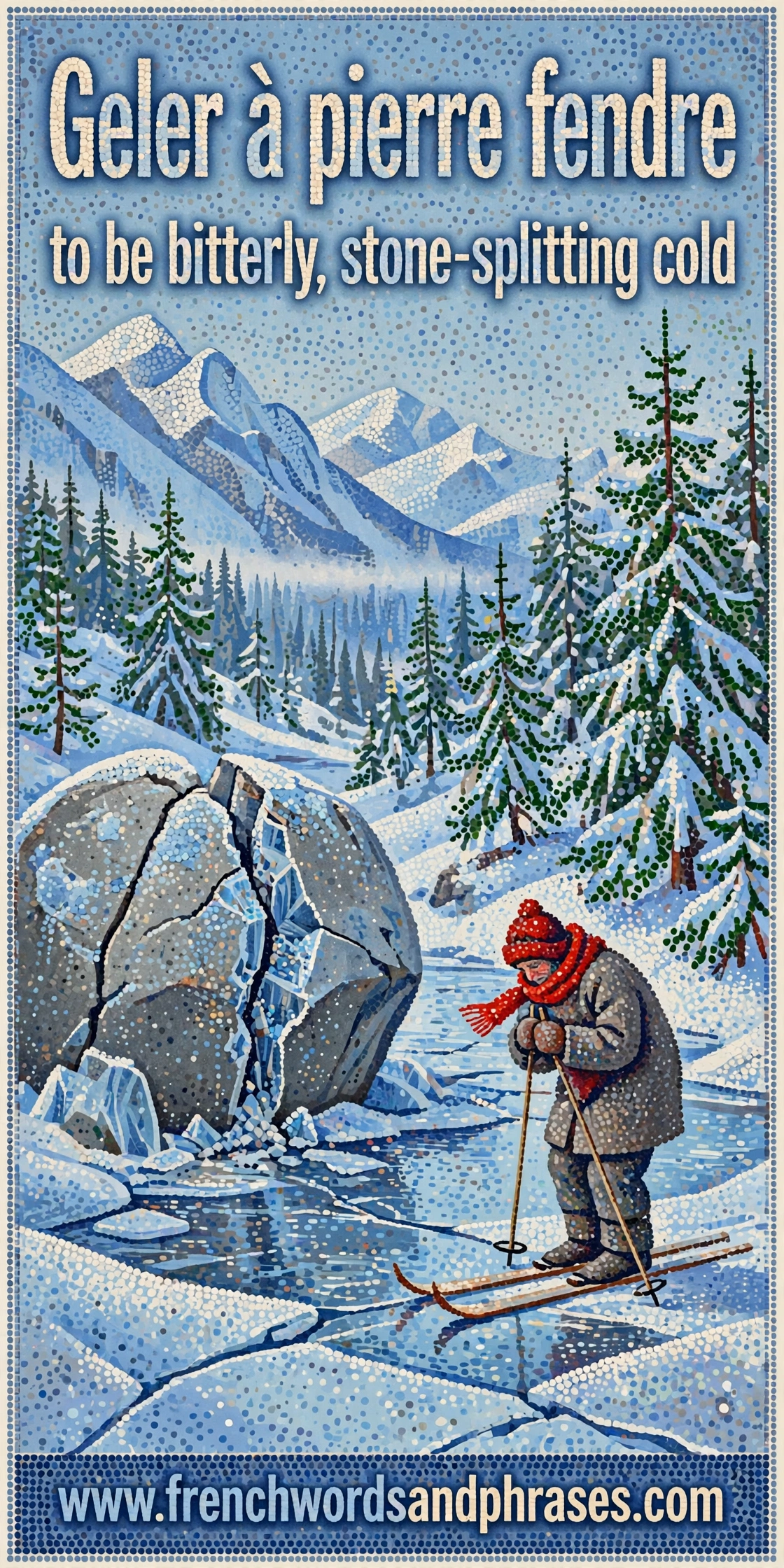
Geler à pierre fendre means to be bitterly cold — freezing so hard it would split stones.
January in the mountains, and the water in the outside pipe burst in the night. The old farmer knocks the ice off his boots on the doorstep, blows on his fingers and delivers the forecast in four words: « Il gèle à pierre fendre. »
Let’s explore how geler à pierre fendre works in French, beginning with the whole phrase on one card.
Understanding the French Phrase Geler à pierre fendre
Geler à pierre fendre is a French idiomatic expression built from geler (to freeze) and à pierre fendre (enough to split stone — fendre means to split or crack). It describes cold at its most violent: a frost so deep that it can crack rock itself.
It means to be bitterly, savagely cold — cold that splits stones. Nobody is quarrying: the picture is of water freezing inside the cracks of a rock and forcing it apart. When the frost can break stone, ordinary words like froid feel too weak, and French reaches for this phrase.
Type: Idiomatic expression — weather (verb + à + noun + infinitive)
Answers the need: Describing cold at its extreme, beyond ordinary frost
Register: Neutral to vivid — everyday speech, weather talk, storytelling
Strength: Maximum — the top of the French cold scale
One important usage detail: the phrase is almost always impersonal — il gèle à pierre fendre — said of the weather, not of a person. A person who is freezing says je gèle or je suis gelé, without the stones. The same image exists as a noun phrase: un froid à pierre fendre, a stone-splitting cold.
Experience the Word
Geler à pierre fendre is the cold of burst pipes and cracked doorsteps — the cold that does damage while you sleep.
Imagine a mountain village in a hard winter: the fountain frozen mid-pour, the woodpile splitting with little cracks in the night, breath hanging in the air like smoke. Villagers do not need a thermometer. They have this phrase, and it is exact.
French weather talk is full of animals and exaggeration — un froid de canard, il pleut des cordes. But when the cold starts breaking the landscape itself, only the stone will do.
How to Use Geler à pierre fendre in French: Complete Guide
Let’s explore how geler à pierre fendre works in French, beginning with the whole phrase on one card.
Geler à pierre fendre at a Glance
The Whole Phrase on One Card
Real meaning, literal picture, English twin and register — geler à pierre fendre in five lines.
| Point | Geler à pierre fendre |
|---|---|
| What it really means | to be bitterly cold — an extreme, damaging frost |
| Word for word | to freeze enough to split stone |
| English equivalent | bitterly cold / cold enough to crack rocks / freezing hard |
| Register | neutral to vivid — everyday speech and storytelling |
| Use it for | hard winter nights, burst pipes, frozen lakes, mountain cold |
Example
Cette nuit, il a gelé à pierre fendre et les tuyaux ont éclaté.
Last night it froze stone-splitting hard and the pipes burst.
Word by Word: Building the Frost
Four small pieces — take them one by one and the temperature drops below zero.
| Word | Literal meaning | Its job in the phrase |
|---|---|---|
| geler | to freeze | the weather verb — with the grave accent change: je gèle, il gèle |
| à | to, enough to | the measure word — cold UP TO the point of splitting stone |
| pierre | stone | the victim of the cold — even rock cannot resist it |
| fendre | to split, to crack | the infinitive of damage — fendre du bois is to split wood |
Example
Quand il gèle à pierre fendre, même la fontaine se tait.
When it freezes hard enough to split stone, even the fountain falls silent.
Quick Quiz 1
What does fendre mean?
Reveal the answer
To split, to crack — the frost freezes water inside the rock’s cracks and splits the stone apart.
Le gel a fendu la pierre du seuil.
The frost split the doorstep stone.
When You Say It: The Hard-Winter Moments
Geler à pierre fendre fires at moments like these — when the cold stops being weather and becomes an event.
| Situation | Example |
|---|---|
| A mountain night | en altitude, il gèle à pierre fendre dès novembre — up high, it freezes stone-hard from November |
| Burst pipes | il a gelé à pierre fendre et le tuyau a cédé — it froze hard enough to split stone and the pipe gave way |
| Warning a traveller | mets des chaînes, il gèle à pierre fendre là-haut — put chains on, it’s bitterly cold up there |
| The frozen lake | le lac est pris, il gèle à pierre fendre depuis une semaine — the lake is frozen over, it has been stone-splitting cold for a week |
| Morning verdict | il gèle à pierre fendre, je reste au chaud — it’s bitterly cold, I’m staying in the warm |
Example
Il gèle à pierre fendre : la route est un miroir de glace.
It’s bitterly cold: the road is a mirror of ice.
Make It Yours: The Frost for Every Sentence
The phrase stays impersonal — il gèle — while the tenses do the travelling: last night, tomorrow, all week.
| Form | French | In English |
|---|---|---|
| Present | il gèle à pierre fendre | it is bitterly cold |
| Last night | il a gelé à pierre fendre cette nuit | it froze bitterly hard last night |
| Forecast | il va geler à pierre fendre demain | it will freeze stone-hard tomorrow |
| As a noun phrase | un froid à pierre fendre | a stone-splitting cold |
| With a place | il gèle à pierre fendre dans la vallée | it’s bitterly cold in the valley |
| Question | il gèle à pierre fendre chez toi aussi ? | is it bitterly cold where you are too? |
Example
Un froid à pierre fendre a saisi tout le village.
A stone-splitting cold gripped the whole village.
Quick Quiz 2
Can you say je gèle à pierre fendre about yourself?
Reveal the answer
Not in the set phrase — à pierre fendre belongs to the impersonal il gèle, the weather. For yourself, say je gèle or je suis gelé.
Il gèle à pierre fendre, et moi, je gèle dans ma voiture.
It’s bitterly cold, and I’m freezing in my car.
Everyday Expressions: Building on the Frost
Geler à pierre fendre slots into these everyday frames — each one ready to use as it stands.
| Frame | In English |
|---|---|
| il gèle à pierre fendre | it’s bitterly, stone-splitting cold |
| un froid à pierre fendre | a stone-splitting cold (noun phrase) |
| geler dur | to freeze hard — the plain version |
| le gel a tout pris | the frost has taken everything — plants, pipes, roads |
| une nuit de grand gel | a night of hard frost |
Example
Par un froid à pierre fendre, les oiseaux se taisent.
In stone-splitting cold, the birds fall silent.
Close Cousins: The Other Ways to Freeze
French has a whole shelf of cold phrases — the pierre fendre is the most violent; its cousins duck, shiver or simply read the thermometer.
| Expression | The difference |
|---|---|
| geler à pierre fendre | cold that splits stones — the extreme of the scale |
| il fait un froid de canard | bitterly cold — the duck-hunter’s cold, vivid and very common |
| il fait un froid glacial | icy cold — neutral, a little formal, no picture |
| on se les gèle | we’re freezing our bits off — informal, humorous, about people not weather |
| il fait moins dix | it’s minus ten — the thermometer’s plain statement |
Example
Un froid de canard, oui — mais ici, il gèle à pierre fendre.
Duck-cold, yes — but here, it freezes hard enough to split stone.
Quick Quiz 3
The pipes have burst and the lake is solid. Froid de canard or à pierre fendre?
Reveal the answer
À pierre fendre — when the cold does physical damage, the stone-splitting phrase is the exact one.
Il a gelé à pierre fendre et la canalisation a éclaté.
It froze stone-hard and the pipe burst.
Geler à pierre fendre and Its Neighbours
The winter shelf around the phrase — frost, ice and the things they break.
| French | In English |
|---|---|
| le gel | the frost, the freeze |
| la glace | the ice |
| geler | to freeze |
| fendre | to split, to crack |
| éclater | to burst — what pipes do in a hard frost |
| le verglas | black ice on the roads |
Example
Le gel a fendu la pierre et fait éclater le tuyau.
The frost split the stone and burst the pipe.
Watch Out: The Traps Around Geler à pierre fendre
The traps: a person where the weather should be, a conjugated fendre, and a stone that stays singular.
| Trap | The truth |
|---|---|
| impersonal only | il gèle à pierre fendre describes the weather; a freezing person says je gèle, je suis gelé |
| fendre stays an infinitive | the phrase is frozen as à pierre fendre — never il gèle à pierre fendue |
| pierre stays singular | à pierre fendre, with pierre in the singular, is the fixed form of the idiom |
| geler changes its accent | je gèle, il gèle — the grave accent appears in the present, but the infinitive stays geler |
Example
Il gèle à pierre fendre, et le verglas couvre les routes.
It’s bitterly cold, and black ice covers the roads.
Quick Quiz 4
True or false: il gèle à pierres fendre, with a plural, is the correct form.
Reveal the answer
False — the idiom is fixed with the singular: à pierre fendre.
Par ce froid à pierre fendre, restez chez vous.
In this stone-splitting cold, stay at home.
Geler à pierre fendre in Everyday French: Real-Life Examples
Now that you know the word, let’s see how geler à pierre fendre appears in everyday French.
Example 1 — The mountain morning
Il gèle à pierre fendre, la fontaine est prise.
It’s bitterly cold, the fountain is frozen solid.
Example 2 — The burst pipe
Il a gelé à pierre fendre et le tuyau du jardin a éclaté.
It froze stone-hard and the garden pipe burst.
Example 3 — The forecast
Attention, il va geler à pierre fendre cette nuit.
Careful, it will freeze bitterly hard tonight.
Example 4 — The valley
Dans la vallée, il gèle à pierre fendre dès janvier.
In the valley, it’s stone-splitting cold from January.
Example 5 — Staying in
Il gèle à pierre fendre, je ne mets pas le nez dehors.
It’s bitterly cold, I’m not setting foot outside.
Example 6 — The farmer’s verdict
Un froid à pierre fendre, comme dans le temps.
A stone-splitting cold, like in the old days.
Beyond Translation: The Meaning of Geler à pierre fendre
Every cold country exaggerates its winters, but French found the engineer’s image: water expands as it freezes, and ice inside a crack is a wedge that no rock can refuse. The phrase is almost a physics lesson disguised as a complaint.
To say il gèle à pierre fendre is to measure the cold not by your skin but by what it can break.
Thermometers give numbers; this gives consequences — burst pipes, split doorsteps, a village holding its breath until the thaw.
How to Remember the French Phrase Geler à pierre fendre
Remember it this way: Geler à pierre fendre is the frost measured by its damage — cold so deep that water freezes in the cracks of rock and splits it.
- You picture the cracked stone — ice is the wedge, fendre is the splitting, and the cold does both.
- You keep it impersonal — il gèle à pierre fendre is the weather; for yourself, plain je gèle.
- You freeze the form — à pierre fendre: singular pierre, infinitive fendre, never changed.
The key idea is geler à pierre fendre means to be bitterly cold — freezing hard enough to split stones.
Test Your Knowledge of Geler à pierre fendre
Let’s see how much you’ve learned. Try answering these questions before revealing the answers.
Question 1
What does geler à pierre fendre mean?
Reveal the answer
To be bitterly cold — an extreme frost, cold enough to split stones.
Question 2
What is the literal, word-for-word meaning?
Reveal the answer
To freeze enough to split stone — fendre means to split or crack.
Question 3
How do you say ‘it froze bitterly hard last night’?
Reveal the answer
Il a gelé à pierre fendre cette nuit — the phrase is impersonal, built on il gèle.
Question 4
What is the difference between geler à pierre fendre and il fait un froid de canard?
Reveal the answer
Both mean bitter cold — the canard is the hunter’s vivid everyday phrase; à pierre fendre is the extreme, damage-doing end of the scale.
Question 5
Complete the sentence:
Il gèle à pierre ______. (It is bitterly, stone-splitting cold.)
Reveal the answer
fendre
Il gèle à pierre fendre.
It is bitterly, stone-splitting cold.
Your Final Challenge
Can You Use It?
How would you say this in French?
“It is bitterly cold this morning.”
Reveal the answer
Il gèle à pierre fendre ce matin.
It is bitterly cold this morning.
A little French. A little curiosity. A richer everyday life.
LEARN FRENCH ONE WORD AT A TIME